Home Guard Salary State Wise 2026 – Daily Allowance, Deployment & Career Path
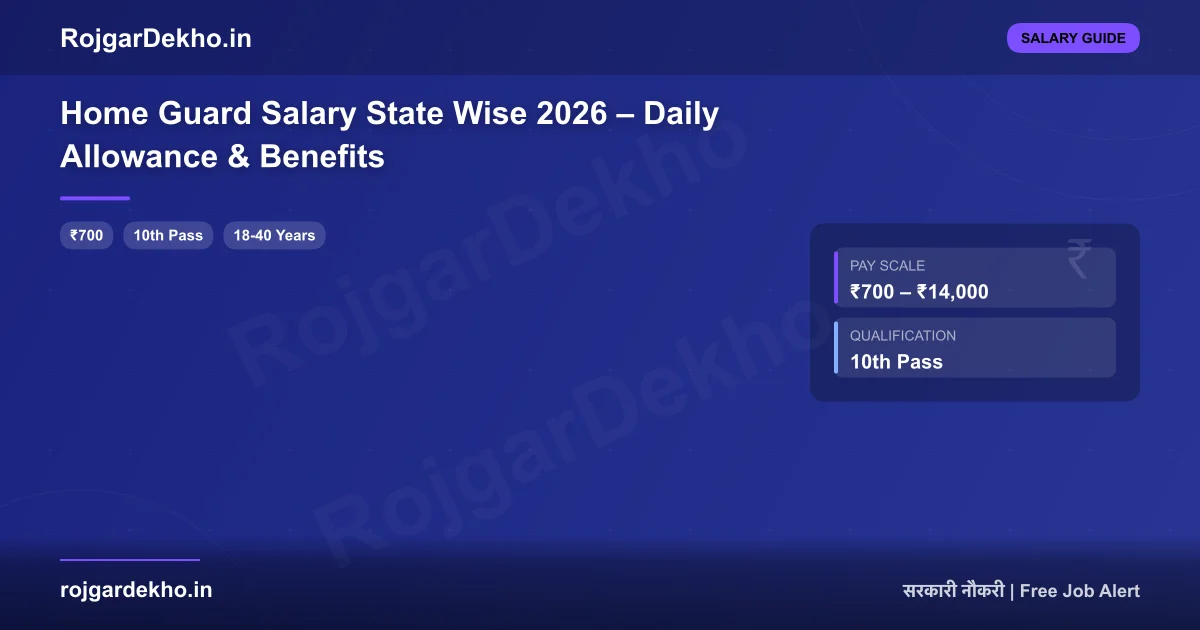
Home Guards occupy a unique position in India's law enforcement ecosystem. They are not regular police personnel — they are volunteer uniformed workers deployed to assist police when needed. Unlike Constables who receive a monthly salary, Home Guards receive a daily allowance (bhatta) only for days they are deployed. But with deployment rates of 20-26 days per month becoming common in many states, the monthly effective income has become significant — and several states have created pathways for Home Guards to be absorbed as regular Constables.
Home Guard: Role and Deployment
Home Guards work under the state Home Guard Department and are deployed to:
- Assist police at traffic duty, check posts, and district headquarters
- Guard government buildings, courts, treasuries, jails, hospitals
- Election duty — booth management, EVM transport, counting security
- Law and order situations — VIP visits, religious gatherings, communal situations
- Disaster management — floods, fires, accidents
Home Guard Daily Allowance (Bhatta) State Wise 2026
| State | Daily Allowance | Avg Deployment Days/Month | Effective Monthly Income | Source |
|---|---|---|---|---|
| Uttar Pradesh | ₹700–800/day | 20–26 days | ₹14,000–20,800 | UP Home Guard Dept notification |
| Rajasthan | ₹600–700/day | 20–25 days | ₹12,000–17,500 | Rajasthan Home Guard notification |
| Haryana | ₹750/day | 22–26 days | ₹16,500–19,500 | Haryana Home Guard notification |
| Madhya Pradesh | ₹500–600/day | 18–24 days | ₹9,000–14,400 | MP Home Guard notification |
| Bihar | ₹500–600/day | 18–22 days | ₹9,000–13,200 | Bihar Home Guard notification |
| Maharashtra | ₹650–750/day | 20–25 days | ₹13,000–18,750 | Maharashtra Home Guard notification |
| Delhi | ₹800–900/day | 22–26 days | ₹17,600–23,400 | Delhi Home Guard notification |
| Punjab | ₹650–700/day | 20–25 days | ₹13,000–17,500 | Punjab Home Guard notification |
Home Guard vs Police Constable: The Key Differences
| Feature | Home Guard | Police Constable |
|---|---|---|
| Employment type | Volunteer (not regular employee) | Regular government employee |
| Payment | Daily allowance (deployment days only) | Monthly salary (all days) |
| Monthly income | ₹9,000–23,400 (variable) | ₹32,000–37,000 (fixed) |
| NPS / Pension | No NPS, no pension | Regular NPS contributor |
| Job security | Deployment-based — no guarantee | Permanent till retirement |
| Investigation powers | None — assist only | Basic police powers |
Home Guard Permanent Absorption: The Real Opportunity
Several states have created provisions for Home Guards to be directly absorbed as regular Police Constables after a minimum period of service and subject to physical/written tests. This is the most important career path for Home Guards:
| State | Absorption Policy |
|---|---|
| Uttar Pradesh | Home Guards with 5+ years service eligible for constable absorption when vacancies arise — physical test + written test required |
| Rajasthan | Preferential consideration in police constable recruitment for Home Guards (age relaxation + reserved seats in some cycles) |
| Haryana | Home Guards receive 5-year age relaxation in Haryana Police Constable exam |
| Maharashtra | Maharashtra state has a defined absorption quota for experienced Home Guards into police constable cadre |
What No Other Site Tells You About Home Guard Income
The daily allowance figures are accurate — but two things distort the realistic picture:
Deployment is not guaranteed at 26 days. Daily allowance is paid only for actual deployment. In non-election periods, some Home Guards get only 15-18 deployment days. The ₹20,000+ monthly income quoted for UP applies to fully-deployed periods — not the annual average. Calculate 20-22 days/month as a realistic baseline, not 26.
No-deployment months exist. Unlike Constables who receive salary regardless, Home Guards who are not called for duty receive nothing. Long weekends, non-event months, and budget shortfalls in state Home Guard departments can reduce deployments. Home Guards who depend on this as primary income should have a secondary income source or savings buffer.
Home Guard Recruitment: How to Enroll
Home Guard enrollment is handled by District Home Guard offices, not through PSC or SSC. The process:
- Application to District Commandant (Home Guards) when enrollment notice is issued
- Physical fitness test — height, chest, running standards (similar to police constable but sometimes lower)
- Medical examination
- Verification — police background check
- Basic training — 2-4 weeks at district Home Guard training center
Qualification: 8th pass (some states require 10th pass). Age: 18-40 years (varies by state). Preference given to ex-servicemen in some states.
Home Guard Training: What the 2–4 Week Program Covers
Home Guard basic training is conducted at District Home Guard Training Centers. The curriculum:
- Drill and discipline: Marching, formation, salute procedures, uniform standards
- Crowd control basics: Lathi handling, crowd management formations
- Arms handling: Basic knowledge of .303 rifle or SLR for armed platoons — safety procedures
- First aid: Bandaging, CPR basics, transport of injured persons
- Legal awareness: Section 144 CrPC, Home Guard powers and limitations, when to summon regular police
- Local geography: District-level map awareness for deployment areas
After training, Home Guards receive a Home Guard Card identifying them as enrolled members — this must be carried during all deployments. Without it, the daily allowance cannot be claimed.
Home Guard in Elections: The High-Deployment Season
For Home Guards seeking maximum monthly income, election season is the peak period. During Lok Sabha and Vidhan Sabha elections:
- Deployment jumps to 25–30 days in the election month
- Duties include booth security, EVM transport, counting center cordoning, candidate convoy management
- Election Commission deployments are channeled through the DM office — paid at the regular daily allowance rate
- Night duties during counting are paid as regular deployment days
Home Guards with consistent attendance records get priority in election deployments. District commandants refer to historical deployment records when assigning election duties — this is why building a strong attendance record from day one directly affects future income.
Home Guard Insurance and Welfare Provisions
While Home Guards lack regular service benefits like NPS or pension, most state Home Guard departments provide some welfare provisions:
| Provision | Details |
|---|---|
| Group Insurance (Duty Death) | ₹5–15 lakh compensation to family if death occurs during deployment (state-specific) |
| Duty Injury | Medical expenses during duty-related injury covered by state Home Guard department |
| Ex-gratia (non-duty death) | Some states provide ₹1–3 lakh ex-gratia to family on death after long service |
| Uniform provided | Initial uniform kit provided free; replacement at subsidized cost |
These provisions are significantly less than regular police — no pension, no CGHS, no LTA. This is why experienced Home Guards who receive police constable absorption should consider it seriously: it converts variable daily-allowance income to a structured salary with full service benefits.
Frequently Asked Questions
Q: Home Guard ki monthly salary kitni hoti hai?
Home Guards receive daily allowance, not monthly salary. UP: ₹700-800/day × 20-26 deployment days = ₹14,000-20,800/month effective. Delhi has the highest at ₹800-900/day.
Q: Kya Home Guard permanent government employee ban sakta hai?
In several states (UP, Rajasthan, Haryana, Maharashtra), experienced Home Guards can be absorbed as regular Police Constables. The process involves a written test and physical test, and is subject to vacancy availability.
Q: Home Guard ko pension milti hai?
No. Home Guards are not regular government employees — there is no NPS, no pension. Some states provide Group Insurance schemes for accidental death/injury during duty.
Q: Home Guard aur Civil Defence mein kya difference hai?
Both are voluntary organizations, but different departments. Home Guards work under Home Guard Department (policing focus). Civil Defence works under Civil Defence Department (disaster/emergency focus). Both report to District Magistrate in their respective functions.
Q: Home Guard ke liye age limit kya hai?
Typically 18-40 years for enrollment. Renewal/re-enrollment varies by state policy. Ex-servicemen may get age relaxation. Maximum service age varies — some states allow service up to 60 years.