Two Scales, Two Different Salary Bands
⚡ Indian Bank SO — Quick Summary
| Organization | Indian Bank — Public Sector Bank (Chennai HQ) |
| Post | Specialist Officer (Scale I–III: IT, Law, CA, HR, Marketing) |
| Basic Pay | ₹36,000–₹48,480 / month (Scale I–II) |
| In-Hand Salary | ₹55,000–₹68,000 / month |
| Grade / Level | Scale I / II / III (JMGS / MMGS) |
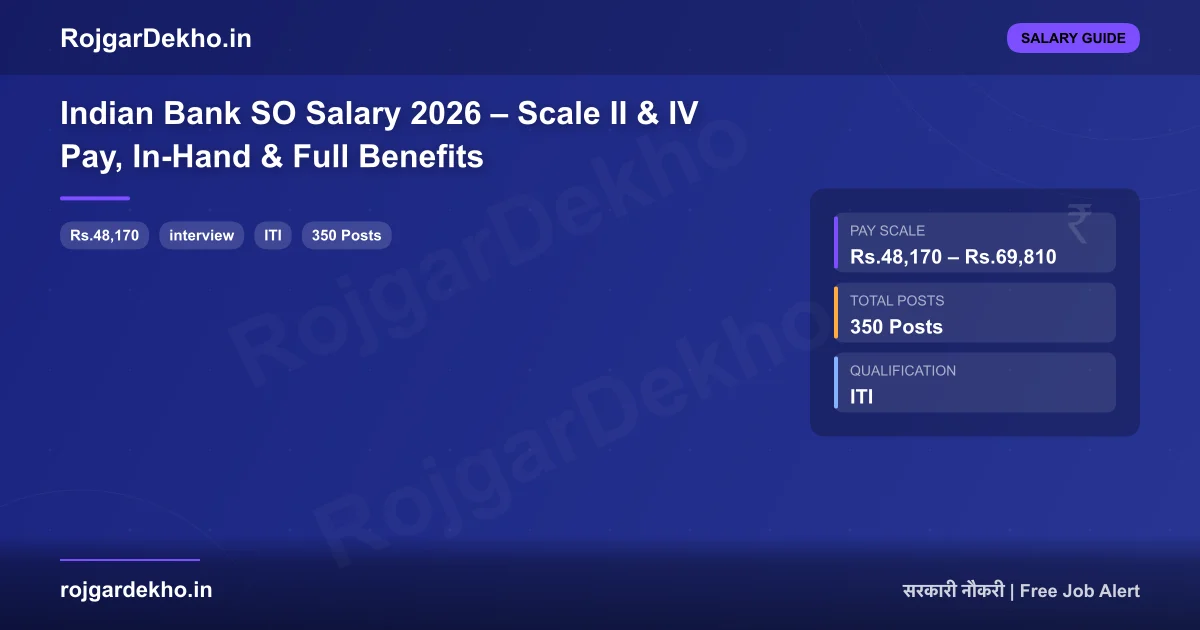
Indian Bank's 350 Specialist Officer posts in 2026 are spread across two salary bands — Scale II (MMGS-II) and Scale IV (SMGS-IV). Most posts, including all the IT Manager and Finance Manager roles, are at Scale II. The Senior Manager posts — Senior Manager Credit, Senior Manager Finance, Senior Manager Risk, Forex Dealers — are at Scale IV. Which scale your target post falls under determines both your eligibility (experience years required) and the salary you enter at. This is the first thing to confirm before any salary calculation.
👉 Indian Bank SO Eligibility 2026 — confirm which scale your post falls under and whether your experience qualifies before calculating salary
Scale II (MMGS-II) — Pay Structure
Under the IBA Bipartite Settlement, Scale II officers at Indian Bank start at a basic pay of approximately Rs.48,170 per month and move up through annual increments to Rs.69,810. At the starting basic, here is how the gross salary builds:
| Component | Amount (Approx.) | Note |
|---|---|---|
| Basic Pay | ₹48,170 | Entry level Scale II |
| Dearness Allowance (DA) | ~₹24,000–₹26,000 | CPI-linked, revised quarterly |
| Special Allowance | ~₹8,000–₹9,000 | % of Basic + DA |
| HRA (Metro City) | ~₹4,300 | 9% of Basic; 8% Urban; 7% Semi-urban |
| Other Allowances | ~₹3,000–₹5,000 | CCA, transport, etc. |
| Gross Monthly (Metro) | ~₹87,000–₹95,000 | Before deductions |
Deductions include Employee PF contribution (10% of basic = ~Rs.4,817), income tax (depends on your total income and tax declarations), and professional tax where applicable. In-hand at Scale II entry in a metro posting: approximately Rs.68,000–78,000 per month. In smaller cities where posting cost of living is lower, the gross is slightly less (lower HRA) but the in-hand difference versus living costs often favours non-metro postings.
Scale IV (SMGS-IV) — Senior Manager Posts
Senior Manager posts — Senior Manager Credit, Senior Manager Finance, Senior Manager Financial Analyst, Senior Manager Risk, Senior Manager Forex Dealer — are at Scale IV. Basic pay starts at approximately Rs.76,010 and goes up to Rs.89,890.
| Component | Amount (Approx.) |
|---|---|
| Basic Pay | ₹76,010 |
| DA (~50% of Basic) | ~₹38,000 |
| Special Allowance | ~₹14,000–₹16,000 |
| HRA (Metro) | ~₹6,840 |
| Gross Monthly (Metro) | ~₹1,35,000–₹1,45,000 |
In-hand at Scale IV entry in a metro: approximately Rs.1,00,000–1,10,000 per month depending on tax regime and deductions. Annual CTC including employer PF, gratuity provision, and group medical insurance works out to approximately Rs.22–26 lakh at Scale IV.
Annual CTC — What the Full Package Looks Like
Scale II (Manager): Annual CTC approximately Rs.14–18 lakh. This includes cash compensation, employer PF contribution (about 12% of basic), gratuity provisioning, group medical insurance premium, and leave encashment value. Take-home as a proportion of CTC is higher in PSBs than in many private sector companies because the non-cash benefits in PSBs — housing, medical — are either provided or reimbursed rather than embedded in the CTC as notional benefits.
Scale IV (Senior Manager): Annual CTC approximately Rs.22–26 lakh, following the same structure as above but at the higher base.
Perquisites That Don't Show on the Payslip
Bank Housing or HRA: Indian Bank, like all PSBs, provides leased accommodation or HRA. For officers posted in Chennai (Indian Bank HQ) and metro branches, HRA adds meaningfully to the effective compensation. Officers allotted bank quarters pay a small deduction from salary — but the accommodation is typically in well-maintained staff quarters, often better than what the HRA alone would rent in the same city.
Medical Insurance: Indian Bank provides group medical insurance to officers and their dependent family. Hospitalization expenses are largely covered. This is a benefit with real monetary value — particularly for officers with families — that does not appear on the salary slip.
Provident Fund: Both employee (10%) and employer (12%) contributions go into PF. Over a 20-year career, this corpus grows substantially. PSB PF contributions are not subject to the ceiling that applies to private sector EPF — the full 12% employer share is calculated on actual basic, not capped at Rs.15,000.
Pension: Officers who joined PSBs before the switchover to the New Pension System receive the defined benefit pension. Officers joining under the current NPS regime get a pension linked to their corpus at retirement. Either way, retirement income from a PSB career is more predictable than from most private sector paths.
Car Loan and Staff Loan: Indian Bank offers concessional interest loans to its own employees — car loans, housing loans, and personal loans at rates significantly below market. A Scale II officer's access to a home loan at 1–2% below the prevailing rate, over the term of a 20-year mortgage, is worth lakhs in saved interest.
Indian Bank SO vs IBPS SO — Why the Pay Differs
IBPS SO recruits at Scale I for most posts (entry basic ~Rs.36,000). Indian Bank's direct recruitment here is at Scale II and Scale IV — meaning you are entering 1–2 scales above the IBPS SO entry level. The salary difference is real and immediate. The reason is that the experience requirement is also higher — these roles need professionals who can function without the extensive in-bank training that a fresh Scale I officer receives.
If you are comparing Indian Bank SO 2026 against a private bank Manager role at similar experience: the gross is often comparable or slightly lower at Indian Bank, but the total compensation including job security, pension, medical, housing, and concessional loans puts the public sector package significantly ahead in total value for most family situations.
Career Growth and Future Salary
A Scale II officer at Indian Bank who joins at Rs.48,170 basic and performs consistently can expect to reach Scale III (basic ~Rs.63,840) within 4–6 years through Annual Performance Appraisal and internal promotion examinations. Scale III to Scale IV typically takes another 4–5 years for strong performers. At each promotion, the salary jumps substantially because it is a change of scale, not just an increment. Specialist Officers who bring deep domain expertise in technology, risk, or treasury often advance faster than generalist officers because the bank has fewer people who can fill those roles from the existing pool.
👉 Indian Bank SO Syllabus 2026 — to reach this career trajectory — know how the interview is structured and what domain questions to prepare
Leave Benefits — Often Overlooked, Genuinely Valuable
Bank officers in India receive more generous leave than most private sector equivalents. At Indian Bank, Scale II and Scale IV officers are entitled to:
- Privilege Leave: 30 days per year, accumulative up to a maximum (typically 240 days). Encashable at retirement — a Scale II officer who accumulates 200+ days of PL over a career can receive a substantial cash payment on retirement.
- Sick Leave: 30 days on full pay per year, with partial pay for additional sick leave as per IBA settlement
- Casual Leave: 12 days per year for personal or urgent matters
- Leave Travel Concession (LTC): Reimbursement of travel expenses for officer and family once in 2 years (for travel within India) or once in 4 years (for home town travel). For a Scale II officer earning Rs.48,170 basic, this can mean Rs.30,000–60,000 in reimbursed travel cost per LTC cycle.
Leave encashment at retirement is often not counted in annual CTC calculations but represents significant terminal value. An officer who retires with 200 days of accumulated privilege leave receives payment equivalent to 200 days of basic pay at the time of retirement — at a Scale IV basic of Rs.76,010, that is approximately Rs.5.07 lakh as a single terminal payment just for earned leave.
City-wise HRA — The Location Effect on In-Hand Salary
HRA at Indian Bank is calculated as a percentage of basic pay based on the city category of your posting:
| City Category | HRA Rate | HRA at Scale II Entry | Examples |
|---|---|---|---|
| Metro / Major A | 9% of Basic | ~₹4,335/month | Chennai, Mumbai, Delhi, Kolkata |
| Urban B | 8% of Basic | ~₹3,854/month | Pune, Hyderabad, Ahmedabad |
| Semi-urban / Rural | 7% of Basic | ~₹3,372/month | Smaller towns and rural branches |
The difference in HRA between metro and semi-urban posting is only about Rs.960/month at Scale II entry — but the cost of living difference is far larger. Most officers posted in smaller cities find their effective purchasing power is actually higher than metro colleagues despite slightly lower gross pay.
Tax Implication — Old vs New Regime at Scale II Income
For a Scale II officer with annual gross income of approximately Rs.12–13 lakh (before deductions), the income tax calculation depends on the tax regime chosen:
Under Old Tax Regime: Deductions available include PF contribution (Rs.57,804/year), HRA exemption (partial, based on actual rent paid vs HRA received), standard deduction (Rs.50,000), Section 80C investments up to Rs.1.5 lakh. With these deductions, taxable income can come down to Rs.8–9 lakh, attracting approximately Rs.65,000–85,000 in income tax annually.
Under New Tax Regime: No deductions except standard deduction (Rs.75,000 from FY 2024-25). Tax on Rs.12 lakh gross is approximately Rs.80,000–1,00,000. For officers who can claim high 80C and HRA deductions, the old regime is typically more favourable.
Salary Growth — Year 3, Year 7, Year 12
An Indian Bank Scale II officer joining at Rs.48,170 basic receives annual increments within the scale. Assuming consistent performance:
- Year 3: Basic approximately Rs.52,000–54,000. Gross in metro Rs.92,000–98,000. In-hand Rs.72,000–80,000.
- Year 7 (Scale III promotion possible): Basic approximately Rs.63,840 (Scale III entry). Gross in metro Rs.1,10,000–1,18,000. In-hand Rs.85,000–95,000.
- Year 12 (Scale IV promotion possible): Basic approximately Rs.76,010. Gross in metro Rs.1,35,000–1,45,000. In-hand Rs.1,00,000–1,10,000.
The IBA Bipartite Settlement also gets revised periodically — the settlement signed in late 2023 included a significant wage revision. Future settlements will further enhance these figures across all serving officers simultaneously.
Frequently Asked Questions
Q: Is Indian Bank SO salary the same as IBPS SO salary?
No. Indian Bank SO 2026 is a direct bank recruitment, not an IBPS-conducted exam. Both follow IBA Bipartite Settlement pay scales, so the base pay structure is identical to IBPS SO at the same scale. However, Indian Bank's allowances, HRA percentages, and loan benefits are specific to Indian Bank's internal policies, not IBPS norms. Indian Bank's IT Officer posts start at Scale I (not Scale II like the Credit/Finance posts in this recruitment).
Q: Is there a pension scheme for Indian Bank Specialist Officers?
Employees who joined Indian Bank after April 2010 are under the New Pension System (NPS), not the Old Defined Benefit Pension. Under NPS, both employee (10% of basic+DA) and employer (14% of basic+DA) contribute monthly. This is different from older officers who have the defined benefit pension. The NPS corpus is portable if you move to another PSB later.
Q: What are the concessional loan benefits for Indian Bank SO?
Indian Bank officers are eligible for staff housing loans at concessional interest rates (typically 1–2% below the standard bank rate), vehicle loans, and personal loans at reduced rates. The exact limits and rates are governed by Indian Bank's staff loan policy, which is revised periodically. Housing loan limits for officers are significantly higher than for clerical staff.
Q: What is the HRA for an Indian Bank SO posted in Chennai (Head Office)?
Chennai falls in the 'Major A' city category for IBA HRA purposes. At Scale II, HRA is 9% of basic pay — approximately ₹4,335/month on the minimum basic of ₹48,170. This is in addition to CCA (City Compensatory Allowance). Officers posted at the Head Office in Chennai also benefit from proximity to the corporate decision-making centre, which has career-progression implications beyond the salary.
Q: Does Indian Bank SO salary increase every year?
Yes. Salary increases through two mechanisms: annual stagnation increments within the current scale (fixed amount per year per IBA scale), and scale promotions (Scale II → Scale III → Scale IV) which give step-up in basic pay. DA is revised quarterly by IBA based on the Consumer Price Index. The net result is that in-hand salary grows every year even without a promotion.