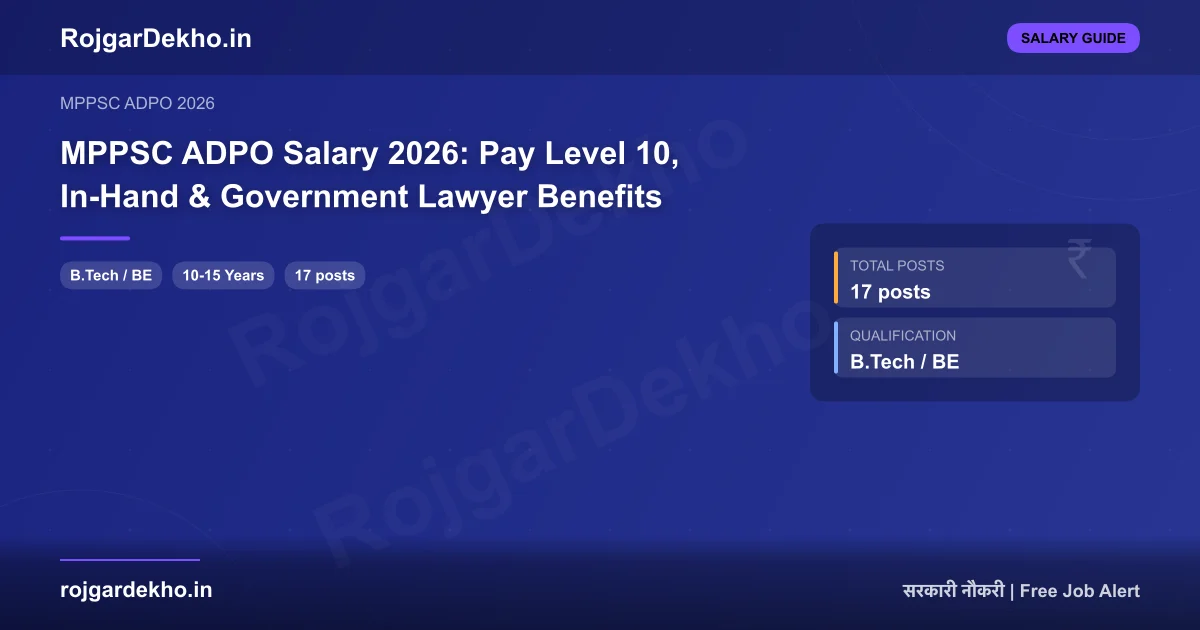
MPPSC ADPO Salary 2026: Pay Level 10, In-Hand & Government Lawyer Benefits
If you're an LLB graduate weighing a government prosecution career against private practice in MP district courts, the numbers matter. The MPPSC ADPO (Assistant District Prosecution Officer) post sits at Pay Matrix Level 10 — the same level as many IAS probationers and central government Group A officers. This article gives you the complete salary picture: basic pay, allowances, deductions, actual in-hand, and a straight comparison with what a fresh LLB earns arguing cases privately in Madhya Pradesh.
📢 MPPSC ADPO 2026 Notification — 17 posts, apply by 8 May 2026. Exam 18 Oct 2026.
MPPSC ADPO Salary 2026 — Quick Overview
| Detail | Value |
|---|---|
| Pay Matrix | Level 10 (7th Pay Commission) |
| Basic Pay (Entry) | ₹56,100 |
| Basic Pay Scale | ₹56,100 – ₹1,77,500 |
| DA (~53% of basic) | ~₹29,733 |
| Gross (approx) | ₹95,000 – ₹1,05,000 |
| In-Hand (after NPS deduction) | ₹70,000 – ₹85,000 |
| Pay Classification | Gazetted Class II, MP Home Department |
| Annual Increment | 3% of basic (fixed under 7th CPC) |
Pay Level 10 — Full Monthly Breakdown
Pay Level 10 in the MP State Pay Matrix is equivalent to the Central Government's 7th CPC Level 10. Here is what the monthly salary actually looks like at entry:
| Component | Basis | Amount (₹/month) |
|---|---|---|
| Basic Pay | Level 10, Cell 1 | 56,100 |
| Dearness Allowance (DA) | ~53% of Basic | ~29,733 |
| House Rent Allowance (HRA) | Varies by posting city | 4,500 – 13,464 |
| Transport Allowance | Standard + DA component | ~2,000 – 3,600 |
| Medical Allowance | State health scheme | ~500 – 1,000 |
| Gross Salary | ~₹95,000 – ₹1,05,000 | |
| NPS Deduction (10% of basic) | Mandatory | −5,610 |
| Professional Tax + Misc | State levy | −200 – 500 |
| Income Tax (approx, new regime) | Estimated | −2,000 – 5,000 |
| Net In-Hand | ~₹70,000 – ₹85,000 |
Source: MP State Pay Matrix Level 10 + standard DA/HRA allowance rates. HRA varies: Bhopal/Indore (larger city) = higher HRA than smaller district headquarters. DA revised every 6 months by state government.
📚 MPPSC ADPO Syllabus 2026 — IPC, CrPC, Evidence Act topics and Oct 2026 exam prep guide.
How In-Hand Changes Over Time
Basic pay gets a 3% annual increment under the 7th Pay Commission. DA also revises upward every 6 months (typically 3–4% each revision). Here is a rough projection:
| Year of Service | Approx Basic | Approx In-Hand |
|---|---|---|
| Joining (2027) | ₹56,100 | ₹70,000 – ₹85,000 |
| 3 Years | ₹61,300 | ₹78,000 – ₹92,000 |
| 7 Years | ₹71,000 | ₹90,000 – ₹1,05,000 |
| 15 Years (DPO level possible) | ₹90,000+ | ₹1,15,000 – ₹1,35,000 |
Note: These are estimates. Actual figures depend on DA revisions and promotion timing. DA is currently tracking higher than historical averages because of post-pandemic catch-up.
ADPO vs Private Practice — What a Fresh LLB Actually Earns in MP
This is the comparison most sites skip. Private practice in MP district courts is not the financially rewarding path that law school brochures suggest — especially in the first 3–5 years.
| Parameter | ADPO (Govt) | Private Practice LLB (MP) |
|---|---|---|
| Monthly income — Year 1 | ₹70,000–₹85,000 | ₹10,000–₹20,000 |
| Monthly income — Year 3 | ₹78,000–₹92,000 | ₹20,000–₹50,000 |
| Monthly income — Year 7 | ₹90,000–₹1,05,000 | ₹30,000–₹1,00,000 (wide range) |
| Income predictability | Fixed, every month | Irregular — depends on clients |
| Government accommodation | Entitled (Gazetted Class II) | No |
| Pension at retirement | NPS (govt contributes 14%) | No pension |
| Medical coverage | State health scheme, family | Self-funded |
| Job security | Permanent (after probation) | None — client-dependent |
| Prestige/gazetted status | Gazetted officer | No gazetted status |
Source for private practice figures: standard earnings reported by junior advocates in MP district courts. Individual results vary significantly based on city, specialisation and connections.
Benefits Beyond the Salary Slip
The ADPO post is Gazetted Class II under the MP Home Department. That classification comes with tangible perks:
- Government accommodation: Entitled to official quarters at the district headquarters. If no quarters available, you draw HRA instead — so either way you benefit.
- NPS pension: You contribute 10% of basic, government contributes 14%. Over a 30-year career, the corpus becomes substantial.
- State health scheme: Covers self and family — hospitalisation, medicines, diagnostics at empanelled hospitals.
- 30 days earned leave + 8 casual leave: Accumulated leave can be encashed at retirement.
- LTC (Leave Travel Concession): Travel reimbursement for you and family every 2 years.
- Gazetted status perks: Self-attestation of documents, signing affidavits, official protocol recognition at district level.
- DA revision: DA is revised twice a year — your real income keeps rising automatically even without a promotion.
Promotion Path — ADPO to Higher Posts
The ADPO is not a terminal post. The prosecution cadre in MP has a defined hierarchy:
- ADPO (Assistant District Prosecution Officer) — entry level, Gazetted Class II
- DPO (District Prosecution Officer) — heads district prosecution, higher pay scale
- State-level prosecution hierarchy — above DPO, handled through departmental promotion / MPSC selection
Promotions in the prosecution cadre are time-bound to some extent — if you clear ACRs (Annual Confidential Reports) and stay out of disciplinary trouble, DPO is a realistic 10–15 year target from ADPO entry.
✅ MPPSC ADPO Eligibility 2026 — LLB requirement, age 21–40, domicile rules and application process.
ADPO Salary vs Other MP State Government Law Posts
Not all government law jobs in MP pay the same. Here is how ADPO stacks up against other options a law graduate might consider:
| Post | Pay Level | Approx In-Hand | Classification |
|---|---|---|---|
| MPPSC ADPO | Level 10 | ₹70,000–₹85,000 | Gazetted Class II |
| MP Civil Judge (MPPSC) | MP Judicial Pay Scale | ₹85,000–₹1,00,000 | Judicial Service |
| MP Govt Pleader (Law Dept) | Varies | ₹50,000–₹70,000 | Contractual/retainer |
| MP Govt Legal Advisor (PSU) | Varies by PSU | ₹45,000–₹80,000 | PSU employee |
| Central Govt Law Officer (SSC/UPSC) | Level 8–10 | ₹60,000–₹90,000 | Central Group B/A |
ADPO is competitive with central government law posts, and significantly above most contractual government legal roles in MP. The Civil Judge route pays more but the selection is even more competitive — and the MPSC Civil Judge exam is harder than ADPO.
7th Pay Commission — What Level 10 Means Long-Term
Pay Level 10 under the 7th Central Pay Commission has a pay matrix that runs from ₹56,100 to ₹1,77,500. Annual increments are 3% of the current basic. Here is what that compounding does over time without any promotion:
- Year 1: ₹56,100 basic
- Year 5: ₹65,000 basic (approx, after 4 increments)
- Year 10: ₹75,400 basic (approx)
- Year 20: ₹1,01,000 basic (approx)
Each basic pay increase also increases DA (which is a percentage of basic), so the real income growth is faster than the 3% increment alone. When DA is at 53%, a ₹1,000 rise in basic adds ₹1,530 to gross salary. Over 20 years, even without promotion, ADPO gross salary crosses ₹1.5 lakh/month comfortably.
Tax on ADPO Salary — Practical Note
At entry-level ADPO salary, income tax liability under the new regime (no exemptions) is modest. Approximate annual gross of ₹11–12 lakh puts you in the 10–15% bracket for the taxable portion. Key points:
- Standard deduction of ₹75,000 under new regime reduces taxable income.
- NPS employer contribution (14% of basic by government) is tax-free income — not added to your taxable income.
- If you opt for old regime, Section 80C (up to ₹1.5 lakh), Section 80CCD(1B) (NPS extra ₹50,000), and HRA exemption can reduce tax to near zero in early years.
- Government employees have tax deducted at source (TDS) monthly — no surprise year-end payment.
What No Other Site Tells You
Most salary articles stop at the pay table. Here is what they miss:
The real value of ADPO is the compounding effect. Your basic salary of ₹56,100 gets 3% increment every year. DA gets revised every 6 months. By Year 5, your effective take-home is already close to ₹90,000 — without any promotion. Private practice at Year 5 in a non-Bhopal district headquarters might still be ₹25,000–₹40,000 unless you have exceptional connections or a big criminal law firm backing you.
The criminal law exclusivity is actually a salary protector. ADPO work is criminal law only — no civil, no contracts, no family law. This sounds limiting but it means your expertise is narrowly specialised. ADPOs who later move to private practice after 10–15 years of government experience command premium fees as criminal defence consultants. The government job builds a specialised reputation you cannot buy.
District headquarters posting means lower cost of living. You are unlikely to be posted in Bhopal or Indore initially — district postings are the norm. Your ₹70,000–₹85,000 in-hand at a district HQ (Sagar, Rewa, Satna, Chhindwara) stretches much further than the same number in a metro. Government quarters at these postings can reduce your monthly outgo by ₹8,000–₹15,000.
NPS — Your Retirement Corpus as ADPO
The National Pension System (NPS) replaces the old defined pension for government employees who joined after 2004. As an ADPO, your NPS contributions work as follows:
- Your contribution: 10% of basic pay, deducted from salary each month = ₹5,610/month at entry.
- Government contribution: 14% of basic = ₹7,854/month — this is over and above your salary, not deducted from it.
- Total NPS input per month: ₹13,464 (your share + govt share) at entry level.
- Investment: NPS funds are invested in equity and debt funds, managed by government-approved fund managers.
Over a 30-year career assuming modest 8% annual return on NPS corpus: monthly contribution of ₹13,464 compounding at 8% over 30 years generates a corpus of approximately ₹2–2.5 crore at retirement. At maturity, 60% is available as tax-free lump sum and 40% must be used to buy an annuity. This is significantly better than no retirement savings, which is the reality for most private practitioners at the junior level.
ADPO — Who Should Apply
ADPO is the right career move if you match at least three of these:
- You want to practise criminal law specifically — not general practice, not civil litigation.
- Financial security matters more than income ceiling. Private practice has a higher ceiling but a much lower floor.
- You are comfortable with the district posting life — smaller cities, government quarters, local court culture.
- You want gazetted status and the social recognition that comes with being a government officer in a state where government service still carries significant prestige.
- You want a defined career path where performance through ACRs translates into promotions, rather than purely business development.
If you want corporate law, international arbitration, or high-value civil litigation — ADPO is not the right path. It is a criminal prosecution post, and that is where your entire career will be focused if you join.
Frequently Asked Questions
Q: Is MPPSC ADPO salary the same as UPSC-level positions?
No — UPSC Civil Services (IAS/IPS) start at higher pay levels. But ADPO at Level 10 is the same pay level as a Group A entry in many central government services, making it one of the highest entry-level state government posts for law graduates in MP.
Q: Does the ADPO get DA at the same rate as central government employees?
No. MP state government DA is revised separately and tracks the central DA but with some lag. Currently MP DA is approximately 53% of basic — slightly behind the central DA rate. The difference is not large in absolute rupee terms at entry level.
Q: When does salary actually start after selection?
Salary starts from the date of joining after document verification. There is usually a 2-year probation period. During probation, you draw full salary — probation only affects confirmation and certain service benefits, not pay.
Q: Is government accommodation guaranteed at all postings?
Entitled but not always immediately available. If quarters are not available at your posting, you draw HRA instead. HRA at a non-metro district posting is lower than major cities, but combined with the lower rent in those locations it still works out positively.
Q: Can an ADPO do private practice on the side?
No. Government prosecution officers are prohibited from private practice. This is non-negotiable — a bar to practice is a condition of service. This is why the NPA concept in medical services has an equivalent here: you give up private income in exchange for the security and seniority of a gazetted post.