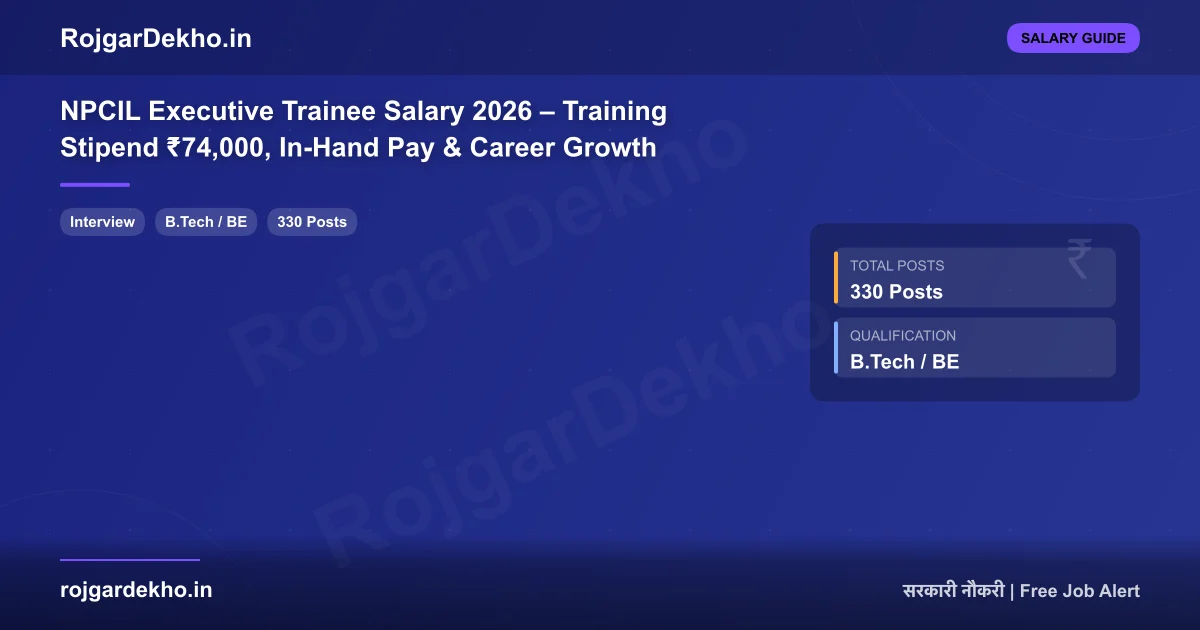
NPCIL Executive Trainee Salary 2026 – Training Stipend, In-Hand Pay & 15-Year Career Math
NPCIL's ₹74,000/month training stipend is the headline number most candidates see — and it creates a specific confusion. That ₹74,000 is a flat consolidated stipend during your one-year training period. Once you're confirmed as an Engineer in E-1 grade, the salary structure shifts to the standard IDA pay scale. Understanding what that transition looks like — and what your actual take-home will be across different posting locations — is what this article is for.
One thing upfront: NPCIL is not a Maharatna or Navratna PSU. It is a Schedule-A Central PSU under the Department of Atomic Energy (DAE). This matters because NPCIL follows the DPE IDA pay scales (same ₹40,000–₹1,40,000 E-1 scale as BPCL or HPCL), but its posting locations and the housing arrangement at nuclear plant sites create a salary picture that is quite different from oil PSUs posted in metro refineries.
👉 NPCIL ET Eligibility 2026 — check GATE 2024/2025/2026 validity, 60% aggregate rule and age limit before reading salary numbers
Year 1 — The ₹74,000 Training Stipend
During the 12-month training period, NPCIL pays a consolidated stipend of ₹74,000 per month. This is not broken into Basic + DA + HRA. It is an all-inclusive figure. PF deduction applies on the notional basic component. The effective in-hand during training is approximately ₹68,000–₹70,000 after PF.
Where you are posted during training matters. New Executive Trainees are typically assigned to one of NPCIL's operating plant sites for on-the-job training — Tarapur (Maharashtra), Rawatbhata (Rajasthan), Kakrapar (Gujarat), Kalpakkam (Tamil Nadu), Narora (Uttar Pradesh), or Kaiga (Karnataka). At all these locations, NPCIL provides residential accommodation in its townships. You do not pay market rent. A nominal licence fee is recovered from the stipend — typically ₹500–₹2,000/month. Your actual cost of living at a nuclear plant township is dramatically lower than a metro city on the same stipend.
Year 2 Onwards — E-1 Grade IDA Salary
After successful completion of training and confirmation, you are placed in the E-1 grade of the IDA pay scale (₹40,000–₹1,40,000). The salary from this point follows the standard CPSE structure: Basic + Industrial DA + HRA + Perks.
| Component | NPCIL HQ Mumbai | Plant Site (Tarapur/Kakrapar) | Plant Site (Rawatbhata/Narora) |
|---|---|---|---|
| Basic Pay | ₹40,000 | ₹40,000 | ₹40,000 |
| IDA @ 53.4% | ₹21,360 | ₹21,360 | ₹21,360 |
| HRA (30% / 20% / 10%) | ₹12,000 | Nil (company qtr) | Nil (company qtr) |
| Plant Site Allowance (est.) | – | ~₹3,000–₹5,000 | ~₹3,000–₹5,000 |
| Perks @ 50% of Basic | ₹20,000 | ₹20,000 | ₹20,000 |
| Gross Monthly | ₹93,360 | ~₹85,000–₹90,000 | ~₹85,000–₹90,000 |
| Less: PF (12% basic) | –₹4,800 | –₹4,800 | –₹4,800 |
| Less: NPS (10% basic+DA) | –₹6,136 | –₹6,136 | –₹6,136 |
| Estimated In-Hand | ~₹82,000 | ~₹74,000–₹79,000 | ~₹74,000–₹79,000 |
Two things worth noting here. First, the in-hand at plant sites looks lower than Mumbai, but this comparison ignores the housing benefit. In Mumbai, that ₹82,000 in-hand requires you to pay rent from your own pocket — a 1BHK in any reasonable area near NPCIL's Anushakti Nagar complex costs ₹20,000–₹35,000/month. At Rawatbhata or Narora, your ₹74,000–₹79,000 in-hand is effectively ₹94,000–₹1,09,000 in real purchasing power because NPCIL covers housing at a nominal licence fee.
Second, the plant site allowance (called Nuclear Power Plant Allowance in some documents) exists for officers posted at operating stations. The exact current rate should be confirmed from your appointment letter — it varies and is revised periodically.
👉 NPCIL ET Syllabus 2026 — to reach this salary — selection is GATE score shortlisting followed by a Personal Interview at NPCIL HQ Mumbai, no separate written test
E-1 to E-7 — 20-Year Pay Progression
| Career Milestone | Grade | Basic Pay (₹) | Approx Gross Mumbai (₹) | Typical Tenure |
|---|---|---|---|---|
| Joining — Training | Trainee | Stipend | ₹74,000 (flat) | Year 1 |
| Confirmation | E-1 / Engineer | 40,000 | ₹93,360 | Years 2–5 |
| Senior Engineer | E-2 | 50,000 | ~₹1,16,000 | Years 5–9 |
| Assistant Manager | E-3 | 60,000 | ~₹1,39,000 | Years 9–12 |
| Deputy Manager | E-4 | 70,000 | ~₹1,62,000 | Years 12–16 |
| Manager | E-5 | 80,000 | ~₹1,86,000 | Years 16–20 |
| Senior Manager / AGM | E-6/E-7 | 90,000–1,00,000 | ~₹2,10,000+ | Years 20+ |
NPCIL promotions are time-bound and non-competitive up to E-4 in most technical disciplines — you progress on seniority and performance, not on defeating colleagues in a written exam. This is a structural advantage over PSUs where promotion bottlenecks at E-3 can stall careers for 3–5 extra years.
NPCIL vs Other GATE PSUs — Where the Salary Really Stands
| PSU | Status | Training Stipend | Confirmed Grade | Starting Basic | Approx Year-2 Gross |
|---|---|---|---|---|---|
| ONGC | Maharatna | ~₹75,000 | E-2 | ₹50,000 | ~₹1,16,000 |
| NTPC | Maharatna | ~₹70,000 | E-2 | ₹50,000 | ~₹1,16,000 |
| PGCIL | Maharatna | ~₹65,000 | E-2 | ₹50,000 | ~₹1,16,000 |
| IOCL | Maharatna | ~₹65,000 | E-1 | ₹40,000 | ~₹93,000 |
| NPCIL | Schedule-A | ₹74,000 | E-1 | ₹40,000 | ~₹93,000 |
| BEL | Navratna | ~₹55,000 | E-1 | ₹40,000 | ~₹85,000 |
| HAL | Navratna | ~₹55,000 | E-1 | ₹40,000 | ~₹85,000 |
The honest read: NPCIL's training stipend (₹74,000) is competitive and slightly above NTPC's (₹70,000). But post-confirmation, NPCIL starts at E-1 while NTPC, PGCIL, and ONGC confirm at E-2 (basic ₹50,000). That means from Year 2 onwards, a NTPC engineer earns roughly ₹22,000–₹23,000/month more in gross salary than a NPCIL engineer at the same career point. Over five years, that gap is ₹13–14 lakh in cumulative salary difference.
The counterargument — and it is a real one — is job security, the nuclear sector premium on your resume, and the housing subsidy at plant sites. If you're comparing NPCIL and NTPC offers, the right question isn't just monthly gross. It's: what is your cost-adjusted net, and how do you value the career differentiation of the nuclear sector vs thermal power?
Annual CTC — Full Calculation
For a NPCIL E-1 engineer at NPCIL HQ Mumbai, Year 2:
- Annual Gross: ~₹11.2 lakh
- Employer PF (12% of basic): ₹57,600
- Superannuation / Gratuity accrual (30% of Basic+DA contribution): ~₹2.2 lakh
- Post-Retirement Medical: ~₹20,000–₹30,000 accrual
- Total CTC: approximately ₹14.5–₹16 lakh
At plant sites with company accommodation, the effective CTC including housing benefit (market value ₹6,000–₹12,000/month equivalent for a 2BHK in a township) pushes the total compensation to ₹15.5–₹17 lakh annually — comparable to Mumbai posted officers despite the lower gross, once housing is included.
Frequently Asked Questions
Q: Does NPCIL pay more than BPCL or HPCL for Engineering Trainees?
During training, NPCIL's ₹74,000 stipend is higher than BPCL's and HPCL's (both around ₹65,000–₹70,000). After confirmation, all three start at E-1 (₹40,000 basic). The gross from Year 2 onwards is similar — approximately ₹85,000–₹93,000 depending on posting location. BPCL and HPCL are Maharatna PSUs, which means their perks ceiling is 50% (same as NPCIL). The real salary difference post-confirmation is not large. The bigger difference is career trajectory: oil PSUs have more metro postings; NPCIL's core work happens at nuclear plant sites.
Q: What is the bond condition at NPCIL?
NPCIL requires a service bond after joining. Based on recent appointment letters, the bond period is typically 3 years with a financial penalty of ₹3–₹5 lakh for early exit. The bond amount is specified in your appointment letter and is non-negotiable. NPCIL HR departments enforce bond recovery. If you are considering NPCIL as a stepping stone before leaving for another opportunity within 1–2 years, factor this cost explicitly into your calculation.
Q: Does NPCIL pay any extra allowance for working in nuclear plants?
NPCIL pays a Nuclear Power Plant (NPP) Allowance to officers posted at operating nuclear stations. The exact rate is revised periodically and is specified in the posting order. Additionally, officers at remote plant sites (Rawatbhata, Narora, Kaiga) may receive a special duty allowance for hardship locations. These allowances partially compensate for the lower HRA at non-metro sites.
Q: Is the ₹74,000 stipend before or after tax?
It is before tax. The training stipend is treated as salary for tax purposes. At ₹74,000/month (₹8.88 lakh annual), assuming standard deduction of ₹75,000 and NPS 80CCD(2) deduction, your taxable income under the new regime falls below ₹5 lakh — resulting in zero or minimal income tax liability during the training year. You will need to check against your specific situation and consult a CA if you have other income.
Q: What happens to salary if posted abroad or at NPCIL construction projects?
NPCIL has new reactor projects under construction — Gorakhpur (Haryana), Kovvada (Andhra Pradesh), and others. ETs posted at construction sites rather than operating plants may receive different allowances. NPCIL also has international technical cooperation programs, but overseas postings for junior-level ETs in the first few years are uncommon. Most E-1 to E-3 officers work at the assigned plant or project site within India.
IDA Quarterly Revision — How Your Salary Grows Without a Promotion
Industrial Dearness Allowance (IDA) is revised every quarter based on the All India Consumer Price Index for Industrial Workers (CPI-IW). Every 1% rise in IDA adds ₹400/month to your take-home on a ₹40,000 basic. Over the last five years, IDA moved from 36.8% (2020) to 53.4% (Q1 2026) — an increase of 16.6 percentage points. That translates to ₹6,640/month additional income on E-1 basic, automatic, without any promotion, without any negotiation.
In practical terms: if IDA continues to rise by 3–4 percentage points per year (the recent historical pace), your monthly gross in E-1 grade will be ₹5,000–₹7,000 higher by Year 5 purely from IDA growth — before any increment or promotion. This is the built-in salary growth mechanism that most PSU salary comparisons with private sector jobs ignore completely.
| Quarter | IDA Rate | IDA on ₹40,000 Basic | Monthly Change vs Q1 2020 |
|---|---|---|---|
| Q1 2020 | 36.8% | ₹14,720 | Base |
| Q1 2022 | 44.3% | ₹17,720 | +₹3,000 |
| Q1 2024 | 50.7% | ₹20,280 | +₹5,560 |
| Q1 2026 | 53.4% | ₹21,360 | +₹6,640 |
| Q1 2027 (projected) | ~56–57% | ~₹22,400–₹22,800 | +₹7,680–₹8,080 |
Leave Encashment — The Retirement Salary Nobody Talks About
NPCIL follows IDA CPSE leave rules. Earned Leave (EL) accrues at 2.5 days per month — 30 days per year. You can accumulate up to 300 EL days over your career. At retirement, the entire accumulated EL balance is paid out in cash at your final basic pay rate. On an E-5 basic of ₹80,000, 300 days of EL encashment is: ₹80,000 × (300 ÷ 26 working days) = approximately ₹9.2 lakh — and this is entirely tax-exempt for government/PSU employees up to the prescribed limit.
Half-Pay Leave (HPL) accrues at 20 days per year. Casual Leave: 8 days annually. LTC (Leave Travel Concession) allows reimbursement of travel to hometown or anywhere in India — once in 2 years to hometown, once in 4 years anywhere. At nuclear plant sites, this LTC reimbursement covers your flights or AC-1 train fare to visit family — a meaningful benefit for those posted in remote plant locations away from their home state.
Old vs New Tax Regime at NPCIL E-1 Salary
| Deduction | Old Regime | New Regime |
|---|---|---|
| HRA Exemption (if paying rent) | ₹1,44,000 (Mumbai, 30% basic) | Not allowed |
| Section 80C (EPF + ELSS) | ₹1,50,000 | Not allowed |
| NPS 80CCD(2) (10% basic+DA) | ₹73,632 | ₹73,632 (allowed in new) |
| Standard Deduction | ₹50,000 | ₹75,000 |
| Effective tax at ₹11L gross | ~₹50,000–₹60,000 | ~₹65,000–₹75,000 |
Approximate values. Individual tax depends on rent paid, investments, and other income.
At NPCIL plant sites where company accommodation is provided (and HRA is not paid), the HRA exemption under the old regime disappears. In those cases, the old and new regimes become much closer in tax impact. Check with a CA for your specific situation — the right choice depends on your actual rent outgo and Section 80C investments.
IDA Quarterly Revision — How Your Salary Grows Without a Promotion
Industrial Dearness Allowance (IDA) is revised every quarter based on the All India Consumer Price Index for Industrial Workers (CPI-IW). Every 1% rise in IDA adds ₹400/month to your take-home on a ₹40,000 basic. Over the last five years, IDA moved from 36.8% (2020) to 53.4% (Q1 2026) — an increase of 16.6 percentage points. That translates to ₹6,640/month additional income on E-1 basic, automatic, without any promotion, without any negotiation.
In practical terms: if IDA continues to rise by 3–4 percentage points per year (the recent historical pace), your monthly gross in E-1 grade will be ₹5,000–₹7,000 higher by Year 5 purely from IDA growth — before any increment or promotion. This is the built-in salary growth mechanism that most PSU salary comparisons with private sector jobs ignore completely.
| Quarter | IDA Rate | IDA on ₹40,000 Basic | Monthly Change vs Q1 2020 |
|---|---|---|---|
| Q1 2020 | 36.8% | ₹14,720 | Base |
| Q1 2022 | 44.3% | ₹17,720 | +₹3,000 |
| Q1 2024 | 50.7% | ₹20,280 | +₹5,560 |
| Q1 2026 | 53.4% | ₹21,360 | +₹6,640 |
| Q1 2027 (projected) | ~56–57% | ~₹22,400–₹22,800 | +₹7,680–₹8,080 |
Leave Encashment — The Retirement Salary Nobody Talks About
NPCIL follows IDA CPSE leave rules. Earned Leave (EL) accrues at 2.5 days per month — 30 days per year. You can accumulate up to 300 EL days over your career. At retirement, the entire accumulated EL balance is paid out in cash at your final basic pay rate. On an E-5 basic of ₹80,000, 300 days of EL encashment is: ₹80,000 × (300 ÷ 26 working days) = approximately ₹9.2 lakh — and this is entirely tax-exempt for government/PSU employees up to the prescribed limit.
Half-Pay Leave (HPL) accrues at 20 days per year. Casual Leave: 8 days annually. LTC (Leave Travel Concession) allows reimbursement of travel to hometown or anywhere in India — once in 2 years to hometown, once in 4 years anywhere. At nuclear plant sites, this LTC reimbursement covers your flights or AC-1 train fare to visit family — a meaningful benefit for those posted in remote plant locations away from their home state.
Old vs New Tax Regime at NPCIL E-1 Salary
| Deduction | Old Regime | New Regime |
|---|---|---|
| HRA Exemption (if paying rent) | ₹1,44,000 (Mumbai, 30% basic) | Not allowed |
| Section 80C (EPF + ELSS) | ₹1,50,000 | Not allowed |
| NPS 80CCD(2) (10% basic+DA) | ₹73,632 | ₹73,632 (allowed in new) |
| Standard Deduction | ₹50,000 | ₹75,000 |
| Effective tax at ₹11L gross | ~₹50,000–₹60,000 | ~₹65,000–₹75,000 |
Approximate values. Individual tax depends on rent paid, investments, and other income.
At NPCIL plant sites where company accommodation is provided (and HRA is not paid), the HRA exemption under the old regime disappears. In those cases, the old and new regimes become much closer in tax impact. Check with a CA for your specific situation — the right choice depends on your actual rent outgo and Section 80C investments.