PCS vs IAS Salary Comparison 2026
If you are preparing for state civil services (UPPSC, BPSC, RPSC, or others), someone has probably told you: "IAS salary is much higher than PCS." That statement is partially true and partially misleading. The starting salary gap between IAS and PCS is just Rs. 3,000 per month. Where the gap becomes dramatic is in the 10–20 year career trajectory, and more importantly, in the nature of the role, the power you hold, and how transferable your career is.
This article gives you an honest, numbers-backed comparison so you can make a clear-eyed decision about which exam to target.
Starting Salary: Smaller Gap Than You Think
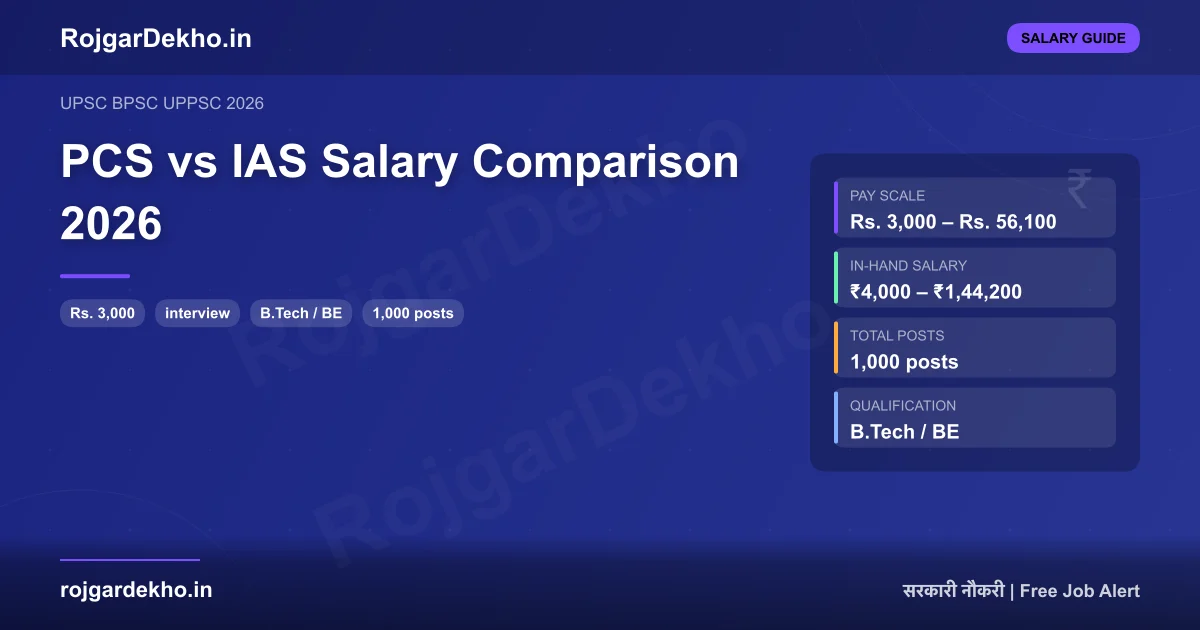
When you first join as an IAS officer, you are placed at Level 10 of the 7th Pay Commission pay matrix, with a basic pay of Rs. 56,100 per month.
When you first join as a PCS officer (Sub-Divisional Magistrate rank equivalent in UP, Bihar, Rajasthan, etc.), you are placed at Level 9, with a basic pay of Rs. 53,100 per month.
The difference: Rs. 3,000 per month in basic pay. After adding DA, HRA, and other allowances, the total in-hand difference at the starting level is approximately Rs. 4,000–6,000 per month. That is real money, but it is not the transformative gap that most coaching centres suggest.
The Real Divergence: Year 10 Onwards
The gap starts to widen noticeably from around year 5–7, and becomes dramatic after year 10–15. Here is why:
An IAS officer is on a faster promotion track. By year 15–20, a well-regarded IAS officer is typically at the Joint Secretary (Level 14, basic pay Rs. 1,44,200) or Additional Secretary level. A PCS officer at the same seniority is typically at SDM-to-DM equivalent, which is around Level 12–13.
More importantly, at the top of an IAS career, you become a Secretary to the Government of India — Level 17, basic pay Rs. 2,25,000 — one of the highest-paid government positions. A PCS officer's career ceiling is typically at Additional Chief Secretary or equivalent at the state level.
20-Year Career Trajectory: Salary Table
| Career Stage |
IAS (Approx. Level & Basic Pay) |
PCS (Approx. Level & Basic Pay) |
Salary Gap |
| Year 0 (Joining) |
Level 10 — Rs. 56,100 |
Level 9 — Rs. 53,100 |
Rs. 3,000 |
| Year 5 |
Level 11 — Rs. 67,700 |
Level 10 — Rs. 56,100–61,300 |
Rs. 6,000–11,000 |
| Year 10 |
Level 12 — Rs. 78,800 |
Level 11 — Rs. 67,700–74,100 |
Rs. 5,000–11,000 |
| Year 15 |
Level 13 — Rs. 1,18,500 (DM/JS level) |
Level 12 — Rs. 78,800–91,100 (ADM level) |
Rs. 25,000–40,000 |
| Year 20 |
Level 14 — Rs. 1,44,200 (Joint Secy) |
Level 12–13 — Rs. 91,100–1,18,500 |
Rs. 25,000–55,000 |
| Year 30 (Senior) |
Level 16–17 — Rs. 2,05,400–2,25,000 (Secy) |
Level 14 — Rs. 1,44,200 (Pr. Secy State) |
Rs. 60,000–80,000 |
Note: These are basic pay figures. Total in-hand with DA, HRA, and allowances will be 2–2.5x the basic pay in most postings.
Power: DM vs SDM — A Critical Difference
At the district level, the IAS officer typically becomes the District Magistrate (DM) or Collector — the apex administrative authority for the entire district. The PCS officer, at a comparable seniority, is the Sub-Divisional Magistrate (SDM) — a level below the DM, reporting to the DM in many states.
This is not just a salary question — it is a question of executive authority, public profile, and the scale of decisions you make. A DM manages a district's revenue, law and order, disaster response, and development — often with a population of 20–50 lakh under their jurisdiction. An SDM manages a sub-division, which is a fraction of that.
In some states (particularly UP, Bihar, MP), a senior PCS officer can eventually become DM. However, the standard career path reserves the DM post for IAS officers in most districts.
Transfer Policy: All-India vs Home State
IAS: All-India Service. You will be allocated a cadre state and can serve in both your cadre state and the Central Government (deputation to GoI). Central deputation postings (in Delhi ministries) often come with premium pay and better career opportunities. However, you can be posted anywhere across the country.
PCS: State cadre only. Your entire career is within your state. This is often seen as a significant advantage by officers who do not want to relocate to distant states. For a UP PCS officer, their family stays in UP; for a Bihar PCS officer, the career is entirely within Bihar.
For candidates who value proximity to family and roots in their home state, PCS actually has a structural advantage. For candidates who want a national-level career or eventual Central Government roles, IAS is the clear choice.
The Honest Take: Is PCS a Smarter Choice for Most?
Here is something most coaching centres will not tell you: for the majority of aspirants, PCS is the smarter strategic choice. Here is why:
Competition ratio: UPSC selects roughly 1,000 candidates total each year, with IAS vacancies typically around 100–150. UPPSC PCS selects 200–400 candidates per cycle. BPSC selects 150–300. The competition is significantly lower for PCS, and the exam is manageable with 2–3 years of serious preparation.
Age and opportunity cost: Many aspirants spend 5–8 years chasing IAS and end up with nothing. A PCS selection at age 26–27 gives you a 33–35-year career with a good salary, real authority, and a secure pension. That is not a consolation prize — it is a genuinely good career.
Quality of work: At the district level, PCS officers do meaningful, visible work. SDMs manage elections, handle revenue disputes, oversee law and order. The work is not small.
The right framework: if you are in your first 2 years of preparation and your score trajectory suggests you can crack UPSC, keep pushing. If you are in year 4–5 and not reaching the interview stage, seriously consider making PCS your primary target.
Benefits, Perquisites, and Pension
Both IAS and PCS officers receive government accommodation, official vehicle (at DM/SDM level), domestic help allowance at senior levels, and medical facilities through CGHS or state equivalents. Both are covered by NPS (New Pension Scheme) for those who joined after 2004.
The pension situation is important: both IAS and PCS officers are on NPS, which is a defined contribution scheme rather than the old defined benefit pension. The NPS corpus at retirement depends on contribution amount and market returns, not a fixed percentage of last drawn salary.
For more on state-level salary comparisons, read our articles on JPSC Salary After Selection 2026 and UP Tehsildar Salary 2026.
Frequently Asked Questions
What is the exact starting basic pay difference between IAS and PCS?
An IAS officer starts at Level 10 with basic pay of Rs. 56,100. A PCS officer typically starts at Level 9 with basic pay of Rs. 53,100. The difference is Rs. 3,000 per month in basic pay. After all allowances, the in-hand difference at joining is approximately Rs. 4,000–6,000 per month.
Can a PCS officer become a DM?
Yes, in some states a senior PCS officer can be appointed as District Magistrate, particularly in smaller or less politically sensitive districts. However, the standard practice in most large states is to appoint IAS officers as DMs. The chance exists but is not guaranteed for all PCS officers.
Is the PCS exam easier than UPSC?
State PCS exams follow a broadly similar pattern to UPSC but with a greater emphasis on state-specific GK, state history, and state issues. The competition is significantly lower — UPSC sees 10–12 lakh applicants for 1,000 posts, while a state PCS exam typically sees 3–5 lakh applicants for 200–400 posts. Preparation time needed is generally 1–2 years shorter for PCS.
Which gives more job security — IAS or PCS?
Both are permanent government positions with identical job security. Government employment in India, at both IAS and PCS level, is among the most secure employment available. Termination requires an elaborate disciplinary process. Both are equally secure from a job tenure perspective.
After how many years does the IAS salary significantly exceed PCS?
The gap starts becoming noticeable from year 10–12, and becomes significant (Rs. 30,000–50,000 per month basic pay difference) from year 15 onwards. At the senior end of the career (year 25–30), the gap can be Rs. 75,000–80,000 per month in basic pay alone — which, with DA applied, becomes a very large difference in total compensation.