RPSC School Lecturer Syllabus 2026: Paper I + Paper II & Exam Pattern
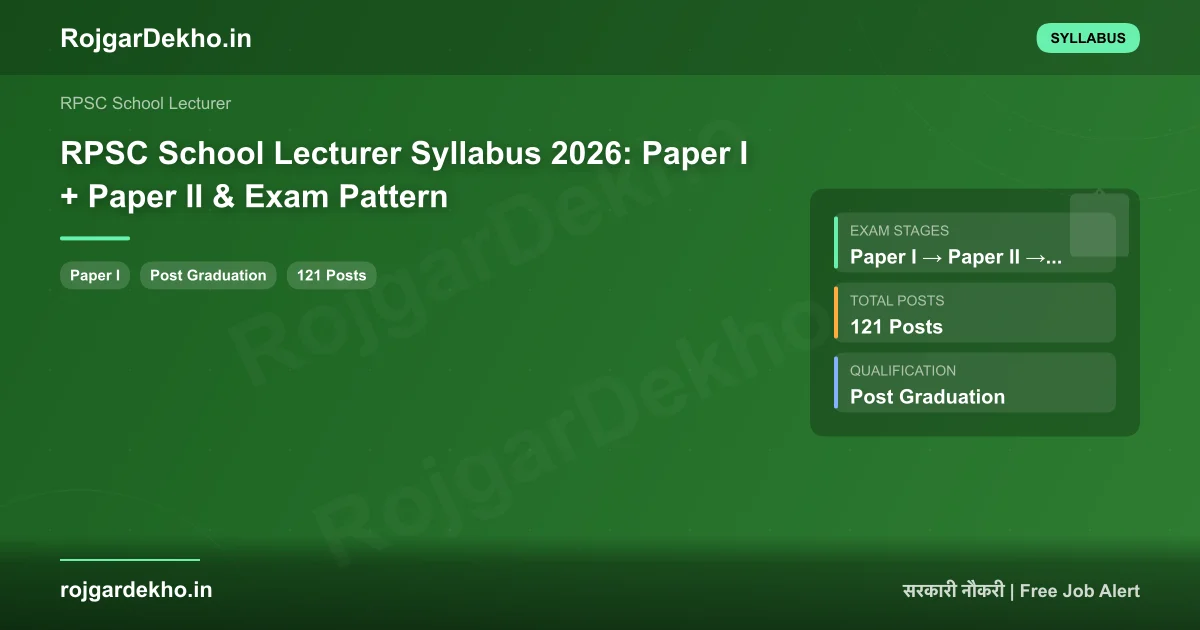
- Two papers: Paper I (GK) 150 marks and Paper II (subject) 300 marks, both with 1/3 negative.
- Paper I = Rajasthan GK, India & World GK, current affairs, educational psychology & management.
- Paper II = your chosen subject at PG level; you must score 40% in each paper.
The RPSC School Lecturer (1st Grade) 2026 syllabus has a clear two-paper structure: a general-studies Paper I common to all candidates, and a subject-specific Paper II at the postgraduate level. Knowing exactly what each paper covers lets you plan your preparation efficiently, because Paper I rewards Rajasthan-focused revision while Paper II demands deep command of your subject. This article lays out the full syllabus for both papers, the exam pattern and the marking rules. Always confirm the detailed subject syllabus against the official RPSC notification for your subject.
👉 RPSC School Lecturer Previous Year Papers — see which of these topics actually carry the most marks.
Exam pattern at a glance
| Feature | Paper I (GK) | Paper II (Subject) |
|---|---|---|
| Questions / Marks | 75 / 150 | 150 / 300 |
| Duration | 1.5 hours | 3 hours |
| Marks per question | 2 | 2 |
| Negative marking | 1/3 | 1/3 |
| Qualifying | 40% | 40% |
Paper I syllabus — General Studies
History, Culture & Geography of Rajasthan
Major dynasties and the history of Rajasthan, art, culture, literature, fairs, festivals, folk deities, dialects, dress, music and dance; and the geography of Rajasthan — physical divisions, rivers, lakes, climate, soils, vegetation, minerals and agriculture.
Rajasthan Polity, Economy & Current Affairs
The Rajasthan administrative and political system, Panchayati Raj, the state economy and major schemes, and current affairs of Rajasthan — recent events, schemes, awards and appointments. Current affairs are reliably tested and worth a running notes sheet.
GK of India & the World
General studies of India and the world — history, geography, polity, economy and general science at a competitive standard, plus important national and international current affairs.
Educational Psychology, Pedagogy & Management
Educational psychology — learning, motivation, intelligence, personality and individual differences; pedagogy and teaching methods; educational management, the role of computers and information technology in teaching, and statistics in education. This block is heavily weighted because the post is a teaching role.
Paper II syllabus — The Subject Paper
Paper II is your chosen subject at the postgraduate level, and it carries 300 marks — double Paper I — so it is the decisive paper. RPSC sets a detailed subject syllabus for each subject (Hindi, English, Sanskrit, Mathematics, Physics, Chemistry, Biology/Zoology/Botany, History, Geography, Political Science, Economics, Sociology, Commerce, Home Science, Drawing, Music, Physical Education and more). The syllabus typically spans:
- The full PG-level content of the subject, unit by unit.
- The teaching methods and pedagogy specific to the subject.
- Recent developments and applications in the subject.
Download the exact Paper II syllabus for your subject from the RPSC notification and map it against past subject papers to find the high-weight units. This targeted approach beats reading every PG textbook cover to cover.
👉 RPSC School Lecturer Eligibility 2026 — confirm your PG subject and B.Ed eligibility before you plan your subjects.
The marking rules that decide results
Both papers carry 1/3 negative marking, so guess only after eliminating options. The critical rule is the 40% in each paper requirement: you cannot compensate a weak Paper I with a strong Paper II — both must independently cross 40%. After qualifying both, your merit is built mainly on Paper II, so the strategy is to secure Paper I and maximise Paper II.
How to plan your preparation
| Phase | Focus |
|---|---|
| Phase 1 | Paper II subject — build deep, unit-wise command from PG sources |
| Phase 2 | Paper I — Rajasthan GK + Educational Psychology, the two biggest blocks |
| Phase 3 | Current affairs, India/World GK and educational management |
| Phase 4 | Past papers for both, timed, with the 1/3 negative applied |
What no other site tells you
The mistake that costs candidates this exam is mismanaging the two papers. Some pour everything into the subject paper and scrape Paper I, risking the 40% cut-off; others over-prepare Paper I general studies and under-prepare the subject paper that actually decides merit. The syllabus is telling you to do both deliberately: treat Paper I as a must-clear gate built on Rajasthan GK and Educational Psychology (which repeat every year), and treat Paper II as the merit-maker built on deep subject command. Map your subject syllabus against past papers, revise Rajasthan GK relentlessly, and you will have prepared exactly the way this two-paper exam rewards — for one of the most respected teaching posts in Rajasthan.
Frequently Asked Questions
What is the RPSC School Lecturer syllabus?
Paper I covers Rajasthan history-culture-geography-polity-economy, current affairs, India/World GK and educational psychology/management; Paper II is your chosen subject at PG level.
What is the exam pattern?
Paper I: 75 questions/150 marks/1.5 hours; Paper II: 150 questions/300 marks/3 hours. Both have 2 marks per question and 1/3 negative marking.
How much does Paper II count?
Paper II carries 300 marks (double Paper I) and is the decisive paper for merit, though you must clear 40% in both.
Is Educational Psychology important?
Yes, it is a heavily weighted part of Paper I because the post is a teaching role.
Where do I get the subject syllabus?
RPSC publishes a detailed Paper II syllabus for each subject in the official notification; download the one for your subject.
Is there negative marking?
Yes, 1/3 mark per wrong answer in both papers.
How much time to give each part
The syllabus is large, so smart time allocation matters as much as effort. Give the biggest share of your hours to your Paper II subject, because it carries 300 marks and decides your merit — deep, unit-wise command here is what separates the selected from the rest. Give a solid, steady share to the two pillars of Paper I: Rajasthan GK and Educational Psychology, which together carry most of Paper I and repeat every cycle. Allocate a smaller but regular slice to current affairs, India and World GK, and educational management, which round out Paper I. This balance ensures you clear the mandatory 40% in Paper I comfortably while maximising the Paper II score that actually wins the seat.
The best approach for each part
For your Paper II subject, study from standard postgraduate sources unit by unit, make concise notes of the high-frequency units identified from past papers, and revise the core concepts until they are second nature. For Rajasthan GK, use one good reference and build one-page summary sheets of dynasties, culture, geography and schemes, revising them repeatedly. For Educational Psychology, focus on the major theories and concepts of learning, motivation and intelligence, which are reliably tested. For current affairs, keep a running Rajasthan-focused notes sheet. This part-specific approach turns a broad two-paper syllabus into a structured, manageable preparation.
Last-month revision strategy
In the final month, shift from learning to consolidation. Do one thorough revision of your Paper II high-frequency units and your Rajasthan GK and Educational Psychology summary sheets, because that is where the bulk of your marks live. Alternate full-length timed papers for both Paper I and Paper II with focused revision of whatever each paper exposes as weak, always practising with the 1/3 negative marking so your attempting strategy is sharp. Keep current affairs handy for quick daily glances. Avoid starting any new, low-yield topic late; the candidate who walks in calm, well-revised and familiar with the paper format outperforms one who crams new material at the last moment.
The final word on the syllabus
The RPSC School Lecturer syllabus is broad but entirely fair and predictable: a Rajasthan-focused general-studies Paper I and a postgraduate subject Paper II, both well-documented and supported by years of past papers. Nothing in it is beyond a serious postgraduate with B.Ed; the challenge is breadth and the discipline of preparing both papers properly. Build deep subject command for Paper II, revise Rajasthan GK and Educational Psychology relentlessly for Paper I, practise both with past papers, and you will have prepared exactly the way this exam rewards — on the way to one of the most respected teaching careers in Rajasthan.
Topics you should not skip
- Rajasthan history, art, culture, fairs, festivals and folk deities.
- Rajasthan geography, polity, economy and major state schemes.
- Educational Psychology — learning, motivation, intelligence, individual differences.
- Rajasthan current affairs from the months before the exam.
- Your Paper II subject’s high-frequency units, identified from past papers.
If you have these areas truly solid, you have covered the heart of both papers. Everything else is a bonus, so make these rock-solid before chasing rarer topics, and keep returning to your one-page summary sheets so the recurring content stays fresh right up to exam day.
Why this preparation is a long-term asset
A strategic point worth knowing: the Rajasthan GK, polity, geography and current-affairs base you build for Paper I is the same foundation tested across almost every Rajasthan state exam — RAS, other RPSC posts, RSSB recruitments and more. So the hours you invest in this syllabus are not spent for a single exam; they build a durable base you can reuse across the Rajasthan job market. And your deep subject command from Paper II strengthens you as a teacher for your entire career, not just for the exam. Prepared properly, this syllabus pays dividends well beyond the School Lecturer post itself, which is one more reason to study it thoroughly rather than superficially.
The final takeaway is that the RPSC School Lecturer syllabus rewards depth and consistency over shortcuts. Build genuine command of your subject for Paper II, revise the Rajasthan-focused Paper I blocks relentlessly, practise both with past papers under the negative-marking rule, and confirm the exact subject syllabus against the official notification. Do that, and a broad-looking two-paper syllabus becomes a structured, conquerable target on the way to a senior teaching post.
Keep one principle at the centre of your preparation: this exam rewards depth and consistency far more than last-minute intensity. A strong Paper II subject score is built over months of genuine study, and a safe Paper I comes from repeated revision of Rajasthan GK and Educational Psychology — neither can be crammed in the final week. A candidate who starts early, prepares both papers deliberately, and revises the recurring topics until they are automatic will almost always outperform a more talented but disorganised one. Treat your preparation as a project with clear milestones for each paper, and a senior teaching post becomes a realistic, well-earned goal.
And remember what is at stake: a permanent, gazetted senior teaching post at Pay Level 12, with full Rajasthan allowances, academic vacations, pension and the respect of shaping students at the senior-secondary stage. For a postgraduate with B.Ed, few careers combine pay, security, standing and meaningful work so completely. That is well worth every hour of disciplined two-paper preparation. Confirm every detail against the official RPSC notification for your subject, choose the subject that matches your PG, prepare both papers consistently, and you give yourself a real, earned chance at one of the 121 seats.
A practical closing tip: build a single revision register that lists, on one side, the recurring Paper I topics (Rajasthan GK, Educational Psychology, current affairs) and, on the other, the high-frequency units of your Paper II subject. Update it as you study and revise only from it in the final fortnight. This compact register keeps the entire two-paper syllabus under control, ensures nothing high-yield slips through, and gives you the calm confidence of knowing exactly what you have covered before exam day.
Above all, respect the structure the syllabus sets: two papers, both mandatory at 40%, with merit decided by your subject. Plan your months so that neither paper is left to chance, lean on past papers to focus your effort, and treat the official subject syllabus as your final authority. A candidate who prepares this way, steadily and completely, gives the broad syllabus no room to surprise them on exam day.