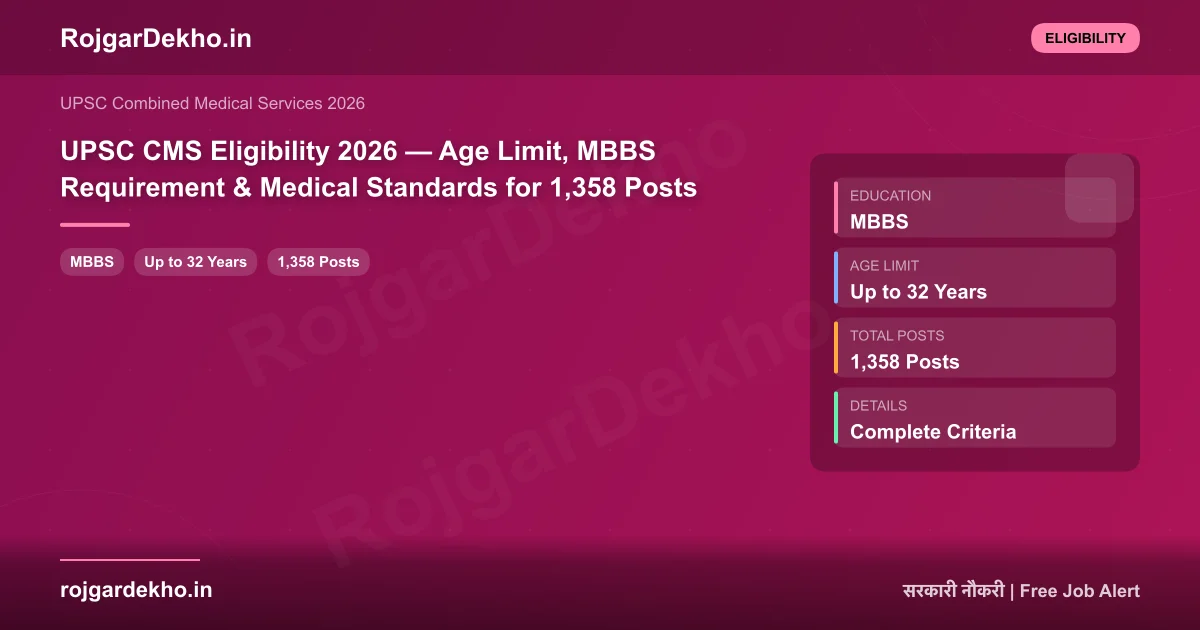
UPSC CMS (Combined Medical Services) is the gateway for MBBS doctors to join central government medical services — 1,358 posts across Central Health Service, Indian Ordnance Factories, Municipal Corporation of Delhi, and Railways. It's one of the most prestigious medical officer exams in India.
Age Limit
| Category | Max Age |
|---|---|
| General / EWS | 32 years |
| OBC | 35 (+3) |
| SC / ST | 37 (+5) |
| PwD (General) | 42 (+10) |
| Central Health Service | 35 years (separate limit) |
As on 1st August 2026. No minimum age.
Education
MBBS degree from a university recognized by the Medical Council of India (MCI) / National Medical Commission (NMC). Candidates who have appeared for the final MBBS exam and are awaiting results can also apply. Internship completion is not mandatory at the time of application — but must be completed before joining.
Medical/Physical Standards
- Must be physically and medically fit as per government medical standards
- Specific conditions like hernia, piles, varicocele have defined fitness protocols
- Vision and hearing standards as per central government medical norms
Other
- Indian citizen (subjects of Nepal/Bhutan also eligible)
- No maximum attempts — can appear any number of times within age limit
- Exam date: 2nd August 2026
👉 Salary: UPSC CMS Salary 2026
👉 Syllabus: UPSC CMS Syllabus 2026
MBBS Requirement — What Exactly Counts
- MBBS from any MCI/NMC recognized college — government or private, both accepted
- Foreign medical graduates (FMG) — eligible if they've cleared the FMGE (Foreign Medical Graduate Examination) and their degree is recognized by NMC
- AYUSH graduates (BAMS, BHMS, BUMS) — NOT eligible. CMS is only for allopathic MBBS holders
- BDS (Dental) graduates — NOT eligible
- Internship completion not mandatory at application time — but you must complete it before the date of joining. If you're doing your compulsory rotating internship during the exam, you can still apply
- Post-graduate (MD/MS) candidates — also eligible and may get preference for certain specialist posts
Services You Can Join Through CMS
| Service | Posts | Pay Level |
|---|---|---|
| Central Health Service (CHS) | Junior Scale Medical Officer | Level 10 (₹56,100) |
| Indian Ordnance Factories Health Service | Medical Officer | Level 10 |
| Delhi Municipal Corporation | Medical Officer | Level 10 |
| Railway Medical Service | Railway Medical Officer | Level 10 |
All CMS posts start at Pay Level 10 (₹56,100 basic) — which means in-hand salary of approximately ₹75,000-90,000 right after joining. With NPA (Non-Practicing Allowance) of 20%, the package is significantly better than most entry-level medical positions.
Selection Process
| Stage | Details | Marks |
|---|---|---|
| Paper I | General Medicine, Pediatrics, Dermatology, Psychiatry, Radiology | 250 |
| Paper II | Surgery, Gynecology, Orthopedics, ENT, Ophthalmology, Anesthesia | 250 |
| Personality Test (Interview) | Knowledge, communication, aptitude | 100 |
| Total | 600 |
CMS vs Other Medical Career Options
| Parameter | UPSC CMS | State Medical Officer | Private Practice |
|---|---|---|---|
| Starting Salary | ₹75,000-90,000 | ₹50,000-70,000 | Variable (₹20K-2L+) |
| Job Security | Central Govt (highest) | State Govt (high) | None |
| Pension | NPS (14% govt contribution) | NPS | None |
| Work-Life Balance | Good (fixed hours) | Moderate | Poor initially |
| Prestige | Very high (UPSC) | High | Depends |
Frequently Asked Questions
Can BAMS/BHMS doctors apply for CMS?
No. UPSC CMS is exclusively for MBBS (allopathic) degree holders. AYUSH, BDS, and nursing graduates are not eligible.
Is there any minimum percentage in MBBS?
No. Just passing MBBS from a recognized college is sufficient. No minimum marks requirement.
Can I apply if my internship is not complete?
Yes. You can apply during internship. But you must complete the full internship before the date of appointment/joining.
What is the salary of a CMS officer?
Pay Level 10 (₹56,100 basic) + NPA (20%) + DA + HRA. In-hand approximately ₹75,000-90,000 per month. Significantly higher than state medical officer positions.
How many attempts are allowed?
No limit on attempts. You can appear every year until you reach the age limit (32 for General, 35 for OBC, 37 for SC/ST).
Is CMS easier than NEET PG?
Different pattern. CMS tests clinical knowledge through MCQs — more conceptual, less memory-based compared to NEET PG. Many candidates find CMS questions more application-oriented.
Post-wise Vacancy Distribution
UPSC CMS allocates doctors to different central government medical services. Here's how the vacancies are typically distributed:
| Service | Approximate Vacancies | Major Hospitals/Locations |
|---|---|---|
| Central Health Service (CHS) | ~864 posts | Safdarjung, RML, AIIMS (pool), Lady Hardinge — Delhi and other central govt hospitals across India |
| Railway Medical Service | ~450 posts | Divisional Railway Hospitals across zones |
| NDMC (New Delhi Municipal Council) | ~14 posts | NDMC health centres and dispensaries in New Delhi |
| MCD Delhi (Municipal Corporation) | ~30 posts | MCD hospitals and health centres in Delhi |
What Each Service Offers
Central Health Service (CHS) is the most prestigious allocation. CHS officers work in premier central government hospitals like Safdarjung Hospital, Ram Manohar Lohia Hospital, and as pool officers in AIIMS. CHS posting means working alongside some of India's best medical professionals. You get exposure to complex cases, research opportunities, and a professional environment that's hard to match in state-level hospitals.
Railway Medical Service means you'll be posted at divisional hospitals run by Indian Railways. Your primary patients are railway employees and their families. The workload is generally manageable, and railways provide excellent accommodation and transport benefits. The downside — divisional hospitals are often in smaller cities or railway junctions, not metros.
NDMC and MCD Delhi — these are Delhi-specific postings. You work in municipal health centres and dispensaries. The vacancy count is small, so getting these posts requires a very high rank. The advantage is guaranteed Delhi posting — which is rare in central government service.
CMS vs NEET PG — Which to Choose?
This is the dilemma every MBBS graduate faces, and here's a practical way to think about it:
CMS gives you a central government job immediately after MBBS. You start earning ₹75,000-90,000 per month right away. You get job security, pension, government quarters, and the prestige of a UPSC selection. But you don't get a post-graduate specialization.
NEET PG gives you specialization — MD/MS in your chosen field. But you spend 3 more years studying (often without significant income), and there's no guarantee of a government job after PG either.
The smart approach that many doctors follow: Appear for both simultaneously. Treat CMS as your backup plan while pursuing NEET PG. If you get CMS, join — you can still pursue PG later through the in-service quota. CHS and Railway Medical Service both offer in-service PG seats in government medical colleges. This way, you get the government job, start earning, and still get your specialization eventually.
Preparation Timeline for Final Year MBBS Students
If you're in your final year of MBBS and planning to appear for CMS, here's a realistic preparation timeline:
- 8-10 months before the exam — Start your dedicated CMS preparation. Continue with internship but allocate 2-3 hours daily for CMS study.
- Focus on Medicine and Surgery first — These two subjects have the highest weightage in both Paper I and Paper II. Master them thoroughly before moving to other subjects.
- Revise Pharmacology and Pathology — These are the next highest-yield subjects. Pharmacology appears across multiple papers and Pathology is the foundation of clinical questions.
- 2-3 mock tests per month — Take full-length mock tests regularly. CMS questions are application-oriented — not direct recall. Mock tests help you practice the analytical thinking required.
- Last 2 months — Focus entirely on revision and solving previous year papers. Don't start new topics at this stage.
Remember: CMS preparation overlaps significantly with NEET PG preparation. About 60-70% of the syllabus is common. So if you're already preparing for NEET PG, you have a head start for CMS.
Post-wise Vacancy Distribution 2026
UPSC CMS 2026 has a total of 1,358 posts across four services. Here's the exact breakdown so you know what you're competing for.
| Service | Vacancies | Key Hospitals/Locations |
|---|---|---|
| Central Health Service (CHS) | 864 posts | Safdarjung Hospital, RML Hospital, Lady Hardinge Medical College, AIIMS (non-faculty), central govt hospitals across India |
| Railway Medical Service | 450 posts | Divisional Railway Hospitals, Railway colonies, Railway referral hospitals |
| NDMC (New Delhi Municipal Council) | 14 posts | NDMC Health Centres, Dispensaries in Lutyens' Delhi area |
| MCD (Municipal Corporation of Delhi) | 30 posts | Hindu Rao Hospital, Kasturba Hospital, municipal dispensaries across Delhi |
As you can see, CHS has the lion's share of vacancies (864 out of 1,358). This is the most sought-after service because of the prestige, urban postings, and career growth opportunities.
What Each Service Offers
Central Health Service (CHS): This is the gold standard. You work in premier government hospitals like Safdarjung, RML, Lady Hardinge in Delhi, and similar central government hospitals across India. Benefits include teaching hospital exposure (academic environment, research opportunities), urban postings (mostly metro cities), promotion path up to Director General level, and 20% NPA (Non-Practicing Allowance) on top of basic pay. CHS doctors are respected across the medical community.
Railway Medical Service: You serve as a doctor in divisional railway hospitals, treating railway employees and their families. Benefits include excellent family accommodation (railway quarters are among the best government housing), free railway passes for travel, posting in railway colonies (self-contained townships), and a relatively less hectic work environment compared to CHS hospitals. Ideal if you value work-life balance.
NDMC: Limited posts but excellent location — you work in the heart of New Delhi. NDMC health centres serve the Lutyens' Delhi area. Benefits include Delhi posting (guaranteed), less patient load compared to large hospitals, and good public health exposure.
MCD: Municipal hospitals and health centres across Delhi. Hindu Rao Hospital (North Delhi) is the largest MCD hospital. Benefits include Delhi-based posting, community health experience, and decent work hours. MCD doctors also handle public health programs, vaccination drives, and epidemic management.
CMS vs State Medical Officer — Which Is Better?
Many MBBS graduates are confused between attempting UPSC CMS and joining as a State Medical Officer through state PSC. Here's a clear comparison.
| Parameter | UPSC CMS | State Medical Officer |
|---|---|---|
| Pay Level | Level 10 (7th CPC): Basic ₹56,100 | Level 8-10 (varies by state) |
| In-hand Salary | ₹75,000 - ₹90,000/month (with NPA) | ₹50,000 - ₹70,000/month |
| NPA (Non-Practicing Allowance) | 20% of basic pay (guaranteed) | Varies by state (some states don't give NPA) |
| Posting Location | Metro/big cities (Delhi, Mumbai, Kolkata, Chennai) | Rural postings very common (PHC/CHC level) |
| Service Type | Central Government (CHS/Railway) | State Government |
| Career Growth | Up to Director General (HAG+ scale) | Up to Director Health Services (state level) |
| Transfer Policy | All-India basis (but mostly urban hospitals) | Within state (frequent rural-urban transfers) |
Verdict: CMS is clearly better on salary (₹15-20K more per month), posting quality (urban vs rural), and career ceiling. The only advantage of State MO is that you stay in your home state. If you're okay with relocating, CMS is the superior choice.
When to Start Preparing — Based on Your Stage
Your preparation timeline depends entirely on where you are in your medical career right now.
Final Year MBBS: Start 10-12 months before the expected exam date. You have the advantage of fresh clinical knowledge. Focus on revising all subjects systematically alongside your final year studies. Use your clinical postings to reinforce theoretical knowledge.
During Internship: Start 6-8 months before. Study during off-duty hours and weekly offs. Internship gives you practical exposure that helps in Paper II (clinical subjects). Join a test series to maintain consistency even with irregular schedules.
Already Practicing (Private practice or hospital job): You'll need 4-6 months of intensive preparation. Your clinical skills are sharp, but you may have forgotten basic sciences. Allocate first 2 months entirely to revising basic subjects (Anatomy, Physiology, Biochemistry, Pathology, Pharmacology, Microbiology). Then shift to clinical subjects for the remaining months.
Subject-wise Weightage in UPSC CMS
Based on analysis of previous years' papers, here's how much each subject contributes. Allocate your study time proportionally.
| Subject | Weightage | Priority |
|---|---|---|
| General Medicine | Highest (15-18%) | Must master — single biggest contributor |
| Surgery | Second highest (12-15%) | High yield — especially general surgery topics |
| Obstetrics & Gynaecology | Third (10-12%) | Important — don't skip even if not your interest |
| PSM / Preventive & Social Medicine | Increasing trend (8-10%) | High scoring — national health programs, epidemiology |
| Pediatrics | 6-8% | Medium — focus on immunization, growth milestones |
| Ophthalmology | 4-6% | Short subject — high return on investment |
| ENT | 4-5% | Short subject — quick to revise |
| Dermatology | 3-4% | Image-based questions common |
| Psychiatry | 3-4% | Increasing trend in recent papers |
| Radiology | 3-4% | X-ray and CT identification questions |
| Anesthesia | 2-3% | Basic concepts sufficient |
| Orthopedics | 3-5% | Fracture classifications, emergency management |
Strategy tip: Medicine + Surgery + OBG together account for nearly 40-45% of the paper. If you're strong in these three, you're already halfway to qualifying. PSM is the dark horse — it's easy to score and has been increasing in weightage over the last 3 years.
Also Read: