UPSRTC Bus Conductor Salary 2026 – What You Actually Need to Know
So you have been eyeing the UPSRTC Bus Conductor Recruitment 2026 notification and the first question in your mind is probably: "Kitna milega?" Fair enough. Before investing weeks into an application and preparation, you deserve a straight, honest answer about the money. This article gives you exactly that — no fluff, just the real picture of what a UPSRTC conductor earns, what benefits come with the job, and where the career can go from here.
Before anything else, bookmark the official job listing: UPSRTC Bus Conductor Recruitment 2026 – Full Details. Now let's get into the salary breakdown.
Outsourcing vs Permanent — Understanding the Key Difference
This recruitment is outsourcing-based, which is the single most important thing to understand before we talk numbers. UPSRTC is hiring 1,077 bus conductors through a third-party manpower agency, not directly on its own payroll. This is a very common arrangement in UP government undertakings right now, and it has direct implications for your salary structure.
A permanent UPSRTC conductor who was recruited through the old direct method draws a salary under the 7th Pay Commission — roughly Rs. 19,500 to Rs. 35,000 (basic + DA + allowances) depending on seniority, plus house rent allowance, medical reimbursement, and pension under NPS. That is a different league entirely.
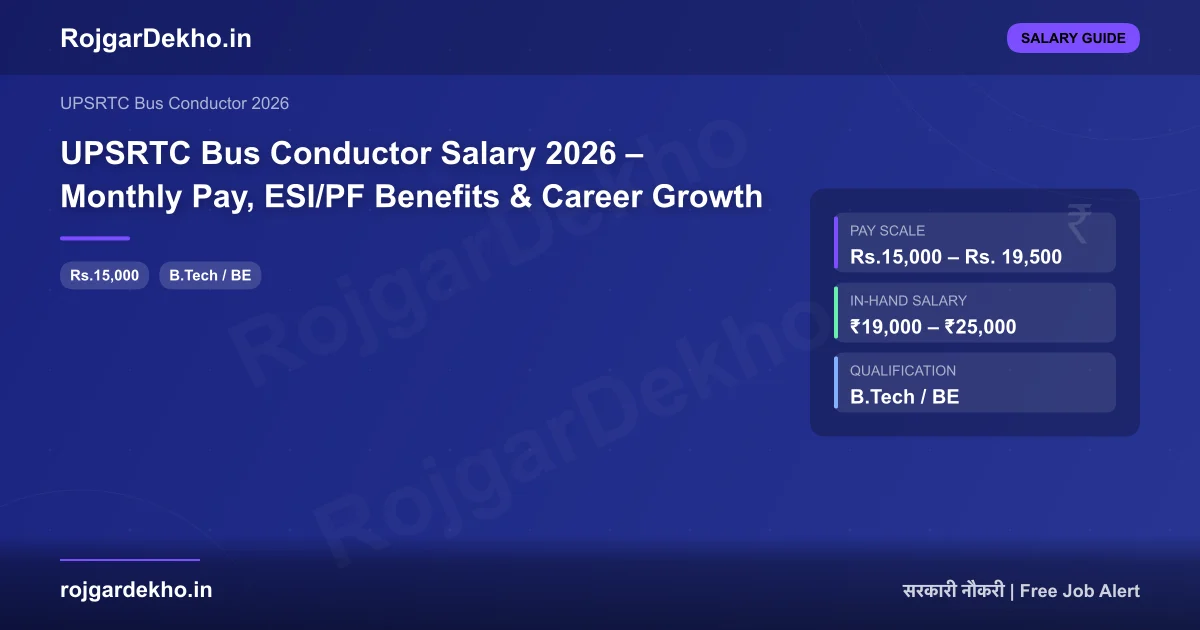
An outsourcing conductor — which is what this 2026 recruitment produces — gets a consolidated monthly salary of approximately Rs. 15,000 to Rs. 20,000. The exact figure depends on the manpower agency's contract with UPSRTC and the district you are posted in. This consolidated pay replaces the individual allowance components you would see in a permanent government job. There is no separate DA, HRA, or TA listed — it is bundled.
Does that make outsourcing a bad deal? Not necessarily. Let's look at the full picture.
ESI and PF — The Benefits That Actually Matter
Here is where outsourcing jobs have gotten significantly better in recent years. Under the Contract Labour (Regulation and Abolition) Act and ESIC/EPFO rules, any outsourcing agency employing you must provide:
- EPF (Employee Provident Fund): 12% of your basic wages is deducted from your salary, and the employer contributes another 12%. This money sits in your PF account, earns interest (~8.15% per year), and is yours when you leave or retire. For a conductor earning Rs. 18,000/month, that's about Rs. 2,160 going into your PF every month — from both sides.
- ESI (Employee State Insurance): Your contribution is 0.75% of wages; the employer pays 3.25%. In exchange, you and your immediate family get free medical treatment at ESI hospitals and dispensaries across Uttar Pradesh. Maternity benefits, disability payments, and even funeral expenses are covered under ESI.
So while the in-hand salary looks modest, the actual cost-to-employer is higher, and the social security net is real. For someone from a lower-income background, ESI coverage alone can save tens of thousands of rupees in medical bills annually.
What Does In-Hand Salary Look Like After Deductions?
Let's be practical and do the math for someone earning Rs. 18,000 consolidated:
- PF deduction (employee share): ~Rs. 1,080
- ESI deduction (employee share): ~Rs. 135
- Estimated in-hand: ~Rs. 16,500 to Rs. 16,800
In smaller cities and rural districts, where the cost of living is lower, Rs. 16,500 in hand is a reasonably comfortable salary for a fresh 12th-pass candidate. In Lucknow, Kanpur, or Agra, it is tighter — but remember, this job comes with fixed working hours, legal job security through the contract, and social security benefits that private transport jobs simply do not offer.
City-Wise Salary Variation — Does Location Matter?
UPSRTC operates in all 75 districts of Uttar Pradesh, from metro cities to tier-3 towns. The outsourcing agency's contract sometimes allows for marginal city-wise adjustments to match minimum wage notifications. The UP government's minimum wage for semi-skilled workers is revised periodically, and agencies must comply.
In practice:
- Lucknow, Kanpur, Agra, Varanasi (larger depots): Consolidated pay tends to be at the higher end — closer to Rs. 18,000–20,000 — because minimum wage notifications for urban areas are slightly higher.
- Smaller district towns (Jhansi, Banda, Sonbhadra, etc.): Pay tends to cluster around Rs. 15,000–17,000, aligned with district minimum wage rates.
The base structure is set by the agency contract, but city-wise minimum wage compliance is a legal floor below which no agency can go.
How Does the Salary Grow Over 5 Years?
This is the honest answer: for an outsourcing employee, salary growth is not automatic the way it is for permanent government employees who get annual increments. Growth depends on two things:
- Minimum wage hike notifications: The UP government revises minimum wages every 1–2 years. As the floor goes up, your consolidated pay must go up too. Historically, UP minimum wages have risen 8–12% every revision cycle.
- Regularization: This is the big one. If you perform well and UPSRTC regularizes the outsourcing batch (which has happened in previous cycles), you move onto the permanent payroll — and your salary can jump to the 7th Pay Commission scale overnight.
Realistically, a conductor who joins at Rs. 16,500 in-hand in 2026 might be earning Rs. 19,000–21,000 in-hand by 2030 through wage revisions alone — even without regularization. With regularization, the jump could be to Rs. 25,000–30,000 in-hand.
Regularization — The Path to a Permanent Government Job
UPSRTC has a history of regularizing outsourcing staff. The exact process depends on government policy, court orders, and the political environment — but the broad path looks like this:
- You complete 3–5 years of continuous outsourcing service with a satisfactory record.
- UPSRTC or the state government issues a regularization order (this has happened for driver and conductor categories before).
- You are absorbed into the permanent cadre, usually at the entry-level scale of the 7th Pay Commission.
- Past service may or may not count for seniority, depending on the order.
There is no guarantee of regularization — but it is a real possibility, and candidates who keep their record clean and stay with the job significantly improve their odds. Hundreds of outsourcing conductors from earlier batches have been regularized in UP's transport sector.
Overtime and Other Earnings
Yes, overtime is paid for hours worked beyond the standard shift. Under the Minimum Wages Act, overtime must be paid at double the ordinary wage rate. Conductors on long-distance routes or routes with high passenger volume often work longer hours and earn meaningful overtime supplements. This can add Rs. 2,000–5,000 to your monthly take-home in busy months.
There is also an informal advantage: on routes with high ticket revenue, conductors are sometimes given performance recognition by depot managers — not formal incentives, but goodwill that can affect shift assignments and future postings.
UPSRTC Conductor vs. Private Transport Jobs — Is This Worth It?
A private bus company in UP might offer a conductor Rs. 12,000–16,000 without any ESI or PF. No job security, no regularization path, no leave entitlement. The UPSRTC outsourcing job, at Rs. 15,000–20,000 with ESI and PF, is objectively better for anyone thinking beyond the first six months. The mental peace of a government-linked job, social security, and the regularization possibility make it a clear winner for a 12th-pass candidate in Uttar Pradesh.
How to Apply
Applications close on 09 April 2026. There is no application fee. You apply through the Sewayojan portal (sewayojan.up.nic.in) with district-wise selection. Full job details, eligibility, and the direct apply link are available here: UPSRTC Bus Conductor Recruitment 2026.
Frequently Asked Questions (FAQ)
UPSRTC bus conductor ki monthly salary 2026 mein kitni hai?
The consolidated monthly salary for an outsourcing-basis UPSRTC bus conductor in 2026 is approximately Rs. 15,000 to Rs. 20,000, varying by district and the agency's wage contract. After PF and ESI deductions, your in-hand amount will be roughly Rs. 13,500 to Rs. 18,500 depending on your exact gross.
Permanent UPSRTC conductor aur outsourcing conductor ki salary mein kya fark hai?
A permanent UPSRTC conductor earns under the 7th Pay Commission — Rs. 19,500–35,000+ including DA and allowances, with pension benefits. An outsourcing conductor gets Rs. 15,000–20,000 consolidated, with ESI and PF but no DA, HRA, or pension. The gap is significant, which is why regularization matters so much.
Kya ESI aur PF milega outsourcing conductors ko?
Yes, absolutely. It is legally mandatory. The outsourcing agency must provide EPF (12% employer contribution) and ESI (3.25% employer contribution) for all employees. ESI gives you and your family free medical care across all ESI facilities in UP. Your PF accumulates and earns interest — it is your retirement corpus.
Regularization kaise hoti hai aur kitne time mein?
Regularization is not guaranteed or automatic. It happens through government policy orders, typically after 3–5 years of continuous service. UPSRTC has regularized outsourcing staff in the past — it depends on state government decisions, court directions, and your own clean service record. The best strategy is to join, perform well, and stay — the regularization opportunity will come when the policy window opens.
Overtime milta hai UPSRTC conductors ko?
Yes. Under the Minimum Wages Act, overtime is paid at double the ordinary rate for hours beyond the standard shift. Conductors on long routes or busy periods routinely earn Rs. 2,000–5,000 extra per month through overtime. It is a meaningful addition to your base salary.
5 saal baad salary kitni ho sakti hai?
Without regularization, your salary will grow with minimum wage revisions — expect Rs. 19,000–22,000 consolidated by 2030–2031, based on historical revision rates. With regularization, you could jump to Rs. 25,000–35,000 under 7th Pay Commission scales. The five-year trajectory is genuinely attractive for a 12th-pass government-linked job.
📌 Related on RojgarDekho: