Bank of India Credit Officer Eligibility 2026: Qualification & Age
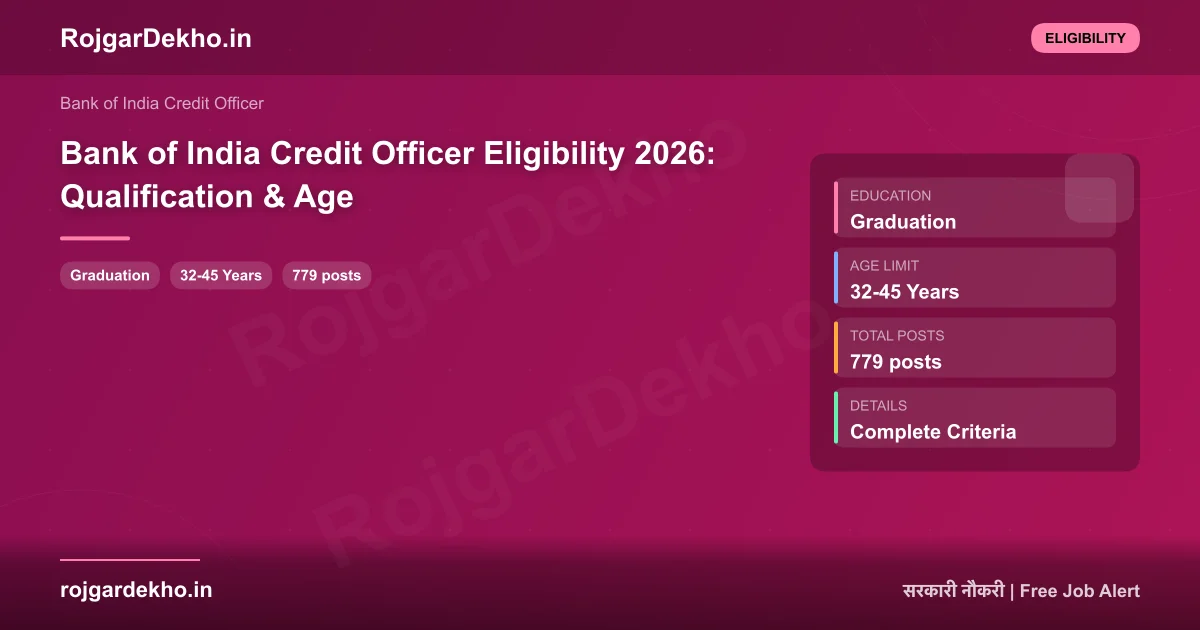
- Qualification: a Bachelor’s degree with 60% (55% for SC/ST/OBC/PwBD) plus relevant post-qualification experience.
- Age and experience rise by scale — broadly MMGS-II 25–32, MMGS-III 28–38, SMGS-IV 32–45 years.
- Fee: ₹850 (General/OBC/EWS) or ₹175 (SC/ST/PwBD); apply for the scale your profile fits.
Because the Bank of India Credit Officer 2026 recruitment (779 posts) hires directly into officer scales, its eligibility is stricter than an entry-level exam — it needs both a good graduation percentage and relevant work experience, and the exact age and experience depend on the scale. This article breaks down the qualification, the scale-wise experience and age, the application fee, and the 779-post split, so you know exactly which scale you can apply for. Always confirm the precise requirements for your scale in the official Bank of India notification before applying.
👉 Bank of India Credit Officer Syllabus & Exam Pattern — once you confirm eligibility, see exactly what the exam tests.
The 779 posts — scale-wise split
The vacancies are spread across three officer scales:
| Scale | Grade | Posts |
|---|---|---|
| MMGS-II | Middle Management Scale II | 677 |
| MMGS-III | Middle Management Scale III | 61 |
| SMGS-IV | Senior Management Scale IV | 41 |
| Total | — | 779 |
You apply for the single scale whose qualification, experience and age you meet — most vacancies are in MMGS-II, which is the natural target for candidates with a few years of relevant experience, while MMGS-III and SMGS-IV are for progressively more experienced professionals.
Educational qualification
The basic academic requirement is a Bachelor’s degree in any discipline from a recognised university with at least 60% marks (relaxed to 55% for SC/ST/OBC/PwBD candidates). Beyond the degree, a professional qualification (such as CA/ICWA/MBA-Finance) and, critically, relevant credit/banking work experience are required, with the exact requirement rising by scale. The role is a specialist credit officer position, so your experience should be in credit, lending or a closely related banking function as specified in the notification.
Experience and age — by scale
This is where the scales differ, and where you must place yourself correctly:
| Scale | Age (indicative) | Experience (indicative) |
|---|---|---|
| MMGS-II | 25–32 years | A few years of relevant experience (broadly 3+) |
| MMGS-III | 28–38 years | More relevant experience (broadly 5+) |
| SMGS-IV | 32–45 years | Substantial senior experience |
Treat the age and experience figures as indicative and read the exact clause for your scale in the notification, since credit-officer experience requirements can be specific about the role and the number of years. Age relaxation applies to reserved categories as per government norms. The key point: you must satisfy both the age band and the experience requirement of the scale you apply for — a strong candidate for MMGS-II is not automatically eligible for MMGS-III and vice versa.
Application fee
| Category | Fee |
|---|---|
| General / OBC / EWS | ₹850 |
| SC / ST / PwBD | ₹175 |
Pay the fee online during the application. Reserved categories pay a substantially lower fee, and the exact fee and any additional charges are as stated in the notification.
👉 Bank of India Credit Officers 2026 — Apply Online (779 Posts) — official notification, scale-wise eligibility and the apply link.
Documents and other conditions
Candidates must be Indian citizens. At document verification you must prove your degree and percentage, your professional qualification if claimed, your experience (through proper experience certificates from employers), your age, and your category if claiming relaxation. Experience proof is especially important for this recruitment — because eligibility hinges on relevant experience, be sure your experience certificates clearly state your role, the credit/banking nature of your work, and the exact dates, so they hold up at verification.
What no other site tells you
The most common reason a candidate is rejected here is not the exam — it is applying for the wrong scale or falling short on experience. Because this is an experienced-hire recruitment, the experience requirement is a hard gate: a fresh graduate, however bright, is simply not eligible, and applying for MMGS-III when you only meet MMGS-II’s experience will get you rejected at verification. Two honest points: the 60% graduation requirement (55% for reserved) is real, so a lower-percentage degree may not qualify; and your experience certificate must clearly establish relevant credit/banking experience, not just any job. Match yourself honestly to the single correct scale — meeting its degree, percentage, experience and age together — and you have cleared the part of this recruitment where most ineligible applicants are filtered out.
Frequently Asked Questions
What is the eligibility for Bank of India Credit Officer 2026?
A Bachelor’s degree with 60% marks (55% for SC/ST/OBC/PwBD) plus relevant post-qualification credit/banking experience, with age and experience rising by scale (MMGS-II/III, SMGS-IV).
What is the age limit?
Broadly MMGS-II 25–32, MMGS-III 28–38 and SMGS-IV 32–45 years, with relaxation for reserved categories; confirm the exact band for your scale in the notification.
How much experience is required?
Relevant experience rising by scale — broadly a few years (3+) for MMGS-II, more (5+) for MMGS-III, and substantial senior experience for SMGS-IV.
What is the application fee?
₹850 for General/OBC/EWS and ₹175 for SC/ST/PwBD candidates.
How many posts are there and how are they split?
779 posts — MMGS-II 677, MMGS-III 61 and SMGS-IV 41.
Can a fresh graduate apply?
No. This is an experienced-hire officer recruitment; relevant post-qualification credit/banking experience is required, so fresh graduates are not eligible.
Why the experience requirement matters most
Of all the eligibility conditions, the one that decides most outcomes is experience. This is a lateral, experienced-hire recruitment: the bank is looking for professionals who can appraise credit from day one, not trainees to be taught. So the experience clause is not a formality — it is the core filter. Read it carefully for your scale: it usually specifies not just a number of years but the nature of the experience, typically in credit, lending, or a closely related banking function. General work experience in an unrelated field will not count, however long it is. Before you apply, honestly map your own work history against the exact wording in the notification, and target the single scale whose experience requirement you genuinely satisfy.
It also pays to prepare your experience evidence early. At document verification you will need proper experience certificates from your employers that clearly state your designation, the credit or banking nature of your duties, and the exact start and end dates. Vague certificates that merely confirm employment without describing the role are a common reason candidates run into trouble at verification, even when they genuinely have the experience. Get your certificates in the right form now, so a technicality does not cost you a post you have earned.
Documents to keep ready before applying
Assemble and check every document the notification asks for before you start the form: your graduation degree and full marksheets (to prove both the qualification and the 60%/55% percentage), any professional qualification certificate you are claiming, your experience certificates, a valid category certificate if you are claiming SC/ST/OBC/EWS relaxation, a PwBD certificate if applicable, and a recent photograph and signature in the specified format. Make sure your name and date of birth match exactly across all documents — a mismatch between your degree and your other proofs is a surprisingly common cause of trouble at verification.
Scan everything in advance at the required size and clarity, apply a few days before the deadline rather than at the last minute, and keep a printed copy of your submitted application and fee receipt along with your registration number. These small disciplines cost nothing and protect an application you have worked hard to be eligible for.
Reservation, relaxation and fee benefits
Bank of India follows the government’s reservation policy, so reserved-category candidates benefit in two ways: posts are reserved category-wise as per the roster, and the age limit is relaxed (broadly five years for SC/ST, three for OBC, with further relaxation for PwBD and others as per rules). The application fee is also far lower for SC/ST/PwBD candidates (₹175 against ₹850). To claim any of these benefits you must hold a valid, current category certificate in the prescribed format — an OBC certificate, in particular, usually needs to be recent and carry the non-creamy-layer clause. Keep these certificates correctly formatted before applying, because at verification an invalid certificate can cost you the benefit you were counting on.
Who should — and should not — apply
To put the eligibility in plain terms: you should apply if you hold a Bachelor’s degree with the required percentage, you have relevant post-qualification credit or banking experience, and you fall within the age band after your category relaxation — all for the same single scale. A candidate with a few years of solid credit experience is the natural fit for MMGS-II, where most of the vacancies are; those with progressively more senior experience should look at MMGS-III and SMGS-IV. You should not apply for a scale whose experience or age you do not meet, hoping it will be overlooked — it will not, and you will only lose your fee and time. And a fresh graduate, however capable, is simply not eligible for this experienced-hire recruitment and should target entry-level exams instead.
Match yourself honestly to the one scale you fully satisfy, and your eligibility is solid. Stretch for a scale beyond your experience, and the application ends at verification. The candidates who succeed here are not just strong at the exam — they are careful and honest at the eligibility stage, where a single unmet condition quietly ends many attempts before they begin.
Reading the official notification correctly
The single most valuable habit in any recruitment is reading the official notification carefully, and this one rewards close reading because its eligibility is scale-specific and detailed. When the notification opens, go straight to your scale and read its full eligibility block — not a summary on a third-party site, but the exact wording in the official PDF. Pay attention to four things in particular: the precise qualification and percentage, the exact experience requirement (years and nature), the age band and cut-off date, and the documents required at each stage. Third-party summaries are useful for an overview, but at document verification it is the notification’s wording — not a website’s paraphrase — that decides your fate. When in doubt, the notification is always the final authority.
It also pays to read the general instructions, not just the eligibility table. That is where the bank spells out the reservation and relaxation rules, the fee and refund terms, the selection process and the certificate formats required. Candidates who skip this section are the ones caught off guard later by a rule they could have read in a few minutes. Treat the notification as the rulebook for the entire recruitment, read it once fully and then again for your scale, and you will avoid almost every avoidable mistake.
The bottom line on eligibility
In short, eligibility here is not a single rule but a checklist you must clear cleanly for one scale: a Bachelor’s degree with 60% (55% reserved), the exact credit/banking experience the scale demands, an age within the band after your category relaxation, and every supporting document valid and consistent. Because this is an experienced-hire recruitment, the experience clause is the decisive gate — fresh graduates are not eligible, and applying above your experience ends at verification. Work through the checklist honestly, target the one scale you truly satisfy, and you give yourself the best possible start in a rewarding officer recruitment.
One final tip: do not leave your application to the last day. Portals slow down near the deadline, uploads fail, and a small error made in a rush can invalidate an otherwise perfect application. Apply a few days early, review every field against your documents before submitting, and keep your registration number and payment receipt safe. That small discipline protects an application you have worked hard to make eligible.