Bank of India Credit Officer Salary 2026: MMGS-II to SMGS-IV Pay
- These are officer-scale posts on the IBA pay scales — far above clerical pay.
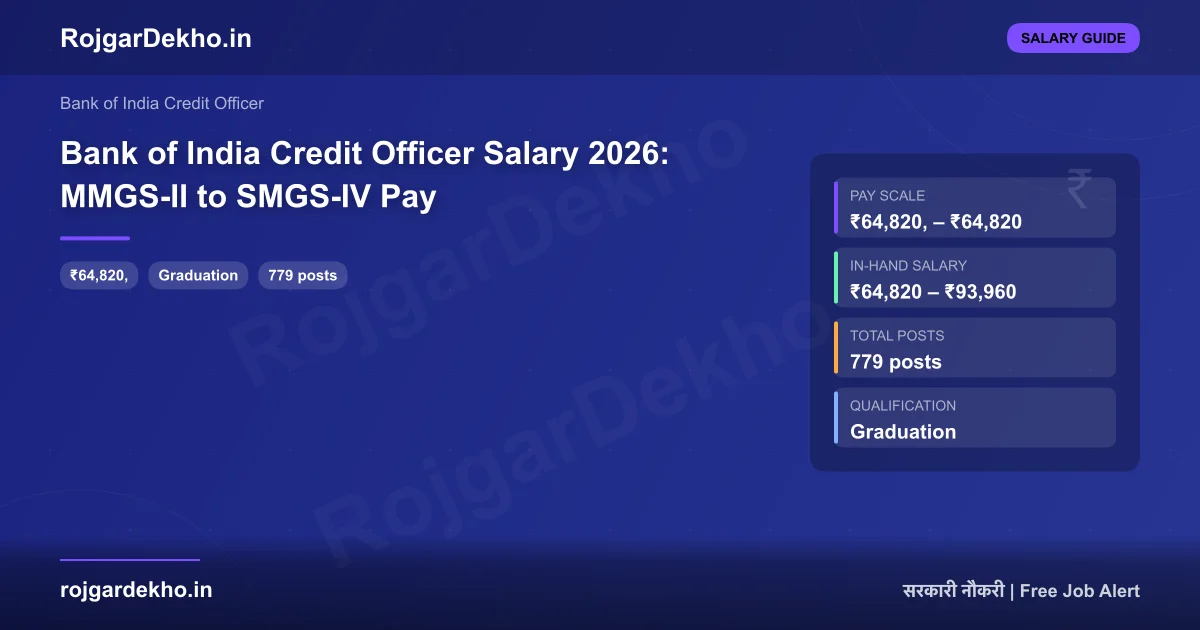
- MMGS-II starts at a basic of ₹64,820 (scale rising to ₹93,960); MMGS-III and SMGS-IV pay more.
- On top of basic come DA, HRA, CCA and bank officer perks — the in-hand is significantly higher.
The Bank of India Credit Officer 2026 recruitment (779 posts) is an officer-level opening, and the salary reflects that — these are not clerical posts but Middle and Senior Management officer roles on the IBA (Indian Banks' Association) pay scales. Because the recruitment spans three scales — MMGS-II, MMGS-III and SMGS-IV — the pay depends on the scale you are selected into. This article gives the honest, scale-wise salary picture: the basic pay, the allowances stacked on top, a realistic in-hand band, the job profile of a Credit Officer, and how the banking career grows. Figures are based on the IBA officer pay structure; confirm the exact scale in the official notification.
👉 Bank of India Credit Officer Eligibility 2026 — check which scale — and which pay — your qualification and experience place you in.
Scale-wise pay at a glance
A Credit Officer is appointed in one of three officer scales, and each scale has its own IBA pay band. Here is the picture:
| Scale | Grade | Indicative basic pay |
|---|---|---|
| MMGS-II | Middle Management Scale II | ₹64,820 (scale ₹64,820–₹93,960) |
| MMGS-III | Middle Management Scale III | Higher band than Scale II |
| SMGS-IV | Senior Management Scale IV | Higher band than Scale III |
So the largest chunk of vacancies (MMGS-II) starts at a basic of ₹64,820, and the scale rises to ₹93,960 over the years through annual increments. MMGS-III and SMGS-IV are progressively senior scales with higher basic pay. Note that these are officer scales, so the pay is far above bank clerical or junior posts — this is one reason an experienced graduate should treat this as a serious career move, not just another exam.
In-hand salary — what MMGS-II actually pays
The basic pay is only the foundation. On top of it, a Bank of India officer receives Dearness Allowance (a percentage of basic, revised periodically), House Rent Allowance (or bank quarters), City Compensatory Allowance, and other officer perks. A rough monthly build-up for an MMGS-II Credit Officer at entry looks like this:
| Component | Approx amount | Note |
|---|---|---|
| Basic Pay (MMGS-II) | ₹64,820 | Entry basic of the scale |
| Dearness Allowance (DA) | Percentage of basic | Revised periodically |
| House Rent Allowance (HRA) | By city / or quarters | If not in bank accommodation |
| CCA & other allowances | As applicable | City compensatory and officer allowances |
| Approx gross | Well above ₹1,00,000 | Varies by DA rate and posting city |
Treat the gross as an indicative band — it moves with the DA rate and your posting city. The reliable anchor is the basic of ₹64,820; the allowances build the rest on top. After standard deductions (NPS, etc.), the net in-hand for an MMGS-II Credit Officer is a strong figure that comfortably exceeds a lakh in gross terms in most postings, and it grows steadily as DA is revised and increments accrue. MMGS-III and SMGS-IV officers earn correspondingly more.
Allowances and perks beyond basic pay
- Dearness Allowance (DA), revised periodically to offset inflation.
- House Rent Allowance or bank-provided quarters.
- City Compensatory Allowance and other officer allowances.
- Medical benefits, leave fare concession and other bank staff benefits.
- Pension/NPS, gratuity and terminal benefits.
- The standing and stability of an officer post in a major public-sector bank.
👉 Bank of India Credit Officers 2026 — Apply Online (779 Posts) — official notification, scale-wise vacancies and the apply link.
The job profile — what a Credit Officer does
A Credit Officer in the General Banking Officer stream works at the heart of the bank’s lending business. The role involves appraising loan proposals, assessing the creditworthiness of borrowers, analysing financial statements and business viability, structuring credit facilities, monitoring existing advances, managing credit risk, and ensuring compliance with the bank’s credit policy and RBI norms. It is a responsible, analytical role that puts you close to the bank’s core function of lending money profitably and safely. For a graduate with relevant experience, it is a genuine career — intellectually engaging, respected, and central to how a bank makes its earnings.
Career growth in the bank
Banking offers a clear, well-defined promotion ladder, and Credit Officers are recruited directly into the middle and senior management scales, which means you start ahead of a fresh probationary officer. From MMGS-II you can rise to MMGS-III, then to Senior Management (SMGS-IV and above), and, for high performers over a long career, into top executive grades. Alongside promotions, annual increments and DA revisions raise your pay steadily. Because you enter as an experienced officer, your trajectory is faster than an entry-level PO’s — the starting salary, strong as it is, understates the long-term earning and standing of the role.
What no other site tells you
Two honest points. First, this is an experienced-hire officer recruitment, not an entry-level PO exam — you are recruited directly into Middle or Senior Management scale, so both the responsibility and the pay start well above a fresh probationary officer. That is a genuine advantage: an eligible candidate skips years of the promotion queue. Second, judge the package by more than the basic — a public-sector bank officer’s total value includes the pension/NPS, medical cover, subsidised staff loans, job security and the professional standing of an officer post, which together make the role far more valuable than a headline salary suggests. The honest caveat is that the eligibility bar (a good graduation percentage plus relevant experience) is real and screens out fresh graduates — but for those who clear it, the Bank of India Credit Officer post is one of the more rewarding lateral entries into public-sector banking.
Frequently Asked Questions
What is the salary of a Bank of India Credit Officer?
Credit Officers are appointed on the IBA officer scales. MMGS-II starts at a basic of ₹64,820 (scale rising to ₹93,960), and with DA, HRA and other allowances the gross comfortably exceeds ₹1,00,000 in most postings. MMGS-III and SMGS-IV pay more.
What is the MMGS-II basic pay?
₹64,820 at entry, on the scale ₹64,820–₹93,960 under the current IBA officer pay structure.
Is this a clerical or officer post?
It is an officer post — Credit Officers are recruited directly into Middle Management (MMGS-II/III) or Senior Management (SMGS-IV) scale, well above clerical pay.
What allowances are paid?
Dearness Allowance, House Rent Allowance (or quarters), City Compensatory Allowance, medical benefits, and other officer perks as per bank rules.
What does a Credit Officer do?
Appraises loan proposals, assesses borrower creditworthiness, analyses financials, structures and monitors credit facilities, and manages credit risk as per the bank’s policy and RBI norms.
What is the career growth?
From MMGS-II to MMGS-III, then Senior Management (SMGS-IV and above), with pay rising at each stage through promotions, increments and DA revisions.
How the officer pay grows year on year
One thing candidates often miss is how a bank officer’s pay compounds over time. Each scale is not a flat salary but a rising band: an MMGS-II officer moves up the scale from ₹64,820 toward ₹93,960 through annual increments, and on top of that the Dearness Allowance — a percentage of basic — is revised periodically, so every DA hike lifts your gross automatically. Add a promotion from MMGS-II to MMGS-III, and the basic jumps to the next scale entirely. Over a decade, this combination of increments, DA revisions and promotions means the pay you start with understates what you will actually earn — a Credit Officer who progresses steadily can see their total compensation rise substantially without changing employer.
This is a crucial difference from many private-sector roles, where a higher headline package can stagnate or come with no guaranteed annual growth. In a public-sector bank, the increment, the DA revision and the promotion ladder are structured and dependable, which is exactly why the long-term value of the post is far greater than a single month’s slip suggests. When you compare this offer with a private alternative, compare the ten-year trajectory, not just the first pay cheque.
A realistic look at deductions and net pay
It helps to be clear about the gap between gross and net so the first salary slip does not surprise you. From your gross, the main deductions are your NPS (National Pension System) contribution — a fixed percentage of basic plus DA — along with professional tax and any other standard deductions. What lands in your account is therefore lower than the gross, but the NPS deduction is not money lost: it builds your own retirement corpus, matched by the employer’s contribution. So read your pay in three layers — basic, gross and net — and judge the offer by the basic and the current DA rate, which are fixed and reliable, rather than by a viral in-hand figure that varies with posting and deductions.
Your posting also shapes the number. House Rent Allowance depends on your city class, or you may be given bank quarters instead, and City Compensatory Allowance applies in larger cities. Two officers in the same scale can therefore take home slightly different amounts purely because of where they are posted. This is normal across banking, so treat the in-hand as a band rather than a fixed figure, and anchor your expectations on the scale and basic that the notification guarantees.
Is the Bank of India Credit Officer salary worth it?
For an experienced graduate weighing this move, the honest verdict is that the Credit Officer salary is well worth it — for the right reasons. If you chase only the highest possible monthly figure, some private financial-sector roles may pay more on paper. But paper salary is not the same as long-term financial security, and this is where a public-sector bank pulls decisively ahead: a guaranteed, inflation-protected pay scale that rises every year, backed by pension/NPS, medical cover, subsidised staff loans and unmatched job security. Because you enter directly at officer scale rather than as a fresh trainee, you also start ahead on both pay and responsibility. Over a full career, the stability, steady growth and standing of a bank officer’s post typically outweigh a higher but uncertain private package — especially once you factor in never fearing a layoff and retiring with a corpus and benefits behind you.
The role also carries a value that does not show on a salary slip: the professional respect of an officer position, the depth of expertise you build in credit and finance, and the doors that experience opens across the banking sector. For a candidate who genuinely enjoys credit and lending work, the Bank of India Credit Officer post combines a strong, secure salary with a meaningful career — a combination that is rarer than it sounds.
The bottom line on pay
In short, the Bank of India Credit Officer salary is a strong, secure and steadily growing officer package, anchored by an MMGS-II basic of ₹64,820 and lifted well past a lakh in gross terms by DA, HRA and allowances, with higher pay in MMGS-III and SMGS-IV. Because you join at officer scale and grow through guaranteed increments, DA revisions and a clear promotion ladder, the long-term value far exceeds the first pay slip. Weigh it as a career, not a single number, and it stands among the most rewarding public-sector banking roles an experienced graduate can target.
A final tip: when you receive your first posting, read your salary slip alongside the pay-scale table in the notification so you can see exactly how basic, DA, HRA and allowances add up to your gross, and how NPS and other deductions bring it down to your net. Understanding your own slip in this way removes all the confusion around bank-officer pay and lets you plan your finances with confidence from month one.