NTPC Assistant Chemist Trainee Salary 2026: E0 Pay & Perks
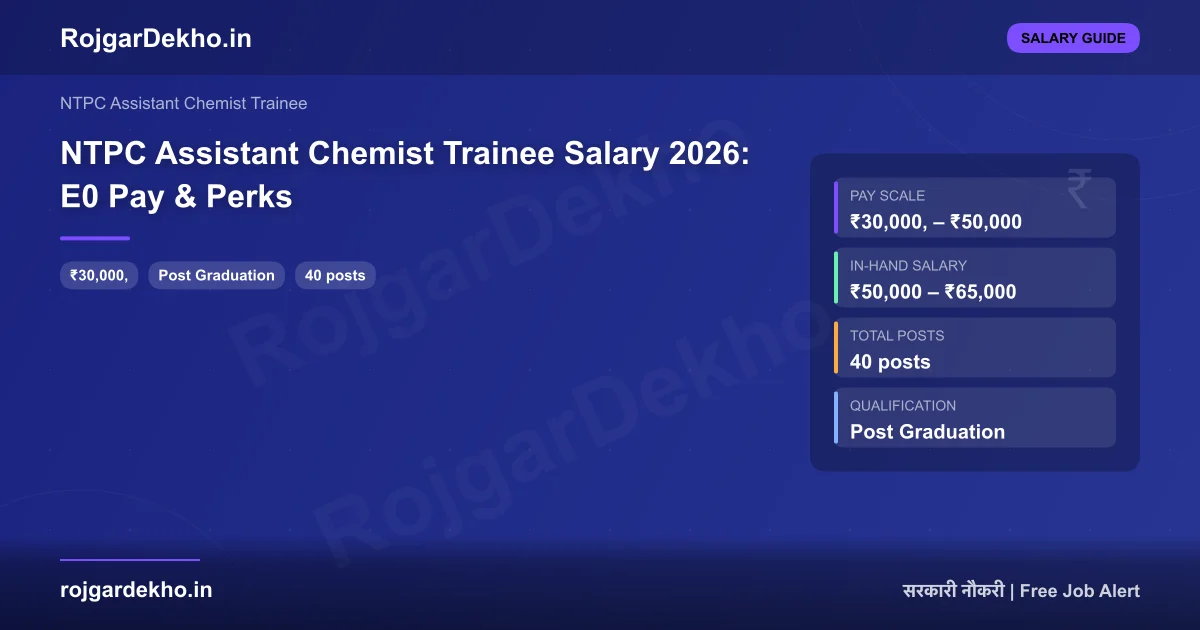
- Pay: E0 grade, basic pay ₹30,000 (pay scale ₹30,000–₹1,20,000).
- With NTPC allowances, the in-hand after training commonly works out to ~₹50,000–₹65,000 a month.
- A prestigious Maharatna PSU career — but note the 1-year training and service bond.
The NTPC Assistant Chemist Trainee (ACT) 2026 recruitment (40 posts) is a highly sought-after opening for M.Sc Chemistry postgraduates, and the pay is a big reason. NTPC is a Maharatna PSU — one of India’s largest and most respected power companies — and it pays on the attractive executive (E-grade) scales rather than clerical pay. This article gives the honest salary picture: the E0 grade basic, the training stipend, a realistic in-hand band, the NTPC perks, the job profile, the training bond, and how the career grows. Figures are based on NTPC’s pay structure; confirm the exact amounts against the official notification.
👉 NTPC Assistant Chemist Trainee Syllabus 2026 — see the online test you clear to reach this pay — and the training bond that comes with it.
The pay scale — E0 grade
An Assistant Chemist Trainee is appointed in NTPC’s E0 grade, with an entry basic pay of ₹30,000 on the pay scale ₹30,000–₹1,20,000. On top of the basic, NTPC pays Dearness Allowance (on the Industrial DA / IDA pattern), and after absorption the standard PSU perks and allowances apply. A rough monthly picture looks like this:
| Component | Approx amount | Note |
|---|---|---|
| Basic Pay (E0 grade) | ₹30,000 | Entry pay on the ₹30,000–₹1,20,000 scale |
| Industrial DA (IDA) | Percentage of basic | Revised periodically (quarterly pattern) |
| Perks & allowances | As per NTPC rules | Cafeteria/other allowances after absorption |
| Approx in-hand (post-training) | ₹50,000–₹65,000 | Varies by location, IDA rate and perks |
Treat the in-hand as an indicative band — it moves with the IDA rate and your posting, and the exact perks apply after you are absorbed into regular service on completing training. The reliable anchor is the E0 basic of ₹30,000; IDA and NTPC’s perks build the rest on top. For a fresh M.Sc Chemistry postgraduate, this is a very strong package — a Maharatna PSU executive salary that few alternatives at the same qualification can match.
The training period and stipend
Assistant Chemist Trainees are recruited into a one-year training period before absorption into regular E0 service. During training you draw pay as per NTPC’s rules for trainees, and on successful completion you are absorbed as a regular executive at E0. This is an important detail to understand honestly: the fuller in-hand and the complete set of PSU perks apply once you are absorbed, while the training year is the stepping stone to it. The one-year training is standard for PSU trainee posts and is well worth it for the career it leads into.
NTPC perks and benefits
- Industrial Dearness Allowance (IDA), revised periodically to offset inflation.
- Provident Fund, gratuity and superannuation/pension benefits.
- Medical facilities for self and family.
- Company accommodation / HRA and other allowances as per NTPC rules.
- A cafeteria of perks and allowances typical of a Maharatna PSU.
- The prestige, stability and growth of a career at India’s largest power producer.
👉 NTPC Assistant Chemist Trainee 2026 — Apply Online (40 Posts) — official notification, dates and the apply link.
The job profile — what an Assistant Chemist does
An Assistant Chemist at NTPC works in the chemistry and laboratory function of a power station. The role involves testing and analysing water, coal, oil, fuel and other materials; monitoring water treatment and chemical processes; ensuring the quality and specifications that keep the plant running safely and efficiently; and maintaining laboratory records and safety standards. It is a hands-on scientific role that puts your M.Sc Chemistry directly to work in a real industrial setting, contributing to the reliable generation of power. For a chemistry postgraduate, it is a genuine science career with the security and scale of a Maharatna PSU behind it.
Career growth at NTPC
NTPC offers a clear executive growth ladder. After absorption at E0, you progress through the executive grades — E1, E2 and upward — over your career through performance and seniority, with the basic pay moving up the scale at each stage and IDA revisions and increments adding to it steadily. NTPC also invests in training and development for its executives. The starting salary, attractive as it already is, understates the lifetime value: a stable, respected, well-paid executive career at India’s largest power producer, with the full set of PSU retirement and medical benefits behind you.
What no other site tells you
Three honest points most pages skip. First, the headline E0 basic of ₹30,000 is not your in-hand — IDA and NTPC’s perks lift the post-absorption in-hand into the ₹50,000–₹65,000 band, so judge the pay by the basic plus the current IDA rate, not a single viral figure. Second, this is a trainee post with a one-year training period and a service bond — you commit to serve NTPC for a fixed period after training, which is standard for PSU trainee roles but something you should factor in before applying. Third, the real value is not just the monthly figure — it is the Maharatna PSU stability, the executive growth ladder, the medical and retirement benefits, and the prestige of NTPC, which together make even the E0 entry one of the best science careers a chemistry postgraduate can target. Go in with clear eyes about the training and bond, and the NTPC Assistant Chemist Trainee post is an excellent, rewarding start.
Frequently Asked Questions
What is the salary of an NTPC Assistant Chemist Trainee?
The post is in the E0 grade with a basic pay of ₹30,000 (scale ₹30,000–₹1,20,000). With Industrial DA and NTPC perks, the in-hand after training commonly works out to roughly ₹50,000–₹65,000 a month.
What is the E0 basic pay?
₹30,000 at entry, on the NTPC pay scale of ₹30,000–₹1,20,000.
Is there a training period?
Yes, Assistant Chemist Trainees undergo a one-year training period before absorption into regular E0 service, and there is a service bond after training.
What perks does NTPC pay?
Industrial DA, Provident Fund, gratuity, medical facilities, company accommodation/HRA and a cafeteria of allowances as per NTPC rules.
What does an Assistant Chemist do?
Tests and analyses water, coal, oil and fuel, monitors water treatment and chemical processes, and maintains laboratory quality and safety standards at a power station.
What is the career growth?
Progression through the executive grades — E0 to E1, E2 and upward — with pay rising at each stage through increments, IDA revisions and promotions.
How the E0 pay grows over a career
One thing worth understanding is how a PSU executive salary compounds over time. The E0 grade is not a flat figure but the entry to a rising ladder: your basic climbs within the ₹30,000–₹1,20,000 scale through annual increments, and on top of that the Industrial DA — a percentage of basic revised on a quarterly pattern — lifts your gross automatically as it rises. Add a promotion from E0 to E1, then E2 and beyond, and the basic jumps to the next grade entirely. Over a decade, this combination of increments, IDA revisions and promotions means the pay you start with substantially understates what you will actually earn, which is exactly why a PSU career should be judged on its trajectory, not its first month.
This is a real difference from many private-sector chemistry roles, where a higher starting figure can stagnate or come with no guaranteed annual growth. In a Maharatna PSU like NTPC, the increment, the IDA revision and the executive promotion ladder are structured and dependable. When you weigh this offer against a private alternative, compare the ten-year picture — pay plus security plus benefits — rather than just the first pay cheque, and the NTPC package stands out clearly.
Understanding your in-hand: basic, gross and net
It helps to read your salary in three layers so the first slip does not confuse you. The basic (₹30,000 at E0) is the anchor. On top come Industrial DA and, after absorption, HRA or company accommodation and a cafeteria of perks, which together build your gross. From the gross, standard deductions — provident fund, and any applicable contributions and taxes — bring it down to your net in-hand. The PF deduction is not money lost: it builds your own retirement corpus. So judge the offer by the basic and the current IDA rate, which are fixed and reliable, rather than by a single viral in-hand figure that varies with your posting, the IDA rate and the perks applicable at your location.
Your posting matters too. NTPC operates power stations across the country, and your accommodation, HRA and some allowances depend on where you are posted. Two chemists in the same E0 grade can therefore take home slightly different amounts purely because of location. This is normal for a PSU with a national footprint, so treat the in-hand as a band rather than a fixed number, and anchor your expectations on the grade and basic that the notification guarantees.
Is the NTPC ACT salary worth it?
For a fresh M.Sc Chemistry postgraduate, the honest verdict is a clear yes — provided you accept the training and bond. A Maharatna PSU executive salary at entry, rising through a structured ladder, backed by PF, gratuity, medical cover and unmatched job security, is among the best a chemistry postgraduate can realistically target. Some private or contract lab roles might offer a comparable or slightly higher starting figure, but few match the stability, the growth and the prestige of an NTPC executive career. Weigh the one-year training and the service bond honestly against that long-term value, and for most candidates the trade is clearly worth it.
The bottom line on pay
In short, the NTPC Assistant Chemist Trainee salary is a strong Maharatna-PSU executive package, anchored by an E0 basic of ₹30,000 and lifted to roughly ₹50,000–₹65,000 in-hand after training by Industrial DA and NTPC’s perks, with higher pay as you rise through E1, E2 and beyond. The full value shows only over time — through guaranteed increments, quarterly IDA revisions, a clear executive ladder, and PF, gratuity and medical benefits behind you. Weigh it as a long-term executive career rather than a single month’s figure, accept the training and bond with open eyes, and it stands among the best science careers a chemistry postgraduate can target.
How NTPC pay compares with other options
A fair question is how the NTPC E0 salary compares with other routes a chemistry postgraduate might take. Against a college or contract lecturer post, or a junior private-lab job, the NTPC package is usually stronger once you account for Industrial DA, PSU perks, job security and the executive growth ladder — a private lab may match the starting figure but rarely the stability or the ten-year trajectory. Against other PSU and government science posts, NTPC sits among the more attractive because it pays on executive E-grades with a Maharatna company behind it. The one genuine trade-off is the training year and the service bond, which some alternatives do not carry — but for the pay, growth and prestige on offer, most candidates find that a fair exchange.
It also helps to remember that the executive grade opens doors beyond pay: the depth of hands-on laboratory and plant-chemistry expertise you build at NTPC is valued across the power and process industries, and the NTPC name on your record carries real weight. So the E0 salary is only the visible part of the package — the experience, the growth and the standing that come with it are a large part of why the post is worth targeting.
For a chemistry postgraduate weighing where to build a career, the NTPC Assistant Chemist Trainee post offers a rare combination of a strong executive salary, genuine scientific work, and the lifelong security of a Maharatna PSU — a package that is well worth the training year and bond it asks in return.
📌 Related on RojgarDekho: