Central Govt vs State Govt Salary Comparison 2026
Many aspirants assume that a central government job always pays more than a state government job. The reality is more nuanced. The pay level structure is similar on paper — many states have adopted 7th Pay Commission recommendations. But the actual take-home salary differs significantly based on Dearness Allowance (DA) rates, HRA percentages, state-specific allowances, and whether the state has implemented the 7th Pay Commission fully or modified it.
This article breaks down the real differences so you can make an informed comparison between central and state government job offers.
The Common Ground: Pay Levels and Basic Pay
The central government uses the 7th Pay Commission pay matrix with 18 levels (Level 1 through Level 18). Most major states have adopted a broadly similar structure, though some use modified matrices. For an accurate comparison, the base starting point is:
- Level 1 (MTS equivalent): Central — Rs. 18,000 basic pay
- Level 4 (Stenographer/LDC type): Central — Rs. 25,500 basic pay
- Level 6 (Head Constable/Junior Clerk type): Central — Rs. 35,400 basic pay
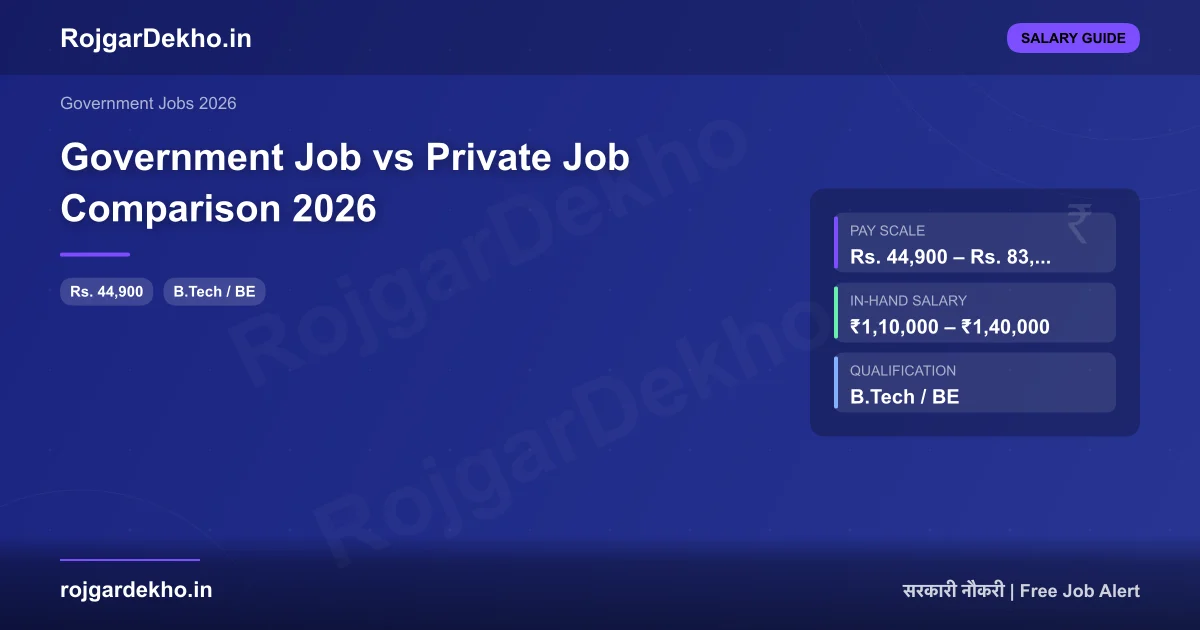
- Level 7 (Inspector/Section Officer entry): Central — Rs. 44,900 basic pay
- Level 8 (ASO type): Central — Rs. 47,600 basic pay
State governments using the 6th Pay Commission equivalent (many smaller or less prosperous states) have lower basic pays. UP and Bihar, for example, have not fully adopted 7th Pay Commission levels for all posts.
Dearness Allowance (DA): The Critical Differentiator
This is where the biggest gap between central and state government salaries emerges. DA is revised twice a year — in January and July — based on the AICPI (All India Consumer Price Index).
As of early 2026:
- Central Government DA: 53% of basic pay (revised and updated promptly)
- UP State Government DA: Typically 3–6 months behind central DA revisions, often at 46–50%
- Bihar State Government DA: Often further behind, at 42–47%
- Rajasthan/MP: Usually 2–4 installments behind central, at 46–50%
- Delhi State Government: Typically matches or is close to central (48–52%)
- Maharashtra: Among better states, usually 1–2 installments behind (50–52%)
On a Level 7 post with basic pay of Rs. 44,900: central DA at 53% = Rs. 23,797 extra per month. Bihar DA at 44% = Rs. 19,756 extra per month. That is a Rs. 4,000 per month difference purely from DA — and this gap compounds over decades.
HRA (House Rent Allowance): City Classification Matters
Under the central government, HRA is based on city classification:
- X cities (population 50 lakh+): 27% of basic pay (Delhi, Mumbai, Chennai, Kolkata, Bengaluru, Hyderabad)
- Y cities (population 5–50 lakh): 18% of basic pay
- Z cities (others): 9% of basic pay
A central government employee in Delhi gets HRA of 27% × Rs. 44,900 = Rs. 12,123 per month.
State government HRA rates vary, and state capitals are typically classified as Y or modified X. A UP state government employee in Lucknow typically gets HRA at 16–20% of their (often lower) basic pay. In practice, the central government employee in Delhi and the UP state government employee in Lucknow may receive similar absolute HRA amounts — but the central employee's X-city classification gives them an edge in higher-cost cities.
Salary Comparison Table: Level 7 Equivalent Post (2026)
| Component | Central Govt (Delhi, X city) | UP Govt (Lucknow) | Bihar Govt (Patna) | Rajasthan Govt (Jaipur) | MP Govt (Bhopal) |
|---|---|---|---|---|---|
| Basic Pay | Rs. 44,900 | Rs. 42,600–44,900 | Rs. 40,000–44,900 | Rs. 42,600–44,900 | Rs. 42,600–44,900 |
| DA (approx.) | Rs. 23,797 (53%) | Rs. 20,000–21,000 (47–50%) | Rs. 17,600–19,800 (44–46%) | Rs. 19,170–21,000 (45–50%) | Rs. 19,170–21,000 (45–50%) |
| HRA | Rs. 12,123 (27%) | Rs. 6,800–8,500 (16–20%) | Rs. 6,000–8,100 (15–18%) | Rs. 7,600–8,100 (18–19%) | Rs. 7,600–8,500 (18–20%) |
| TA + Other Allowances | Rs. 3,000–5,000 | Rs. 1,500–3,000 | Rs. 1,200–2,500 | Rs. 1,500–3,000 | Rs. 1,500–3,000 |
| Approx. Gross In-Hand | Rs. 83,000–86,000 | Rs. 70,900–77,400 | Rs. 64,800–75,300 | Rs. 70,870–77,000 | Rs. 70,870–77,400 |
Note: These are estimated figures. Actual amounts vary based on grade pay, specific post, and current DA/HRA rates at time of joining. Deductions (NPS 10%, CGHS/health insurance, income tax) will reduce net take-home by Rs. 8,000–15,000 in most cases.
Why Delhi and Maharashtra State Jobs Can Be Competitive
Delhi government employees follow pay scales that are competitive with central government. Delhi's HRA allowance for state employees in Delhi is effectively similar to central X-city rates since Delhi itself is an X city. Delhi government also has relatively better DA implementation.
Maharashtra's state government jobs in Mumbai offer similar compensation benefits because of the Bombay High Court-monitored compliance with 7th Pay Commission implementation. A Maharashtra state employee in Mumbai can be close to a central government employee in salary terms.
Benefits Comparison: Pension, Medical, Transfer
Pension: Both central and state government employees who joined after 2004 are under NPS. The employer contribution is 14% (central) and varies by state (typically 10–14%). Central government employees get a slightly better NPS employer contribution in most cases.
Medical: Central government has CGHS (Central Government Health Scheme) — well-networked, available in all major cities, cashless facility. State government medical schemes vary considerably. Some states like Maharashtra, UP, and Rajasthan have reasonable RGHS or equivalent schemes. Bihar and smaller states often have weaker medical coverage.
Transfer: Central government employees may be transferred across India — a real disruption for families. State government transfers are within the state. For officers who value staying in one region, state government transfer policy is an advantage.
The Bottom Line
A central government Level 7 job in a major city (Delhi, Mumbai) pays Rs. 8,000–20,000 more per month than a comparable state government Level 7 job in states like UP and Bihar, primarily because of higher DA, better HRA classification, and additional central allowances. The gap is smaller in states like Delhi, Maharashtra, and Kerala that have better salary implementation.
For a detailed comparison of para-military central forces, read our article on BSF CRPF CISF ITBP SSB Salary Comparison 2026. For all government job listings, visit Government Jobs.
Frequently Asked Questions
Is central government DA always higher than state government DA?
Central government DA is revised promptly twice a year and is currently 53% (early 2026). Most state governments are 1–6 installments behind, meaning their effective DA rate is lower. This creates a real salary gap at the same pay level. Delhi and Maharashtra are among the states that track central DA most closely.
Do state government jobs follow the 7th Pay Commission?
Most major states have adopted the 7th Pay Commission's basic pay matrix, but some have modified the pay bands or levels. States like UP, Bihar, and Rajasthan have largely implemented it for Group B and above posts, but some Group C and D posts may still be on older pay bands. Always verify the specific pay band for the post you are applying to.
Which state government pays its employees the most?
Kerala, Maharashtra, and Delhi consistently rank among the highest-paying state governments in India. Tamil Nadu and Karnataka are also above average. Bihar, Uttar Pradesh, and Jharkhand tend to be on the lower end relative to living costs, primarily due to delayed DA revisions and lower pay band implementation for some grades.
Is CGHS better than state government medical schemes?
For most employees, CGHS is considered superior because of its national network, cashless facilities at empanelled hospitals, and consistent policy. State schemes vary enormously — Maharashtra's RGHS and Delhi's DGEHS are reasonably comparable to CGHS in those states, but schemes in smaller states often have limited coverage and reimbursement delays.
Does working for the central government mean compulsory postings outside your home state?
For many central government positions — particularly SSC CGL posts in departments like Income Tax, Customs, CBI, etc. — transfer to other states is possible, though most posts within ministries are in Delhi. Field postings (BSF, CRPF, etc.) routinely post officers across India. If you strongly prefer staying near your home state, state government positions offer that stability by definition.