Government Job vs Private Job Comparison 2026: An Honest 35-Year Look
The government job versus private job debate is one of the most emotionally charged career conversations in India — and it is also one of the most poorly argued. Coaching centres oversell government jobs. LinkedIn influencers oversell private tech careers. Neither camp gives you the complete picture.
This article will. We will look at the numbers at age 25, age 35, and age 45 — and give you an honest assessment of the 35-year career value of both paths, including things that salary comparisons usually miss.
Age 25: Private Sector Wins on Take-Home Salary
Let us start with the honest numbers at the starting point.
A government job at 25 (SSC CGL Level 7 type post in Delhi):
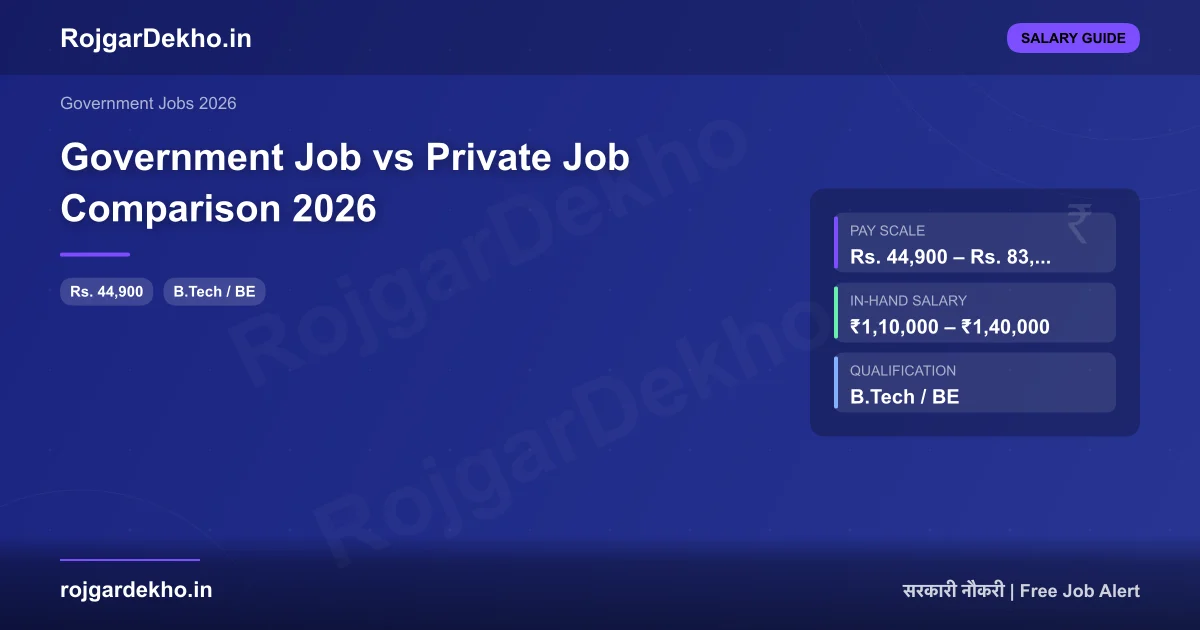
- Basic pay: Rs. 44,900
- Total in-hand (with DA 53%, HRA 27%): approximately Rs. 83,000–87,000 per month
- Annual CTC equivalent: approximately Rs. 10–11 lakh
A private sector IT job at 25 (3–4 years experience, mid-level software engineer in Bengaluru/Hyderabad/Pune):
- Typical CTC: Rs. 10–18 lakh per annum
- In-hand: Rs. 65,000–1,20,000 per month depending on company and role
- Top-quartile performers: Rs. 20–25 lakh CTC by age 25–26
At this stage, a median private IT professional earns more than a government Level 7 officer. A top-quartile private sector professional earns significantly more. The government job is not losing badly at this stage — but it is not winning on salary.
Where the government job wins at age 25: job security (no performance review termination), pension contributions, subsidised housing in government quarters in many cities, CGHS medical coverage, and predictable working hours.
Age 35: Private Sector Still Leads on Salary — But the Gap Narrows in Some Sectors
By age 35, a government employee has had 10 years of service. At Level 7 entry, with annual increments and Time Bound Higher Promotion, they would typically be at Level 8–9, earning approximately:
- Basic pay: Rs. 47,600–53,100
- Total in-hand: Rs. 95,000–1,10,000 per month
By age 35, a private sector professional:
- IT/Tech (manager level): Rs. 25–40 lakh CTC (Rs. 1,65,000–2,65,000 in-hand)
- Banking/BFSI (mid-senior): Rs. 18–30 lakh CTC (Rs. 1,20,000–2,00,000 in-hand)
- Manufacturing/Core Engineering: Rs. 12–20 lakh CTC (Rs. 80,000–1,30,000 in-hand)
- Commerce/Accounting (CA level): Rs. 15–30 lakh CTC
The tech sector private professional at age 35 earns substantially more. However — and this is important — this comparison assumes career progression. Not everyone in private tech reaches manager level by 35. Many stagnate or are pushed out during restructuring (layoffs at age 30–35 are increasingly common in Indian tech companies following global downcycles).
Age 45: The Crossover Begins
This is where the comparison gets genuinely interesting. By age 45, a government employee has 20 years of service:
- If in Group B/C: Level 10–12, in-hand Rs. 1,10,000–1,50,000 per month
- If promoted to gazetted officer (Group A): Level 12–14, in-hand Rs. 1,40,000–1,90,000
- Fully paid-off or heavily subsidised government accommodation in most cases
- CGHS medical coverage for self and family — zero marginal cost at point of use
- No layoff risk whatsoever
Private sector at 45:
- Survived and thriving: Director/VP level in IT = Rs. 60–1,20,000 lakh CTC (Rs. 3,00,000–6,00,000+ in-hand). These people have won — clearly better than government at this stage too.
- Average outcome: Senior Manager level = Rs. 30–50 lakh CTC (Rs. 2,00,000–3,30,000 in-hand). Still ahead of government salary, but now facing corporate politics, performance reviews, and potential restructuring.
- Below-average outcome: Stuck at middle management Rs. 15–25 lakh CTC, facing age bias in hiring and very real layoff risk. Government employee at this stage is ahead on job security and total compensation value.
35-Year Career Value: Comprehensive Comparison Table
| Parameter | Government Job (Group B, Central) | Private Sector (IT/Tech, median) | Private Sector (IT/Tech, top-quartile) |
|---|---|---|---|
| Age 25 monthly in-hand | Rs. 83,000–87,000 | Rs. 65,000–90,000 | Rs. 1,20,000–1,50,000 |
| Age 35 monthly in-hand | Rs. 95,000–1,10,000 | Rs. 1,30,000–1,65,000 | Rs. 2,00,000–3,00,000 |
| Age 45 monthly in-hand | Rs. 1,20,000–1,60,000 | Rs. 1,80,000–2,50,000 | Rs. 3,50,000–6,00,000+ |
| Layoff risk (age 40–55) | Near zero | Moderate (10–25%) | Low-moderate |
| Retirement corpus (NPS/PF) | Rs. 80 lakh–1.5 crore | Rs. 1–3 crore (if disciplined) | Rs. 3–8 crore (if disciplined) |
| Post-retirement monthly income | Rs. 30,000–60,000 (NPS pension + gratuity) | Depends entirely on corpus and investments | Depends entirely on corpus and investments |
| Medical coverage (post-retirement) | CGHS for life (major benefit) | None from employer; must self-fund | None from employer; must self-fund |
| Housing (during service) | Govt quarter or subsidised HRA | Market rent (significant cost) | Market rent (minor cost at senior level) |
| Working hours predictability | High (mostly 9–6, bounded) | Variable (can be high-pressure) | Very high; always on call at senior level |
| Geographic flexibility | Limited (state or all-India service bound) | High (work from anywhere possible) | High |
The Medical and Housing Benefits: What the Salary Table Misses
The salary comparison above understates the real value of government employment in two areas:
Medical: A senior private sector employee at age 50 pays Rs. 30,000–60,000 per year in health insurance premiums for family coverage. At age 60, this rises to Rs. 80,000–1,50,000 per year (assuming no serious illness; with illness, the costs multiply). A retired central government employee on CGHS pays a small annual contribution (around Rs. 500–3,500 depending on pay group) for comprehensive family coverage for life. Over a 20-year retirement, this saving alone can be worth Rs. 20–40 lakh in today's rupee terms.
Housing: A government quarter in Delhi, Mumbai, or Bengaluru — even a Type II or III accommodation — would rent for Rs. 15,000–40,000 per month on the open market. The government employee either pays no rent or a nominal licence fee of a few hundred rupees. Over 30 years of service, this is equivalent to receiving Rs. 50–100 lakh in housing benefit that does not appear on the salary slip.
Leave Policy: Government Still Wins
Central government employees receive:
- 8 Casual Leaves (CL) per year
- 30 Earned Leaves (EL) per year, which accumulate up to 300 days and can be encashed at retirement
- 20 Half Pay Leaves (HPL) per year
- Maternity leave: 180 days (6 months) — significantly more than the 26 weeks legally required of private employers
- Child care leave: 730 days over entire career for women employees
Most private sector companies offer 15–20 days of annual leave. At senior levels (VP and above), private sector employees often have unlimited or liberal leave policies, but middle management typically has limited leave that they feel pressure not to fully use.
The Real Answer: It Depends on Risk Appetite
The government job versus private job debate is ultimately a question about your relationship with risk and certainty.
Choose private sector if:
- You have high risk tolerance and are genuinely excited by the possibility of Rs. 50–100 lakh CTC at age 35–40
- You are in a high-demand technical field (software, data science, product management) where the market rewards skills generously
- You are comfortable managing your own investments, health insurance, and retirement planning
- You want geographic freedom and do not want to be tied to one employer's transfer policies
Choose government if:
- You have lower risk tolerance and value certainty of income over maximum income
- You are the primary financial support for a family and cannot afford a period of unemployment
- You value work-life balance and predictable working hours
- You want the comprehensive post-retirement ecosystem (pension, medical, housing) without having to manage it yourself
- You find meaningful satisfaction in public service work
The honest synthesis: if you are talented and in a high-demand field, private sector will pay you more at every age. But the government job has a risk-adjusted return that is genuinely competitive — especially when you factor in medical, housing, job security, and leave benefits that never appear in salary comparisons.
For government job options based on your qualification level, read our article on Highest Paying Government Jobs After 12th Pass 2026. Browse all current openings at Government Jobs.
Frequently Asked Questions
At what age does a government job become financially better than a private job?
For median performers in both sectors, government job total compensation (salary + benefits) becomes competitive with private sector around age 40–45, particularly when job security, medical coverage, and housing benefits are valued. For top-quartile private sector performers, government never catches up on cash compensation — but those individuals are a small fraction of the workforce.
Is the NPS pension enough for retirement?
It depends on the corpus accumulated. A government employee who contributes to NPS for 35 years (both employee and employer contributions combined at roughly 24% of pay) can expect a retirement corpus of Rs. 80 lakh to Rs. 1.5 crore, which — if annuitised at 6% — provides Rs. 40,000–75,000 per month. Combined with CGHS and a gratuity of Rs. 20–25 lakh, this is a reasonably secure retirement. It is not lavish, but it is not uncertain either.
Do private companies offer any equivalent of pension?
Some large private sector companies (TCS, Infosys, major PSU-like companies) have Gratuity and some have voluntary PF provisions. However, there is no mandatory pension equivalent for private sector employees post-NPS changes. Private sector retirement security entirely depends on personal investment discipline — provident fund, mutual funds, real estate, and personal savings.
What about job satisfaction — is government work boring?
This varies enormously by department and role. Field postings in revenue, forest, police, and social welfare departments involve high-impact, visible work. Desk jobs in routine administrative roles can indeed be monotonous. Similarly, private sector work varies from highly engaging product roles to repetitive IT services work. Neither sector has a monopoly on meaningful or boring work.
Can a government employee leave and join the private sector later?
Yes, there is no bar on resigning from government service. However, the skills built in government — while valuable in public policy and consulting — are not always directly transferable to private sector hierarchies. Someone who spent 15 years in a government department and then seeks a corporate role at 40 may find the transition harder than expected, particularly in sectors with steep technical learning curves.