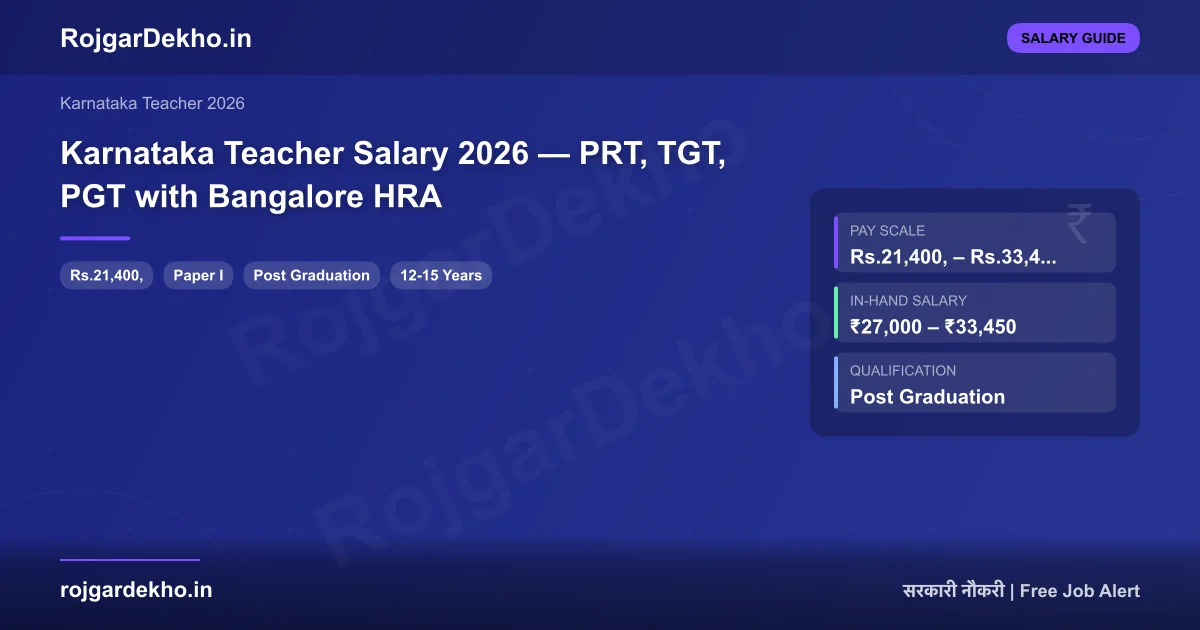
Karnataka is one of the more progressive states when it comes to public education, and its teacher salary structure reflects this commitment. While the state does not match Tamil Nadu or Kerala at every pay level, Karnataka offers some unique advantages — particularly the high HRA for Bangalore postings and a strong promotion pathway for dedicated educators.
This guide breaks down the actual salary structure for PRT, TGT, and PGT teachers in Karnataka government schools, covering the state pay matrix, Bangalore-specific allowances, KTET requirements, and honest comparisons with neighbouring states. If you are preparing for Karnataka teacher recruitment or simply researching your options, this is the complete picture.
Also Read:
Karnataka State Pay Structure for Teachers
Karnataka follows its own state pay revision framework, which was last comprehensively updated after the state's pay commission recommendations. The state aligns broadly with central pay commission principles but has its own pay bands and grade pay structure that result in slightly different numbers compared to central government teachers.
Dearness Allowance in Karnataka is revised periodically by the state government, currently running at approximately 38% of basic pay. This is slightly lower than some other south Indian states like Tamil Nadu (42%), but the difference is partially offset by Karnataka's generous HRA structure for Bangalore postings.
PRT (Primary Teacher) Salary in Karnataka
Primary teachers in Karnataka government schools teach classes 1 to 5. They are recruited through the Karnataka Examinations Authority (KEA) and must hold D.Ed/D.El.Ed qualification along with KTET (Karnataka Teacher Eligibility Test) Paper I clearance.
| Component | Amount (Monthly) |
|---|---|
| Basic Pay (starting) | ₹21,400 |
| Dearness Allowance (DA ~38%) | ₹8,132 |
| HRA (Bangalore 27%) | ₹5,778 |
| HRA (District HQ 18%) | ₹3,852 |
| HRA (Other areas 9%) | ₹1,926 |
| City Compensatory Allowance | ₹500-800 |
| Gross Salary (Bangalore) | ₹35,000-37,000 |
| Deductions (NPS/GPF + GIS + PT) | ₹3,500-4,500 |
| Net In-Hand (Bangalore) | ₹31,000-33,000 |
| Net In-Hand (District) | ₹27,000-30,000 |
Karnataka's PRT basic pay of Rs.21,400 is actually the highest among south Indian states at entry level — slightly above Tamil Nadu's Rs.20,600. However, the lower DA rate means the total compensation is roughly comparable.
TGT (Graduate Primary Teacher / Assistant Teacher) Salary
TGT-equivalent teachers in Karnataka handle classes 6 to 10 and are designated as Graduate Primary Teachers or Assistant Teachers depending on the school type. They need a bachelor's degree plus B.Ed and KTET Paper II clearance.
| Component | Amount (Monthly) |
|---|---|
| Basic Pay (starting) | ₹33,450 |
| Dearness Allowance (DA ~38%) | ₹12,711 |
| HRA (Bangalore 27%) | ₹9,032 |
| HRA (District HQ 18%) | ₹6,021 |
| City Compensatory Allowance | ₹500-800 |
| Gross Salary (Bangalore) | ₹55,000-57,000 |
| Deductions | ₹5,500-7,000 |
| Net In-Hand (Bangalore) | ₹48,000-51,000 |
| Net In-Hand (District HQ) | ₹43,000-46,000 |
Bangalore postings command the highest HRA in Karnataka at 27% of basic pay — which is actually higher than Chennai's 24% in Tamil Nadu. For TGT teachers, this translates to over Rs.9,000 per month in HRA alone for Bangalore postings.
PGT (Post Graduate Teacher / Lecturer) Salary
PGT teachers in Karnataka handle classes 11 and 12 in Pre-University Colleges (PUC). They are often designated as Lecturers rather than PGT, and require a postgraduate degree plus B.Ed. The salary structure is the most attractive for experienced professionals considering a teaching career.
| Component | Amount (Monthly) |
|---|---|
| Basic Pay (starting) | ₹40,900 |
| Dearness Allowance (DA ~38%) | ₹15,542 |
| HRA (Bangalore 27%) | ₹11,043 |
| HRA (District HQ 18%) | ₹7,362 |
| Gross Salary (Bangalore) | ₹67,000-69,000 |
| Deductions | ₹7,000-9,000 |
| Net In-Hand (Bangalore) | ₹58,000-62,000 |
| Net In-Hand (District HQ) | ₹53,000-56,000 |
Karnataka's PGT basic pay of Rs.40,900 is lower than Tamil Nadu's Rs.47,600, and this gap is not fully compensated by the higher Bangalore HRA. At the PGT level, Tamil Nadu pays approximately Rs.6,000-8,000 more per month in take-home salary. This is worth noting if you are deciding between the two states.
Bangalore Posting — The HRA Advantage
Bangalore is classified as an X category city for HRA purposes, commanding a 27% HRA rate — one of the highest in south India. For teachers posted in Bangalore, this significantly boosts take-home pay.
- PRT in Bangalore: HRA Rs.5,778 per month
- TGT in Bangalore: HRA Rs.9,032 per month
- PGT in Bangalore: HRA Rs.11,043 per month
However, Bangalore is also one of the most expensive cities in India for housing. A teacher with Rs.11,043 HRA would still need to add a significant amount from their own pocket for decent accommodation in Bangalore. In contrast, a teacher posted in a smaller city like Mysuru or Hubli can find comfortable housing within the HRA amount.
Rural Posting Allowance
Karnataka provides a rural posting allowance for teachers serving in villages and remote areas. This compensates for the lower HRA and the inconvenience of rural postings.
- Rural Allowance: Rs.1,000-2,500 per month depending on remoteness classification
- Tribal Area Allowance: Rs.2,000-3,500 per month for postings in scheduled tribal areas
- Incentive Marks: Rural service gives weightage in departmental promotions
While the monetary amount is modest, rural postings offer a lower cost of living, less competition for promotions, and earn you preference points that accelerate career growth.
KTET — Karnataka Teacher Eligibility Test
KTET is mandatory for all government school teaching positions in Karnataka. The test is conducted by the Department of Public Instruction, Karnataka.
- KTET Paper I: For classes 1-5 (PRT level) — tests child development, language, mathematics, and environmental studies
- KTET Paper II: For classes 6-8 (TGT level) — tests child development, language, and subject-specific knowledge
- KTET Paper III: For classes 9-10 — subject expertise at higher level
- Validity: KTET certificate is valid for 7 years from the date of passing
- Minimum Qualifying Marks: 60% (55% for reserved categories)
Kannada Medium Preference
Karnataka gives a strong preference to Kannada medium instruction in government schools. The state's education policy prioritizes Kannada as the medium of instruction at the primary level, which means several important things for aspiring teachers.
- Most PRT vacancies are for Kannada medium schools — English medium government schools are limited
- Proficiency in Kannada is effectively mandatory for government school teaching at the primary level
- At TGT and PGT levels, English medium positions exist but are fewer in number
- The KTET exam has a Kannada language component
For non-Kannada speakers considering Karnataka teaching posts, TGT and PGT positions in English medium schools are the more realistic options. PRT positions overwhelmingly require Kannada fluency.
Karnataka vs Tamil Nadu vs Kerala — Which State Pays Better?
Let me give you an honest comparison. At the PRT level, Karnataka's basic pay (Rs.21,400) is the highest among the three states, but Tamil Nadu's higher DA rate equalizes the total. At TGT level, Tamil Nadu leads (Rs.36,200 vs Karnataka's Rs.33,450). At PGT level, Tamil Nadu leads significantly (Rs.47,600 vs Rs.40,900).
However, for Bangalore-based postings, Karnataka's 27% HRA partially compensates for the lower basic pay. A TGT in Bangalore and a TGT in Chennai would have roughly similar take-home pay despite the basic pay difference.
The real advantage of Tamil Nadu is at the PGT level, where TN's basic pay is Rs.6,700 higher than Karnataka's. Over a career, this compounds significantly with annual increments and DA revisions.
Career Growth for Karnataka Teachers
- PRT to Graduate Teacher: With additional degree + B.Ed, promotion after 5-8 years
- Graduate Teacher to PGT/Lecturer: With postgraduate degree, promotion after 5-8 years
- PGT to Headmaster/Principal: After 12-15 years of distinguished service
- Administrative roles: BEO (Block Education Officer), DDPI (Deputy Director of Public Instruction)
Promotions in Karnataka follow a combination of seniority and departmental examination performance. Teachers who clear the departmental exam early can accelerate their promotion timeline significantly.
Frequently Asked Questions
What is the starting salary for a government teacher in Karnataka?
PRT starts at Rs.21,400 basic (in-hand Rs.27,000-33,000 depending on city). TGT starts at Rs.33,450 basic (in-hand Rs.43,000-51,000). PGT starts at Rs.40,900 basic (in-hand Rs.53,000-62,000). Bangalore postings receive the highest HRA at 27% of basic.
Is KTET mandatory for Karnataka teacher recruitment?
Yes. KTET (Karnataka Teacher Eligibility Test) is mandatory for all government school teaching positions. You must clear the relevant paper before applying for teaching posts. KTET is valid for 7 years from the date of passing.
How does Karnataka teacher salary compare with Tamil Nadu?
At PRT level, they are roughly comparable. At TGT level, Tamil Nadu pays Rs.2,750 more in basic pay. At PGT level, Tamil Nadu leads by Rs.6,700 in basic pay. Karnataka's higher Bangalore HRA (27% vs Chennai's 24%) partially offsets this, but overall Tamil Nadu pays more, especially at senior levels.
Do Karnataka teachers get pension?
Teachers recruited after 2006 in Karnataka are covered under NPS (National Pension System). Teachers recruited before 2006 receive the old pension scheme. The state has faced pressure to restore OPS, but as of 2026, NPS continues for newer recruits.
Can non-Kannada speakers apply for Karnataka teacher posts?
Technically yes, but practically it is difficult for PRT positions which are overwhelmingly Kannada medium. TGT and PGT positions in English medium schools are more accessible for non-Kannada speakers. However, basic Kannada proficiency is expected in most government interactions.
What is the retirement age for government teachers in Karnataka?
The retirement age is 60 years for government school teachers in Karnataka. After retirement, benefits include pension (OPS or NPS), gratuity, and provident fund. A PGT retiring with 30+ years of service can expect a total retirement corpus of Rs.45-70 lakhs.