If you are preparing for the Chhattisgarh Teacher Recruitment 2026, the salary question is probably one of the first things on your mind — and rightly so. Teaching in a government school in Chhattisgarh is not just about job security. The pay, allowances, and long-term career trajectory make it one of the better government jobs in the state, especially when you factor in postings in tribal areas that come with additional financial benefits.
In this article, we break down the salary for all three teaching levels — PRT, TGT, and PGT — along with how DA, HRA, and the Chhattisgarh-specific tribal area allowance work in practice. We also compare this with private school salaries in CG so you have full context. Want to explore all current teaching jobs in Chhattisgarh? Check here: All Government Jobs 2026 →
The CG State Pay Matrix — How It Works
Chhattisgarh follows the Seventh Pay Commission structure adopted at the state level. Every government employee is placed in a Pay Level (1 through 18), and within that level there are multiple cells that increase with each annual increment. Teachers fall into three distinct pay levels depending on their designation:
- PRT (Primary Teacher / Assistant Teacher Class I–V) — Pay Level 2
- TGT (Trained Graduate Teacher / Assistant Teacher Class VI–VIII) — Pay Level 4
- PGT (Post Graduate Teacher / Lecturer Class IX–XII) — Pay Level 6
Your actual take-home salary depends on three things layered on top of this basic pay: the Dearness Allowance (DA), the House Rent Allowance (HRA) based on your posting city, and any special allowances applicable to your location. Let's go level by level.
PRT Salary 2026 — Primary Teacher (Class 1–5)
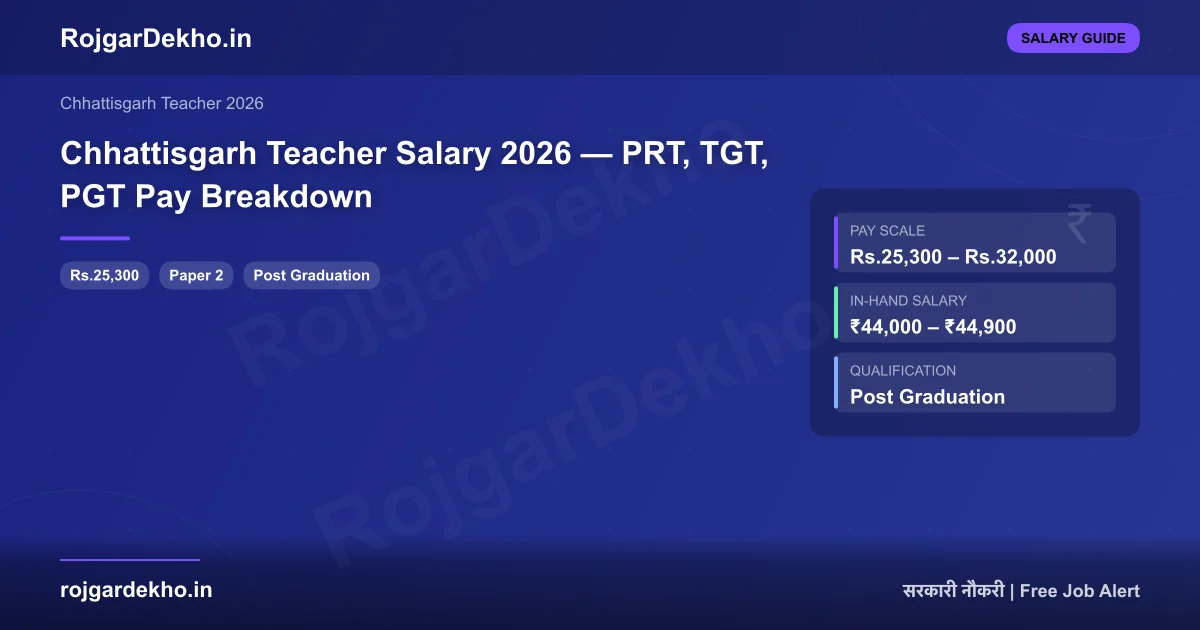
A newly appointed PRT in Chhattisgarh starts at Pay Level 2, Cell 1 — basic pay Rs.25,300 per month. This is the starting cell. With each passing year, you move one cell higher, increasing your basic pay by roughly 3% per increment.
Here is what the monthly salary looks like at the time of joining:
- Basic Pay: Rs.25,300
- DA (currently ~42% of basic): Rs.10,626
- HRA: Rs.2,030 (8% for non-classified / small district posting) to Rs.4,554 (18% for Raipur/Bilaspur X/Y city)
- Medical Allowance: Rs.500 (approximate)
- Gross Salary: approx. Rs.38,000–42,000 (Raipur) or Rs.32,000–36,000 (rural/small district)
- Deductions (NPS 10% + other): Rs.3,000–4,500
- In-hand (take-home): Rs.32,000–38,000 depending on posting location
The HRA difference between a Raipur posting and a remote district posting is meaningful — roughly Rs.2,500 per month. However, remote district postings often come with the tribal area allowance, which can more than compensate for this difference (more on this below).
TGT Salary 2026 — Trained Graduate Teacher (Class 6–8)
TGT is the mid-level teaching post and requires graduation + B.Ed + CG TET Paper 2 pass. The pay structure is significantly better than PRT:
- Basic Pay (Pay Level 4, starting cell): Rs.35,400
- DA (~42%): Rs.14,868
- HRA: Rs.2,832 (8%) to Rs.6,372 (18%)
- Gross: approx. Rs.52,000–56,000 (Raipur) or Rs.44,000–48,000 (rural)
- Deductions: Rs.4,500–5,500
- In-hand: Rs.44,000–52,000
Over a 10-year career, a TGT's basic pay grows to approximately Rs.44,900 (they start catching up to where a fresh PGT begins). Annual increments compound meaningfully over time.
PGT Salary 2026 — Post Graduate Teacher / Lecturer (Class 9–12)
PGT is the senior teaching position requiring post-graduation + B.Ed. It is placed at Pay Level 6, the same level as many Group B state government officers:
- Basic Pay (Pay Level 6, starting cell): Rs.44,900
- DA (~42%): Rs.18,858
- HRA: Rs.3,592 (8%) to Rs.8,082 (18%)
- Gross: approx. Rs.64,000–70,000 (Raipur) or Rs.55,000–60,000 (rural)
- Deductions: Rs.5,500–7,000
- In-hand: Rs.55,000–65,000
Post-wise Salary Comparison Table
| Post | Pay Level | Basic Pay | In-hand (Raipur) | In-hand (Rural) |
|---|---|---|---|---|
| PRT (Class 1–5) | Level 2 | Rs.25,300 | Rs.35,000–38,000 | Rs.32,000–35,000 |
| TGT (Class 6–8) | Level 4 | Rs.35,400 | Rs.48,000–52,000 | Rs.44,000–47,000 |
| PGT / Lecturer (Class 9–12) | Level 6 | Rs.44,900 | Rs.60,000–65,000 | Rs.55,000–59,000 |
DA Calculation — How Dearness Allowance Works
DA is revised twice a year by the central government (January and July), and Chhattisgarh typically follows suit with a small delay. As of early 2026, DA stands at approximately 42% of basic pay for state government employees following the Seventh Pay Commission scale.
This means a PRT with basic Rs.25,300 gets DA of Rs.10,626. A PGT with basic Rs.44,900 gets DA of Rs.18,858. DA is not taxed the same way as salary, and it is a significant chunk of your gross — roughly 30% of your total gross pay comes from DA alone at current rates.
HRA — City Classification in Chhattisgarh
Chhattisgarh classifies cities for HRA purposes into three tiers. Here is how it maps for state teachers:
- X/Y Cities (Raipur, Bilaspur, Durg-Bhilai, Korba) — HRA at 18% of basic
- Z Cities and district headquarters — HRA at 12% of basic
- Rural / unclassified areas — HRA at 8% of basic
The vast majority of CG government school postings are in rural areas or small towns, so most teachers receive HRA at 8–12%. This is worth knowing before you calculate your expected take-home.
Tribal Area Allowance — Chhattisgarh's Unique Benefit
This is what makes CG teacher jobs genuinely interesting from a financial standpoint. Approximately 44% of Chhattisgarh's land area falls under Schedule V tribal zones, and government employees posted in these areas receive a special Tribal Area Allowance.
The allowance ranges from Rs.1,200 to Rs.3,000 per month depending on the remoteness of the area (classified as normal tribal area vs. scheduled tribal area vs. difficult/remote tribal area). While the posting may be in a remote location with lower HRA, the tribal area allowance often more than compensates for this. In practice, many teachers posted in tribal districts of Bastar, Surguja, Dantewada, or Kondagaon end up with a higher total package than their counterparts posted in Raipur.
NPS Pension — What to Expect at Retirement
Teachers recruited from 2004 onwards in Chhattisgarh fall under the National Pension System (NPS) rather than the old defined-benefit pension. Here is how NPS works for CG teachers:
- Employee contribution: 10% of (Basic + DA) deducted from salary
- Government contribution: 14% of (Basic + DA) added to your corpus
- The combined 24% accumulates over 30 years in a market-linked fund
- At retirement (age 60), you can withdraw 60% as a lump sum (tax-free) and must use 40% to buy an annuity (monthly pension)
For a PRT who joins at Rs.25,300 basic and retires after 33 years, the NPS corpus can realistically reach Rs.1–1.5 crore depending on investment returns (assuming 8–10% average annual growth). The monthly annuity would be approximately Rs.15,000–25,000. It is not as generous as the old pension, but it is still meaningful retirement security.
Summer and Winter Vacation — The Invisible Salary Benefit
Government school teachers in Chhattisgarh get roughly 60–65 days of summer vacation (May–June) and about 15–20 days of winter vacation (December–January). Unlike private sector employees, you receive full pay during these holidays. When you calculate the effective hourly compensation, a government teacher's package becomes even more attractive compared to corporate roles.
CG Government Teacher vs Private School — The Real Comparison
Let's be honest about why government teaching is so sought after in Chhattisgarh. Private schools in the state pay extremely poorly:
- Private school PRT salary in CG: Rs.5,000–10,000/month (most unaided schools)
- Private school TGT salary: Rs.8,000–14,000/month
- Private school PGT salary: Rs.12,000–20,000/month (top city schools only)
- No DA, no HRA structure, no NPS, no job security, no paid vacation
The gap between government and private is 3x to 5x at the entry level alone. This is why competition for CG teacher vacancies is intense — thousands of candidates compete for a few hundred posts each cycle.
Career Growth: Teacher to DEO
Government teaching in Chhattisgarh is not a dead-end job. The promotion ladder looks like this:
- Assistant Teacher (PRT/TGT) → Headmaster (after 8–10 years, departmental promotion)
- Headmaster → Block Education Officer (BEO) (by promotion or direct recruitment)
- BEO → District Education Officer (DEO) (senior Gazetted Officer equivalent)
- DEO → Joint Director / Director of Public Instruction (IAS-equivalent admin level)
PGT/Lecturers have a parallel track: Lecturer → Senior Lecturer → Principal (Class 11–12 school) → Principal (Higher Secondary) → administrative positions.
A 30-year government teaching career in Chhattisgarh, starting at Rs.25,300 basic and ending near Rs.80,000–90,000 basic (with increments and promotions), generates a cumulative earning of approximately Rs.1.5–2 crore in salary alone, plus NPS corpus, gratuity (Rs.20 lakh maximum under current rules), and leave encashment. That is a very solid financial lifetime for someone starting with a D.El.Ed or B.Ed degree.
Want to apply for teaching jobs in Chhattisgarh?
Browse all active government teacher vacancies here: RojgarDekho — Government Jobs 2026 →
Frequently Asked Questions
What is the starting salary of a PRT in Chhattisgarh?
A newly appointed PRT in Chhattisgarh gets a basic pay of Rs.25,300 at Pay Level 2 Cell 1. With DA at 42% and HRA, the gross salary comes to approximately Rs.38,000–42,000 (Raipur posting) and the in-hand take-home is roughly Rs.32,000–38,000 after NPS deduction. This increases with annual increments every year.
What is the salary difference between TGT and PGT?
TGT starts at basic pay Rs.35,400 (Pay Level 4) with an in-hand salary of around Rs.44,000–52,000. PGT starts at basic pay Rs.44,900 (Pay Level 6) with an in-hand salary of around Rs.55,000–65,000. The gap at entry level is approximately Rs.10,000–15,000 per month. Over a full career, the PGT path results in significantly higher cumulative earnings.
How does CG teacher salary compare with MP teacher salary?
Madhya Pradesh and Chhattisgarh both follow the Seventh Pay Commission structure at the state level, so the basic pay scales are similar. However, Chhattisgarh has an edge in one specific way: the tribal area allowance, which applies to a large number of postings given CG's geography. An MP teacher posted in a non-tribal area may earn slightly more in HRA (if posted in a larger city), but a CG teacher in a tribal district can often match or exceed the MP total package.
Do teachers posted in tribal areas of CG get extra pay?
Yes. The Chhattisgarh government provides a Tribal Area Allowance ranging from Rs.1,200 to Rs.3,000 per month for teachers posted in Schedule V tribal areas. Since around 44% of CG's area is under tribal jurisdiction — including districts like Bastar, Dantewada, Bijapur, Surguja, and Kondagaon — this allowance applies to a large number of postings. It partially offsets the lower HRA that rural postings receive.
When does a government teacher get promoted in Chhattisgarh?
Promotion timelines vary by department rules and vacancy availability. Generally, a PRT with a good service record can be considered for Headmaster after approximately 8–12 years of service. TGT and PGT teachers have separate promotion tracks. Additionally, the state runs departmental promotion exams periodically, and teachers with certain qualifications can appear for direct recruitment to higher posts like Block Education Officer (BEO) without waiting for seniority-based promotion.
📌 Related on RojgarDekho:
Frequently Asked Questions
What is the in-hand salary of a Chhattisgarh Sahayak Shikshak after regularisation?
After regularisation, a Sahayak Shikshak in Chhattisgarh is placed in Level 6 (Rs.35,400 basic pay). With DA at 46%, HRA at 8%, and other allowances, the gross salary comes to approximately Rs.58,000–Rs.65,000 per month. After NPS deduction (~Rs.5,400), the net in-hand salary is approximately Rs.52,000–Rs.59,000. Teachers posted in tribal districts (Bastar, Dantewada, Bijapur, etc.) additionally receive a tribal area allowance of 10% of basic pay, taking in-hand to Rs.56,000–Rs.63,000.
How long does regularisation take for Sahayak Shikshak in Chhattisgarh?
The standard probation and regularisation period for Sahayak Shikshak in Chhattisgarh is 3 years of satisfactory service. During probation, the salary is at the Sahayak Shikshak scale. Upon regularisation, pay is revised to the regular teacher pay scale with retrospective effect from the joining date. In practice, regularisation paperwork can take 1–2 years beyond the 3-year service period due to administrative processes, but the arrears are paid once regularisation is completed.
Is Chhattisgarh teacher salary better than private school salary in Raipur?
Significantly better for most candidates. A government primary teacher in Chhattisgarh earns Rs.45,000–Rs.52,000 in-hand (after regularisation) with complete job security, pension through NPS, medical benefits, and earned leaves. A private school teacher in Raipur at an average school typically earns Rs.15,000–Rs.28,000 per month with no job security and limited benefits. Only the top private schools in Raipur (DPS, Ryan International) pay Rs.35,000+, and competition for those positions is intense.