You've Watched Crime Shows. Now Here's the Real Job — MP Forensic Science Lab Is Hiring 126 People and Most Science Graduates Have Zero Idea
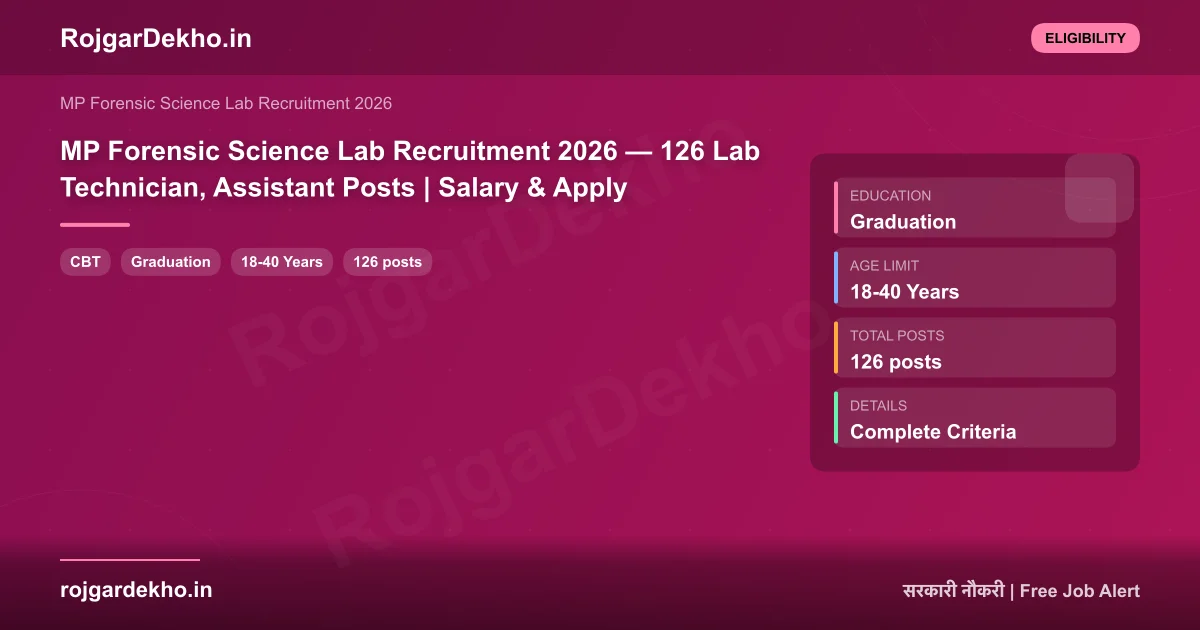
You've watched crime shows. The people who analyze blood samples, match fingerprints, and test chemical evidence in real criminal cases — those are forensic lab technicians. And MP Forensic Science Laboratory is hiring 126 of them. Last date: 6 April 2026. Application fee: Zero. Most science graduates have no idea this recruitment exists.
That's genuinely baffling to me. This is a state government job with real forensic science work — actual DNA profiling, actual toxicology, actual ballistics analysis — and people are out here preparing for SSC CGL for the fourth year in a row. The MPSFL recruitment is sitting there, quiet, with barely a fraction of the competition of a central government exam. Wild.
Let's fix that. Everything about MPSFL 2026 — posts, salary, eligibility, what the actual work is, how to apply. All of it, right here.
Quick Overview
| Detail | Info |
|---|---|
| Organisation | MP Forensic Science Laboratory (MPSFL), Government of Madhya Pradesh |
| Total Posts | 126 |
| Post Names | Lab Technician, Lab Assistant, Lab Attendant |
| Last Date to Apply | 6 April 2026 |
| Application Fee | ZERO (₹0) |
| Apply Mode | Online via mponline.gov.in |
| Job Location | Madhya Pradesh (Bhopal HQ + regional labs across MP) |
| Age Limit | 18 to 40 years |
| Domicile | MP domicile required |
Post-wise Vacancy Breakdown
Three categories. Very different eligibility levels. Check which one fits you before reading any further.
| Post Name | Approximate Vacancies | Pay Level | Basic Pay |
|---|---|---|---|
| Lab Technician | ~80 posts | Level 7 | ₹28,700 basic |
| Lab Assistant | ~30 posts | Level 5 | ₹19,900 basic |
| Lab Attendant | ~16 posts | Level 1 | ₹15,000 basic |
Lab Technician at Level 7 — that's the same pay level as an SSC CGL Inspector. For a state recruitment with this little competition? Genuinely impressive. If you have a B.Sc in Chemistry, Biology, or Forensic Science and you haven't looked at this vacancy yet, that's a real miss.
Eligibility — Who Can Apply
Each post has its own qualification requirement. No crossover — check carefully.
| Post | Educational Qualification | Age |
|---|---|---|
| Lab Technician | B.Sc in Chemistry / Biology / Forensic Science (or related science discipline) | 18–40 years |
| Lab Assistant | 12th pass with Science stream (PCB or PCM) | 18–40 years |
| Lab Attendant | 10th pass (Matric) | 18–40 years |
MP domicile is mandatory for all three posts. Non-MP candidates cannot apply. Age relaxation applies to reserved category candidates as per MP government rules — OBC, SC, ST get standard relaxation. Check the official notification for exact category-wise details before assuming anything.
Salary — Let's Be Honest About the Numbers
Basic pay is one thing. In-hand salary is what actually hits your account. Here's a realistic breakdown after standard deductions (DA, HRA, TA included; GPF and NPS subtracted).
| Post | Pay Level | Basic Pay | Estimated In-Hand (Monthly) |
|---|---|---|---|
| Lab Technician | Level 7 | ₹28,700 | ₹42,000 – ₹48,000 |
| Lab Assistant | Level 5 | ₹19,900 | ₹30,000 – ₹35,000 |
| Lab Attendant | Level 1 | ₹15,000 | ₹22,000 – ₹26,000 |
A B.Sc graduate getting a Level 7 government job — that's rare. Private diagnostic labs and testing companies pay chemistry or biology graduates ₹15,000 to ₹20,000 a month. Government forensic lab pays ₹42,000+. Do the math. And that's before you count pension, job security, government medical benefits, and the fact that your salary goes up every year whether the economy is doing well or not.
What Does MPSFL Actually Do — and Why It's Fascinating
This is the part most recruitment articles skip entirely. They'll list the posts and salary and leave you with no idea what you're actually getting into. So let's fix that.
The MP Forensic Science Laboratory is the scientific backbone of criminal justice in Madhya Pradesh. Every major criminal case in the state — murder, rape, fraud, drug trafficking, cybercrime — the physical evidence goes through MPSFL labs. Judges and courts depend on their reports. Police cannot file charge sheets in serious crimes without forensic analysis from a certified lab. That's MPSFL.
Here's what the divisions actually do:
DNA Profiling: Blood, saliva, hair, skin cells. DNA extracted from crime scenes gets matched against suspect samples or national databases. The techniques are the same ones you read about in science journals — PCR amplification, STR analysis. This is real molecular biology, not a classroom exercise.
Fingerprint Examination: Lifted prints from crime scenes compared against suspect databases. Latent print development — the powders and chemicals you've seen in shows — that's exactly what happens here. Except the results go to court as legal evidence.
Ballistics: Bullet trajectory analysis, weapon identification, gunshot residue testing. When a body is found with a gunshot wound, ballistics determines the weapon type, firing distance, and sometimes narrows down the shooter's position. Genuinely complex physics and chemistry combined.
Toxicology: Poison detection. Drug identification. Alcohol analysis. If someone dies under suspicious circumstances and poison is suspected, the samples go to toxicology. The division uses gas chromatography, mass spectrometry — equipment that costs crores — to identify exact compounds at trace levels.
Document Examination: Forged signatures, altered documents, fake currency, questioned handwriting. This division handles banking fraud cases, property dispute cases, and government document forgery. The work involves microscopy, chemical analysis, and UV examination of ink and paper.
Cyber Forensics: The newest and fastest-growing division. Data recovery from seized phones, laptops, and hard drives. Tracing digital footprints. Analyzing encrypted communications. This is where forensic science meets the current decade.
Every major criminal case in MP — murder, rape, fraud, drug cases — evidence goes through MPSFL labs. This is real CSI work. Not the dramatic 45-minute version with perfect lighting, obviously. The actual painstaking, methodical version that actually holds up in court. Which, if you ask me, is even more interesting.
Zero Fee — The Part That Should Remove Every Excuse
Zero. Nothing. ₹0.
In a country where every government recruitment charges ₹500 to ₹1,000 as application fee — sometimes more — MPSFL charges nothing at all. No general category fee. No OBC fee. No woman candidate fee. Zero across the board.
The financial barrier to applying is literally nonexistent. You need internet access and a valid email ID. That's it. There is genuinely no reason not to apply if you meet the eligibility criteria. None. The cost of not applying is potentially a missed government job. The cost of applying is zero rupees and maybe ninety minutes to fill out an online form.
Selection Process — What You Actually Need to Prepare
MPSFL uses a multi-stage selection process. It's not just a written exam and done — which makes sense, given that forensic work is genuinely practical.
| Stage | Details |
|---|---|
| Stage 1 | Written Exam (Computer Based Test / CBT) — General Science, Reasoning, Subject Knowledge |
| Stage 2 | Practical / Lab Test — actual hands-on assessment in a laboratory setting |
| Stage 3 | Document Verification (DV) |
| Stage 4 | Medical Examination |
The Lab Technician practical test actually tests real lab skills. Microscopy, chemical testing, sample handling, basic analytical procedures. If you have a B.Sc background with lab work experience, this is your advantage — most competitive exam candidates who cleared the written test on theory alone will struggle here. The practical stage is genuinely separating, and it's a stage that rewards people who actually know what they're doing in a lab.
How to Apply — Step by Step
Applications go through the Madhya Pradesh Online portal. Here's the process:
Step 1: Go to mponline.gov.in — the official MP government recruitment portal.
Step 2: Find the MPSFL 2026 recruitment notification. Look under "Recruitment" or "Latest Jobs." If you can't find it on the homepage, search "Forensic Science Laboratory" in the portal's search bar.
Step 3: Register with your mobile number and email ID. Keep both active — OTPs and notifications will come here throughout the process.
Step 4: Fill in personal details, educational qualifications, domicile information, and category. Be accurate. Document verification will check everything you enter against originals.
Step 5: Upload scanned copies of required documents — photograph, signature, marksheets, caste certificate (if applicable), domicile certificate.
Step 6: Review everything. Read it twice before submitting. You likely won't be able to edit after final submission.
Step 7: Submit. Download and save the confirmation receipt. Screenshot it. Print it if you want to be safe.
No fee payment step because there is no fee. Genuinely one of the simpler application processes for a government job.
MPSFL vs Private Lab vs Other Government Jobs — Honest Comparison
| Factor | MPSFL Government Job | Private Diagnostic / Testing Lab | SSC / Other Central Govt Exam |
|---|---|---|---|
| Salary (B.Sc graduate) | ₹42,000–48,000 in-hand | ₹15,000–22,000 | ₹35,000–55,000 (varies widely) |
| Job Security | High (state govt employee) | Low to moderate | High (central govt employee) |
| Work Type | Real forensic casework, criminal investigation support | Routine testing, repetitive | Administrative, clerical (usually) |
| Competition Level | Low to moderate (state exam, niche field) | Low (but job quality is lower) | Extremely high (lakhs of candidates) |
| Application Fee | Zero | No fee (private HR process) | ₹100–1000+ |
| Growth Potential | Promotions within MPSFL, seniority-based increments | Depends on company performance | Department promotions, central pay commission benefits |
The competition angle is the real one here. SSC CGL sees 30–50 lakh candidates for roughly 10,000–15,000 posts. MPSFL is a state-level niche recruitment. The candidate pool is dramatically smaller. If you are a B.Sc Chemistry or Forensic Science graduate from MP, this is arguably your best near-term shot at a quality government job — better odds than the central exams by a significant margin.
Also Read:
Frequently Asked Questions
Q1. What is the actual day-to-day work at MPSFL like?
Depends on the division you're posted to. Could be analyzing drug samples, examining fingerprints from a crime scene, running toxicology screens on blood samples, or processing digital evidence from seized devices. It's scientific, methodical work with direct connection to active criminal cases. Not glamorous in the TV sense. Genuinely important in the real sense.
Q2. Can B.Sc graduates apply directly for Lab Technician?
Yes — B.Sc in Chemistry, Biology, or Forensic Science is the qualifying degree for Lab Technician. No additional certification or diploma is required. Your degree is the eligibility. Apply directly.
Q3. Is the fee really zero? No hidden charges?
Zero. As in ₹0. No processing fee, no category fee, no exam fee. The mponline portal may have a nominal portal convenience charge in some cases — check at the time of applying — but the MPSFL recruitment fee itself is nil.
Q4. Are postings only in Bhopal?
No. MPSFL has its headquarters in Bhopal but operates regional labs across Madhya Pradesh. Postings can be at any MPSFL facility in the state. Your actual posting location will depend on vacancy availability and departmental requirements. You cannot choose your posting city.
Q5. Is a government forensic job really better than a private lab job?
For salary, security, and work quality — yes, by a wide margin. Private labs typically pay B.Sc graduates ₹15,000–20,000 with no job security. Government forensic lab starts at ₹42,000+ with pension and permanent employment. The work is also more interesting — private labs do routine diagnostic tests, MPSFL does actual criminal investigation support.
Q6. What does the Lab Technician written exam cover?
The CBT covers General Science (Chemistry, Biology, Physics basics), Reasoning and Aptitude, and subject-specific forensic or science knowledge. Exact syllabus will be in the official notification — always go by that rather than third-party sources. For Lab Technician specifically, chemistry and biology fundamentals are central.
Q7. Is it safe to work at a forensic lab? Do you handle crime scene material?
Lab personnel work with samples — blood, tissue, chemicals, drugs — under strict laboratory safety protocols. You're not going to crime scenes as a Lab Technician or Lab Assistant; you're in a controlled lab environment. Standard PPE and safety procedures apply. It's no more dangerous than working in any analytical chemistry or pathology lab.
Q8. Is MP domicile strictly required? What if I studied in MP but live elsewhere?
MP domicile is required. It's based on your official domicile certificate, not where you currently live or studied. If you are a permanent resident of Madhya Pradesh and have a valid MP domicile certificate, you are eligible. If you don't have one, you are not — regardless of where you completed your education.
📌 Related on RojgarDekho:
📌 Related on RojgarDekho:
What is MP FSL Recruitment 2026?
MP FSL (Forensic Science Laboratory) Recruitment 2026 is conducted by the Madhya Pradesh Police for Lab Technician, Lab Assistant, and Scientific positions at the state forensic science laboratory. The recruitment includes posts in biology, chemistry, physics, ballistics, and document examination divisions. Candidates with B.Sc background can apply through the official MP Police recruitment portal.