Everyone's talking about the NFSU Section Officer post. 12 vacancies. Level 6. Three years of experience required. But while thousands fight over those 12 seats, there are 15 DSO vacancies sitting right next to them — same institution, same career ladder, same campus life — with a lower experience bar. The NFSU Deputy Section Officer post at Pay Level 5 is not a consolation prize. It's a strategic entry point. You join at ₹43,000+ in hand, work the same admin role, and promote to SO via departmental exam in 4-6 years. If SO eligibility is borderline for you right now, DSO is the smarter play. Period.
📋 NFSU DSO 2026 Quick Status
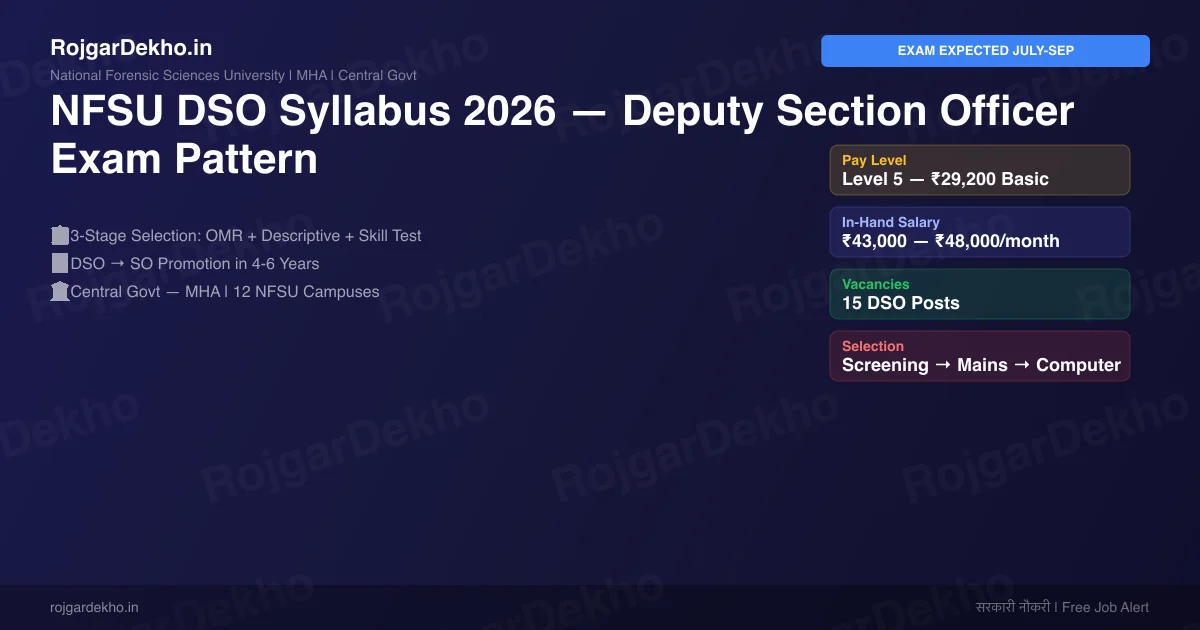
Post: Deputy Section Officer | Vacancies: 15 | Pay Level 5 (₹29,200 basic)
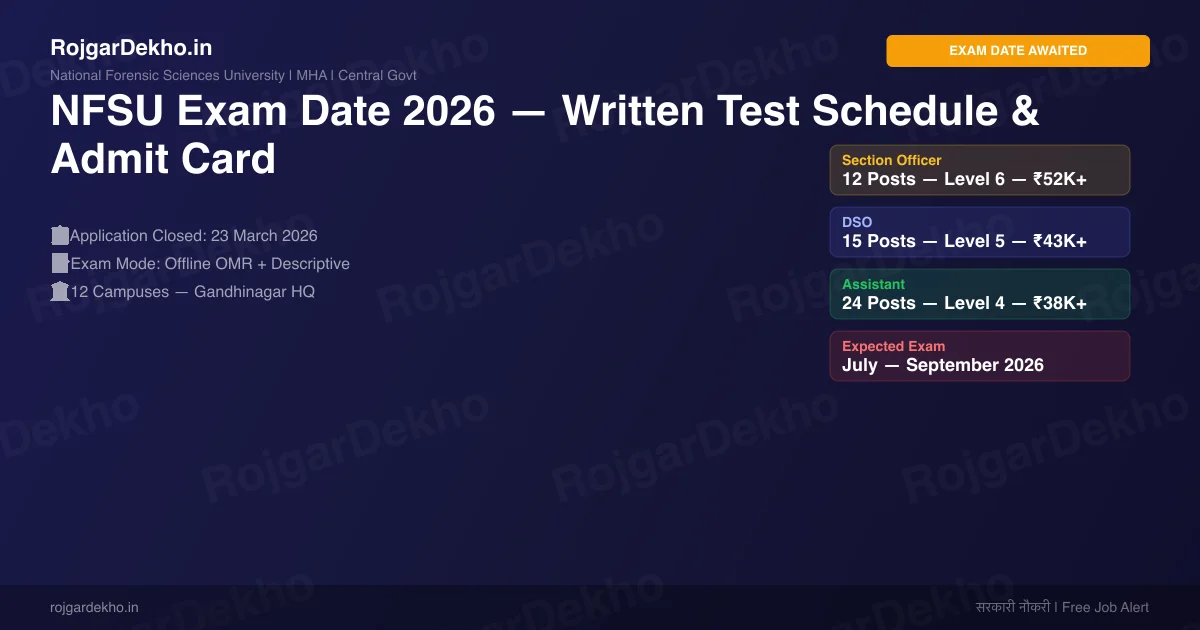
Application closed: 23 March 2026 | Exam expected: July – September 2026
Selection: Screening → Mains → Computer Skill Test
NFSU All 3 Posts — Side-by-Side Comparison
Before diving into the DSO syllabus, understand where DSO sits in the NFSU hierarchy. This table is why 652 people searching for DSO information end up on our SO page — because nobody else has this comparison.
| Factor | Assistant | DSO (Deputy Section Officer) | Section Officer |
|---|---|---|---|
| Pay Level | Level 4 | Level 5 | Level 6 |
| Basic Pay | ₹25,500 | ₹29,200 | ₹35,400 |
| In-Hand Salary | ₹38,000 – ₹43,000 | ₹43,000 – ₹48,000 | ₹52,000 – ₹58,000 |
| Vacancies | 24 | 15 | 12 |
| Qualification | Graduation | Graduation + relevant exp | Graduation + 3 yrs exp |
| Age Limit | 18-40 | 18-40 | 18-40 |
| Hierarchy | Reports to DSO | Reports to SO | Reports to Admin Officer |
| Promotion Path | Assistant → DSO | DSO → SO | SO → Under Secretary |
Key insight: DSO is the sweet spot. More vacancies than SO (15 vs 12), significantly less experience required, and the salary gap is only ₹9,000-10,000 per month. In 4-6 years, you'll reach SO level anyway through promotion.
NFSU DSO Exam Pattern 2026
The NFSU Deputy Section Officer selection follows the same 3-stage process as the Section Officer post. The syllabus overlaps significantly — the difference is in depth, not subjects.
| Stage | Papers / Subjects | Total Marks | Mode | Duration | Negative Marking |
|---|---|---|---|---|---|
| Stage 1: Screening Test | GK + English, Higher Education Policy, Administrative Laws | 300 | Offline (OMR) | 2 hours | 0.25 per wrong answer |
| Stage 2: Mains Examination | Descriptive Paper + Subject-specific Paper | 200 | Offline (Written) | 2-3 hours | None |
| Stage 3: Computer Skill Test | MS Office, Typing, Computer Basics | Qualifying | Practical | 30-45 min | N/A |
How elimination works: If 50,000+ apply for all 51 posts, the screening test eliminates roughly 85-90% of candidates. Only top scorers (proportional to vacancies) advance to mains. The computer skill test is pass/fail — you either clear it or you don't. No marks are added to your final ranking.
NFSU DSO Subject-wise Syllabus — Complete Breakdown
Paper 1: General Knowledge + English Language
| Topic | Key Sub-topics | Weightage | Best Resource |
|---|---|---|---|
| General Knowledge | Indian Polity, History, Geography, Economy, Science, Current Affairs (last 6 months) | ~40% | Lucent's GK + Monthly Capsules |
| English Language | Comprehension, Grammar (Tenses, Voice, Narration), Vocabulary, Cloze Test, Error Detection | ~30% | SP Bakshi (Arihant) + The Hindu editorials |
| Quantitative Aptitude | Basic Arithmetic, Percentage, Ratio, SI/CI, Data Interpretation | ~15% | RS Aggarwal (basics only) |
| Reasoning | Coding-Decoding, Syllogism, Series, Blood Relations, Direction | ~15% | RS Aggarwal Verbal & Non-Verbal |
Paper 2: Higher Education & University Administration
| Topic | Key Sub-topics | Weightage | Best Resource |
|---|---|---|---|
| NEP 2020 | Chapter 10-12 (Governance), Multidisciplinary education, Credit framework, Academic Bank of Credits | ~25% | NEP 2020 official document (free PDF on education.gov.in) |
| UGC / AICTE Regulations | Grading system, Faculty qualifications, Affiliation rules, Recognition norms | ~20% | UGC website — Regulations tab |
| University Administration | Academic Council, Board of Management, Finance Committee, Examination system | ~20% | NFSU Act + Central Universities Act |
| NFSU Specific | NFSU Act, MHA mandate, Campus structure, Forensic science education ecosystem | ~15% | nfsu.ac.in — About Us + Annual Report |
| Quality Assurance | NAAC process, NIRF parameters, NBA accreditation, QS rankings methodology | ~20% | NAAC manual + NIRF methodology document |
Paper 3: Administrative Laws & Office Procedures
| Topic | Key Sub-topics | Weightage | Best Resource |
|---|---|---|---|
| RTI Act 2005 | Sections 4, 6, 7, 8 — Information disclosure, exemptions, time limits, appellate mechanism | ~20% | RTI Act bare text + DoPT circulars |
| CCS Conduct Rules | Government servant conduct, restrictions on political activity, media interaction, property declaration | ~15% | Free PDF on DoPT website |
| General Financial Rules | Procurement procedures, Tender process, Budget cycle, Expenditure control, GeM portal | ~20% | GFR 2017 (focus Ch 6 — Procurement) |
| Office Procedures | Noting, drafting, file management, e-Office, dak handling, record retention | ~20% | Manual of Office Procedure (MoP) |
| IT & Digital Governance | e-Office, Digital India initiatives, Cyber security basics, IT Act 2000 | ~10% | Digital India website + IT Act summary |
| Service Rules | CCS Leave Rules, CCS CCA Rules, Pension rules, NPS, MACP | ~15% | DoPT website — Establishment tab |
Mains — Descriptive Paper
This is where most candidates fail. The screening is objective — tick the right bubble and move on. Mains requires you to actually write coherent answers under time pressure.
- Essay writing: 300-500 words on governance, education policy, or current affairs topics
- Letter/Report writing: Official correspondence — the kind a DSO would actually draft at work
- Precis writing: Summarize a 400-word passage into 100 words without losing meaning
- Comprehension + Answer: Read a passage, answer structured questions
Pro Tip: Practice writing by hand. Not on your laptop, not on your phone — on paper with a pen. The mains exam is pen-and-paper. If you haven't written 500 words by hand in the last year, your hand will cramp, your handwriting will deteriorate mid-answer, and your time management will collapse. Start practicing now.
Computer Skill Test
| Skill | What They Test | Pass Criteria |
|---|---|---|
| MS Word | Formatting, tables, mail merge, headers/footers | Complete assigned tasks correctly |
| MS Excel | Formulas (SUM, AVERAGE, VLOOKUP), charts, data sorting | Complete assigned tasks correctly |
| MS PowerPoint | Create a basic presentation with formatting | Complete assigned tasks correctly |
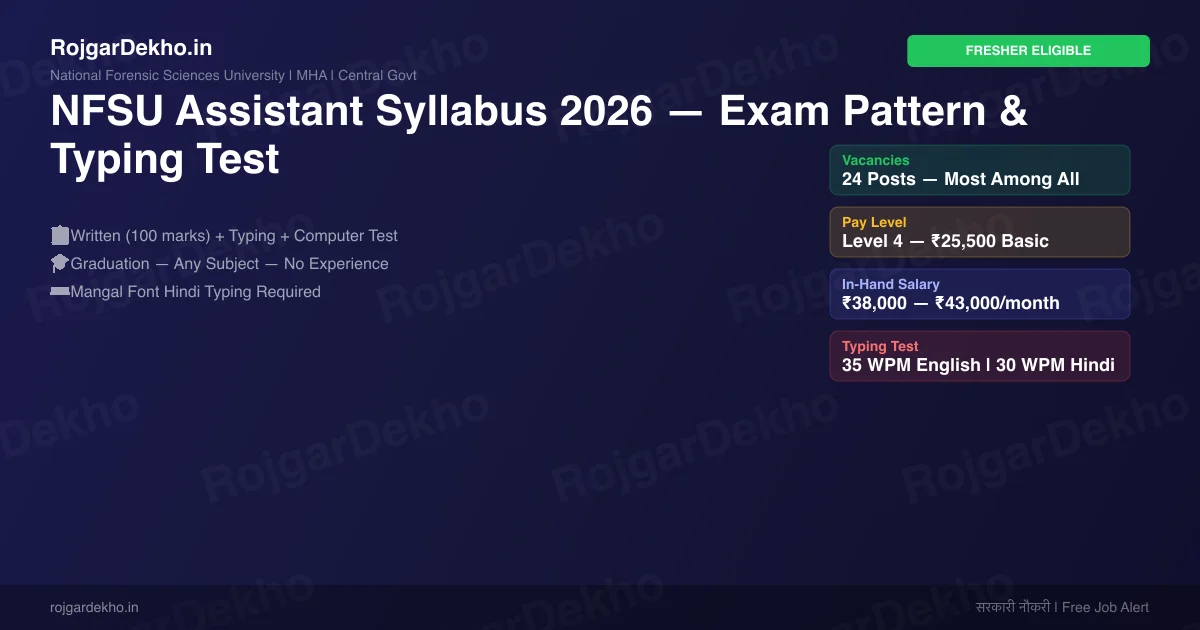
| Typing Speed | English typing — typically 30-35 WPM minimum | Meet minimum WPM threshold |
| Email / Internet | Compose official email, basic internet navigation | Complete assigned tasks |
The computer test is qualifying — not scored. But don't take it lightly. Candidates who clear screening and mains sometimes fail here because they've never used MS Excel beyond opening it. Spend one weekend learning VLOOKUP, Pivot Tables, and Mail Merge. That's all you need.
NFSU DSO vs SO Syllabus — What's Actually Different?
This is the question 652 people ask every month. The syllabus for DSO and SO is largely the same — the difference is in depth and expectations, not subjects.
| Aspect | DSO (Deputy Section Officer) | SO (Section Officer) |
|---|---|---|
| Core Subjects | Same — GK, English, Higher Ed, Laws | Same — GK, English, Higher Ed, Laws |
| Administrative Depth | Operational — file handling, noting, drafting basics | Strategic — policy drafting, decision notes, budget proposals |
| Management Topics | Basic office management | Detailed — HR management, institutional planning |
| Financial Knowledge | GFR basics, procurement fundamentals | Deeper — Budget preparation, expenditure analysis, audit response |
| Descriptive Paper | Shorter answers expected, simpler prompts | Longer essays, complex analytical prompts |
| Computer Test | Same standard | Same standard |
| Overall Difficulty | Slightly easier — junior admin focus | Tougher — senior admin and policy focus |
| Cut-off (Expected) | ~5-8% lower than SO | Highest among all 3 posts |
Translation: If you're preparing for SO, you're automatically prepared for DSO. If you applied for both, prepare at SO level and you'll over-qualify for DSO. Smart candidates apply for both posts as insurance.
NFSU Deputy Section Officer — Job Profile & Daily Work
Here's what no coaching site will tell you. Once you clear the exam, what does a DSO actually do every day?
| Aspect | Reality for DSO |
|---|---|
| Role Type | Operational administrator — you execute, not decide |
| Reports To | Section Officer directly |
| Daily Work | File movement, correspondence drafting, record keeping, staff attendance monitoring, purchase order processing, meeting coordination |
| Decision Authority | Limited — most decisions need SO approval. You prepare the file, SO approves it. |
| Work Timings | 9:30 AM – 6:00 PM, Mon-Fri. Some Saturdays during admissions. |
| Posting | Any of 12 NFSU campuses — Gandhinagar HQ most likely, but Agartala/Dharwad/Raipur possible |
| Transfers | Every 3-5 years between campuses |
| Work Pressure | Moderate. Peak during admissions (July-Aug) and exam seasons. |
| Work Environment | University admin office — not forensic lab. Paper files, e-Office, meetings. |
Think of it this way: The DSO is the person who makes the office function. The SO decides what needs to happen, the DSO makes sure it actually happens. If you're detail-oriented and process-driven — someone who finds satisfaction in systems running smoothly — DSO is a natural fit.
Career Strategy — Why DSO is the Smart Entry Point
🎯 Apply for DSO if:
- You're a fresh graduate or have less than 2-3 years of experience
- You specifically want to work at NFSU but SO eligibility is borderline
- You want a central government job NOW rather than waiting years for higher experience
- You're OK starting at ₹43K and growing to ₹52K+ through promotion
The Promotion Reality
NFSU conducts internal departmental promotion exams. The typical DSO → SO promotion timeline:
| Stage | Timeline | What Happens |
|---|---|---|
| Joining as DSO | Year 0 | ₹43,000-48,000 in-hand. Probation period. |
| Probation Complete | Year 2 | Confirmed. Eligible for MACP after this. |
| Eligible for Departmental Exam | Year 3-4 | Internal exam for promotion to SO (Level 6) |
| Promotion to SO | Year 4-6 | ₹52,000-58,000 in-hand. Same role as direct SO recruit. |
| MACP (if no promotion) | Year 10 | Financial upgradation to next level regardless |
The math is simple: Join NFSU as DSO at age 25. Become SO by 29-31. At 31, you're earning ₹52,000+ with central government job security. Your friend who's been waiting for SSC CGL for 4 years? Still preparing. Your batchmate in a private company? Making ₹35K with no pension and yearly layoff anxiety. Who made the better career decision?
NFSU DSO Preparation Plan — Month by Month
Exam expected July-September 2026. If you start in April, you have 3-5 months. Here's the realistic plan:
Month 1 — April 2026: Foundation
- GK: Lucent's GK — read cover to cover, don't memorize yet, understand structure
- English: SP Bakshi grammar chapters 1-15. One editorial daily — note 5 new words.
- Current Affairs: Start monthly capsule habit. Oliveboard or GradeUp free PDFs.
- Target: 2-3 hours daily. Build the habit, not the intensity.
Month 2 — May 2026: Domain Knowledge
- NEP 2020: Read the full document. Focus Chapters 10-12 on governance.
- NFSU specific: Read NFSU Act, visit nfsu.ac.in — understand 12 campus structure, MHA mandate.
- UGC/AICTE: Regulations on grading, affiliation, faculty qualification norms.
- NAAC/NIRF: Understand accreditation process and ranking parameters.
Month 3 — June 2026: Laws & Administration
- RTI Act: Sections 4, 6, 7, 8 — know them cold. Most tested in university admin exams.
- CCS Rules: Conduct Rules + Leave Rules. Free PDFs on DoPT website.
- GFR 2017: Chapter 6 (Procurement) is critical. Understand tender process, GeM portal.
- Office Procedures: Noting, drafting, file management. Read Manual of Office Procedure.
Month 4 — July 2026: Descriptive + Computer
- Write 3 essays per week (300-500 words) — governance, education policy, NFSU-related topics
- Practice official letters — the kind a DSO would draft: meeting notices, procurement requests, status reports
- Computer skills: One weekend on MS Excel (VLOOKUP, Pivot Tables). One weekend on MS Word (Mail Merge, formatting).
- Typing practice: Aim for 35 WPM English. Use keybr.com — free.
Last 30 Days Before Exam
- 5 full-length mock tests under timed conditions
- Revise current affairs — last 6 months only
- Re-read RTI Act and GFR key chapters
- Practice OMR bubble filling — seriously, this trips people up
- Check nfsu.ac.in daily for admit card
Common mistake DSO aspirants make: Preparing at Assistant level because "DSO is mid-level." No. Prepare at SO level. If you over-prepare, you'll top the DSO merit list. Under-prepare and you'll miss the cut-off by 5 marks.
Document Checklist for NFSU DSO
| Document | Purpose | Get It From | Time Required |
|---|---|---|---|
| Graduation Marksheet + Degree | Education verification | Your university | Already have / 2-4 weeks if lost |
| Experience Certificate | Eligibility proof | Current/previous employer (on letterhead) | 1-2 weeks |
| Aadhaar Card | ID proof | UIDAI | Already have |
| Category Certificate (if applicable) | Reservation benefit | District Magistrate office | 2-4 weeks |
| Domicile Certificate | May be needed for reservation | Tehsil / SDM office | 1-2 weeks |
| Passport-size Photos | Application + admit card + DV | Photo studio (white background) | Same day |
| NOC from employer | If currently employed in govt | Your department | 1-4 weeks |
Most common rejection reason at Document Verification: Experience certificate not on official letterhead, or the dates don't match what was declared in the application. Double-check your experience certificate NOW — don't wait until DV.
NFSU DSO Salary — Detailed Breakdown
| Component | Amount |
|---|---|
| Basic Pay | ₹29,200 |
| DA (@ 55%) | ₹16,060 |
| HRA (Gandhinagar/Tier-2) | ₹4,380 – ₹5,840 |
| Transport Allowance | ₹1,350 – ₹3,600 |
| Gross Salary | ₹50,990 – ₹54,700 |
| Deductions (NPS + Tax + CGHS) | ₹6,000 – ₹8,000 |
| In-Hand Salary | ₹43,000 – ₹48,000 |
Private sector comparison: A fresh graduate with similar experience in a private company earns ₹18,000-25,000 in tier-2 cities. NFSU DSO starts at ₹43,000+ with pension, medical, LTC, and zero layoff risk. The gap widens every year because government DA increases are automatic while private sector increments are performance-dependent and capped.
📚 Also Read on RojgarDekho:
FAQ — NFSU DSO Syllabus 2026
What is the syllabus for NFSU Deputy Section Officer 2026?
The NFSU Deputy Section Officer syllabus covers three main areas: General Knowledge with English Language, Higher Education Policy and University Administration, and Administrative Laws with Office Procedures. The screening test is objective (OMR-based, 300 marks), followed by a descriptive mains examination (200 marks) and a qualifying computer skill test. Key topics include NEP 2020, RTI Act 2005, CCS Rules, GFR 2017, and NFSU-specific institutional knowledge.
Difference between NFSU SO and DSO syllabus
The core subjects are identical — GK, English, Higher Education, Laws, and Computer Skills. The difference is in depth. SO papers focus on senior-level administrative concepts like policy drafting, budget proposals, and institutional planning. DSO papers focus on operational administration — file handling, noting, drafting, and execution. The SO descriptive paper expects longer, more analytical essays while DSO prompts are relatively simpler. However, the screening test is the same for both posts, so preparation overlap is roughly 85-90%.
NFSU DSO salary in hand per month
NFSU Deputy Section Officer salary at Pay Level 5 with basic pay of ₹29,200 results in an in-hand salary of approximately ₹43,000 to ₹48,000 per month. This includes DA (55%), HRA (varies by campus city — Gandhinagar, Delhi, etc.), and Transport Allowance. Deductions include NPS contribution, income tax, and CGHS. The salary increases with annual increments and DA revisions. After 10 years, in-hand crosses ₹65,000+.
Is NFSU DSO exam easier than Section Officer?
Slightly easier, but not significantly. The screening test is the same for all candidates. The mains paper for DSO is focused on operational administration rather than policy-level questions, making it somewhat more straightforward. The expected cut-off for DSO is typically 5-8% lower than SO. However, the competition ratio may be higher because more people are eligible for DSO (lower experience requirement). Bottom line: if you prepare at SO level, you'll comfortably clear DSO. Don't prepare at a lower level thinking it's "easier."
NFSU DSO promotion to Section Officer how many years
Typically 4-6 years. After completing probation (2 years), a DSO becomes eligible for departmental promotion exams. NFSU conducts internal exams for promotion from DSO to SO (Level 6). If no promotion happens through exam, MACP (Modified Assured Career Progression) gives automatic financial upgradation to the next level after 10 years of service. So at worst, you get SO-equivalent pay by year 10. At best, you're an SO by year 4-5 through departmental exam.
Can fresher apply for NFSU DSO 2026?
DSO requires graduation and some relevant administrative experience as per the official notification. A completely fresh graduate with zero work experience may face eligibility issues. However, the experience requirement for DSO is lower than SO (which needs 3 years). Check the official NFSU notification carefully for the exact experience clause — some university admin roles count internships and contractual experience. If you're a pure fresher with no experience at all, the Assistant post (Level 4, 24 vacancies) is your safest bet.
NFSU DSO vs NFSU Assistant which post is better?
It depends on your eligibility and career timeline. DSO (Level 5, ₹43-48K) is better in terms of salary, hierarchy, and career growth — you're one step closer to SO and earn ₹5,000-7,000 more per month from day one. Assistant (Level 4, ₹38-43K) has more vacancies (24 vs 15) and lower eligibility requirements. If you qualify for both, always choose DSO. If you're a fresher without experience, Assistant is your realistic entry point. Either way, both are central government permanent posts at NFSU — you can't go wrong.
NFSU Deputy Section Officer job profile daily work
A DSO's daily work is operational administration. You'll handle file movement between sections, draft official correspondence (letters, meeting notices, circulars), maintain attendance and leave records of staff under you, process purchase orders and procurement requests, coordinate meetings and prepare agendas, and manage record keeping for your section. You report directly to the Section Officer. Think of the DSO as the person who makes the office run — the SO decides what needs to happen, the DSO ensures it actually happens. It's paper-heavy, process-driven work. No forensic science involvement — purely administrative.
NFSU DSO eligibility qualification required
The basic eligibility for NFSU DSO 2026: Graduation from a recognized university with relevant administrative experience (exact duration specified in the official notification — typically less than the 3 years required for SO). Age limit: 18-40 years with standard relaxation for reserved categories (SC/ST: 5 years, OBC: 3 years). There's no specific subject requirement for graduation — BA, B.Com, B.Sc, BBA, BCA all qualify. Computer proficiency is tested separately in Stage 3. Check the exact notification at nfsu.ac.in/Regular_Recruitment for the precise experience clause.