SSC CGL Syllabus 2026 – Complete Tier I & Tier II Guide
Every year, hundreds of thousands of students sit for the SSC CGL exam hoping to land a Group B or Group C central government post — from Income Tax Inspector to Assistant Section Officer. But here is what most aspirants get wrong: they study the wrong version of the syllabus. SSC has restructured the exam, and the SSC CGL 2026 pattern is now a two-tier system. If you are still referencing old four-tier material, you are wasting precious preparation time.
This guide breaks down the complete SSC CGL syllabus 2026 — every subject, every section, every module — with the honest perspective of someone who has coached students through multiple CGL cycles. You will know exactly what to study, how much weightage each section carries, and which topics you can skip versus which ones you simply cannot afford to ignore.
SSC CGL 2026 Exam Structure — The New Two-Tier Pattern
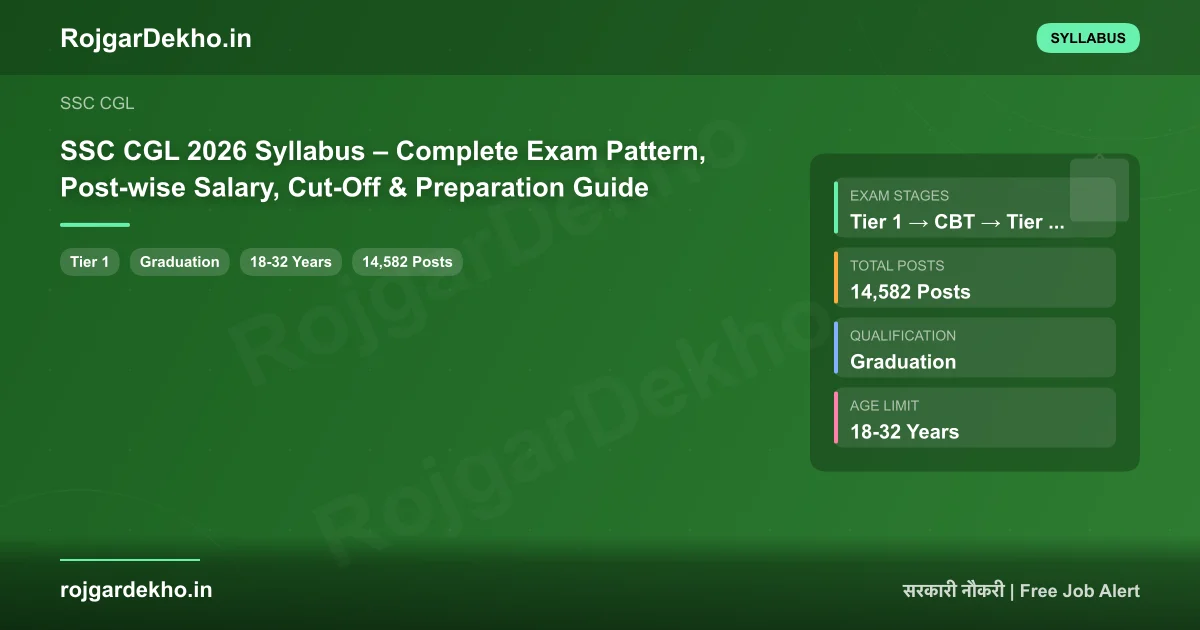
One of the biggest misconceptions floating around is that SSC CGL still has four tiers. It does not. SSC simplified the pattern significantly. Here is how 2026 works:
- Tier I — Computer Based Test (CBT). Screening round only. Your Tier I marks do NOT count in the final merit list.
- Tier II — Computer Based Test (CBT). This is where the game is played. Final merit is based on Tier II marks alone.
- Document Verification — After Tier II shortlisting. No separate exam.
This change matters more than students realise. It means a student who barely cleared Tier I can beat someone who topped it — because Tier II is all that counts. Do not obsess over your Tier I rank. Focus your deepest preparation energy on Tier II.
Tier I Exam Pattern — Full Details
Tier I is a 60-minute, 100-question, 200-mark objective test. Four sections, 25 questions each, with a 0.50-mark penalty for every wrong answer.
| Section | Subject | Questions | Marks |
|---|---|---|---|
| 1 | General Intelligence & Reasoning | 25 | 50 |
| 2 | General Awareness | 25 | 50 |
| 3 | Quantitative Aptitude | 25 | 50 |
| 4 | English Comprehension | 25 | 50 |
| Total | — | 100 | 200 |
Total Time: 60 minutes (no section-wise time limit). Negative Marking: −0.50 marks per wrong answer. Purpose: Shortlisting only — SSC typically shortlists 15 to 20 candidates per post for Tier II.
A common mistake here: students spend 70% of their preparation time on Tier I because it comes first. Resist that impulse. The Tier I cutoff is not very high. You need to clear it comfortably, not top it. Aim for 140+ out of 200 in Tier I — beyond that, shift your focus to Tier II preparation immediately.
Tier II Exam Pattern — Full Details
Tier II is the real battleground. It has three papers. Paper I is mandatory for everyone; Papers II and III are only for specific post categories.
Paper I — Mandatory for ALL Candidates
Paper I consists of 150 questions worth 450 marks, spread across two sessions. Total time: 2 hours 30 minutes. Negative marking: −1 mark per wrong answer (double the Tier I penalty, so think before you guess).
| Session | Section | Module | Subject | Questions | Marks |
|---|---|---|---|---|---|
| Session 1 | Section 1 | Module I | Mathematical Abilities | 30 | 90 |
| Session 1 | Section 1 | Module II | Reasoning & General Intelligence | 30 | 90 |
| Session 1 | Section 2 | Module I | English Language & Comprehension | 45 | 135 |
| Session 1 | Section 2 | Module II | General Awareness | 25 | 75 |
| Session 2 | Section 3 | Module I | Computer Knowledge Test | 20 | 60 |
| Total — Paper I | 150 | 450 |
Paper II — Only for JSO and Statistical Investigator Posts
Paper II covers Statistics: 100 questions, 200 marks, 2-hour duration. This paper is only mandatory if you are applying for the post of Junior Statistical Officer (JSO) or Statistical Investigator Grade II under M/o Statistics & Programme Implementation.
| Topic | Key Sub-topics |
|---|---|
| Collection & Classification of Data | Primary & secondary data, frequency distributions, tabulation |
| Measures of Central Tendency | Mean, Median, Mode — grouped and ungrouped data |
| Measures of Dispersion | Range, QD, MD, SD, Variance, Coefficient of Variation |
| Skewness & Kurtosis | Karl Pearson's and Bowley's measures |
| Correlation & Regression | Scatter diagram, Pearson's r, Spearman rank correlation, regression lines |
| Probability | Basic concepts, Bayes' theorem, Binomial & Normal distributions |
| Index Numbers | Laspeyre's, Paasche's, Fisher's — price & quantity index |
| Time Series Analysis | Trend, Seasonal, Cyclical, Irregular components; Moving averages |
Paper III — Only for AAO (Audit/Accounts Officer) Posts
Paper III is General Studies (Finance & Economics): 100 questions, 200 marks, 2-hour duration. It is divided into two parts.
| Part | Subject Area | Marks | Key Topics |
|---|---|---|---|
| Part A | Finance & Accounts | 40 | Financial Accounting fundamentals, Self-Balancing Ledger, Error Rectification, Trial Balance, Capital vs. Revenue Expenditure |
| Part B | Economics & Governance | 60 | Macro Economics, Indian Economy, Demand & Supply theory, Role of RBI, Finance Commission, Constitutional articles related to finance, Fiscal Policy, FRBM Act |
Tier I — Subject-wise Syllabus
General Intelligence & Reasoning
Reasoning in Tier I is largely non-verbal and logical. Most questions take 30–60 seconds if you have practiced the pattern. The big time-killers for beginners are Matrix questions and Missing Number series — practice these specifically until they become automatic.
- Analogies (verbal and figural)
- Similarities and Differences
- Space Visualisation and Spatial Orientation
- Problem Solving and Analysis
- Judgment and Decision Making
- Visual Memory and Discrimination
- Relationship Concepts (Blood Relations)
- Arithmetical Reasoning
- Arithmetic Number Series and Non-Verbal Series
- Verbal and Figural Classification
- Coding-Decoding
- Statement & Conclusion, Syllogisms
- Seating Arrangement
- Direction Sense and Ranking
- Puzzles and Venn Diagrams
- Mirror Images, Water Images, Embedded Figures
- Figure Completion, Matrix Questions
General Awareness
GK in SSC CGL is the wildcard section. Scores vary by 15–20 marks based purely on how recent your preparation is. The questions are not deep — they are factual. You either know it or you do not. The strategy is wide coverage of the last 6 months of current affairs plus a solid grip on static GK from standard sources.
- Current Affairs — last 6 months (national and international)
- Indian History (Ancient, Medieval, Modern)
- Indian and World Geography
- Indian Polity and Constitution
- Indian Economy (basic concepts, five-year plans, budget terms)
- General Science — Physics, Chemistry, Biology (Class 9–10 level)
- Environmental Studies
- Computer Basics
- Awards and Honours, Sports, Important Days
- Books and Authors, Government Schemes
Quantitative Aptitude
Maths is where most students either make or break their Tier I score. Twenty-five questions, but they are not all equal. Profit & Loss, Time & Work, and Mensuration together account for roughly 30–35% of Quantitative Aptitude questions. Data Interpretation, while only 3–4 questions, is mostly time-consuming rather than difficult — practice DI under time pressure.
- Number Systems — whole numbers, decimals, fractions
- Relationships between numbers
- Fundamental Arithmetic Operations — BODMAS, HCF, LCM
- Percentages, Ratio and Proportion
- Profit and Loss
- Simple and Compound Interest
- Discount and Partnership
- Average
- Time and Work, Time and Distance
- Pipes and Cisterns
- Mensuration — 2D and 3D (area, perimeter, volume)
- Trigonometry (height and distance problems)
- Geometry (circles, triangles, quadrilaterals)
- Algebra basics (linear equations, inequalities)
- Data Interpretation — Bar, Pie, Line charts, Tables
English Comprehension
The English section in Tier I is more about grammar accuracy than vocabulary depth. Students who read even one good English newspaper for 20 minutes per day for three months will find this section straightforward. Do not neglect it thinking it is "easy" — a careless student loses 6–8 marks here through silly errors in error spotting and sentence improvement.
- Reading Comprehension (1–2 passages)
- Cloze Test
- Para Jumbles
- Error Spotting
- Fill in the Blanks
- Sentence Improvement
- Active and Passive Voice
- Direct and Indirect Speech
- Idioms and Phrases
- One Word Substitution
- Synonym and Antonym
- Spelling Error Detection
- Word Usage in Context
Tier II — Detailed Syllabus for Paper I Modules
Mathematical Abilities (30 questions, 90 marks)
This is a harder, deeper version of the Tier I Maths section. The same topics appear, but the questions require more steps and more accurate calculation. At 3 marks per correct answer and -1 per wrong, you need to be very selective — a wrong answer costs you 4 marks net. Aim to attempt 20–22 questions with very high accuracy rather than attempting all 30.
Tier II Maths covers: all Tier I topics plus advanced Algebra (quadratic equations, polynomials), Coordinate Geometry (distance between points, section formula, slope of lines), advanced Trigonometry (identities, max-min values), and Complex DI sets with mixed chart types.
Reasoning & General Intelligence (30 questions, 90 marks)
Tier II Reasoning is noticeably harder than Tier I. Expect more complex puzzles, multi-step seating arrangements, and figure-based questions that require careful observation. The same -1 negative marking applies. Students who have practiced 500+ reasoning questions at Tier I level should start doing Tier II-specific mock tests at least two months before the exam.
English Language & Comprehension (45 questions, 135 marks)
This is the highest-scoring single module in Paper I — 135 marks. Students who score 120+ here are often in the top 10% of merit lists. The Tier II English section includes everything from Tier I plus more passages, more complex error spotting, and questions on vocabulary in context that require a broader word bank. Spend at least 45–50 minutes per day on English in your Tier II preparation phase — this single module can swing your final rank by a very significant margin.
General Awareness (25 questions, 75 marks)
Same conceptual scope as Tier I GK but questions tend to be more specific. Where Tier I might ask "who is the current RBI Governor?", Tier II might ask about a specific RBI policy announcement. Keep your current affairs preparation live through Tier II, not just Tier I.
Computer Knowledge Test (20 questions, 60 marks)
This is possibly the most underestimated module in the entire exam. Most serious aspirants ignore Computer Knowledge because it comes in Session 2 and they treat it as an afterthought. Do not. With 60 marks at stake and the difficulty level being moderate at best, a prepared student can score 54–60 marks here — an advantage of 15+ marks over someone who skipped it.
| Topic Area | What to Study |
|---|---|
| Computer Fundamentals | Hardware, software, input/output devices, memory types (RAM, ROM, cache) |
| Operating Systems | Windows basics, file management, types of OS (batch, time-sharing, real-time) |
| MS Office | Word (formatting, mail merge), Excel (formulas, charts, pivot tables), PowerPoint |
| Internet & Networking | Protocols (HTTP, FTP, TCP/IP), LAN/WAN/MAN, WWW, browsers, cybersecurity basics |
| Database Basics | DBMS concepts, SQL basics, primary key, foreign key, data types |
| Number Systems | Binary, octal, hexadecimal — conversions and basic arithmetic |
Expected Important Dates for SSC CGL 2026
SSC has not officially released the CGL 2026 notification at the time of writing. Based on historical patterns from CGL 2023 and CGL 2024 cycles, here is the expected timeline. Treat these as planning benchmarks, not confirmed dates — always verify on the official SSC website (ssc.gov.in) once the notification drops.
| Event | Expected Timeline |
|---|---|
| Official Notification | August – September 2026 (expected) |
| Online Application Window | August – September 2026 (expected) |
| Tier I Exam | October – November 2026 (expected) |
| Tier II Exam | January – February 2027 (expected) |
| Final Result | April – May 2027 (expected) |
Expert Preparation Strategy for SSC CGL 2026
Having guided students through multiple CGL cycles, here is what separates candidates who get their preferred post from those who keep attempting year after year.
Phase 1 — Foundation (Months 1–3)
Do not start with mock tests. First build the concept base. For Maths, work through every topic from scratch using a standard textbook like R.S. Aggarwal's Quantitative Aptitude. For English, start reading editorials from any reputable newspaper every morning. For Reasoning, solve at least 20 questions per day from previous year papers (2017–2024) — the pattern repeats more than most coaches admit. For GK, follow a monthly current affairs digest consistently — pick one source and stick to it for the entire preparation.
Phase 2 — Tier I Specific (Months 4–6)
Time allocation for Tier I daily practice: 40% on Quantitative Aptitude (this is the most scoring for most students), 30% on English Comprehension (easy marks for those who prepare), 20% on Reasoning (speed matters here more than depth), and 10% on General Awareness (read current affairs daily — 15 minutes is enough if you are consistent). Take at least two full-length timed mock tests per week. Analyse where you lost marks — not just the total score.
Phase 3 — Tier II Deep Preparation (After Tier I)
After Tier I, you typically have 2–3 months before Tier II. This is when the real work begins. English is worth 135 marks — give it at least 50 minutes of focused practice every day. Work through SSC CGL previous year English papers from 2019 onwards. Computer Knowledge: spend 3–4 hours total across one week covering the entire syllabus — it is not vast, and the return on time is excellent. Mathematical Abilities in Tier II: shift from speed-based solving to accuracy-first. One wrong answer in Tier II costs you 4 marks net. Do not guess blindly.
Common Mistakes to Avoid
- Ignoring Computer Knowledge: Students who skip this module lose 20–30 marks compared to prepared candidates. It is predictable and coverable in a week.
- Over-focusing on Tier I GK: GK is unpredictable. Cap your GK preparation time at 10% of total daily study. Do not sacrifice Maths or English for GK.
- Guessing randomly in Tier II: The -1 negative marking in Tier II is brutal. A wrong guess costs you 4 marks (you lose 1 and miss the potential 3). Only attempt questions you have a genuine shot at.
- Not practising DI under time pressure: Data Interpretation questions look easy but eat up 4–6 minutes each without practice. Time yourself on DI sets specifically.
- Neglecting Tier II English: Many Maths-focused students score 80–90 in Mathematical Abilities but only 80 in English — leaving 50+ marks on the table. English at Tier II is 135 marks and largely practise-dependent.
Frequently Asked Questions
Q: Does Tier I score count in the SSC CGL 2026 final merit list?
No. Tier I is purely a screening/qualifying stage. Your Tier I marks are not added to the final merit. The merit list is prepared solely based on Tier II Paper I marks (and Paper II or III where applicable). This means even if you barely clear Tier I, you can still beat higher Tier I scorers if you perform better in Tier II.
Q: Who needs to appear for Paper II (Statistics) in Tier II?
Paper II is only for candidates who are applying for the post of Junior Statistical Officer (JSO) under the Ministry of Statistics and Programme Implementation, and Statistical Investigator Grade II. If you are not targeting these specific posts, you only need to appear for Paper I.
Q: What is the negative marking in SSC CGL 2026?
Tier I: −0.50 marks per wrong answer (questions carry 2 marks each). Tier II Paper I: −1 mark per wrong answer (questions carry 3 marks each). Tier II Papers II and III: −0.50 marks per wrong answer. There is no negative marking for unattempted questions.
Q: Is the SSC CGL 2026 syllabus the same as 2024 and 2025?
The two-tier structure was introduced for CGL 2023. For 2024, 2025, and 2026, the pattern remains consistent — Tier I screening followed by Tier II (Paper I mandatory; Papers II and III post-specific). Topic coverage within each section has remained stable. Always cross-check the official notification once released, but you can safely prepare on the 2024 pattern for 2026.
Q: How important is the Computer Knowledge module in Tier II?
Very important. It carries 60 marks in Paper I (out of 450) and is one of the easiest modules to score full marks in — the difficulty level is comparable to Class 10 IT. Students who dedicate even 8–10 hours specifically to Computer Knowledge preparation routinely score 55–60 out of 60. Do not skip it.
Q: What is the shortlisting ratio for Tier II?
SSC typically shortlists approximately 15 to 20 candidates per available post for Tier II. So if a cycle has 10,000 posts, expect around 1.5 to 2 lakh candidates to be called for Tier II. The exact ratio can vary slightly based on the year and total applicants, but 15x is a reasonable benchmark to plan around.
👉 SSC CGL Salary 2026 — Post-wise in-hand salary breakdown with all allowances and HRA comparison