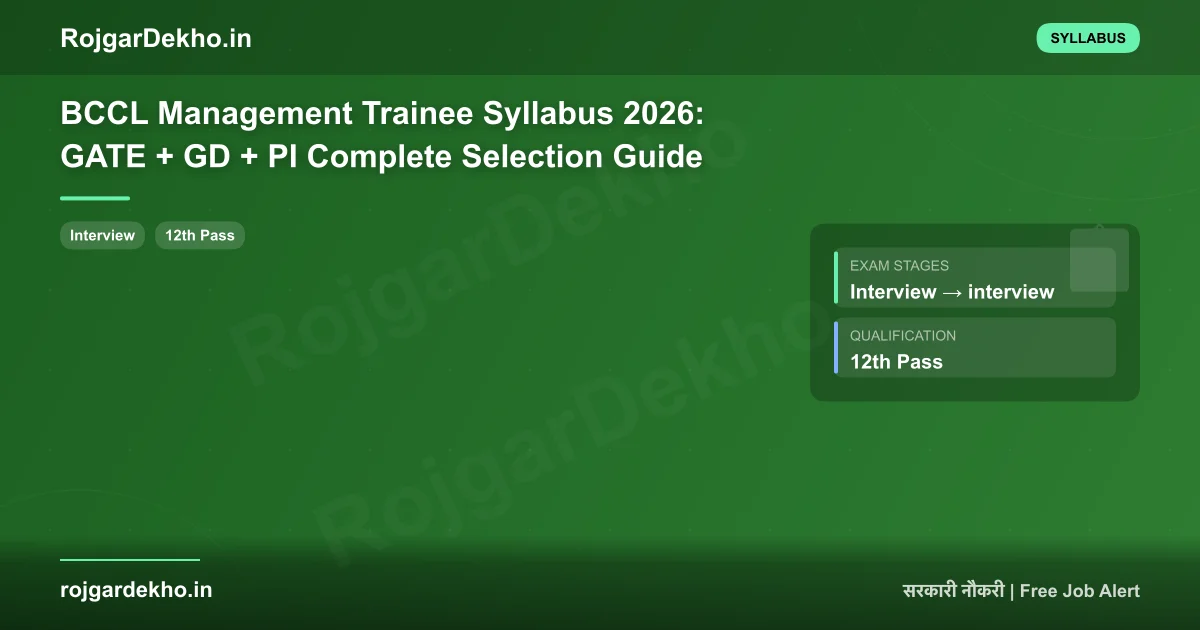
BCCL Management Trainee Syllabus 2026: GATE + GD + PI Complete Selection Guide
BCCL Management Trainee selection uses no separate written test. GATE score contributes 70% of the final merit, Group Discussion adds 15%, and Personal Interview adds 15%. This is the CIL standard MT model, and BCCL follows it exactly. The one differentiation in BCCL's selection context is that GD and PI panels at BCCL often probe your understanding of coking coal, its role in India's steel supply chain, and the specific operational complexities of the Jharia coalfield — not just generic coal sector knowledge. This guide covers every stage in full detail.
BCCL MT Selection Process — Overview
Four stages after application: GATE-based shortlisting, Group Discussion, Personal Interview, and Medical Examination with Document Verification. Shortlisting for GD/PI is purely by GATE rank within each discipline — typically 5 to 10 times the vacancy count is called. Final merit combines the three scored stages. Medical and document verification are qualifying steps only.
| Stage | Mode | Weightage | Who Evaluates |
|---|---|---|---|
| GATE Score | National exam, merit-based | 70% | IITs / IISc (GATE organising body) |
| Group Discussion (GD) | Offline panel discussion | 15% | BCCL Selection Committee |
| Personal Interview (PI) | Offline panel interview | 15% | BCCL Selection Committee |
| Medical Examination | Physical fitness test | Qualifying | BCCL Medical Officers |
| Document Verification | Certificate check | Qualifying | BCCL HR Team |
GATE Disciplines Accepted for BCCL MT 2026
BCCL recruits in disciplines that serve its coking coal mining operations — underground extraction, mine electrification, mechanical maintenance, civil and surface infrastructure, and information systems. Your GATE paper must match the BCCL MT discipline you apply for:
| BCCL MT Discipline | GATE Paper Code | Full Paper Name |
|---|---|---|
| Mining Engineering | MN | Mining Engineering |
| Electrical Engineering | EE | Electrical Engineering |
| Mechanical Engineering | ME | Mechanical Engineering |
| Civil Engineering | CE | Civil Engineering |
| Systems / IT | CS | Computer Science & Information Technology |
Mining Engineering is particularly impactful at BCCL because the Jharia coalfield requires mining engineers who understand the unique challenges of coking coal seams: managing volatile matter in gas-prone, gassy seams; controlling spontaneous heating (which is especially relevant given Jharia's historical subsurface fire zones); designing effective ventilation circuits for deep underground workings; and managing the quality implications of blasting and handling procedures on coking coal characteristics. BCCL Mining Engineer MTs encounter some of the most technically demanding underground mining conditions in India — and this depth of experience is recognised in career advancement at BCCL and in the broader industry.
GATE Exam Pattern
GATE is a 3-hour computer-based test with 65 questions worth 100 marks. Three question types: MCQ with 1/3 negative marking, MSQ with no negative marking, and NAT with no negative marking. General Aptitude is common to all papers and carries 15 marks.
| Section | Total Marks | Questions | Negative Marking |
|---|---|---|---|
| General Aptitude | 15 | 10 (5 × 1-mark + 5 × 2-mark) | 1/3 for MCQ only |
| Technical (Core Subject) | 85 | 55 (mix of 1-mark and 2-mark) | 1/3 for MCQ only |
| Total | 100 | 65 | — |
GATE Mining Engineering — Key Topics for BCCL's Coking Coal Context
| Topic Area | Key Subtopics | BCCL Relevance |
|---|---|---|
| Mine Ventilation | Circuit design, fan selection, methane classification, SHC controls | Gassy seams in Jharia — methane and CO monitoring critical |
| Mining Methods | Bord & Pillar, Longwall, inclined seam extraction | BCCL's deep underground coking coal mines |
| Ground Control | Rock mechanics, pillar design, roof bolting, subsidence | Aged workings with subsidence and fire proximity |
| Spontaneous Heating | Crossing point temperature, blackdamp zones, early detection | Jharia fire zone management — unique to BCCL |
| Coal Quality | Ash, moisture, volatile matter, coking index, washability | Coking coal quality management — BCCL-specific |
| Mine Machinery | Winders, SDL/LHD, continuous miner, pump, compressor | BCCL underground equipment fleet |
| Explosives | Permitted explosives for gassy mines, blast design, initiation | Required for gas-prone seam operations |
GATE Preparation Strategy for BCCL — Mining and Electrical
For Mining Engineering candidates: BCCL's operational complexity makes Mine Ventilation and Ground Control the two most important GATE sections to master — not just for GATE score but because these are exactly the topics BCCL PI panels probe in detail. The spontaneous heating topic is particularly worth deep preparation: it appears in the GATE MN paper and is also highly likely in BCCL PI (given Jharia's fire zone history). Understand crossing point temperature testing, blackdamp monitoring, and the standard DGMS protocols for managing heating in underground workings. For open topics like Mining Methods, focus on Bord-and-Pillar (BCCL's primary method) and emerging longwall systems — understand the retreat mining sequence and its advantages in gas-prone seams. Use the last 10 years of GATE MN papers as your primary practice bank. Visit BCCL's annual report on the company website — understanding production figures, the Jharia Action Plan status, and recent mine upgrades gives you live material for PI.
For Electrical Engineering: BCCL's mine electrical infrastructure is complex because of the underground nature of operations — flame-proof equipment requirements in gassy zones, intrinsically safe circuits for instrumentation, shaft winding systems, and heavy dewatering pump installations in deep mines. GATE EE sections on Electrical Machines and Power Systems are your priority. Pay specific attention to motor starting methods, protection relay operation, and transformer differential protection — these are directly relevant to BCCL's electrical engineering work. The concept of Zone classification for hazardous areas (ATEX/IEC standards) is worth understanding for the PI, even though it is not a standard GATE topic, as it directly shapes BCCL's electrical engineering decisions.
Group Discussion — BCCL-Specific Topics
| GD Topic Area | Key Points to Know |
|---|---|
| Coking Coal Imports | India imports ~85% of coking coal — BCCL's strategic role in reducing import dependency |
| Jharia Rehabilitation | Jharia Action Plan (JAP), relocation of fire-affected communities, resettlement policy |
| Steel Industry Growth | India's steel capacity expansion plans, government infrastructure push, BCCL supply |
| Underground Mining Safety | DGMS oversight, statutory examinations, gas monitoring, BCCL's safety record |
| Coal Mine Fire Management | Spontaneous heating, Jharia fire zones, prevention vs. fighting strategies |
| Coking Coal Washeries | Coal washing to improve grade, washery technology, BCCL's washery infrastructure |
Personal Interview — What BCCL Evaluates
BCCL PI panels for Mining candidates consistently test knowledge that is specific to gassy underground mines and coking coal operations. Common BCCL PI questions for Mining engineers: "India imports a large proportion of its coking coal. What role does BCCL play in reducing this dependency, and what are the constraints?" "What is the significance of the Jharia Action Plan? What engineering and social challenges does it involve?" "How does coking coal differ from thermal coal in terms of quality parameters and extraction handling requirements?" "A section of underground workings shows elevated CO readings and rising temperature. Walk through your response procedure." "What are permitted explosives, and why are they mandatory in BCCL's gassy mines rather than general explosives?" For Electrical candidates: "Explain the difference between flame-proof and intrinsically safe equipment. When would you use each in a coal mine?" "What is the Zone 0, Zone 1, Zone 2 classification system and how does it affect your electrical design decisions underground?" For Mechanical candidates: "What unique challenges does a gassy underground environment create for mechanical equipment maintenance compared to open-cast equipment maintenance?"
Frequently Asked Questions
Q: Does BCCL have a separate written exam for MT selection?
No. BCCL MT selection is entirely based on GATE score (70%) + GD (15%) + PI (15%). There is no BCCL-specific written test at any stage.
Q: How many candidates does BCCL shortlist per vacancy for GD/PI?
BCCL typically shortlists 5–10 times the vacancy count per discipline for GD/PI. Competition at the GD/PI stage is real — candidates within a narrow GATE score band compete primarily on GD and PI performance for final merit ranking.
Q: Where is the BCCL GD/PI conducted?
BCCL GD/PI is typically conducted at Dhanbad (BCCL HQ) or designated venues. The exact venue is specified in the GD/PI call letter. Travel and accommodation for GD/PI attendance is at the candidate's expense unless BCCL specifies otherwise.
Q: What GATE score is competitive for BCCL MT shortlisting?
Cutoffs vary by discipline and vacancy count. Mining Engineering typically has a smaller candidate pool and thus lower absolute cutoffs than EE or ME. As a reference, GATE scores above 450 (normalised/1000) for Mining and above 550 for EE/ME have historically been in the competitive range for CIL subsidiaries — but verify this against BCCL's most recent notification for actual cutoff data.
Q: Can I appear for BCCL and ECL GD/PI in the same year?
Yes, if their GD/PI dates do not clash. Your GATE score is common to both. If both shortlist you, you can appear for both GD/PI processes and accept the offer that you prefer. You can only join one and will be bound by that company's service bond.
📌 BCCL MT Complete Guide:
GATE Preparation Timeline — Six Months to BCCL MT Selection
Six months of structured preparation is sufficient for a Mining or Electrical candidate targeting BCCL MT. Month one and two: build theory. Work through your discipline's core textbooks systematically. For Mining: Mine Ventilation (Hartman or Misra), Strata Control (Bieniawski), and Mining Engineering (SME Handbook or equivalent standard text) for Mining Methods. For EE: Electrical Machines (Kothari & Nagrath), Power Systems (Nagrath & Kothari). Do not attempt GATE papers in these months — foundations first. Month three: solve previous 5 years of GATE MN or EE papers under timed conditions. Identify weak sections and catalogue them. Month four: focused revision on weak sections. Use standard topic-wise practice books to drill specific question types. Month five: full-length mock GATE examinations under exam conditions — 3 hours, no interruptions, strict timer. After each mock, analyse errors and classify them (concept gap, formula error, time pressure mistake). Month six: revise high-frequency topics, maintain strong sections through daily short sets, and pivot to GD and PI preparation. Read BCCL's recent annual report, the Jharia Action Plan status from Ministry of Coal updates, and India's coking coal import data. Prepare two factual talking points per GD topic. Run at least one mock PI session with a peer or in front of a mirror on camera.
The Jharia Action Plan — Why BCCL GD Candidates Must Know This
The Jharia Action Plan (JAP) is a long-standing government programme to relocate communities living in fire-affected zones of the Jharia coalfield and allow BCCL to safely resume or extend mining operations in those areas. Started under the Ministry of Coal, the plan involves shifting tens of thousands of households from subsidence and fire-risk zones to a new township being built at Belgoria in Dhanbad. The plan has faced significant delays due to land acquisition challenges, litigation, community resistance in some areas, and logistics of mass relocation. For BCCL MTs, the JAP is directly relevant: newly joined Mining MTs at BCCL often work in or near areas where JAP rehabilitation is ongoing — the social dimension is a live operational reality, not just a policy document.
In a GD on Jharia rehabilitation or coal mine fire management, candidates who understand the JAP from both engineering and social angles — the technical challenge of mapping fire zones and deciding which areas can be safely mined vs. permanently sealed vs. rehabilitated, alongside the human challenge of community relocation — contribute far more substantively than those who only know that "Jharia has coal fires." Key facts worth knowing: the Belgoria township is being developed by BCCL as the relocation site, the fire zones cover specific blocks within the Jharia coalfield (not the entire coalfield), and the pace of relocation has been a subject of Supreme Court monitoring. Knowing these specifics — and being able to bring them to a GD without making the discussion sound like a scripted speech — positions you as a candidate who has genuinely engaged with the complexity of BCCL's operational environment.
What to Expect in the First Year as a BCCL MT
After joining, BCCL MTs undergo an induction training period — typically classroom training at BCCL's training institute, followed by mine attachment rotations across different mines in the Jharia coalfield. During this training year, your salary is paid in full but your posting can vary. After training, you are given a regular posting. Understanding this helps with PI preparation: when a panel member asks "Are you prepared for posting at any BCCL mine?", the honest and correct answer is yes — because the training year itself involves rotations, and your final posting is decided by BCCL's HR based on operational needs, not personal preference. Expressing willingness and flexibility at PI is not just a social nicety — it is directly relevant to the job you are accepting.