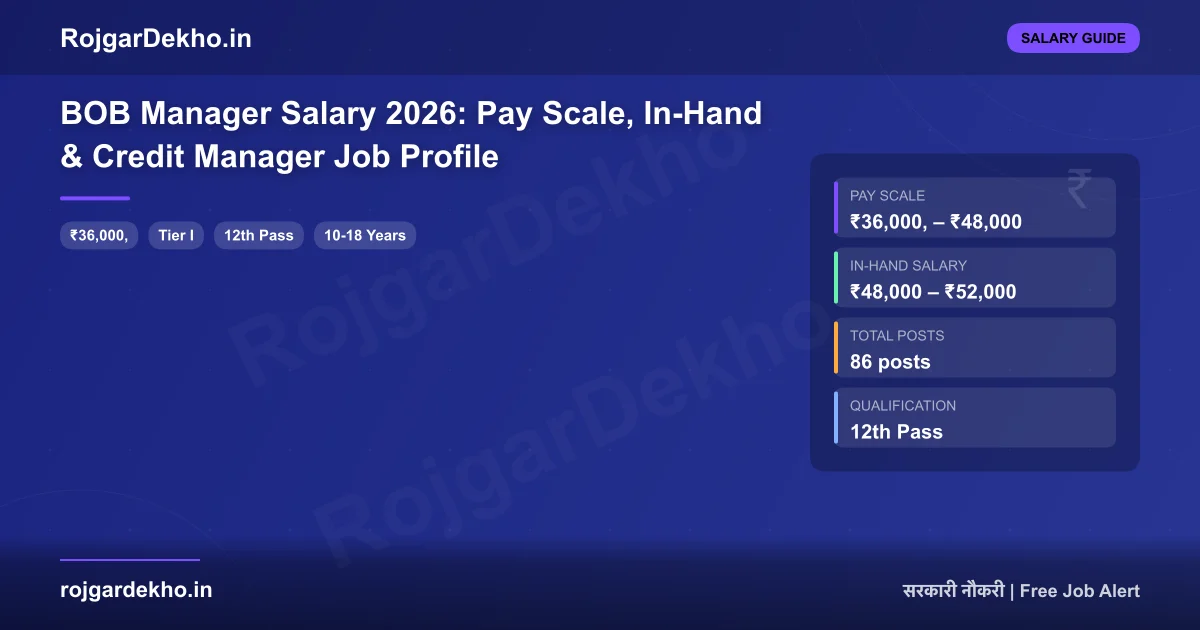
BOB Manager Salary 2026: Pay Scale, In-Hand & Credit Manager Job Profile
- 86 posts — Manager Credit Analyst, Senior Manager, Chief Manager (Credit & IC)
- Pay Scale: JMGS-I to SMGS-IV depending on post — ₹36,000 to ₹89,890 basic
- In-hand: ₹65,000–₹1,10,000/month after allowances and deductions
By RojgarDekho Team | Updated: June 2026
Bank of Baroda's Manager Credit & IC 2026 recruitment is filling specialized roles — Credit Analyst, Relationship Managers, and C&IC (Current & Institutional Credit) officers. These aren't generalist banking jobs. The work is credit assessment, structured lending, and institutional relationship management. The salary reflects both the specialization and the seniority of the posts. Here's the full picture.
BOB Manager C&IC last date: 6 July 2026. 86 posts. Advt 2026/10. Apply at bankofbaroda.in →
BOB Manager C&IC 2026 — Post-Wise Pay Scale
BOB Manager recruitment under Advt 2026/10 covers three levels of seniority. Pay scales are as per IBA (Indian Banks' Association) 11th Bipartite Settlement, which governs salary structures across public sector banks:
| Post Level | Scale | Basic Pay Range (IBA 11th BPS) | Approx Entry Basic |
|---|---|---|---|
| Manager (Credit Analyst) | JMGS-I (Junior Management Grade Scale I) | ₹36,000–₹63,840 | ₹36,000 |
| Senior Manager (Credit & IC) | MMGS-II (Middle Management Grade Scale II) | ₹48,170–₹69,810 | ₹48,170 |
| Chief Manager (Credit & IC) | SMGS-III (Senior Management Grade Scale III) | ₹63,840–₹78,230 | ₹63,840 |
| Chief Manager (Head) | SMGS-IV (Senior Management Grade Scale IV) | ₹76,010–₹89,890 | ₹76,010 |
The pay scale above is based on IBA 11th Bipartite Settlement norms applicable across public sector banks. BOB follows the same structure as SBI, PNB, Canara Bank, and other PSU banks. Exact scale allocation depends on the post applied for and years of experience if lateral hire.
Under the 11th Bipartite Settlement (effective from November 2022), bank employees received a Special Allowance in addition to their Basic Pay. For JMGS-I officers, this adds approximately ₹5,000–₹7,000/month to the monthly package. This is in addition to DA, HRA, and other allowances.
Allowances on Top of Basic Pay
| Allowance | Rate / Amount (JMGS-I) | Rate / Amount (MMGS-II) |
|---|---|---|
| Dearness Allowance (DA) | ~23% of basic (rate revised quarterly) | ~23% of basic |
| House Rent Allowance (HRA) | 7–9% of basic (metro cities higher) | 7–9% of basic |
| City Compensatory Allowance | ₹600–₹1,200/month depending on city | ₹700–₹1,400/month |
| Special Allowance | ~13% of basic (11th BPS) | ~13% of basic |
| Medical Aid | ₹8,000/year (reimbursement basis) | ₹8,000/year |
| LFC (Leave Fare Concession) | Travel reimbursement, once in 2 years | Once in 2 years |
In-Hand Salary After Deductions
Your monthly take-home is gross pay minus NPS/PF contribution, income tax, and professional tax. For a JMGS-I Manager at BOB (Metro posting, basic ₹36,000):
| Component | Amount (JMGS-I Metro) | Amount (MMGS-II Metro) |
|---|---|---|
| Basic Pay | ₹36,000 | ₹48,170 |
| DA (~23%) | ₹8,280 | ₹11,079 |
| Special Allowance (~13%) | ₹4,680 | ₹6,262 |
| HRA (9% metro) | ₹3,240 | ₹4,335 |
| CCA + Other | ₹1,200 | ₹1,400 |
| Gross Pay (approx) | ₹53,400 | ₹71,246 |
| NPS / PF (10% of basic) | −₹3,600 | −₹4,817 |
| Income Tax (approx) | −₹2,000 | −₹5,000 |
| In-Hand (approx) | ₹47,800–₹50,000 | ₹61,000–₹66,000 |
Note: DA is revised quarterly. The 23% estimate is approximate for mid-2026. Actual in-hand varies based on city, tax bracket, and loan EMIs deducted at source (if any bank loans taken).
BOB Manager roles in this advertisement are for Credit Analyst and C&IC (Current & Institutional Credit). These are specialist roles — not branch manager or generalist banking. The work involves credit risk assessment, loan structuring, and institutional relationship management. Salary reflects both rank and specialization.
Total Cost to Company (CTC) vs In-Hand
Banks often present CTC figures that are higher than in-hand because they include:
| Component | JMGS-I CTC Element | Included in In-Hand? |
|---|---|---|
| Basic Pay | ₹36,000 | Yes |
| DA + Allowances | ~₹17,000 | Yes |
| Bank's NPS Contribution (14%) | ₹5,040 | No (goes to NPS account) |
| Medical Aid / LFC (annualized) | ~₹1,000/month equiv | Partly |
| Annual CTC (approx) | ₹7.2–₹8.5 lakh | — |
Perquisites and Benefits
| Benefit | Details |
|---|---|
| Staff Loan at Concessional Rate | Home loan, vehicle loan, and personal loan at below-market rates (typically 1–2% below PLR) |
| Medical Insurance | Group medical insurance for self and family — ₹3–5 lakh coverage |
| Pension / NPS | NPS with 14% employer contribution (NPS Tier I) |
| Club Membership | BOB pays for professional club memberships at senior levels (SMGS-III+) |
| Leave Encashment | Earned leaves can be encashed — up to 240 days over career |
| Performance Bonus | Annual performance-linked incentive — typically 1–2 months' salary for above-average performers |
Salary Growth — Credit Manager to General Manager
| Years of Service | Grade | Basic Pay (approx) | In-Hand (approx) |
|---|---|---|---|
| 0–5 years (joining) | JMGS-I (Manager) | ₹36,000–₹42,000 | ₹50,000–₹58,000 |
| 5–10 years | MMGS-II (Senior Manager) | ₹48,170–₹55,000 | ₹65,000–₹75,000 |
| 10–18 years | SMGS-III (Chief Manager) | ₹63,840–₹72,000 | ₹85,000–₹1,00,000 |
| 18–25 years | SMGS-IV (Asst. GM) | ₹76,010–₹83,000 | ₹1,00,000–₹1,15,000 |
| 25+ years | TEG-V/VI (DGM/GM) | ₹89,890–₹1,05,000 | ₹1,20,000–₹1,40,000 |
BOB Manager vs Private Bank — Honest Comparison
| Factor | BOB Manager (JMGS-I) | Private Bank (Axis/HDFC) Equivalent |
|---|---|---|
| Starting In-Hand | ₹48,000–₹52,000 | ₹55,000–₹70,000 |
| Growth Pace | Slower (seniority-based) | Faster (performance-driven) |
| Job Security | Very high | Moderate (restructuring risk) |
| NPS/PF | NPS (14% employer) | PF (12% employer) |
| Staff Loans | Very concessional | Market rate or small concession |
| Work Culture | Process-driven, defined working hours | Result-driven, longer hours |
| Brand Prestige | Public sector — stable, trusted | Private — growth-focused |
Frequently Asked Questions
Q: What is the exact in-hand salary for a BOB Manager (JMGS-I) at a metro posting?
Approximately ₹48,000–₹52,000/month in-hand for a fresh JMGS-I Manager at a metro location, based on current IBA 11th Bipartite Settlement rates with ~23% DA, 9% HRA (metro), Special Allowance, after NPS and tax deductions. This increases with DA revisions (quarterly) and annual increments.
Q: Do BOB Manager officers get staff home loans at discounted rates?
Yes. Bank of Baroda officers are entitled to staff home loans at rates significantly below market rates — typically 1.5–2% lower than regular customers. For a ₹50 lakh home loan, this can mean saving ₹40,000–₹80,000 per year in interest. This is one of the most financially significant perks of a PSU bank officer role.
Q: What is the difference between JMGS-I, MMGS-II, and SMGS-III posts in this recruitment?
JMGS-I is entry-level officer (Manager). MMGS-II is middle management (Senior Manager — typically 5+ years experience or merit-based direct hire). SMGS-III is senior level (Chief Manager). This recruitment fills all three levels. Check the notification for which exact posts you're eligible for based on your experience.
Q: Is there a performance bonus in BOB?
Yes. BOB offers performance-linked incentives. At JMGS-I level, this is typically 1–2 months of salary for above-average performers, paid annually. At senior levels (SMGS-III+), performance bonuses can be more significant.
Q: What happens to my salary if I'm transferred to a rural branch?
If posted to a rural/semi-urban area, HRA reduces (from 9% metro to 7% urban or 6% semi-urban). However, a Rural Development Allowance (or equivalent) partially compensates. Overall in-hand may reduce by ₹3,000–₹6,000 compared to a metro posting.
What Credit Analyst Work Actually Looks Like at BOB
A Credit Analyst at JMGS-I in Bank of Baroda spends their day reviewing loan proposals, not sitting in a branch taking deposits. The typical workflow for a credit file involves several steps, and understanding this helps you prepare both for the interview and for the role itself.
When a borrower (a business or individual) applies for a loan, the credit analyst reviews the proposal. This includes examining financial statements from the last 3 years (audited P&L, Balance Sheet, and Cash Flow statements), calculating key financial ratios (Current Ratio, Debt-Equity Ratio, ICR, DSCR), visiting the borrower's business premises, writing a Credit Appraisal Memorandum (CAM) that summarizes the loan assessment, and recommending approval or rejection with conditions.
For working capital loans (Cash Credit, Overdraft), the analyst calculates Drawing Power from monthly stock statements and debtor aging reports. For term loans (project finance, machinery purchase), the analyst models the project's cash flows and repayment schedule over 5–10 years. For institutional credit (large corporate), it's about relationship management, covenant monitoring, and ensuring timely renewal of credit limits.
This is substantive work. If you have a finance background (MBA, CA, CFA), you'll recognize much of it from your coursework. If you don't, the learning curve is steep but manageable — BOB provides structured training for new joiners.
Specialist Officer vs PO Track — Career Difference
BOB recruits both Probationary Officers (PO through IBPS PO) and Specialist Officers (through dedicated specialist recruitment). Here's what this means for your career:
A PO joins as a generalist — posted to branches, rotated across departments (savings, current accounts, loans, forex), and takes departmental exams for promotion. A Credit Specialist Officer joins directly in the credit department and builds deep domain expertise. Career tracks diverge:
PO track: Branch Manager → Regional Manager → Zonal Head — broad administrative career. Specialist Officer track: Manager → Chief Manager → Asst. GM (Credit) → GM (Credit) — deep credit expertise career. Senior credit officers command premium within the bank's internal hierarchy and often get posted to larger branches or corporate banking offices in metro cities.
The specialist officer track pays the same (same IBA pay scales) but the career trajectory is more specialized. If you genuinely like finance and credit work, the specialist route offers more intellectually satisfying work and faster domain mastery.
IBA 11th Bipartite Settlement — What Changed in 2022
The 11th Bipartite Settlement between the Indian Banks' Association and bank employee unions (effective November 2022) brought significant salary revisions. Key changes relevant to a newly joining officer:
Wage revision: The 11th BPS increased basic pay across all scales. The JMGS-I basic pay of ₹36,000 (minimum) is the post-revision figure. Previously under the 10th BPS, the JMGS-I minimum basic was ₹23,700. The increase was substantial — approximately 17% in the form of enhanced wages.
Special Allowance: A new Special Allowance was introduced (approximately 13% of basic for officers) to partly compensate for the non-revision of HRA and other allowances. This Special Allowance is included in in-hand pay.
DA revision: Dearness Allowance continues to be revised quarterly based on CPI (Consumer Price Index) changes. As of 2025–26, DA for officers is approximately 23% of basic. This changes every quarter — always check the latest revision from IBA circulars.
Pay revision cycle: Bipartite settlements typically happen every 5 years. The 12th BPS negotiation is expected around 2027. This means the current salary structure is locked in for approximately the next 3 years, with only DA revisions affecting in-hand pay during this period.
Additional Income Sources for Bank Officers
Beyond the monthly salary, bank officers have several additional income opportunities that are legitimate and common:
Mortgage valuation empanelment: Experienced officers (especially at MMGS-II and above) can get empanelled as property valuers — earning fees for valuations done outside working hours. This requires additional certification.
CAIIB exam incentive: Clearing JAIIB and CAIIB exams earns you increments within the same scale. Each JAIIB pass gives 1 increment (approximately 3% of basic). CAIIB gives 2 increments. For a JMGS-I at ₹36,000 basic, this means ₹1,080 extra per month after JAIIB, and ₹2,160 after CAIIB — compounding annually thereafter.
Performance-linked incentive: Annual incentive equivalent to 5–15 days of salary for meeting individual and branch performance targets. This is over and above regular salary.
Comparing BOB Manager with Other PSU Bank Officer Salaries
One question candidates ask: is BOB better than SBI, PNB, or Canara Bank? All public sector banks follow the same IBA pay structure, so the base salary at the same grade is identical. What differs is branch network (SBI has the largest), posting preferences, and career growth speed. At the JMGS-I level, whether you join BOB, SBI, or Canara, your monthly in-hand will be in the same ₹48,000–₹55,000 range for a metro posting. The real differentiation is the culture, career growth track, and the quality of your posting location.
BOB has a strong international presence — with branches in 17 countries including the UK, UAE, and the US. Specialist officers with credit backgrounds sometimes get opportunities in international postings after 5–8 years, which carry significant additional allowances (Foreign Service Allowance can be 2–3x the domestic salary). This is a career upside that purely domestic banks don't offer.
Another angle: BOB's credit division has historically been more structured than smaller PSU banks. The bank's investment in training (BOB Manipal Institute) and internal certification programs means credit officers develop skills that are transferable to private banks and NBFCs if they choose to move after 5–7 years. Many BOB credit alumni work at HDFC Bank, Kotak, and leading NBFCs in senior roles.
Retirement Benefits — What to Expect After 30 Years
If you join BOB at age 28 and serve until 58 (retirement age for bank officers), here's what the retirement package looks like under NPS. Assuming basic pay grows from ₹36,000 to approximately ₹1,10,000 over 30 years (through increments and promotions), and NPS corpus earns 8% per annum on combined contributions (10% employee + 14% employer = 24% of basic+DA monthly):
Monthly NPS contribution (average over career): approximately ₹15,000–₹25,000/month in the later years. Over 30 years at 8% compounded, the NPS corpus at retirement is estimated at ₹2.5–₹3.5 crore. Of this, minimum 40% (₹1–₹1.4 crore) must be used to purchase an annuity. At a 6% annuity rate, monthly pension would be approximately ₹50,000–₹70,000/month. The remaining 60% (₹1.5–₹2.1 crore) is received as a tax-free lump sum.
In addition to NPS, bank officers who retire with a clean service record receive gratuity (15 days of last basic pay per year of service, maximum ₹20 lakh as per current Income Tax limits), and leave encashment for any unused earned leaves (up to 240 days equivalent).