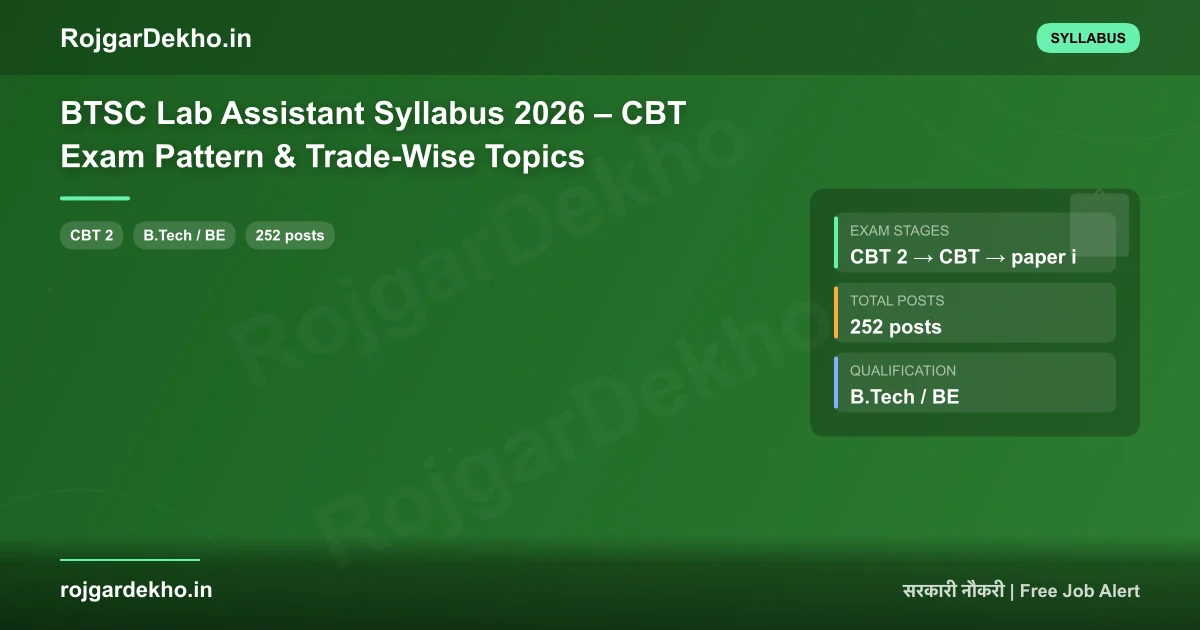
BTSC Lab Assistant Syllabus 2026 – CBT Exam Pattern & Trade-Wise Topics
⚡ BTSC Lab Assistant Exam — Quick Summary
| Organization | BTSC (Bihar Technical Service Commission) |
| Post | Lab Assistant |
| Selection Process | Written CBT → Document Verification |
| Total Marks | CBT: 100 marks | Lab Science + GK |
| Exam Mode | Online CBT (no interview) |
BTSC's Computer Based Test for all 1,091 Laboratory Assistant posts follows a single unified structure: 100 questions, 100 marks, 2 hours. What changes between the 12 advertisements is the technical section — your 75-mark trade paper is specific to your discipline. General Studies (25 marks) is common to all trades. Getting the technical section right is what separates candidates in the merit list.
This guide covers the full CBT pattern, then breaks down the syllabus trade by trade — starting with Computer Science and IT (252 posts, the largest category) and working through Electrical, Civil, Mechanical, Electronics, and Science (PCM). Read the section for your exact advertisement number before preparing.
CBT Exam Pattern – Complete Structure
| Component | Details |
|---|---|
| Mode | Computer Based Test (CBT) |
| Total Questions | 100 |
| Total Marks | 100 |
| Marks per Question | 1 mark each |
| Negative Marking | None |
| Duration | 2 Hours (120 Minutes) |
| Question Type | Multiple Choice (4 options) |
| Language | Hindi and English |
| General Studies | 25 marks (common to all trades) |
| Technical / Subject | 75 marks (trade-specific) |
No negative marking means you answer every question — guessing costs nothing. That said, CBT scores cluster tightly in competitive government exams. Candidates routinely score 68–78 out of 100 in similar BTSC exams. Leaving questions blank is a rank-killer.
👉 BTSC Lab Assistant Salary 2026 — clearing this CBT lands you a Pay Level 6 government job — see the full in-hand breakdown before you start preparing
Section 1 – General Studies (25 Marks) – All Trades
Every candidate, regardless of trade, answers the same 25 General Studies questions. BTSC's GS section for technical posts leans toward Bihar-specific content and applied knowledge rather than deep polity theory.
History & Culture (4–5 Questions)
- Bihar in the freedom movement — Champaran Satyagraha, Non-Cooperation, quit India events in Bihar
- Medieval Bihar — Nalanda, Vikramshila, Sher Shah Suri's administration
- Ancient Bihar — Maurya and Gupta dynasties, Pataliputra
- Important Bihar personalities — political, cultural, literary
Geography of India & Bihar (4–5 Questions)
- Bihar physical geography — Gangetic plains, Chotanagpur plateau (before Jharkhand), rivers (Ganga, Sone, Kosi, Gandak)
- Bihar districts, divisions, and important cities
- India physical geography — major mountain ranges, rivers, climate zones
- Natural resources and mineral wealth of Bihar
Indian Polity & Constitution (3–4 Questions)
- Fundamental Rights, Directive Principles, Fundamental Duties
- Structure of Parliament, State Legislature
- Bihar state legislature — Vidhan Sabha, Vidhan Parishad
- Panchayati Raj — three-tier structure, 73rd and 74th amendments
- Important constitutional articles relevant to state government employment
Science & Technology (4–5 Questions)
- Basic physics — mechanics, electricity, waves, optics (class 10–12 level)
- Basic chemistry — periodic table concepts, acids/bases, chemical reactions
- Biology basics — cell structure, human body systems (for Science trade especially)
- Recent developments in technology — AI, satellite missions, space (ISRO), national science programs
- Bihar's science and technology initiatives
Mathematics & Reasoning (3–4 Questions)
- Percentage, ratio, average, profit/loss
- Simple and compound interest
- Number series and basic reasoning
- Time, speed, distance (applied)
Current Affairs (4–5 Questions)
- Bihar state government schemes — Mukhyamantri Cycle Yojana, Har Ghar Bijli, Bihar Startup Policy
- National programs — PM Gati Shakti, PLI schemes, Digital India
- Sports events — national and international (last 12 months)
- Important appointments — Governor of Bihar, Chief Minister, state cabinet changes
- National and state awards, census data, economic survey highlights
Section 2 – Technical Syllabus (75 Marks) – By Trade
Advt 09/2026 — Computer Science & IT (252 Posts)
Biggest trade in this recruitment. CBT covers core Diploma/Degree CS curriculum:
Programming & Data Structures (20–25 marks)
- C language fundamentals — data types, loops, functions, arrays, pointers, structures
- Data structures — arrays, linked lists (singly/doubly), stacks, queues, trees (BST), graphs
- Sorting algorithms — bubble, selection, insertion, merge, quicksort (know time complexities)
- Searching — linear, binary search; Big-O notation basics
- OOP concepts — class, object, inheritance, polymorphism, encapsulation (C++/Java context)
Database Management Systems (12–15 marks)
- DBMS concepts — ACID properties, normalization (1NF, 2NF, 3NF, BCNF)
- SQL — SELECT, INSERT, UPDATE, DELETE; JOIN types; GROUP BY; aggregate functions
- ER diagram — entities, attributes, relationships, cardinality
- Transaction management — concurrency control, deadlock
- File organization — sequential, indexed, hashed
Computer Networks (12–15 marks)
- OSI model — 7 layers, function of each
- TCP/IP model — layers and protocols (HTTP, FTP, SMTP, DNS, DHCP)
- IP addressing — classes A/B/C, subnetting, subnet mask
- Routing — static vs dynamic, routing protocols (RIP, OSPF basics)
- LAN, WAN, MAN — topologies (bus, ring, star, mesh)
- Ethernet, MAC addresses, switching, ARP
Operating Systems (10–12 marks)
- Process management — process states, PCB, context switching
- CPU scheduling — FCFS, SJF, Round Robin, Priority (with examples)
- Memory management — paging, segmentation, virtual memory, page replacement algorithms (FIFO, LRU, Optimal)
- Deadlock — conditions, prevention, avoidance (Banker's algorithm)
- File systems — FAT, NTFS, Unix inodes
Digital Electronics & Computer Organization (10–12 marks)
- Number systems — binary, octal, hexadecimal conversions
- Boolean algebra — De Morgan's theorem, simplification (K-map)
- Logic gates — AND, OR, NOT, NAND, NOR, XOR
- Flip-flops — SR, JK, D, T; counters, registers
- CPU architecture — ALU, registers, instruction cycle, fetch-decode-execute
- Memory hierarchy — registers, cache, RAM, ROM types
Advt 04/2026 — Electrical Engineering (166 Posts)
- Circuit theory — Ohm's Law, KVL, KCL, Thevenin/Norton theorems, Superposition
- AC circuits — phasors, RLC circuits, resonance, power factor, power triangle
- Electrical machines — DC motors and generators (types, characteristics, speed control); Transformers (construction, EMF equation, efficiency, losses); Induction motors (squirrel cage, slip ring, slip, torque)
- Power systems — generation types (thermal, hydro, nuclear), transmission lines, substations, distribution systems, load flow basics
- Measurements — ammeters, voltmeters, wattmeters, energy meters, CTs and PTs, multimeters
- Control systems — open/closed loop, transfer functions, block diagrams, PID basics
- Electrical wiring — types of wiring, earthing methods, fuses, MCBs, switchgear
Advt 10/2026 — Civil & Rural Engineering (166 Posts)
- Structural engineering — bending moment, shear force diagrams, types of beams, RCC basics, concrete mix design
- Fluid mechanics — properties of fluids, Bernoulli's equation, flow measurement (Venturimeter, orifice), pipe flow, Darcy-Weisbach equation
- Soil mechanics — soil classification, compaction, permeability (Darcy's Law), consolidation, shear strength
- Surveying — chain surveying, levelling (staff reading, RL calculation), theodolite, total station basics, contour mapping
- Building materials — types of bricks, cement, concrete, steel, timber; IS codes basics
- Construction technology — formwork, scaffolding, foundation types, road construction (WBM, BM, surface dressing)
- Water supply and sanitation — sources of water, treatment process, distribution systems, sewer types, sewage treatment basics
Advt 11/2026 — Mechanical Engineering (166 Posts)
- Thermodynamics — laws (1st and 2nd), Carnot cycle, Rankine cycle, refrigeration cycle (VCR), IC engine cycles (Otto, Diesel)
- Fluid mechanics — Pascal's law, Bernoulli, flow through pipes, hydraulic machines (pumps, turbines — Pelton, Francis, Kaplan)
- Manufacturing processes — casting (sand casting, die casting), forging, welding (arc, MIG, TIG, resistance), machining (turning, drilling, milling, grinding), sheet metal operations
- Machine design — stress, strain, factor of safety, bolted and welded joints, shafts, keys, couplings, belts, gears
- Theory of machines — kinematics (links, pairs, mechanisms), governors, flywheel, cams
- Heat transfer — conduction (Fourier's law), convection, radiation, heat exchangers
- Engineering drawing — projection types, isometric view, sectional views, tolerances
Advt 05/2026 — Electronics & ECE (146 Posts)
- Analog electronics — diodes (rectifiers, clippers, clampers), BJT and MOSFET (biasing, amplifier configurations), op-amp (inverting, non-inverting, differentiator, integrator, comparator)
- Digital electronics — combinational circuits (adder, subtractor, multiplexer, demultiplexer, encoder, decoder); sequential circuits (flip-flops, counters, shift registers)
- Communication systems — AM, FM, PM modulation; AM/FM receivers; digital modulation (ASK, FSK, PSK, QAM); multiplexing (TDM, FDM)
- Signals and systems — Fourier series, Fourier transform, Laplace transform (basic), sampling theorem
- Microprocessors — 8085/8086 architecture, instruction sets, memory interfacing, I/O interfacing
- Electronic instruments — CRO, function generator, spectrum analyzer, signal generator basics
Advt 12/2026 — Science (Physics, Chemistry, Mathematics) – 164 Posts
This advertisement requires B.Sc in Physics, Chemistry, or Mathematics. Diploma holders are not eligible here. The technical section covers graduate-level science:
- Physics: Mechanics (Newton's laws, rotational motion, SHM), Waves & Optics (interference, diffraction, polarization), Electricity & Magnetism (Gauss's law, Faraday's law, Maxwell's equations), Modern Physics (photoelectric effect, X-rays, nuclear physics basics), Semiconductor devices
- Chemistry: Physical Chemistry (thermodynamics, chemical equilibrium, electrochemistry, kinetics), Organic Chemistry (reaction mechanisms, named reactions, functional group identification), Inorganic Chemistry (coordination compounds, d-block elements, p-block properties)
- Mathematics: Calculus (differential, integral), Linear algebra (matrices, determinants, eigenvalues), Differential equations, Coordinate geometry (conics), Complex numbers, Probability & Statistics
Preparation Strategy – What Actually Works
For CS/IT Trade (252 posts — most competitive)
CS candidates should spend 60% of preparation time on DBMS + OS + Networking — these three subjects consistently generate the most questions in similar state technical exams. Data structures over algorithms at this level. Practice SQL queries manually on paper, not just theory. For networks, memorize the OSI model with one real example per layer — it sticks better during the exam.
For Electrical (166 posts)
Machines (DC + transformers + induction motor) typically carry 25–30 marks in Electrical technical papers. Start there. Circuit theorems (Thevenin, Norton, Superposition) are 10-15 mark territories. Power systems theory — know generation types and the purpose of each component in a substation.
For GS (25 marks — all trades)
Bihar-specific current affairs from the last 12 months: read one Bihar newspaper summary daily for 4 weeks before the exam. Bihar Geography — know all 38 districts, 9 divisions, major rivers and their tributaries. Constitution and Polity — Laxmikant's Chapter 5 (Fundamental Rights) and Chapter 27 (Panchayati Raj) cover most BTSC GS polity questions.
Experience Weightage (25 marks — selection only)
Experience marks do not appear in the CBT — they are added to your CBT score afterward for the final merit list. A candidate scoring 65 in CBT with 25 experience marks (3+ years) outranks a candidate scoring 80 in CBT with zero experience. If you have relevant technical work experience, the experience certificate is as important as your exam preparation.
👉 BTSC Lab Assistant Eligibility 2026 — check which of the 12 advertisement numbers matches your exact diploma trade before registering
Frequently Asked Questions
Q1. Is there negative marking in BTSC Lab Assistant CBT 2026?
No negative marking. Attempt all 100 questions — unanswered questions are zero, wrong answers are also zero. There is no penalty for guessing.
Q2. What is the syllabus for the largest trade (CS/IT)?
Programming (C/DSA), DBMS, Computer Networks, Operating Systems, and Digital Electronics — each carrying roughly 12–20 marks out of 75. General Studies adds another 25 marks common to all.
Q3. Which advertisement do I apply to if I have a Diploma in Computer Science?
Advt 09/2026 — Computer Science / IT — with 252 vacancies. Make sure your diploma branch exactly matches the advertisement description before applying.
Q4. Is there a separate cut-off for GS and Technical?
No sectional cut-off has been announced. The merit list uses the combined score out of 100 (CBT) plus experience weightage (25 marks).
Q5. When will the BTSC Lab Assistant exam date be announced?
BTSC has not announced the CBT date yet. Applications close on 06 May 2026. Exam dates are typically announced 4–8 weeks after the application window closes. Check btsc.bihar.gov.in for official updates.
Q6. What standard reference books work for the technical section?
For CS: DS by Lipschutz, Computer Networks by Forouzan, OS by Silberschatz. For Electrical: Electrical Technology by BL Theraja (Volume 1 & 2). For Civil: Building Construction by Rangwala, Fluid Mechanics by Modi & Seth. Most BTSC-level technical questions are at diploma-curriculum depth — standard polytechnic textbooks are sufficient.
Trade-Wise Preparation Strategy
The 80-mark technical section is where most candidates are separated on the merit list. The General Awareness section (20 marks) is similar across all trades, but your competitive advantage lives in the technical portion. Here is how to approach preparation by the three highest-vacancy trades:
Computer Science & IT (Advt. No. 02/2026 — 210 posts): Focus on Data Structures (arrays, linked lists, stacks, queues, trees, sorting algorithms), DBMS (normalization, SQL queries, transaction management), Computer Networks (OSI model, TCP/IP, subnetting basics), Operating Systems (process management, memory management, file systems), and Programming fundamentals in C/C++. Questions are set at diploma-curriculum depth — not degree-level competitive exam depth.
Electrical (Advt. No. 04/2026): Core areas include DC circuits (Ohm's Law, Kirchhoff's Laws, Thevenin/Norton), AC fundamentals (phasors, power factor, resonance), Transformers (construction, working, efficiency calculations), Electrical Machines (DC motors/generators, induction motors, synchronous machines), and Electrical Measurements (instruments, error types, bridge circuits). BL Theraja Volumes 1 and 2 cover almost all of this.
Civil (Advt. No. 05/2026): Focus areas are Building Construction (materials, masonry, foundations), Surveying (chain surveying, levelling, theodolite, contour maps), Structural basics (beams, columns, bending moment diagrams), Hydraulics & Fluid Mechanics (Bernoulli's theorem, pipe flow, pump basics), and Estimating & Costing (rate analysis, BOQ preparation).
General Awareness — What Actually Gets Asked
The 20-mark GS section at BTSC Lab Assistant level focuses on three areas: Bihar-specific current affairs (state government schemes, industrial developments, appointments), national current affairs from the last 6 months (government schemes, budget highlights, awards), and basic science concepts at Class 10 level (physics laws, chemistry periodic table fundamentals, biology basics).
Do not spend disproportionate time on GS. Since all trade candidates face the same GS paper, it is a leveller — not a differentiator. Spend 20–25% of your preparation time on GS and 75–80% on the technical section where trade-specific advantage is built.
Experience Weightage — How the Merit List Is Actually Constructed
The BTSC Lab Assistant merit list uses: CBT Score (100 marks) + Experience Score (up to 25 marks) = Final Merit Score (up to 125 marks). Experience is calculated as 2 marks per year of relevant post-qualification experience in a government polytechnic, up to 12.5 years (25 marks maximum).
This means a candidate with 5 years of relevant experience and a CBT score of 72 has a final score of 82, which can beat a fresher who scored 80 on the CBT. If you have relevant government polytechnic experience, document it carefully — the certificate from your institution head is required and must match the dates on your appointment order.
For fresh candidates with no experience, the strategy is clear: maximize CBT score to compensate for the 0-mark experience component. A score of 80+ puts a fresher ahead of most experienced candidates unless they scored significantly above 70 on CBT.