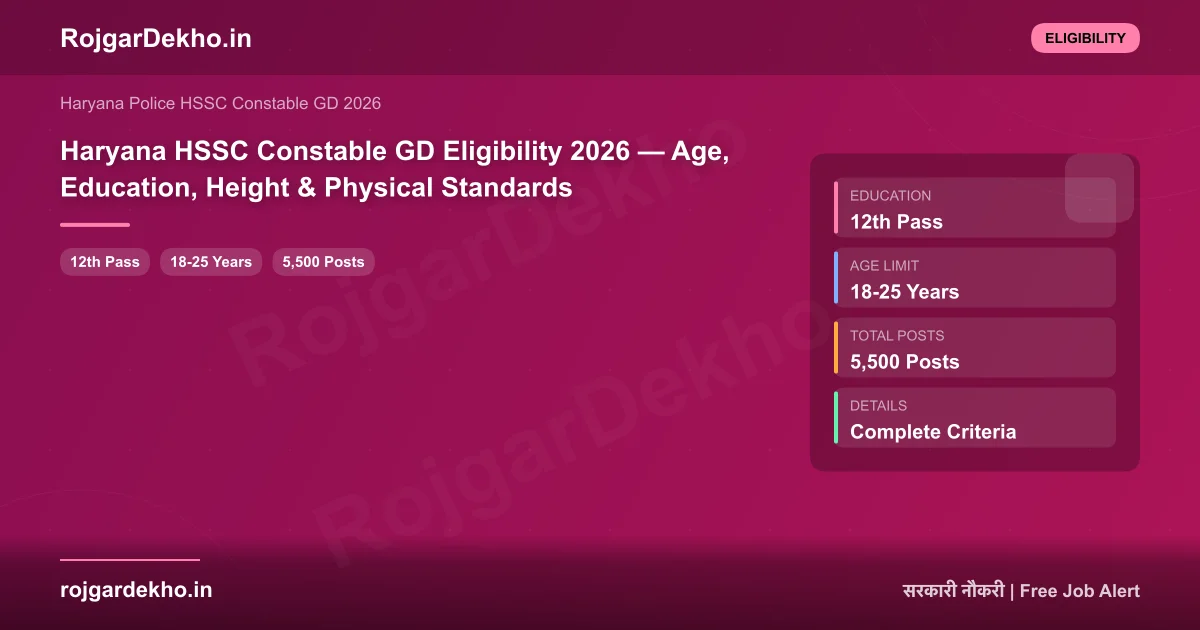
Haryana Police Constable GD recruitment 2026 is a massive opportunity — 5,500 posts (4,900 male + 600 female). But Haryana police has strict physical standards, and the unique requirement is HSSC Group C CET qualification — without it, you can't apply.
Age Limit
| Category | Min | Max |
|---|---|---|
| General | 18 | 25 |
| SC / BCA / BCB (Haryana) | 18 | 28 (+3) |
| ESM / PH | As per Haryana govt rules | Additional relaxation |
As on 1st January 2026. Age relaxation for Haryana domicile reserved categories only.
Education
12th pass (10+2) from a recognized board + HSSC Group C CET qualified. CET is the gateway — without CET score, application rejected.
Physical Standards
Male
| Parameter | General | SC/BCA/BCB |
|---|---|---|
| Height | 170 cm | 168 cm |
| Chest (Unexpanded) | 83 cm | 81 cm |
| Chest (Expanded) | 87 cm (+4) | 85 cm (+4) |
Female
| Category | Height |
|---|---|
| General | 158 cm |
| SC / BCA / BCB | 156 cm |
Physical Efficiency Test (PET)
| Test | Male | Female |
|---|---|---|
| Running | 2.5 km in 12 min | 1 km in 6 min |
| Long Jump | 3.60 meters | 2.50 meters |
| High Jump | 1.15 meters | 0.90 meters |
Other
- Haryana domicile required for reservation
- No application fee — completely free
- Character certificate from gazetted officer
👉 Salary: Haryana HSSC Constable Salary 2026
👉 Syllabus: Haryana HSSC Constable Syllabus 2026
HSSC Group C CET — The Gateway
This is the most unique eligibility requirement. Unlike most police recruitments where you directly apply, Haryana requires you to first clear the HSSC Group C Common Eligibility Test (CET). Only CET-qualified candidates can apply for Constable GD.
CET is conducted by HSSC for all Group C posts in Haryana — Constable, Clerk, Patwari, Gram Sachiv, etc. You need to clear CET first, get your score, and then apply when the Constable recruitment opens. If you haven't appeared for CET, you cannot apply — there's no alternative.
Domicile & Reservation
Haryana domicile is crucial for this recruitment:
- Haryana domicile mandatory for all reserved category benefits (SC, BCA, BCB, ESM, EWS)
- Non-Haryana candidates can only apply under General/unreserved category
- Haryana-specific reservation: BCA (Backward Class A) and BCB (Backward Class B) — different from national OBC
- Sports quota, ESM quota, outstanding player quota — separate horizontal reservation
Medical Standards
Medical examination is strict for police service. Common rejection reasons include:
- Vision: 6/6 in both eyes without glasses. Colour blindness — rejected. LASIK surgery — accepted if done 1 year+ before medical.
- Flat Feet: Rigid flat feet = rejection. Flexible flat feet = case-by-case.
- Knock Knees: Not accepted
- Varicose Veins: Not accepted
- Tattoo: Only on inner forearm allowed. Visible tattoos on face, neck, hands — rejected.
- Dental: Minimum 14 dental points required
- Hearing: Normal in both ears
- BMI: Must be within normal range — neither underweight nor overweight
PET/PST Detailed Standards
The Physical Efficiency Test is the make-or-break stage. More candidates fail here than in the written exam:
Male Candidates
- 2.5 km run in 12 minutes — pace yourself, don't sprint at start
- Long jump: 3.60 meters — practice with proper technique
- High jump: 1.15 meters — Fosbury flop technique works best
Female Candidates
- 1 km run in 6 minutes
- Long jump: 2.50 meters
- High jump: 0.90 meters
Preparation tip: Start physical preparation at least 3 months before PET. Daily running + jumping drills. Most failures are in the run — build endurance first, speed later.
Frequently Asked Questions
Is HSSC CET mandatory for Haryana Police Constable?
Yes. Without CET qualification, you cannot even fill the Constable GD form. CET is the gateway for all HSSC Group C posts.
Can non-Haryana candidates apply?
Yes, but only under General/unreserved category. Category-based reservation and age relaxation is only for Haryana domicile holders.
What is the height for SC/ST candidates?
Male SC/BCA/BCB: 168 cm (vs 170 cm General). Female SC/BCA/BCB: 156 cm (vs 158 cm General). 2 cm relaxation.
Is there any application fee?
No. The application is completely free for all categories. Zero fee.
Can candidates with spectacles apply?
You can apply, but during the medical exam, vision must be 6/6 without glasses. LASIK surgery is accepted if done at least 1 year before the medical test.
How is the final merit prepared?
CET Score + Written Knowledge Test + PET/PST + Document Verification. No interview.
Life After Selection — What to Expect
Once selected, you'll undergo 9-12 months of rigorous training at Police Training Centre (PTC) Sunaria, Rohtak or other Haryana PTC centres. Training includes physical fitness, weapon handling, law, traffic management, and crowd control. After training, you're posted at a police station within Haryana — typically in the district you applied for.
Starting salary: Level 3 (₹21,700 basic), in-hand approximately ₹30,000-35,000 with DA and allowances. After 5-7 years, you can appear for departmental exams to become Head Constable and further rise to ASI, SI through promotions.
Also Read:
HSSC CET — How to Get Qualified
Before you can apply for HSSC Constable, you need to clear the Common Eligibility Test (CET). Here's everything you need to know:
- CET is conducted annually by HSSC — it's a screening exam that tests your basic aptitude and knowledge
- Syllabus covers — General Knowledge, Reasoning, Mathematics, Hindi, and English — all at 12th class level. Nothing beyond what you studied in school.
- Once you clear the CET cut-off, you receive a score card that is valid for 3 years. During these 3 years, you can apply for any HSSC Group C and D post (including Constable) without appearing for CET again.
- CET score is used for shortlisting — the higher your CET score, the better your chances of being called for the physical test and further rounds.
Think of CET as a one-time investment — clear it once with a good score, and you're eligible for multiple HSSC recruitments over the next 3 years.
Training at PTC Sunaria
Once selected as a Haryana Police Constable, you undergo training at the Police Training Centre (PTC), Sunaria (Bhiwani district). Here's what to expect:
- Duration — 9 to 12 months of rigorous training
- Physical drills at 5 AM — the day starts early with running, PT exercises, obstacle course, and endurance training. The first month is the toughest — your body needs time to adjust.
- Weapon training — you'll learn to handle the standard police service weapons, including firearms training at the shooting range. Safety protocols are strictly enforced.
- Law classes — Indian Penal Code (IPC), Criminal Procedure Code (CrPC), Indian Evidence Act, traffic laws, and local acts. This classroom training is as important as physical training.
- Traffic management — practical training on managing traffic, handling road accidents, and dealing with traffic violations.
- First aid — basic medical emergency response, CPR, wound management. As a constable, you're often the first responder at accident sites.
Training is tough — but it transforms you physically and mentally. The discipline, fitness, and confidence you gain during these months stay with you throughout your police career. Many constables describe their PTC training as the hardest but most rewarding period of their lives.
Haryana Police vs CAPF (SSC GD) — Which is Better for Haryana Residents?
This is a common dilemma for Haryana youth who are eligible for both state police and central paramilitary forces. Here's an honest comparison:
| Parameter | Haryana Police Constable | CAPF (SSC GD — BSF, CRPF, etc.) |
|---|---|---|
| Posting | Within Haryana — close to home | All-India — could be Kashmir, NE, or border |
| Risk Level | Lower — law & order, traffic, crime | Higher — border duty, anti-naxal ops, riot control |
| Salary (starting) | ₹21,700 (Level 3) + Haryana DA | ₹21,700 (Level 3) + Central DA + risk allowance |
| Family Time | More — posted near home in Haryana | Less — remote postings, leave depends on situation |
| Allowances | Standard state allowances | Higher — field area allowance, risk allowance, ration money |
| Promotion | Constable → Head Constable → ASI → SI | Constable → Head Constable → ASI → SI (similar) |
For Haryana residents who want to stay near family, state police is usually the preferred choice. The posting is within the state, you can go home on weekends, and the risk level is manageable. CAPF pays slightly more in allowances, but the all-India posting and higher risk factor (especially for BSF and CRPF) make it a tougher lifestyle choice.
That said, many candidates apply for both and decide based on which selection comes through first. There's no rule against appearing for state police and SSC GD simultaneously.
Frequently Asked Questions
Is CET conducted every year?
HSSC aims to conduct CET annually, but the exact schedule depends on the commission's calendar. In some years, there may be delays. The good news is that once you clear CET, the score card is valid for 3 years — so even if CET is delayed the next year, your existing score card remains valid and usable for any HSSC recruitment during that period.
Can I apply for Constable after failing CET?
No. CET qualification is mandatory for HSSC Constable (and all HSSC Group C/D posts). If you don't clear the CET cut-off, you cannot apply. However, you can appear for CET again in the next cycle. There's no limit on the number of attempts — you can keep trying until you clear it or cross the age limit for the post you want.
What is the training stipend at PTC Sunaria?
During training at PTC Sunaria, constable trainees receive a stipend. The exact amount varies, but it's typically in the range of ₹14,000-18,000 per month. It's not the full constable salary, but it covers your basic expenses during training. Accommodation, food, and uniforms are provided by the training centre. After completing training and being posted, you start receiving the full salary (Level 3 — ₹21,700 basic + DA + HRA).