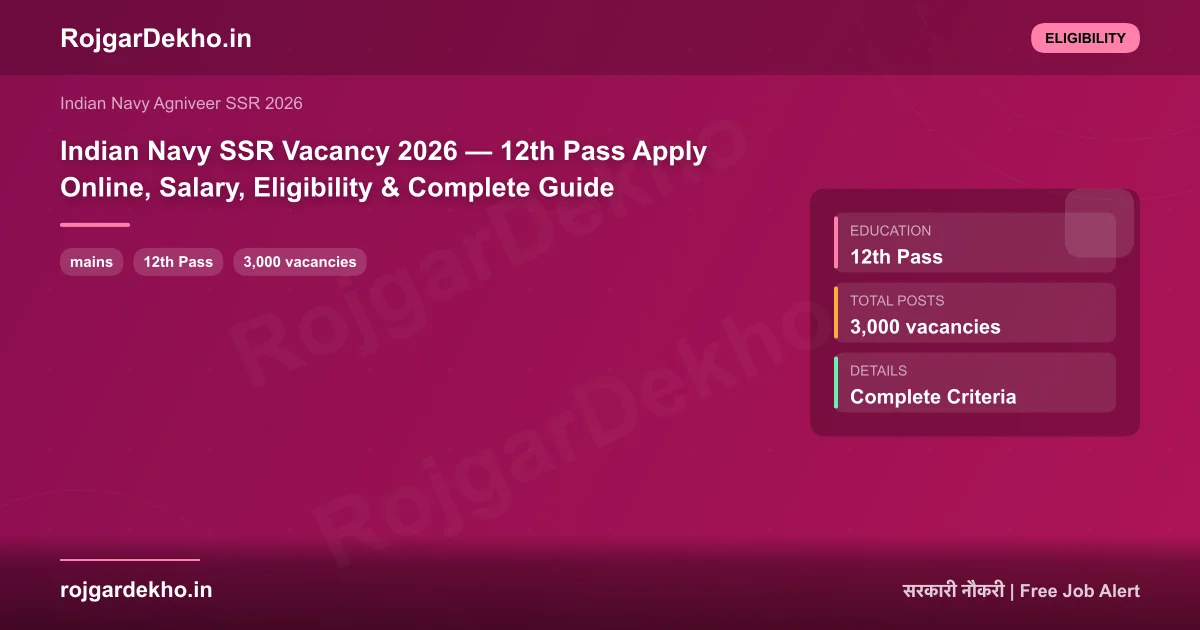
Indian Navy SSR Vacancy 2026 — Technical Branch Opportunity for 12th PCM Students
If you have cleared your 12th board exams with Physics, Chemistry, and Mathematics — the Indian Navy's Agniveer SSR (Senior Secondary Recruit) 2026 is the most prestigious entry-level technical opportunity available to you right now. The application form is open from 14 March 2026 and the last date to apply is 6 April 2026. This is not an opportunity you want to miss.
SSR stands for Senior Secondary Recruit, and it is the technical branch of the Indian Navy's Agniveer programme. SSR recruits work in domains like electronics, weapons systems, propulsion engineering, aviation maintenance, and communications — the backbone of India's naval war-fighting capability. If you want to serve in a genuinely technical role, work with cutting-edge naval equipment, and build skills that translate directly into high-value civilian careers, SSR is the path. The form closes on 6 April 2026 — apply today.
Navy SSR 2026 — Quick Overview
| Parameter | Details |
|---|---|
| Post Name | Agniveer SSR (Senior Secondary Recruit) |
| Conducting Body | Indian Navy |
| Educational Eligibility | 12th pass with PCM or PCB, minimum 50% aggregate |
| Age Limit | 16.5 to 21 years |
| Expected Vacancies | Approximately 3,000 |
| Form Start Date | 14 March 2026 |
| Last Date to Apply | 6 April 2026 |
| Application Fee | Rs.550 (SC/ST candidates: Rs.0) |
| Exam Name | INET (Indian Navy Entrance Test) |
| Expected Exam Date | May 2026 |
| Service Period | 4 Years (Agniveer Scheme) |
| Official Website | joinindiannavy.gov.in |
Eligibility Criteria — Who Can Apply for Navy SSR?
Educational Qualification
Candidates must have passed Class 12th (Senior Secondary) from a recognized board with Physics, Chemistry, and Mathematics (PCM) as core subjects. The minimum aggregate score required is 50% across all subjects in the 12th board examination. Additionally, candidates who have studied Physics, Chemistry, and Biology (PCB) are also eligible for certain specific trades. Your 12th marksheet must clearly reflect the required subjects and minimum percentage.
Age Limit
The age should be between 16.5 years and 21 years at the time of enrollment. This translates to a date of birth window of 1 November 2004 to 30 April 2009 (both dates inclusive). The Agniveer scheme does not provide age relaxation for any category — General, OBC, SC, or ST candidates all fall under the same age bracket.
Nationality and Marital Status
The candidate must be a male Indian citizen. He must be unmarried at the time of enrollment and must remain unmarried throughout the 4-year Agniveer service period. Marriage is not permitted during service under the Agniveer scheme.
Physical Standards
Minimum height of 157 cm is required. Weight and chest must be proportionate to height as per Indian Navy standards. Eyesight must meet the Navy's visual acuity requirements. A full medical examination will be conducted after the Physical Fitness Test to assess overall fitness.
SSR Technical Branches — What Will You Actually Do?
Electronics (ET Branch)
Electronics Technicians in the Navy work with radar systems, sonar equipment, fire control systems, and electronic warfare systems aboard warships and submarines. This is highly specialised work that requires a strong foundation in electronics and electrical circuits — exactly what 12th PCM students have. The Navy provides advanced training at INS Valsura and other establishments, and the technical skills acquired are directly applicable in the defence electronics and civilian technology sector after service.
Weapons (WE Branch)
SSR recruits in the weapons branch are trained in missile systems, gun armament, underwater weapons (torpedoes and mines), and naval gunnery. This is among the most operationally critical roles in the Navy. Weapons ratings serve aboard destroyers, frigates, and submarines and are responsible for maintaining combat readiness of the ship's weapons suite. The discipline, precision, and technical knowledge developed in this branch are unique to the Indian Navy.
Engineering (ER Branch — MER and GS)
Engineering branch SSRs work in marine engineering (MER) — maintaining and operating ship propulsion systems, diesel engines, gas turbines, and auxiliary machinery — or in General Service (GS) roles. This is the equivalent of being an engineer in the most demanding environment possible: at sea, often in high-pressure situations. Post-service, Marine Engineering qualifications are highly valued in merchant shipping and the private engineering sector.
Aviation (Air Branch)
Aviation SSRs are posted at naval air stations and aircraft carriers for maintenance of naval aircraft including helicopters, maritime patrol aircraft, and carrier-based fighters. They assist aircraft maintenance engineers in line maintenance, component servicing, and airfield operations. This branch opens pathways into the civilian aviation and aerospace maintenance industry after completing Agniveer service.
Communication (Telecom / IT Branch)
Communications branch SSRs manage naval communication systems, encrypted radio networks, satellite communication, and information technology infrastructure aboard ships and shore establishments. In the age of network-centric warfare, this is an increasingly critical branch. Skills developed here — in networking, IT systems, and cryptographic communication — directly translate into high-demand civilian IT and telecommunications jobs.
Navy Agniveer SSR Salary — Year by Year
The salary structure is identical across all Agniveer categories — MR and SSR both receive the same package. Here is the complete breakdown:
| Year of Service | Total Package (Monthly) | Agniveer Corpus Contribution (30%) | In-Hand Salary (70%) |
|---|---|---|---|
| Year 1 | Rs.30,000 | Rs.9,000 | Rs.21,000 |
| Year 2 | Rs.33,000 | Rs.9,900 | Rs.23,100 |
| Year 3 | Rs.36,500 | Rs.10,950 | Rs.25,550 |
| Year 4 | Rs.40,000 | Rs.12,000 | Rs.28,000 |
Upon completion of 4 years, you receive a Seva Nidhi lump sum of Rs.10.04 lakh. This amount is entirely tax-free. The government contributes an equal amount to the corpus fund. Food and accommodation being free throughout the service period means your effective savings rate is significantly higher than the in-hand figure suggests.
Benefits of Joining as Agniveer SSR
- Free Food: All meals provided free of cost throughout the 4-year service period — no deductions from salary.
- Free Accommodation: Naval accommodation provided at all postings — no rent, no housing expense.
- Rs.48 Lakh Life Insurance: All Agniveers are covered under a comprehensive life insurance policy worth Rs.48 lakh during service.
- CSD Canteen: Access to Canteen Stores Department — household items, electronics, and food at subsidised prices.
- Travel Concession: Concessional railway travel entitlement for the Agniveer and family members.
- Free Medical: Healthcare for the Agniveer and immediate family at naval hospitals and empanelled civil hospitals.
- Advanced Technical Training: World-class training at naval training establishments — the equivalent of specialised technical education, valued in both defence and civilian sectors.
- Certificate and Skill Recognition: Post-service, the Navy provides certificates recognising trades and skills acquired — accepted by many civilian employers.
INET Exam Pattern for Navy SSR 2026
The INET for SSR is more demanding than the MR exam. With 12th PCM background, the difficulty level is appropriate. Here is the complete exam pattern:
| Subject | Number of Questions | Marks |
|---|---|---|
| Mathematics | 25 | 25 |
| Science (Physics + Chemistry) | 25 | 25 |
| English | 25 | 25 |
| General Knowledge | 25 | 25 |
| Total | 100 Questions | 100 Marks |
Duration: 60 minutes | Each Question: 1 mark | Negative Marking: 0.25 marks deducted per wrong answer
Qualifying Score: 40% for General/OBC candidates | 30% for SC/ST candidates
The Mathematics section covers 12th level topics including algebra, trigonometry, coordinate geometry, calculus basics, probability, and statistics. Science covers 12th Physics (mechanics, electricity, optics, modern physics) and Chemistry (atomic structure, chemical bonding, states of matter, organic basics). English tests grammar, comprehension, and vocabulary at 12th level. GK covers current affairs and static general awareness.
Physical Fitness Test (PFT) Standards
Same standards apply for both SSR and MR. After clearing INET, shortlisted candidates must clear the PFT:
| Test | Standard / Requirement |
|---|---|
| 1.6 km Run | Complete in 7 minutes or less |
| Squats (Uthak-Baithak) | 20 repetitions |
| Push-ups | 10 repetitions |
| Minimum Height | 157 cm |
| Weight | Proportionate to height as per Navy norms |
| Chest | Proportionate, minimum 5 cm expansion required |
PFT is qualifying — there is no merit ranking based on physical performance. All candidates who pass PFT proceed to the medical examination. The 1.6 km run within 7 minutes is the event where most candidates fail — begin running training well before the exam date.
SSR vs MR — Which Is Better for You?
For 12th PCM students, this comparison is important. Both posts fall under the same Agniveer scheme but serve very different purposes:
| Parameter | Agniveer SSR | Agniveer MR |
|---|---|---|
| Minimum Qualification | 12th pass PCM/PCB (50%) | 10th pass (50%) |
| INET Paper | 100 Questions / 60 Minutes | 50 Questions / 30 Minutes |
| Branch / Domain | Technical (Electronics/Weapons/Engineering/Aviation) | Hospitality (Chef/Steward/Hygienist) |
| INET Difficulty | 12th PCM level — challenging but fair | 10th level — easier |
| Post-Service Career | Technical sector — engineering, IT, aviation, defence PSUs | Hospitality, healthcare, or permanent Navy |
| Monthly Salary | Rs.21,000 to Rs.28,000 in-hand (same) | Rs.21,000 to Rs.28,000 in-hand (same) |
| Seva Nidhi (4 years) | Rs.10.04 lakh — same | Rs.10.04 lakh — same |
| Why Choose This | Better career alignment for PCM students; technical skills are more transferable | Easier entry; suitable if only 10th is cleared |
Recommendation: If you have 12th PCM, apply for SSR. The technical training and domain knowledge you gain in SSR is far more valuable in the civilian job market compared to the hospitality domain of MR. The salary is the same — but the long-term career advantage clearly favours SSR for PCM students.
How to Apply for Navy SSR 2026 — Step by Step
The complete application process is online at joinindiannavy.gov.in. Follow every step carefully:
- Go to joinindiannavy.gov.in on your browser.
- Navigate to "Agniveer Recruitment" section and select "SSR (Senior Secondary Recruit) 2026".
- New Registration: Enter your mobile number and email ID. Verify with OTP. Save the registration number.
- Log in and fill the application form — personal details, educational qualifications (10th and 12th marks), preferred examination centre city.
- Upload documents — passport-size photograph (white background, JPG format, within specified size) and signature.
- Pay the application fee: Rs.550 for General/OBC. SC/ST candidates pay Rs.0. Payment via debit card, credit card, net banking, or UPI.
- Review all details thoroughly. Errors cannot be corrected after final submission.
- Submit the application and download/print the confirmation page. Note your application number — you will need it for admit card download.
Pro tip: Apply at least 2-3 days before the deadline of 6 April. Government recruitment portals experience very high traffic on the last day, leading to slow loading times and occasional errors. Do not risk losing your chance due to a technical issue on the server.
Frequently Asked Questions (FAQ)
What is Agniveer SSR in the Indian Navy?
Agniveer SSR (Senior Secondary Recruit) is the technical entry branch of the Indian Navy under the Agniveer scheme. SSR recruits serve for 4 years in technical domains including electronics, weapons, engineering, aviation, and communications. It requires 12th PCM/PCB with 50% and is the most technically enriching entry-level naval role available to 12th pass candidates.
What is the minimum qualification for Navy SSR?
You must have passed Class 12th with Physics, Chemistry, and Mathematics (PCM) from a recognized board with a minimum of 50% aggregate marks. Physics and Chemistry with Biology (PCB) is also accepted for certain trades. There is no requirement for a gap year or recent passing — older passouts are also eligible as long as they meet the age criteria.
What is the SSR INET exam like?
The SSR INET consists of 100 questions in 60 minutes, divided equally across Mathematics (25Q), Science (25Q), English (25Q), and General Knowledge (25Q). Each correct answer carries 1 mark and each wrong answer results in a deduction of 0.25 marks. The qualifying cutoff is 40% for General/OBC and 30% for SC/ST candidates. Syllabus is based on 12th NCERT PCM.
When will the Navy SSR form close?
The online application window closes on 6 April 2026. After this date, no applications will be accepted under any circumstances. The website will automatically stop accepting registrations at the deadline. Apply well in advance — do not wait for the final day.
How many vacancies are there in Navy SSR 2026?
The official notification does not specify the exact vacancy count. Based on previous batch patterns, approximately 3,000 vacancies are expected for the SSR 2026 batch. The actual number will be confirmed during the INET admit card stage or through an official Navy press release.
What happens after 4 years of Agniveer service?
After completing 4 years, Agniveer SSR recruits receive a tax-free Seva Nidhi of Rs.10.04 lakh. Additionally, up to 25% of Agniveers may be selected for permanent induction into the Indian Navy based on performance and merit. Those not retained receive priority in state police forces, paramilitary, defence PSUs, and several private sector employers who have committed to preferential hiring of Agniveers.
Can I apply for both SSR and MR simultaneously?
If you meet the eligibility criteria for both — i.e., you have cleared both 10th (50%) and 12th PCM (50%) — you can apply for both SSR and MR in the same cycle. However, you will appear for different INET papers. If selected in both, you will be required to choose one. Strategically, SSR is the better option for 12th PCM students due to superior technical career prospects.
What is the physical test for Navy SSR?
The Physical Fitness Test (PFT) requires candidates to complete a 1.6 km run in 7 minutes, perform 20 squats, and do 10 push-ups. Minimum height is 157 cm. Weight and chest must be proportionate to height. The PFT is a pass/fail test — no merit ranking. A medical examination follows for candidates who clear the PFT.