Lakshmibai College Non-Teaching Salary 2026: Post-wise DU Pay
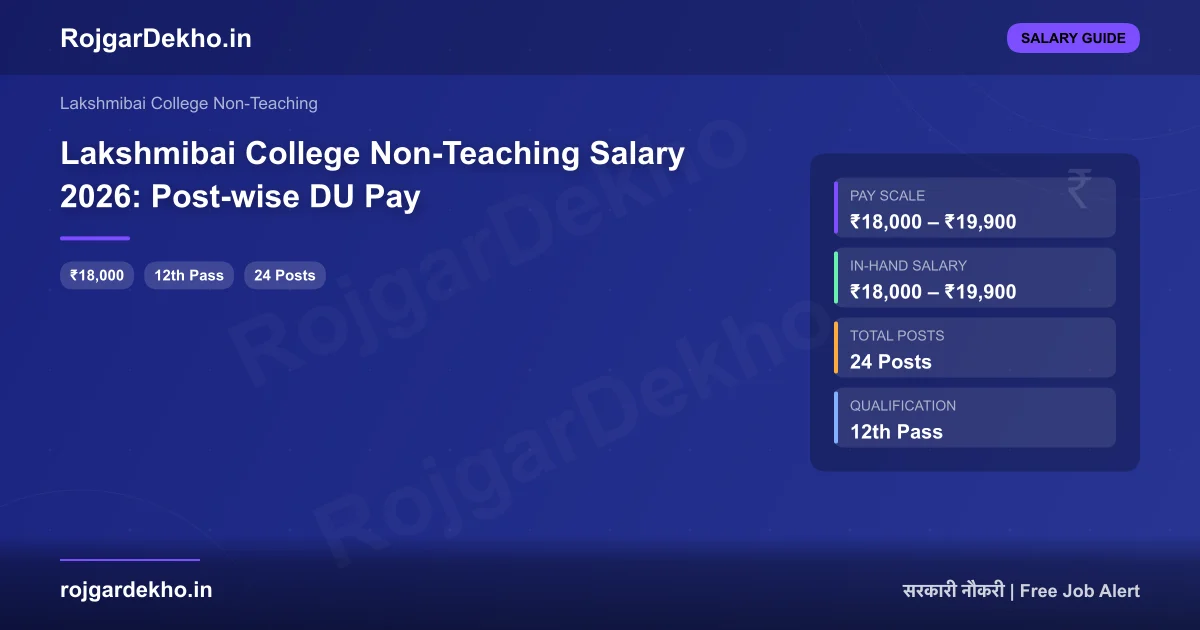
- Pay follows the 7th CPC pay matrix as applicable to University of Delhi colleges, with a defined level per post.
- Indicative levels: Junior Assistant Level 2, attendants Level 1, Lab Assistant Level 4, higher posts above.
- As a Delhi-based DU college, metro HRA and central allowances make the real in-hand attractive.
The Lakshmibai College (University of Delhi) Non-Teaching 2026 salary follows the 7th Central Pay Commission pay matrix as applicable to DU colleges, so each post sits at a defined pay level with Dearness Allowance, House Rent Allowance and other allowances on top. These are permanent University of Delhi posts, which is a major attraction — secure central-funded employment at a respected institution in Delhi. This article gives the post-wise pay picture, the allowances that build the take-home, and the job profile for each role. Pay levels are indicative of DU/7th-CPC norms; always confirm the exact level for each post against the official notification.
👉 Lakshmibai College Non-Teaching Eligibility 2026 — check the post-wise qualification before you plan for this pay.
Post-wise pay (indicative, 7th CPC)
| Post | Pay Level | Indicative basic pay |
|---|---|---|
| Library Attendant / Lab Attendant | Level 1 | ₹18,000 entry basic |
| Junior Assistant | Level 2 | ₹19,900 entry basic |
| Lab Assistant | Level 4 | ₹25,500 entry basic |
| Assistant | Level 6 (typical DU) | ₹35,400 entry basic |
| Librarian | Academic level (as per UGC/DU) | Substantially higher |
These levels are indicative of the DU/7th-CPC norms for such posts; the binding level for each post is whatever the official notification specifies. Use this to understand the broad picture: the attendant and Junior Assistant posts offer a solid entry-level government salary, while the Assistant and Librarian posts pay more, in line with their higher qualification.
Allowances that build the take-home
On top of basic pay, employees receive allowances that significantly raise the in-hand, especially in Delhi:
- Dearness Allowance (DA) — a percentage of basic, revised twice a year to track inflation.
- House Rent Allowance (HRA) — at the higher metro rate for Delhi, if not in institutional accommodation.
- Transport Allowance and other applicable allowances.
- Medical benefits and a structured leave entitlement as per DU/Government rules.
- Pension/NPS and other service benefits of a permanent post.
Because the college is in Delhi, the metro HRA and transport allowance are at the top slab, which meaningfully lifts the real in-hand above the basic pay alone. For an entry-level post, the combination of a central pay level plus full Delhi allowances makes the package noticeably stronger than many comparable jobs.
Job profile — what each role does
The work matches the cadre. A Junior Assistant handles clerical and administrative support — file and record management, data entry, correspondence and office coordination in the college administration. A Library Attendant supports the library’s daily operations — shelving, issue/return assistance and upkeep — while a Librarian manages the library professionally. A Lab Assistant and Lab Attendant support the practical functioning of the Home Science or Computer laboratories — preparing, maintaining and assisting in lab work. An Assistant handles higher administrative responsibilities. All roles sit within a respected University of Delhi college with the stability and structure of a permanent academic-institution job.
👉 Lakshmibai College Non-Teaching Syllabus & Exam Pattern — the two-stage selection you clear to reach these roles.
Career growth and stability
As permanent University of Delhi posts, these roles offer the stability and structure of a government-funded career: regular increments, twice-yearly DA revisions, and promotion opportunities within the cadre over time. A Junior Assistant can progress to higher clerical grades; attendant and lab posts have their own progression. Combined with central allowances, pension/NPS and the security of a permanent post at a reputed institution, even the entry-level roles offer a stable, steadily-improving career — the kind of secure government job many candidates specifically target, with the added prestige of working at the University of Delhi.
What no other site tells you
Two honest points. First, do not judge these posts by the basic-pay number alone — for a Delhi-based DU college, the allowances (especially metro HRA and DA) add substantially to the take-home, so the real in-hand even for an entry-level post is more attractive than the bare basic suggests. Second, the genuine value here is the permanence and prestige: a permanent University of Delhi non-teaching post is a secure, respected government job with full benefits and a Delhi posting, which for the qualifications required (a graduate for Junior Assistant, 10th/12th plus a skill certificate for attendants) is an excellent outcome. The honest caveat is that the entry-level posts are not high-paying in absolute terms and the work is administrative or support-oriented, but for security, central benefits, a Delhi posting and the standing of a DU college, the package is well worth targeting. Confirm the exact pay level for your post in the notification, and judge the role by its full package and stability, not the basic pay alone.
Frequently Asked Questions
What is the salary of a Lakshmibai College Junior Assistant?
It is paid on 7th CPC Pay Level 2 (entry basic ₹19,900), plus DA, Delhi HRA and other allowances. Confirm the exact level in the notification.
How is the pay decided?
Pay follows the 7th Central Pay Commission pay matrix as applicable to University of Delhi colleges, with a defined level per post plus allowances.
Which post pays the most?
The Librarian (an academic-level post) and the Assistant pay more than the entry-level attendant and Junior Assistant posts.
Do employees get Delhi HRA?
Yes. As a Delhi-based college, postings attract the higher metro HRA rate (if not in institutional accommodation), which raises the in-hand.
What does a Junior Assistant do?
Clerical and administrative support — record and file management, data entry, correspondence and office coordination in the college.
Is this a permanent government job?
Yes. These are permanent University of Delhi posts with the stability, increments, DA, pension/NPS and promotion structure of a government-funded career.
A realistic in-hand example for a Junior Assistant
To make the Pay Level 2 figure concrete, consider a Junior Assistant at this Delhi college. The entry basic pay is ₹19,900, on top of which Dearness Allowance is added as a percentage of basic, House Rent Allowance is paid at the higher Delhi metro rate if you are not in institutional accommodation, and transport and other allowances are added. After standard deductions such as the NPS contribution, the real in-hand is meaningfully higher than the basic alone — the Delhi allowances do a lot of the work. The exact figure depends on the precise level set in the notification, the prevailing DA rate and your accommodation, so treat the basic as the anchor and the allowances as a substantial top-up that makes the take-home attractive for the qualification required.
How the salary grows over time
The entry salary is only the starting point. In a permanent DU post, your pay rises steadily through annual increments that raise your basic, twice-yearly DA revisions that track inflation, and promotions within the cadre over time. A Junior Assistant can progress to higher clerical grades; attendant and lab posts have their own progression paths. Even without a promotion, the steady accumulation of increments and DA hikes means your in-hand a few years into service is noticeably higher than on the day you joined. This quiet, compounding growth, combined with the security of a permanent post and pension/NPS benefits, makes the long-run value of these roles greater than the starting figure suggests.
How it compares with other options
For the qualifications involved, the honest comparison is against private-sector clerical and support jobs. Private roles can pay similarly or even a little more at the start, but they usually lack the job security, the structured increments, the central allowances and the pension that a permanent DU post provides. They also rarely carry the prestige of working at a University of Delhi college. Against other government options like DSSSB or SSC CHSL clerical posts, the DU non-teaching route is comparable in pay and offers the added attraction of a fixed Delhi posting at a reputed academic institution. For many candidates who value stability and standing over a marginally higher but precarious private salary, a permanent DU non-teaching post is a genuinely sound choice.
The final word is honest and simple: these are not high-paying posts in absolute terms, especially at the entry level, and the work is administrative or support-oriented. But for a graduate or a 10th/12th pass with a skill certificate, a permanent University of Delhi job with a 7th-CPC pay level, full Delhi allowances, central benefits, pension/NPS and real job security is an excellent outcome — and one that grows steadily over a career. Confirm the exact pay level for your post in the notification, judge the role by its complete package and long-term security rather than the basic pay alone, and for the right candidate this is a stable, respected and worthwhile career to target.
Allowances and benefits beyond basic pay
Beyond the basic pay, these permanent DU posts come with a full set of benefits that significantly raise the real value of the job. Dearness Allowance rises with inflation and is revised twice a year, so your gross quietly increases over time even before any promotion. House Rent Allowance, at the higher Delhi metro slab if you are not in institutional accommodation, is a substantial addition. On top of cash, you get medical benefits, a structured leave entitlement, pension or NPS, and the other service benefits of a permanent government-funded post. When you add these to the basic pay, the real value of even an entry-level role is considerably more than the headline figure, and it comes with a level of security that private clerical jobs rarely match.
Judging the offer the right way
The smartest way to evaluate these posts is by the complete package rather than any single number. A permanent University of Delhi job brings together a defined 7th-CPC pay level, inflation-protected DA, Delhi HRA, medical benefits, pension or NPS, paid leave, the security of a permanent post, and the prestige of a respected academic institution. For the qualification each post requires, that full package represents real value, especially for the Junior Assistant and attendant roles that are open to graduates and 10th/12th-pass candidates with a skill certificate. Weigh it as a whole, plan your finances around the realistic in-hand including allowances, and you will see why a secure DU post is a target worth serious preparation even when the basic pay looks modest at first glance.
The final word on the salary
Put it all together and the picture is clear and honest. Lakshmibai College non-teaching posts pay on the 7th CPC pay matrix as applicable to DU colleges, with each post at a defined level and full Delhi allowances on top — and because the college is in Delhi, the metro HRA and DA make the real in-hand meaningfully stronger than the basic alone. These are not high-paying posts in absolute terms, and the work is administrative or support-oriented, but for the qualifications required they are an excellent outcome: a permanent, pensionable government job at a respected University of Delhi college, with full benefits, steady growth and real security. Confirm the exact pay level for your post in the notification, judge the role by its full package and long-term stability rather than the basic pay alone, and for the right candidate these posts offer a stable, respected and steadily-improving career well worth targeting.
Keep one principle at the centre of your preparation: this recruitment rewards consistency across both stages more than last-minute intensity in one. The written exam is built over weeks of steady practice on standard aptitude subjects, and the typing or skill test improves only through daily hands-on work — neither can be crammed at the end. A candidate who starts early, prepares both tracks together, and stays consistent will almost always outperform one who focuses on the written exam alone and treats the skill test as an afterthought. Plan your weeks to cover both, and a permanent post at a University of Delhi college becomes a realistic, well-earned goal.
And remember what is at stake: a permanent, pensionable government job at a respected University of Delhi college, with full central allowances and the security that draws so many aspirants to government work. For the qualification required, that is an outcome well worth every hour of disciplined written and skill preparation you put in. Confirm every detail against the official notification, choose the post you genuinely qualify for, prepare both stages consistently, and you give yourself a real, earned chance at one of the most secure and respected entry-level government careers available.