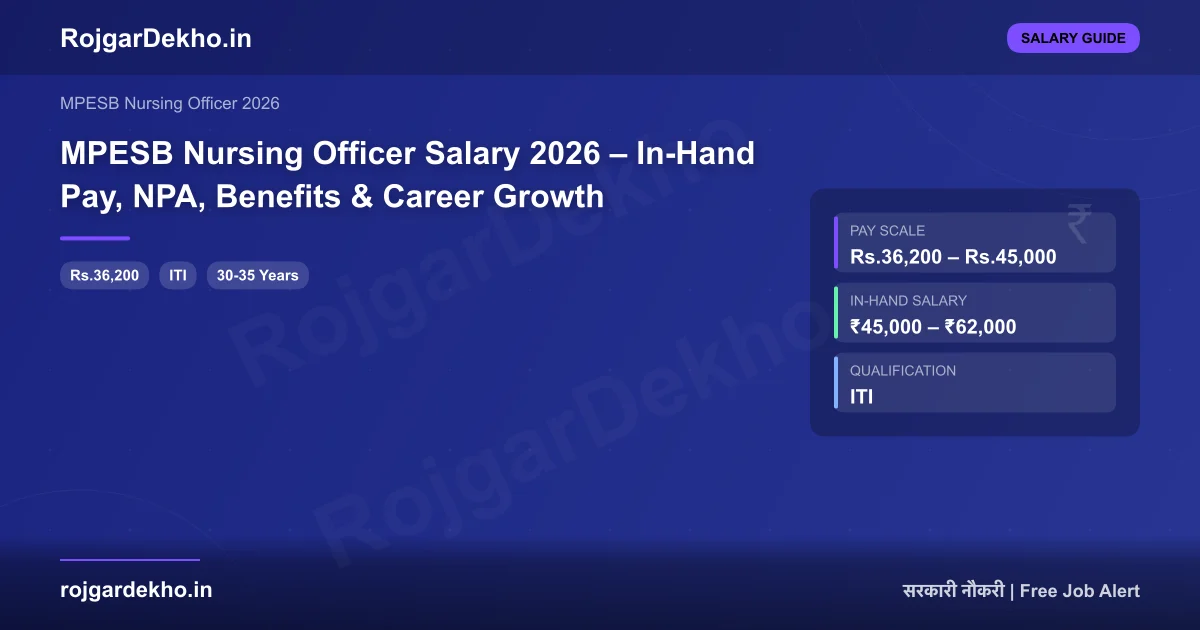
One of the most searched questions after MPESB releases a nursing recruitment is: "Actual mein kitna milega haath mein?" (How much will I actually receive in hand?) The official notification mentions the pay scale, but that number is not what lands in your bank account each month. This article breaks down the complete salary structure for MPESB Nursing Officer 2026 — gross, in-hand, city-wise differences, all allowances, Sister Tutor pay comparison, and the long-term career growth picture.
Apply for MPESB Nursing Officer 2026 here →
Pay Matrix Level and Basic Pay
MPESB Nursing Officers in Madhya Pradesh are placed in MP State Pay Matrix Level 7. This is the same pay level as entry-level gazetted/semi-gazetted posts in the state government. The pay band details:
- Pay Matrix Level: Level 7 (MP 7th Pay Commission)
- Basic Pay Range: Rs. 36,200 – Rs. 1,14,800 (pay progression over career)
- Entry-Level Basic Pay: Rs. 36,200 (at time of joining)
- After 5 years (with increments): Approximately Rs. 44,900
Every year you receive an annual increment of 3% of your basic pay on 1st July. So your basic pay grows steadily over your career without needing a promotion — though promotions push it up faster.
Total Gross Salary Breakdown
The gross salary is basic pay plus multiple allowances. Here is the breakup for a Nursing Officer posted in a medium-tier MP city:
| Component | Amount (Approx) | Notes |
|---|---|---|
| Basic Pay | Rs. 36,200 | Entry level |
| Dearness Allowance (DA) | Rs. 15,800–18,000 | ~44–50% of basic (revised twice a year) |
| HRA (House Rent Allowance) | Rs. 3,600–7,240 | 10–20% of basic, city-dependent |
| NPA (Nursing Practice Allowance) | Rs. 4,800–6,000 | Special for nursing cadre |
| TA/Transport Allowance | Rs. 1,000–2,000 | Fixed for government employees |
| Gross Total | ~Rs. 61,400–69,440 | Before deductions |
In-Hand (Take-Home) Salary After Deductions
From gross salary, the following deductions happen:
- NPS Contribution: 10% of basic + DA (~Rs. 5,200–5,400)
- Professional Tax: Rs. 200/month
- CGHS/State Health Scheme Premium: Rs. 150–300/month
- Income Tax (TDS): Nil or minimal at entry level (varies by tax slab)
After these deductions, the actual in-hand salary ranges from Rs. 45,000 to Rs. 55,000 in a small/medium district and Rs. 52,000 to Rs. 62,000 in Bhopal or Indore (because HRA is higher in X-class/Y-class cities).
City-Wise Salary Difference: Bhopal/Indore vs Small District
The biggest variable in your take-home pay is where you are posted. Here is a realistic comparison:
| Location | HRA Category | HRA on Basic | Approx In-Hand |
|---|---|---|---|
| Bhopal / Indore (larger cities) | Y-class | 20% of basic = ~Rs. 7,240 | Rs. 52,000–62,000 |
| Jabalpur / Gwalior | Y-class | 20% of basic = ~Rs. 7,240 | Rs. 50,000–58,000 |
| District HQ towns | Z-class | 10% of basic = ~Rs. 3,620 | Rs. 45,000–52,000 |
| Tribal/Remote areas (CHC level) | Z-class + Remote Allowance | Special remote area allowance | Rs. 48,000–56,000 |
Interestingly, posting in remote/tribal areas of MP (like Balaghat, Mandla, Dindori) sometimes gives a Hard Area Allowance or Special Duty Allowance which can actually increase your total compensation above what a district headquarters posting gives.
NPA – Nursing Practice Allowance (What It Is & How It Helps)
NPA (Nursing Practice Allowance) is a special allowance exclusive to the nursing cadre in government service — it is not paid to other government employees. It is given to compensate for the unique demands of nursing practice: irregular shifts, physical demands, infection exposure risk, etc.
- NPA is approximately Rs. 4,800 to Rs. 6,000 per month at entry level
- NPA is included in the base for DA calculation in some states — check MP Finance Department orders for the latest circular
- It increases incrementally with pay revisions
- NPA makes government nursing pay significantly more attractive compared to just the basic pay figure
Sister Tutor Pay – Is It Higher?
Yes, Sister Tutors are placed at a slightly higher pay level (Level 8) in the MP pay matrix, or with a higher entry-level basic pay, because the role requires additional qualifications (B.Sc Nursing + 1 year experience) and involves teaching responsibilities.
- Sister Tutor Basic Pay: Approximately Rs. 40,300–44,900 at entry (Level 8)
- Estimated In-Hand: Rs. 50,000–68,000 depending on city
- The teaching role also gives more regular working hours (no night duties typically) compared to clinical Nursing Officers
Government Benefits Beyond Salary
The monthly in-hand number is only part of the picture. Here are the non-cash benefits that make a government nursing job genuinely valuable:
- Government Quarters: On-campus accommodation in most district hospitals and CHCs, saving Rs. 5,000–12,000/month rent. Even if quarters are not available, HRA compensates.
- State Health Insurance: Arogya Setu or equivalent state scheme covering employee and family — covers hospitalisation, surgeries, medicines for free in government hospitals
- Leave Benefits: Earned Leave (30 days/year), Casual Leave (8 days), Maternity Leave (180 days — full pay), Paternity Leave, Medical Leave
- NPS (National Pension Scheme): Government contributes 14% of basic + DA to your NPS account every month. After 30–35 years of service, this builds into a substantial retirement corpus.
- Uniform Allowance: Annual uniform allowance for nurse uniform
- LTC (Leave Travel Concession): Travel reimbursement for home-town visits twice in a 4-year block
Comparison: Government Nurse vs Private Hospital
Here is the reality check many nursing graduates need before deciding:
| Parameter | Government Nursing Officer (MP) | Private Hospital (MP) |
|---|---|---|
| Starting In-Hand Pay | Rs. 45,000–62,000 | Rs. 10,000–18,000 |
| Night Duty Pay | Included (covered by NPA) | Often no extra pay |
| Job Security | Permanent post | Contract/at will |
| Pension | NPS (14% govt contribution) | Typically none |
| Medical Benefits | Free for family | Partial/none |
| Maternity Leave | 180 days (full pay) | Often 12–45 days |
| Annual Increment | 3% guaranteed | Performance-based, uncertain |
| Uniform | Provided + allowance | Often self-purchased |
Private hospital pay in smaller MP cities (outside Bhopal/Indore) is often as low as Rs. 8,000–12,000/month for fresh B.Sc Nursing graduates. Even in corporate hospitals in Bhopal, most staff nurses earn Rs. 14,000–22,000 — less than half of what a government Nursing Officer earns in-hand.
Career Growth Path: What Happens After You Join?
A government nursing career in MP is not stagnant. Here is the typical progression:
- Nursing Officer / Staff Nurse → Entry level (Level 7, Rs. 36,200 basic)
- Senior Nursing Officer → After 5–8 years with DPC (Departmental Promotion Committee) → Level 8 (~Rs. 40,300)
- Nursing Superintendent / Head Nurse → After 12–15 years → Level 9–10 (~Rs. 53,100+)
- Deputy Chief Nursing Officer → District/Division level → Level 11 (~Rs. 67,700+)
- Chief Nursing Officer → State level → Level 12+ (~Rs. 78,800+)
In addition, you can apply for specialist/deputation posts in AIIMS Bhopal, central government hospitals, or international nursing assignments (Saudi Arabia, Gulf countries) after a few years of government service — your government experience is highly valued.
Ready to start your government nursing career? Apply for MPESB Nursing Officer 2026 before 20 April 2026.
Frequently Asked Questions (FAQs)
MPESB Nursing Officer ki starting salary kitni hai?
Joining ke samay basic pay Rs. 36,200 hoti hai (MP Pay Matrix Level 7). Sabhi allowances (DA ~44%, HRA 10–20%, NPA ~Rs. 5,000, TA) jodne ke baad gross salary approximately Rs. 61,000–70,000 hoti hai. Deductions ke baad in-hand salary Rs. 45,000 to Rs. 62,000 ke beech hoti hai depending on posting city.
Bhopal mein posting ho to salary zyada milegi kya?
Haan. Bhopal and Indore Y-class cities hain, jahan HRA basic pay ka 20% milta hai (~Rs. 7,240). Smaller districts mein HRA 10% hota hai (~Rs. 3,620). Iska matlab Bhopal mein in-hand salary approximately Rs. 3,500–4,000 zyada hogi compared to a district posting. Remote/tribal areas mein special duty allowance bhi milta hai.
Sister Tutor ko Nursing Officer se zyada salary milti hai?
Haan, Sister Tutor generally Level 8 par hote hain MP pay matrix mein, jiska entry basic pay approximately Rs. 40,300 se shuru hota hai — Nursing Officer ke Rs. 36,200 se higher. In-hand Sister Tutor ko approximately Rs. 50,000–68,000 milta hai. Iske alawa Sister Tutor ka kaam zyada regular hours mein hota hai — generally koi night duty nahi.
Private hospital se government nurse ko kitna zyada milta hai?
Bahut zyada farq hai. MP ke private hospitals mein fresh B.Sc Nursing graduates ko generally Rs. 10,000–18,000/month milta hai. Government Nursing Officer ko in-hand Rs. 45,000–62,000 milta hai — yani almost 3 se 4 guna zyada. Iske upar pension, health insurance, 180-din maternity leave, aur job security alag se hain.
MPESB Nursing Officer mein promotion kab aur kaise milega?
Approximately 5–8 saal service ke baad DPC (Departmental Promotion Committee) ke zariye Senior Nursing Officer bante hain. 12–15 saal mein Nursing Superintendent/Head Nurse, phir Deputy Chief Nursing Officer aur Chief Nursing Officer tak ja sakte hain. Har promotion ke saath pay level aur basic pay dono badhte hain — ek stable, long-term career path hai.
Full Salary Calculation — Every Component Explained
The headline figure for MPESB Nursing Officer salary is ₹28,700 basic (Pay Matrix Level 8). But that is just the starting point. Here is the complete calculation:
| Component | Basis | Amount (Approx.) |
|---|---|---|
| Basic Pay | MP 7th Pay Commission, Level 8, Cell 1 | ₹28,700/month |
| Dearness Allowance (DA) | ~50% of Basic (current rate) | ₹14,350/month |
| House Rent Allowance (HRA) | Based on posting city (see below) | ₹2,296 – ₹6,888/month |
| NPA (Nursing Practice Allowance) | 20% of Basic (for nursing staff) | ₹5,740/month |
| Medical Allowance | Fixed | ₹500 – ₹1,000/month |
| Other Allowances | Conveyance, misc. | ₹500 – ₹800/month |
| GROSS TOTAL | ~₹52,000 – ₹58,000/month | |
| Less: NPS Contribution | 10% of Basic + DA | -₹4,305/month |
| Less: Income Tax | Depends on investments/regime | -₹1,000 – ₹3,000/month |
| NET IN-HAND | ~₹46,000 – ₹53,000/month |
NPA — Nursing Practice Allowance Explained
NPA is a specific allowance for nursing and paramedical professionals in government service. It recognizes that nursing work involves direct patient contact, shift duties, and clinical risks that general employees do not face. Key points:
- Who gets NPA: All sanctioned Nursing Officer and Sister Tutor posts in MPESB/MP government hospitals receive NPA. It is not discretionary — it is part of the pay structure.
- Amount: 20% of Basic Pay — so at ₹28,700 basic, NPA = ₹5,740/month
- NPA and DA: DA is calculated on Basic Pay only, NOT on NPA. NPA itself does not attract DA.
- NPA is NOT for administrative nurses: If a nurse is posted in a purely administrative role (e.g., Nursing Superintendent's office clerical work), NPA may be withheld. This is rare but worth knowing.
- NPA and promotion: NPA continues after promotion to Sister Tutor or Nursing Superintendent level — the percentage remains the same but the base (basic pay) increases, so absolute NPA amount rises.
District-wise Posting Information
MPESB Nursing Officer posts are spread across Madhya Pradesh's 52 districts. After selection, postings are determined by the Directorate of Medical Education (DME) and Health Department:
- District Hospital (DH): Every district headquarters has a District Hospital — these are the primary posting locations. DHs in cities like Bhopal, Indore, Jabalpur, Gwalior are preferred but competitive for posting requests.
- Community Health Centres (CHC): Rural postings, serving 80,000-1,20,000 population catchment. CHC postings are common for fresh joiners — especially in tribal districts (Mandla, Dindori, Alirajpur, Jhabua, Balaghat).
- Medical College Hospitals (Government): AIIMS Bhopal, Gandhi Medical College Bhopal, MGM Medical College Indore, SS Medical College Rewa, etc. These are premium postings but highly competitive for transfers.
- Night Duty Posting: All hospital postings involve rotational night shifts — typically 3-4 nights per month in most DHs and CHCs. Night duty allowance is paid for these shifts.
Night Duty Allowance
Nurses working night shifts (typically 10 PM to 6 AM) receive Night Duty Allowance (NDA). In MP government service, NDA is approximately ₹200-250 per night duty. If you work 8 night duties per month, that is ₹1,600-2,000 extra. This may seem small but adds up over a year (₹19,200-24,000). In hospitals with heavy nursing shortage (common in rural MP), some nurses end up doing more night duties and earn proportionally more in NDA.
Government Quarters vs HRA — Which to Choose?
In many DHs and medical college hospitals, government residential quarters are available for nursing staff. Here is how to decide:
| Factor | Take Government Quarters | Take HRA Instead |
|---|---|---|
| If market rent in that city is... | Higher than quarters maintenance cost | Lower than quarters maintenance cost |
| Quality of quarters | Good — worth it | Poor/outdated — HRA + private rental better |
| Safety (especially for female nurses) | Campus quarters are safer and convenient | Private accommodation security varies |
| Commute | Near hospital — less travel | May require daily commute cost |
| HRA amount you lose | HRA = ₹2,296 – ₹6,888/month (small loss) | You keep full HRA |
For a fresh joiner in a new city — especially female nurses in small district towns — government quarters near the hospital campus is almost always the better choice for safety and convenience. HRA barely covers rent in any decent accommodation anyway.
30-Year Career Earning Projection
| Career Stage | Year | Approx. Basic | Approx. Gross (with NPA + DA) |
|---|---|---|---|
| Joining | 2026 | ₹28,700 | ₹52,000 – ₹58,000 |
| 5 years in | 2031 | ₹33,000 – ₹35,000 | ₹65,000 – ₹70,000 |
| 10 years (Post-8th Pay Commission) | 2036 | ₹45,000 – ₹55,000 | ₹88,000 – ₹1,05,000 |
| 15 years (Senior Nursing Officer) | 2041 | ₹55,000 – ₹65,000 | ₹1,05,000 – ₹1,25,000 |
| 25 years (Nursing Superintendent potential) | 2051 | ₹75,000 – ₹90,000 | ₹1,40,000 – ₹1,70,000 |
Comparison Table — MPESB vs AIIMS vs Private Hospital
| Factor | MPESB Nursing Officer | AIIMS (NORCET) | Private Hospital (MP) |
|---|---|---|---|
| Starting In-Hand | ₹46,000 – ₹53,000 | ₹55,000 – ₹65,000 | ₹18,000 – ₹30,000 |
| NPA | Yes (20% of basic) | Yes (NPA in central service) | No |
| Job Security | Permanent government | Permanent central government | Contract/at-will |
| Pension (NPS) | Yes (state NPS) | Yes (central NPS) | No pension usually |
| Night Duty Allowance | Yes (~₹200-250/night) | Yes (higher — ~₹400+/night) | Sometimes (inconsistent) |
| Promotion Path | Nursing Officer → Sr. Nursing Officer → Nursing Superintendent | Staff Nurse → Sr. Staff Nurse → Nursing Officer → Matron | Depends on hospital |
| Transfer Risk | Yes — district postings in MP | Pan-India transfers possible | Usually fixed location |
| Work Load | High (nurse:patient ratio poor in rural DHs) | Very high (tertiary care) | High, more supervision |
| 30-Year Peak Salary | ₹1,40,000 – ₹1,70,000 | ₹1,80,000 – ₹2,20,000 | ₹50,000 – ₹80,000 (ceiling) |
Sister Tutor Teaching Allowance
Sister Tutors (the 218 posts in MPESB 2026) receive an additional Teaching Allowance because their role involves instruction in nursing schools attached to government hospitals. This allowance varies but is typically ₹1,500-2,500/month over and above the basic nursing salary. Sister Tutor posts also have a higher promotion ceiling — they can become Principal of Government Nursing School, which carries a significantly higher pay scale.
Frequently Asked Questions
MPESB Nursing Officer ka in-hand salary Bhopal mein kitna hoga?
Bhopal ek Y Category city hai (HRA 16% of basic = ₹4,592/month). Basic ₹28,700 + DA ₹14,350 + HRA ₹4,592 + NPA ₹5,740 + misc ₹800 = Gross ~₹54,182. Minus NPS ₹4,305 aur tax ~₹1,500 = approximately ₹48,000-49,000 in-hand per month Bhopal mein. Rural district mein HRA kam hogi lekin quarters ki suvidha hogi.
Kya MPESB Nursing Officer ki salary private hospital se zyada hai?
Haan — significantly zyada. MP mein zyatar private hospitals freshers ko ₹18,000-25,000 dete hain. Kuch corporate hospitals (Apollo, Medanta) Bhopal/Indore mein ₹28,000-35,000 dete hain. MPESB ka in-hand ₹46,000-53,000 unse 50-150% zyada hai — aur usmein job security, NPS pension, NPA, government quarters sab alag se hain.