MPPSC SSE Salary 2026: Pay Scale, In-Hand & Post-Wise Job Profile
- 158 posts — Deputy Collector, DSP, Commercial Tax Officer, District Registrar and more
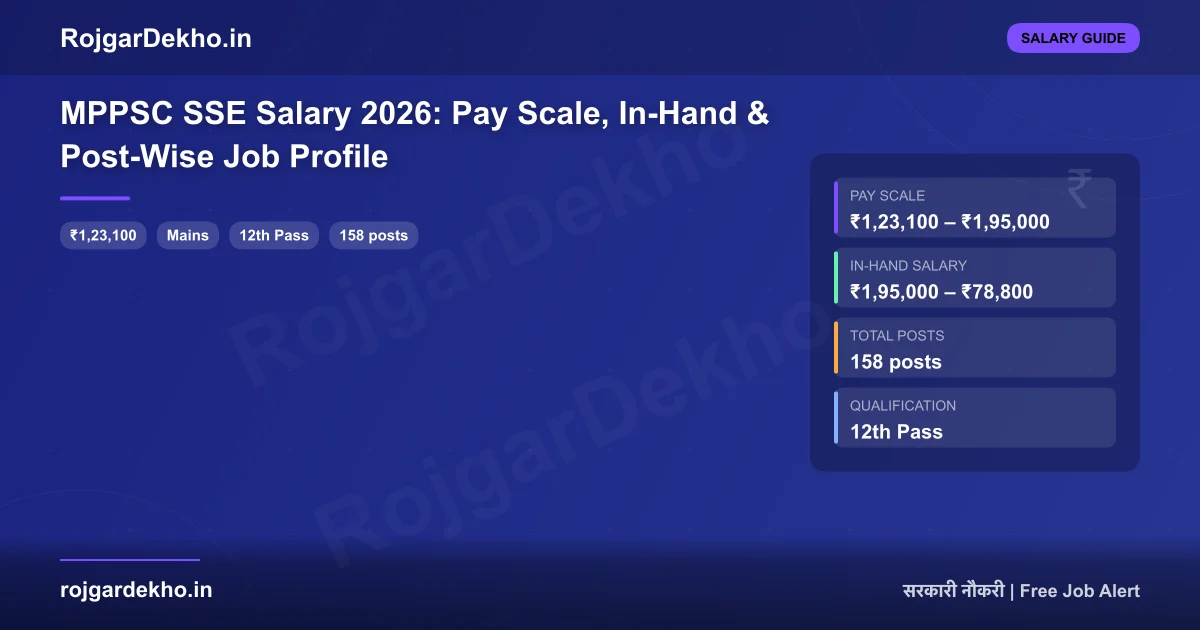
- Pay Level 12–14 as per MP 7th Pay Commission — basic ₹78,800–₹1,23,100
- In-hand: ₹1,05,000–₹1,50,000/month depending on post and allowances
By RojgarDekho Team | Updated: June 2026
MPPSC State Service Exam (SSE) is the gateway to Madhya Pradesh's most prestigious state services — posts equivalent to what UPSC Civil Services gives at the central level. If you've cleared the MPPSC SSE 2025 Prelims and are now filling the Mains form (last date 15 July 2026), you're competing for roles that carry real administrative authority across MP's 52 districts. The salary is competitive, the social standing is exceptional, and the career trajectory can take you to the highest levels of MP government. Here's the complete financial picture.
MPPSC SSE 2025 Mains: 17–22 August 2026. Mains form last date: 15 July 2026. Only Prelims qualified candidates apply. Apply via mponline.gov.in →
MPPSC SSE 2025 — Post-Wise Pay Scale
The 158 posts under MPPSC SSE 2025 span multiple departments of Madhya Pradesh government. Post allocation happens based on your merit rank and choice at the time of document verification. Here is the pay structure for the major posts as per MP 7th Pay Commission:
| Post | Department | Pay Level (MP Matrix) | Basic Pay (Entry) |
|---|---|---|---|
| Deputy Collector (Naib Tehsildar/SDM track) | Revenue Department | Level 13 | ₹1,23,100 |
| Deputy Superintendent of Police (DSP) | Home Department (Police) | Level 12 | ₹78,800 |
| Commercial Tax Officer (CTO) | Commercial Tax Department | Level 12 | ₹78,800 |
| District Registrar | Registration Department | Level 12 | ₹78,800 |
| Block Development Officer (BDO) | Panchayat & Rural Dev | Level 12 | ₹78,800 |
| CEO, Janpad Panchayat | Panchayat Department | Level 12 | ₹78,800 |
| Treasury Officer | Finance Department | Level 12 | ₹78,800 |
| Labour Officer | Labour Department | Level 11 | ₹67,700 |
Note: The exact post list and pay levels are finalized in the MPPSC official notification for SSE 2025. The figures above are based on MP 7th Pay Commission pay matrix for state civil services. Verify from the official MPPSC notification at mppsc.nic.in.
The most sought-after post in MPPSC SSE is Deputy Collector — it tracks directly toward SDM and eventually District Collector. Only the top 15–20 rankers in the final merit list typically get Deputy Collector posting. If your rank is outside that range, you'll be allocated to other departments (Police, Tax, Registration, Panchayat). Every rank matters — even the difference between rank 25 and rank 40 can mean the difference between DSP and Commercial Tax Officer.
Monthly Salary Calculation — Deputy Collector vs DSP
Here is the full monthly salary breakdown for the two most high-profile MPPSC SSE posts, at a state-capital (Bhopal) or divisional HQ posting (X city HRA):
| Component | Deputy Collector (Level 13) | DSP (Level 12) |
|---|---|---|
| Basic Pay | ₹1,23,100 | ₹78,800 |
| Dearness Allowance (DA ~55%, 2026) | ₹67,705 | ₹43,340 |
| HRA (24% metro/Bhopal) | ₹29,544 | ₹18,912 |
| Transport Allowance | ~₹9,000 | ~₹7,000 |
| Medical Allowance | ₹1,000 | ₹1,000 |
| Other MP state allowances | ₹2,000 | ₹1,500 |
| Gross Pay (approx) | ₹2,32,349 | ₹1,50,552 |
| NPS Deduction (10% Basic+DA) | −₹19,081 | −₹12,214 |
| Income Tax (approx) | −₹18,000 | −₹9,000 |
| In-Hand (approx) | ₹1,95,000–₹2,00,000 | ₹1,25,000–₹1,32,000 |
These calculations use Bhopal (state capital, X city) HRA of 24%. For district HQ postings (Y city), HRA drops to 16%, reducing in-hand by approximately ₹10,000–₹15,000. DA is revised twice yearly by MP government — the 55% estimate is for mid-2026.
Benefits Beyond Monthly Salary
Government perquisites significantly augment the financial value of an MPPSC SSE post. Here's what an MP state services officer receives beyond the salary slip:
| Benefit | Details |
|---|---|
| Government Accommodation | Type III/IV bungalow at divisional HQ or district — saves ₹20,000–₹50,000/month in rent in MP cities |
| Official Vehicle + Driver | Deputy Collectors and DSPs get government vehicles for official use — a significant convenience |
| MPGHS Medical Coverage | Madhya Pradesh Government Health Scheme — cashless treatment for self and family at empanelled hospitals |
| Children Education Allowance | ₹2,250/month per child (max 2) — ₹4,500/month if both school-going |
| LTC (Leave Travel Concession) | All-India LTC once in 4 years; home-town LTC in alternating years |
| Police Force Benefits (DSP) | DSP officers receive additional police allowances — weapon allowance, field duty allowance — not available to civil officers |
| Orderly/Peon Staff | Senior officers receive an assigned peon/orderly for official duties |
Salary Growth Over a Career
MP state services officers receive annual increments (3% of basic pay on 1 July) and periodic pay commission revisions (approximately every 10 years). Promotions also carry pay level upgrades. Here is the realistic trajectory for an MPPSC SSE officer selected in 2026 who joins at age 26:
| Year | Age | Designation (Revenue Track) | Basic Pay | In-Hand (approx) |
|---|---|---|---|---|
| Year 1 | 26 | SDM / Deputy Collector | ₹78,800–₹1,23,100 | ₹1,25,000–₹2,00,000 |
| Year 5 | 31 | Sub-Divisional Magistrate (confirmed) | ₹90,000+ | ₹1,40,000+ |
| Year 10 | 36 | Additional Collector / Additional Commissioner | ₹1,20,000+ | ₹1,80,000+ |
| Year 20 | 46 | District Collector (IAS equivalent) | ₹1,44,200+ | ₹2,30,000+ |
| Year 30 | 56 | Commissioner / Principal Secretary | ₹1,82,200+ | ₹2,80,000+ |
MPPSC SSE vs IAS — The Honest Difference
Many candidates prepare for MPPSC SSE while also targeting UPSC Civil Services. Understanding the difference helps you decide where to invest additional preparation. The core difference is the scope of authority and career ceiling. An IAS officer can serve as District Collector in any state in India (cadre permitting), and can reach Cabinet Secretary level. An MP state services officer can reach Commissioner or Principal Secretary level within MP — a significant career in itself, but bounded by state boundaries.
Salary at entry is comparable (both Level 12–14 range). But IAS officers get faster track promotions, better postings, and higher-profile assignments. The flip side: MPPSC SSE is significantly less competitive (you're competing with MP state graduates, not all of India) and the exam is conducted annually, giving more attempts. For a candidate rooted in MP, MPPSC SSE offers a more realistic path to significant administrative responsibility than UPSC CSE.
NPS Pension — What to Expect at Retirement
Officers who joined after 2004 are under the National Pension System. For a DSP joining at basic ₹78,800 with 30 years of service, assuming 8% annual return on NPS corpus, the retirement corpus is estimated at ₹2.5–₹3.5 crore. Of this, 40% (approximately ₹1–₹1.4 crore) is used to purchase a monthly annuity. At 6% annuity rate, this provides approximately ₹50,000–₹70,000/month as pension. The remaining 60% (₹1.5–₹2 crore) is received tax-free as a lump sum. For a Deputy Collector with higher basic, the corpus and monthly pension would be proportionally higher — retirement corpus exceeding ₹5 crore is realistic with 30 years of service at Level 13.
Frequently Asked Questions
Q: What is the in-hand salary for a fresh Deputy Collector from MPPSC SSE?
At entry level (basic ₹1,23,100), with DA (~55%), HRA (24% for Bhopal posting), transport allowance, after NPS deduction (~₹19,000) and income tax (~₹18,000), the approximate in-hand salary is ₹1,95,000–₹2,00,000/month. For a district HQ posting (16% HRA), in-hand is approximately ₹1,80,000–₹1,85,000.
Q: Do MPPSC SSE officers get IAS-equivalent status?
Not automatically. MP state services officers can be empanelled for IAS after approximately 8–10 years of distinguished service, subject to UPSC DPC (Departmental Promotion Committee) recommendation. This is selective — typically 3–5 officers from MP state services are empanelled per year. If empanelled, pay and designation merge with IAS cadre. Most MP SSE officers reach Additional Collector or Commissioner level within the state service without IAS empanelment.
Q: Is there any difference in salary between the 158 posts in MPPSC SSE 2025?
Yes — salary differs based on post/pay level. Deputy Collector (Level 13, basic ₹1,23,100) earns significantly more than a DSP or Commercial Tax Officer (Level 12, basic ₹78,800) at entry level. The difference in basic pay is ₹44,300/month, which compounds over a career. Top rankers who secure Deputy Collector posts have a clear financial advantage from day one.
Q: When are MPPSC SSE 2025 Mains results expected?
MPPSC has not specified result dates. Based on historical patterns, Mains results (merit list + interview calls) typically come 3–5 months after the exam. With Mains in August 2026, results are likely January–March 2027, and final selections after interviews in April–June 2027.
Why MPPSC SSE Is Worth More Than the Salary Number Suggests
When candidates evaluate MPPSC SSE, they often focus only on the monthly in-hand figure. But the true value of a state services post lies in the combination of stability, authority, perquisites, and social standing — none of which fully appear in the salary slip. Let's break down the complete value proposition.
Consider a Deputy Collector earning ₹1,95,000 in-hand. On top of that, they receive a government bungalow (which would cost ₹30,000–₹50,000/month to rent in Bhopal or Indore), an official vehicle with a driver (private equivalent value ₹40,000+/month including driver salary and fuel), full family medical coverage through MPGHS (private health insurance for a family of four costs ₹25,000–₹40,000/year), and an orderly/peon for official duties. When you add these tangible benefits to the cash salary, the effective compensation of a Deputy Collector exceeds ₹2.7–₹2.9 lakh/month in real terms.
Beyond the tangibles, there's the intangible value of administrative authority. As an SDM or Deputy Collector, you have the power to make decisions that affect thousands of citizens — land disputes, disaster relief, election administration, law and order. This is meaningful work that very few private sector jobs offer at age 26–30. For candidates from Madhya Pradesh's smaller towns and rural areas, the social respect that comes with being a "Collector Sahab" is, in many communities, valued as highly as the salary itself.
How DA Revisions Affect Your Salary Every Six Months
Dearness Allowance (DA) is the component of your salary that protects against inflation. It is revised twice a year — typically in January and July — by the Madhya Pradesh government, following the Central Government's DA pattern. Each revision increases your DA by 2–4 percentage points depending on inflation. For a Deputy Collector with basic pay of ₹1,23,100, every 3% DA increase adds approximately ₹3,693/month to gross salary. Over a 30-year career, DA revisions are a major driver of salary growth — they compound on top of annual increments and promotions.
Importantly, DA also applies to your NPS contribution base (Basic + DA). As DA rises, your monthly NPS contribution rises too, which means more is going into your retirement corpus. This is a hidden benefit — higher DA doesn't just increase your in-hand, it also accelerates your retirement savings accumulation.
Comparing the Top 4 MPPSC SSE Posts on Total Value
| Post | Cash In-Hand | Govt Vehicle | Field Authority | Best For |
|---|---|---|---|---|
| Deputy Collector | ₹1,95,000+ | Yes | Very High (SDM, revenue, disaster mgmt) | Those wanting maximum administrative power |
| DSP (Police) | ₹1,25,000+ | Yes | High (law & order, investigation) | Those drawn to policing and field action |
| Commercial Tax Officer | ₹1,20,000+ | Limited | Medium (tax administration) | Those preferring desk-based specialist work |
| District Registrar | ₹1,18,000+ | Limited | Medium (property registration) | Those wanting predictable, urban postings |
The Deputy Collector post offers the highest combination of authority and perquisites, which is why it's the most competed-for. But the DSP post carries a unique appeal for those drawn to active policing and a more dynamic field role. Each post has a distinct work culture — choose based on your temperament, not just the marginal salary difference.
Income Tax Planning for MP State Service Officers
With a gross salary above ₹2 lakh/month, MP state service officers fall in the higher income tax brackets, making tax planning an important part of financial management. Officers can reduce their tax liability significantly through legitimate deductions. Section 80C (up to ₹1.5 lakh) covers your NPS contribution, life insurance premiums, PPF, and children's tuition fees. Section 80CCD(1B) gives an additional ₹50,000 deduction specifically for NPS contributions beyond the 80C limit — a benefit government employees should fully utilize. The standard deduction of ₹50,000 (or ₹75,000 under the new regime) applies automatically. Home loan interest under Section 24(b) can be claimed up to ₹2 lakh per year. A Deputy Collector who plans taxes well can keep their effective tax rate substantially lower than the headline rate, improving real take-home income.
Many officers also benefit from the staff housing they receive — living in a government bungalow means no rent outflow, which is effectively tax-free income compared to a private employee paying rent from post-tax salary. This is one of the underappreciated financial advantages of government service that compounds over a 30-year career.
How Salary Differs Between Probation and Confirmation
During the 2-year probation period, an MPPSC SSE officer receives the full pay scale of their post — there is no reduced probation salary. However, certain allowances and benefits may be calibrated during probation. Confirmation after successful probation makes you a permanent member of the state service with full pension rights, seniority benefits, and eligibility for the first promotion cycle. The financial difference between probation and confirmation is minimal in monthly terms, but confirmation establishes your permanent position in the seniority list, which determines all future promotions and postings.