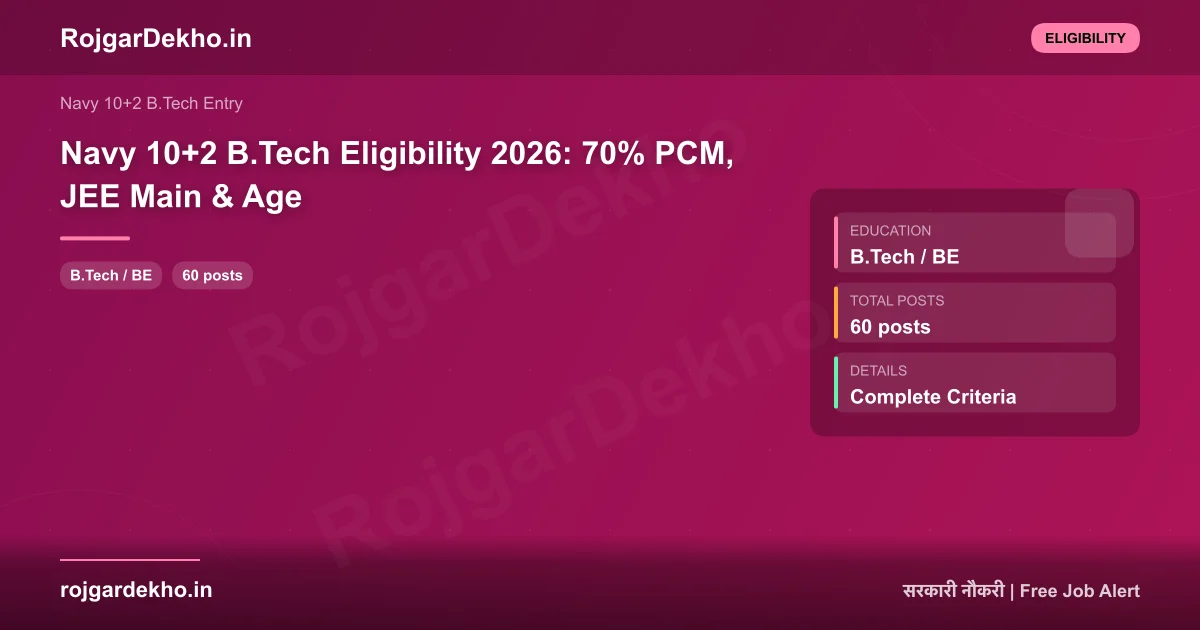
Navy 10+2 B.Tech Eligibility 2026: 70% PCM, JEE Main & Age
- Academics: 12th with 70% aggregate in Physics, Chemistry & Maths and 50% in English (Class 10 or 12).
- JEE (Main) 2026 is compulsory — shortlisting is purely on your JEE Main All India CRL rank.
- Age: born 02 Jul 2007 – 01 Jan 2010; unmarried men and women; 60 posts (Mech 30, ECE 30).
The Indian Navy 10+2 (B.Tech) Cadet Entry, January 2027 has precise eligibility, and because it leads to a free engineering degree and a Permanent Commission, the bar is set to attract strong science students. Before you apply, make sure you clear every condition exactly — the academic percentage, the compulsory JEE Main requirement, the age window and the marital-status rule. This article lays them all out so you know whether you qualify and what to get right. Always confirm against the official notification.
👉 Navy 10+2 B.Tech Jan 2027 — Apply Online (60 Posts) — official notification, dates and the apply link in one place.
Academic qualification
You must have passed the 10+2 (Senior Secondary) examination, or be appearing, with at least 70% aggregate marks in Physics, Chemistry and Mathematics (PCM) taken together, and a minimum of 50% marks in English (in either Class 10 or Class 12). The PCM 70% is the key bar and it is a genuine cut-off, so borderline candidates should focus on lifting their PCM aggregate. Mathematics and Physics must be among your subjects, as the entry is for engineering branches.
The compulsory JEE Main requirement
This is the condition many candidates miss: it is mandatory to have appeared in JEE (Main) 2026 (B.E./B.Tech). The Navy does not set its own entrance exam — instead, shortlisting for the SSB is done purely on the basis of your JEE Main 2026 All India Common Rank List (CRL). So you cannot apply for this entry without having sat JEE Main 2026, and the better your JEE Main rank, the stronger your chance of being shortlisted for the SSB.
👉 Navy 10+2 B.Tech Previous Year Papers — how JEE Main practice drives your shortlisting.
Age limit
For the January 2027 course, candidates must have been born between 02 July 2007 and 01 January 2010 (both dates inclusive). This is a narrow, fixed window appropriate to a just-after-Class-12 entry, with no separate relaxation table — the date-of-birth range is the rule. Always confirm your exact eligibility window against the official notification before applying.
| Criterion | Requirement |
|---|---|
| Education | 10+2 with 70% in PCM and 50% in English |
| Entrance | Must have appeared in JEE (Main) 2026 (B.E./B.Tech) |
| Date of birth | 02 Jul 2007 – 01 Jan 2010 (both inclusive) |
| Marital status | Unmarried |
| Gender | Men and women |
| Vacancies | 60 — Mechanical 30, Electronics & Communication 30 |
Nationality, marital status and gender
You must satisfy the nationality conditions laid down by the Government of India. Only unmarried candidates are eligible, and you must remain unmarried through training. The entry is open to both men and women, which makes it an excellent route for women aspirants to become technical officers in the Navy after Class 12. The 60 vacancies are split as 30 for Mechanical Engineering and 30 for Electronics & Communication Engineering.
Physical and medical standards
You must meet the Navy’s medical standards (height, weight, vision, hearing, dental and general fitness), which are checked at the medical examination after SSB recommendation. There is no separate written physical test, but you should be reasonably fit for the SSB’s GTO outdoor tasks. Fix correctable medical issues before your medical date so a temporary deferment does not delay your joining.
What no other site tells you
Two eligibility traps catch candidates every year. The first is the compulsory JEE Main requirement — some students assume the Navy will test them directly and fail to register for or sit JEE Main 2026, which makes them ineligible no matter how good their school marks are. If you want this entry, sitting JEE Main is non-negotiable. The second is the 70% PCM bar — "pass marks" are not enough, and a candidate at 65-69% PCM is simply ineligible, so your Class 12 PCM aggregate genuinely decides your eligibility. The good news is that this is one of the best-value entries open to women and men alike straight after Class 12: clear the eligibility, score a strong JEE Main rank, and you are in line for a free B.Tech and a Permanent Commission. Get the percentage and JEE Main right early, because both are hard conditions you cannot fix later.
Frequently Asked Questions
What percentage is required for Navy 10+2 B.Tech entry?
At least 70% aggregate in Physics, Chemistry and Mathematics (PCM) together, and a minimum of 50% in English (Class 10 or 12).
Is JEE Main compulsory?
Yes. You must have appeared in JEE (Main) 2026 (B.E./B.Tech); shortlisting for the SSB is based purely on your JEE Main All India CRL rank.
What is the age limit?
For the January 2027 course, candidates must be born between 02 July 2007 and 01 January 2010 (both dates inclusive).
Can women apply for Navy 10+2 B.Tech entry?
Yes. The entry is open to both unmarried men and women.
How many vacancies are there?
60 — 30 for Mechanical Engineering and 30 for Electronics & Communication Engineering.
Can married candidates apply?
No. Only unmarried candidates are eligible, and you must remain unmarried during training.
Documents and how to apply
Applications are made online on the Join Indian Navy portal (joinindiannavy.gov.in). Before you start, keep scanned copies ready in the required format — your Class 10 and 12 mark sheets and certificates, your JEE (Main) 2026 admit card and result/score, a valid photo ID, a recent photograph and signature, and any other documents the notification specifies. Register on the portal, fill the application with your personal, academic and JEE Main details exactly as they appear on your documents, upload the files, and submit before the closing date. Save and print the submitted form for your records, and keep checking the portal and your email for the SSB call-up and further instructions.
Because the form asks for your JEE Main details, make sure your JEE Main 2026 registration and roll number are correct and accessible. An error in your JEE Main particulars can disrupt the rank-based shortlisting on which this entire entry depends, so double-check those fields with particular care.
Why women candidates should seriously consider this
This entry is open to unmarried women as well as men, and that makes it one of the most valuable post-Class-12 routes available to young women who want a technical and leadership career. A woman selected through this entry gets the same fully-funded four-year B.Tech at INA Ezhimala, the same stipend, and the same Permanent Commission as a technical officer in the Navy. For a science student who has the PCM marks and is preparing for JEE Main anyway, this is a route worth taking seriously — it offers a debt-free engineering degree and an officer’s career with genuine respect, security and growth, in a service that is steadily expanding opportunities for women.
Common eligibility traps and the bottom line
Two conditions trip up the most candidates. The first is forgetting that JEE (Main) 2026 is compulsory — without it you simply cannot apply, regardless of your school marks, so registering for and sitting JEE Main is the foundation of your eligibility. The second is the 70% PCM bar, which is a hard cut-off and not satisfied by mere pass marks; if your PCM aggregate is below 70%, you are not eligible, full stop. Beyond these, confirm your date of birth falls within the window and that you meet the unmarried and nationality conditions. The bottom line is that the eligibility, while strict, is clear: a 12th science student with 70% PCM, 50% English, a JEE Main 2026 attempt and a date of birth in the window can apply — and for that student, this is one of the highest-value entries in the country. Get the percentage and the JEE Main attempt right early, because neither can be fixed afterwards, and read the official notification carefully before you pay.
A quick eligibility self-check
Run through this check before you open the form. If you can answer yes to all of these, you are eligible to apply: Are you an unmarried Indian citizen? Were you born between 02 July 2007 and 01 January 2010? Did you take, or are you taking, the 10+2 with Physics, Chemistry and Mathematics? Is your PCM aggregate at least 70%, with at least 50% in English? And have you appeared in JEE (Main) 2026? If every answer is yes, you clear the eligibility and your focus shifts to your JEE Main rank and SSB preparation. If any answer is no, address what you can — lift your PCM if you are still in school, ensure you sit JEE Main — or recognise that this particular cycle may not be open to you.
The two answers that most often turn out to be no are the JEE Main attempt and the 70% PCM. Both must be secured before the exam season, not after, because neither can be corrected once results are out. If you are still in Class 11 or early Class 12 and aiming for this entry, treat your PCM marks and your JEE Main registration as non-negotiable priorities, because they are the gates everything else depends on.
The bottom line on eligibility
In summary, the Navy 10+2 B.Tech entry has a strict but clear set of conditions: an unmarried man or woman, born in the specified window, who has passed (or is appearing in) 10+2 with 70% in PCM and 50% in English, and who has appeared in JEE (Main) 2026. Meet all of these and you can apply for a route that offers a fully-funded engineering degree, a monthly stipend, and a Permanent Commission as a technical officer. Read the official notification line by line to confirm every detail for your exact case, get your documents and JEE Main particulars in order, and apply on time. For an eligible science student, getting these basics right opens the door to one of the best opportunities available straight after Class 12.
Keep one principle at the centre of everything: this entry rewards early, organised preparation more than last-minute effort. The JEE Main rank that gets you shortlisted is built over months of practice, and the Officer-Like Qualities the SSB looks for are developed over time, not switched on at the board. A candidate who starts early, plans the JEE Main and SSB tracks together, and stays consistent will almost always outperform one who is more talented but disorganised. Treat your preparation as a project with clear milestones, and this entry becomes a realistic, achievable goal rather than a distant hope.
And remember what is at stake: not just a job, but a fully-funded engineering degree, a monthly stipend, and a Permanent Commission as an officer of the Indian Navy. Few opportunities after Class 12 combine education, income and a secure career so completely. That is worth every hour of disciplined JEE Main and SSB preparation you put in.
Ultimately, the candidates who succeed in this entry are those who respect both halves of it equally — the academic rigour of JEE Main and the personality assessment of the SSB — and who start early enough to do justice to each. Approach it that way, confirm every detail against the official notification, and you give yourself a genuine, earned shot at a free engineering degree and a Permanent Commission in the Indian Navy.
In the end, eligibility for this entry is a gate you either clear cleanly or not at all — there is no partial credit for being close on the percentage or for having skipped JEE Main. So secure those two conditions well in advance, keep your documents and date-of-birth proof in order, verify your exact case against the official notification, and apply with confidence knowing you have met every requirement the Navy has set for this prestigious entry.