Navy 10+2 B.Tech Salary 2026: ₹56,100 Stipend + Free B.Tech
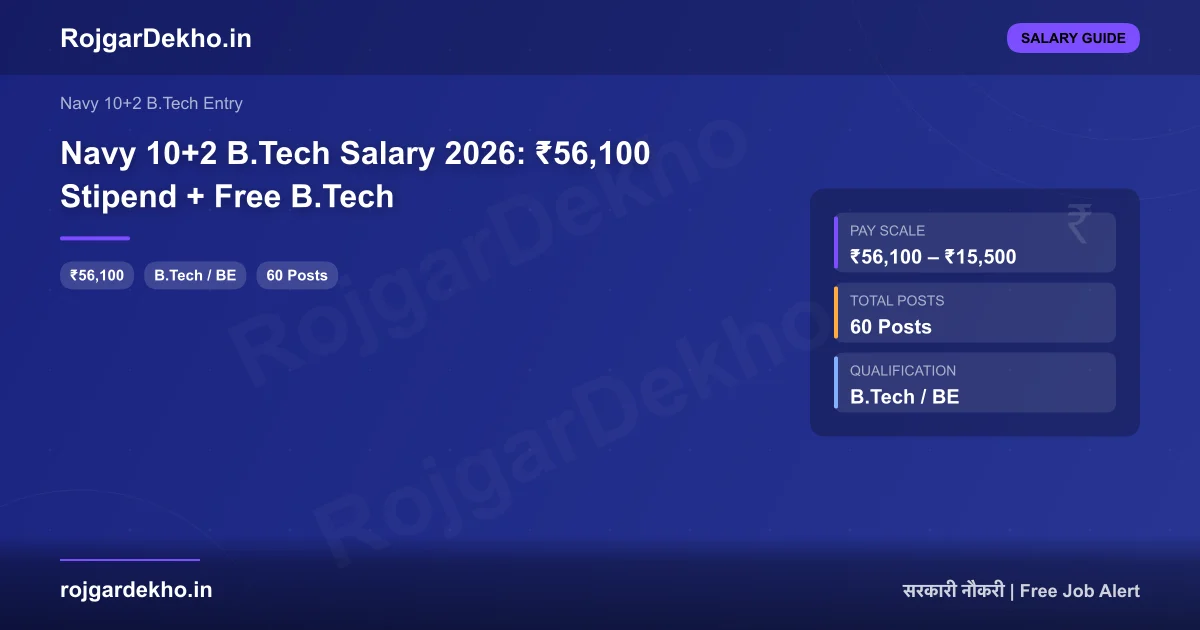
- During the 4-year B.Tech at INA Ezhimala you get a fixed stipend of ₹56,100/month (Pay Level 10) — and the degree is free.
- On commissioning you become a Sub Lieutenant on Pay Level 10 — basic ₹56,100 + MSP ₹15,500 + DA + HRA.
- Approx gross ₹1.10–1.25 lakh/month at the start, and it is a Permanent (pensionable) Commission.
This entry has one of the most attractive financial packages available to a Class-12 science student, because you are paid to earn a free engineering degree and then commissioned as an officer. The Indian Navy 10+2 (B.Tech) Cadet Entry pays you a stipend through training, costs you nothing for the B.Tech, and leads to a Sub Lieutenant’s salary on a Permanent Commission. This article gives the honest, 7th-CPC-based breakdown — the training stipend, the starting officer pay, and the full value of the free degree. We flag clearly which figures are fixed (basic, MSP, stipend) and which vary (DA, HRA).
👉 Navy 10+2 B.Tech Eligibility 2026 — check the 70% PCM and JEE Main requirement before you plan for this.
Pay during the 4-year B.Tech (the stipend)
Unlike a normal engineering college where you pay fees, here the Navy pays you while you study. During the four-year B.Tech at the Indian Naval Academy, Ezhimala, cadets receive a fixed monthly stipend of ₹56,100 (equivalent to the entry of Pay Level 10). On top of that, the Navy bears all the costs of training, books, clothing and messing, so your living expenses through the degree are effectively covered. In real terms, you graduate as an engineer with savings rather than education debt — a stark contrast to private engineering colleges.
Starting pay on commissioning — Sub Lieutenant
On successfully completing the B.Tech, you are commissioned as a Sub Lieutenant in the Technical branch on Pay Level 10 of the 7th CPC matrix, with a starting basic pay of ₹56,100. Like all defence officers you also receive Military Service Pay (MSP) of ₹15,500, plus Dearness Allowance, House Rent Allowance and other allowances. The rough monthly build-up at the start:
| Component | Approx amount | Note |
|---|---|---|
| Basic Pay (Level 10) | ₹56,100 | Fixed entry pay |
| Military Service Pay (MSP) | ₹15,500 | Fixed, armed-forces only |
| Dearness Allowance (DA) | ~₹37,000+ | % of (basic+MSP); revised twice a year |
| House Rent Allowance (HRA) | ~₹8,400–₹16,800 | By city class, if no government quarters |
| Approx gross | ₹1.10–1.25 lakh | Varies by posting, DA rate and HRA class |
Treat the gross as an approximate band — DA changes every six months and HRA depends on your posting and accommodation. The reliable anchors are the basic ₹56,100 and MSP ₹15,500. Note that this is the same starting officer pay as the graduate-level Navy entries, but you reach it at a younger age, having been paid through your degree.
👉 Navy Officer Salary — Full Pay & Allowances — the detailed officer pay structure, rank progression and allowances.
It is a Permanent Commission — the pension difference
This is a crucial advantage many candidates overlook. Unlike the Short Service Commission entries, the 10+2 B.Tech entry grants a Permanent Commission. That means it is a full, pensionable career by default — you are not on a fixed 10-14 year tenure, but on a long-term commission with the prospect of serving up to retirement and earning a pension, along with promotions through Lieutenant, Lieutenant Commander, Commander and beyond. For a young officer, a Permanent Commission from the start is a significant financial and career security advantage.
The hidden value — a free B.Tech
To judge this package honestly, add the value of the degree itself. A four-year B.Tech at a good private engineering college can cost several lakhs in fees alone, plus living costs — and you graduate with no guaranteed job. Here, the degree is fully funded, you are paid ₹56,100 a month while you study, and you walk straight into a Permanent Commission as an officer. When you combine the free degree, the stipend, and the guaranteed officer career, the real value of this entry is far higher than the starting salary figure alone suggests.
How the salary grows
| Rank | Pay Level | Indicative basic pay |
|---|---|---|
| Sub Lieutenant | Level 10 | ₹56,100 onward |
| Lieutenant | Level 10B | ₹61,300 onward |
| Lieutenant Commander | Level 11 | ₹69,400 onward |
| Commander | Level 12A | ₹1,21,200 onward |
Pay rises with every promotion, plus annual increments and twice-yearly DA hikes. Because this is a Permanent Commission, you can progress through the senior ranks over a full career, with the pay, allowances and pension that come with them — a trajectory the starting figure only hints at.
What no other site tells you
Most "Navy B.Tech salary" articles quote only the stipend or only the starting gross, missing the three things that make this package exceptional. First, you are paid to study — ₹56,100 a month with all costs covered, so you save rather than spend during your degree. Second, it is a Permanent, pensionable Commission, not a fixed-tenure one, which is a major long-term advantage. Third, the free B.Tech itself is worth lakhs that you would otherwise pay or borrow. Add these together and, for a Class-12 science student, this is arguably one of the highest-value career entries in the country — you earn a degree, a salary and an officer’s pensionable career all at once. The honest trade-off is the demanding service life and the commitment it requires, but in pure financial and career terms, very little else available after Class 12 compares.
Frequently Asked Questions
What is the stipend during Navy 10+2 B.Tech training?
A fixed ₹56,100 per month (equivalent to Pay Level 10) during the four-year B.Tech at INA Ezhimala, with all training, book, clothing and messing costs borne by the Navy.
What is the starting salary after commissioning?
You are commissioned as a Sub Lieutenant on Pay Level 10 with basic ₹56,100, plus MSP ₹15,500, DA and HRA — an approximate gross of ₹1.10–1.25 lakh per month.
Is the B.Tech really free?
Yes. The Navy fully funds the four-year B.Tech at INA Ezhimala, including training, books, clothing and messing.
Is this a Permanent Commission?
Yes. Unlike Short Service Commission entries, the 10+2 B.Tech entry grants a Permanent (pensionable) Commission on successful completion.
What is Military Service Pay?
MSP is ₹15,500 per month, paid to armed-forces officers in addition to basic pay, and it counts towards DA.
How does the pay grow over time?
Through promotions (Lieutenant, Lieutenant Commander, Commander and beyond), annual increments and twice-yearly DA hikes, over a full pensionable career.
The value compared to a private B.Tech
To grasp how strong this package is, compare it honestly with the usual path. A four-year B.Tech at a private engineering college commonly costs several lakhs in tuition alone, plus living expenses, and many graduates still face an uncertain job market at the end. Through this Navy entry, the same four years cost you nothing — tuition, books, clothing, messing and accommodation are all funded — and you are paid a ₹56,100 monthly stipend while you study. Instead of graduating with education loans, you graduate with savings, an engineering degree from a national institution, and a guaranteed Permanent Commission as an officer. When you put a rupee value on the avoided fees, the stipend earned, and the assured career, the real worth of this entry runs well into the tens of lakhs over the four years alone.
Career and pension growth
Because this is a Permanent Commission, the financial picture extends across a full career rather than a fixed tenure. Your pay rises steadily through annual increments, twice-yearly DA revisions, and promotions through Lieutenant, Lieutenant Commander, Commander and beyond, each step lifting both basic pay and the allowances calculated on it. As a permanent officer you are on a pensionable career path, with the long-term security and post-retirement benefits that a Short Service Commission does not guarantee by default. This combination of steadily rising pay and a pension makes the long-run financial value far greater than the starting figure, and it is a key reason the 10+2 B.Tech entry is considered one of the most rewarding routes into the officer cadre.
Allowances and the real take-home
Beyond basic pay and MSP, an officer receives Dearness Allowance that rises with inflation, House Rent Allowance by posting city (or government accommodation), transport and other allowances, and role-specific allowances where applicable. As a technical officer you may also serve in postings that attract specialised allowances. Together these lift the real take-home well above the basic pay alone, and they come on top of subsidised housing, world-class medical for you and your family, and the other benefits of service life. The honest way to judge the salary is by this complete package — guaranteed basic and MSP, inflation-protected allowances, and substantial non-cash benefits — rather than any single number.
The final word is that, for a Class-12 science student, very few opportunities match this one financially. You are paid to earn a free engineering degree, then commissioned into a pensionable officer’s career with a strong starting salary that grows across decades. The trade-off is the discipline and commitment of service life, but in pure money-and-career terms, the 10+2 B.Tech entry offers a combination of a free degree, an immediate stipend, and a secure long-term career that is genuinely hard to beat after Class 12.
Judging the package as a whole
The smartest way to evaluate this entry financially is to view it as a whole rather than as a single salary number. Add together the fees you do not pay for the four-year B.Tech, the stipend you earn through training, the strong Sub Lieutenant starting salary, the steady growth through promotions and DA, the pension that comes with a Permanent Commission, and the non-cash benefits of subsidised housing and world-class medical. Seen this way, the entry delivers value at every stage — during the degree, at commissioning, across your career, and into retirement. Very few options open to a Class-12 student combine all of these, which is why those who understand the full picture treat this as a top-tier opportunity rather than just another government entry.
The final word is honest and simple: for a science student with the marks and the JEE Main attempt, the Navy 10+2 B.Tech entry is one of the most financially and professionally rewarding routes available after Class 12. You are paid to study, you graduate debt-free as an engineer, and you step into a secure, pensionable officer’s career with a salary that grows for decades. The commitment of service life is real and should be weighed seriously, but in terms of degree, stipend, salary and long-term security combined, this entry is genuinely hard to beat — and well worth the focused JEE Main and SSB preparation it asks of you.
Keep one principle at the centre of everything: this entry rewards early, organised preparation more than last-minute effort. The JEE Main rank that gets you shortlisted is built over months of practice, and the Officer-Like Qualities the SSB looks for are developed over time, not switched on at the board. A candidate who starts early, plans the JEE Main and SSB tracks together, and stays consistent will almost always outperform one who is more talented but disorganised. Treat your preparation as a project with clear milestones, and this entry becomes a realistic, achievable goal rather than a distant hope.
And remember what is at stake: not just a job, but a fully-funded engineering degree, a monthly stipend, and a Permanent Commission as an officer of the Indian Navy. Few opportunities after Class 12 combine education, income and a secure career so completely. That is worth every hour of disciplined JEE Main and SSB preparation you put in.
Ultimately, the candidates who succeed in this entry are those who respect both halves of it equally — the academic rigour of JEE Main and the personality assessment of the SSB — and who start early enough to do justice to each. Approach it that way, confirm every detail against the official notification, and you give yourself a genuine, earned shot at a free engineering degree and a Permanent Commission in the Indian Navy.