NVS TGT Salary 2026: ₹44,900 Pay Scale, In-Hand & Campus Perks Explained
The salary number for NVS TGT looks modest at first glance — ₹44,900 basic pay in Level 7. But here is what most articles miss: NVS TGT is one of very few central government teaching jobs where your total compensation package is worth significantly more than the in-hand figure suggests. Free campus accommodation, subsidized meals, CBSE school holidays as paid leave, and CGHS medical add up. This guide breaks it all down — every rupee, every perk.
👉 NVS TGT Eligibility 2026 — Age limit, education qualifications, B.Ed subject matching & CTET requirement
NVS TGT Pay Scale – 7th CPC Structure
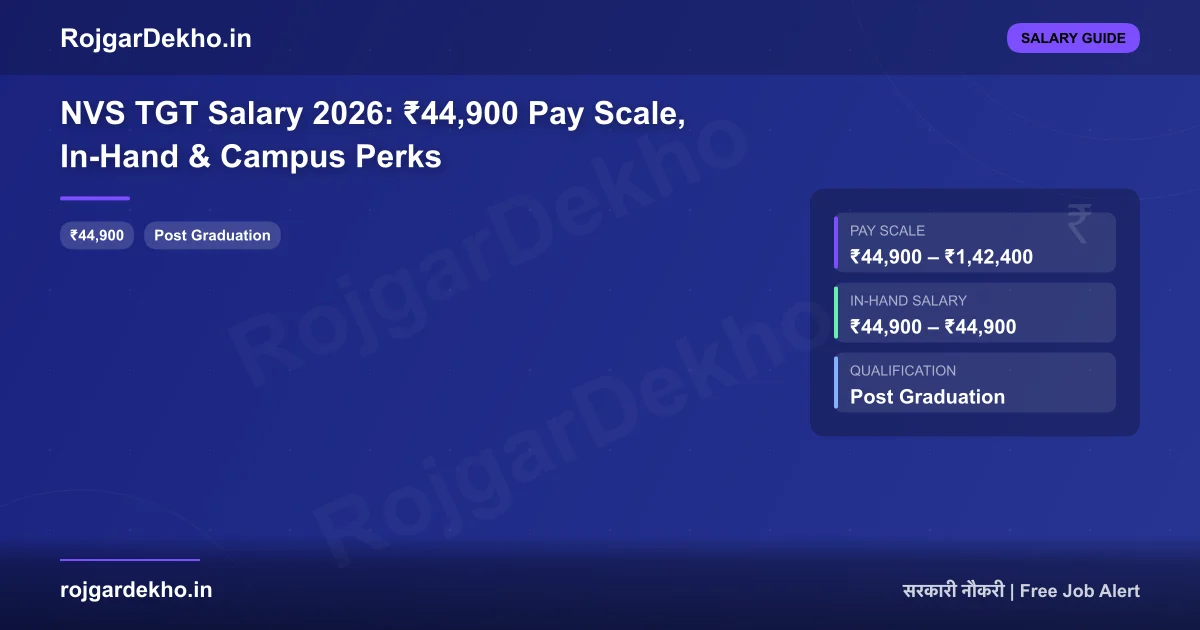
NVS TGT is a Group B Gazetted central government post placed in Pay Level 7 of the 7th Central Pay Commission pay matrix. The starting basic pay is ₹44,900 and the scale extends up to ₹1,42,400 over a full career.
| Pay Component | Details |
|---|---|
| Pay Level | Level 7 (7th CPC Pay Matrix) |
| Starting Basic Pay | ₹44,900 |
| Maximum Basic Pay | ₹1,42,400 |
| Annual Increment | 3% of Basic Pay (₹1,347 in first year) |
| Post Type | Group B, Gazetted, Non-Ministerial |
| Conducting Body | Navodaya Vidyalaya Samiti (under MoE, Govt. of India) |
Complete Monthly Salary Breakdown – What You Actually Earn
The in-hand salary depends on three variable factors: your city's HRA class, the current DA rate, and applicable deductions. Here is the full picture for a fresh NVS TGT joining in 2026:
| Component | Calculation | Amount (approx.) |
|---|---|---|
| Basic Pay | Level 7 minimum | ₹44,900 |
| Dearness Allowance (DA) | ~50–55% of Basic | ₹22,450–₹24,695 |
| House Rent Allowance (HRA) | 8% (Z-class / rural JNV) | ₹3,592 |
| Transport Allowance (TA) | As per CPC rules for level 7 | ₹3,600 + DA |
| Gross Pay (approx.) | Basic + DA + HRA + TA | ₹76,000–₹80,000 |
| NPS Contribution (deduction) | 10% of (Basic + DA) | −₹6,735–₹7,000 |
| CGHS Contribution (deduction) | Fixed per category | −₹250–₹500 |
| In-Hand Take-Home (approx.) | Gross minus deductions | ₹55,000–₹68,000 |
Note: DA rate is revised twice a year (January and July). The range above reflects current DA levels. HRA amount assumes a rural/semi-urban JNV posting (Z-class city = 8% HRA). Metro-area postings get 24% HRA, significantly increasing take-home.
HRA – How Your Posting Location Changes In-Hand by ₹8,000+
Most Jawahar Navodaya Vidyalayas are in rural or semi-urban districts — which means 8% HRA is the norm for most NVS TGT postings. But the difference is large:
| City Class | HRA Rate | HRA Amount (Basic ₹44,900) | Examples |
|---|---|---|---|
| X (Metro) | 24% | ₹10,776 | Delhi, Mumbai, Chennai, Kolkata |
| Y (Major city) | 16% | ₹7,184 | Lucknow, Jaipur, Patna, Bhopal |
| Z (Rural / Others) | 8% | ₹3,592 | Most JNV campus locations |
However: For most NVS TGT postings, HRA is largely irrelevant in practice. If you opt for campus accommodation (which nearly all NVS TGTs do), HRA is reduced to a nominal licence fee — and the accommodation you receive is worth far more than the HRA you forgo.
What No Other Site Tells You – The Hidden Value of NVS TGT
Most salary articles stop at the in-hand figure. Here is the full picture that changes the calculation completely:
| Hidden Benefit | Market Value (Monthly Equivalent) |
|---|---|
| Campus Accommodation (free / nominal licence fee) | ₹8,000–₹20,000 |
| Subsidized Campus Mess / Canteen | ₹3,000–₹6,000 |
| CGHS Medical Coverage (entire family) | ₹3,000–₹5,000 |
| School Holidays as Paid Leave (~12–14 weeks/year) | Effectively 3 extra months of salary/year |
| Leave Travel Concession (LTC) | ₹800–₹1,500 (monthly amortised) |
| Children's Education Allowance | ₹2,250 per child/month (up to 2 children) |
Add these non-cash benefits to the in-hand salary and the real monthly equivalent is closer to ₹85,000–₹1,00,000+ — which matches or beats most private school teacher salaries in Tier-1 cities, with far greater job security.
NVS TGT vs KVS TGT vs State Government Teacher – Salary Comparison
| Comparison Point | NVS TGT | KVS TGT | State Govt TGT (UP/Bihar) |
|---|---|---|---|
| Pay Level | Level 7 | Level 7 | Level 7 / Equivalent |
| Basic Pay (start) | ₹44,900 | ₹44,900 | ₹44,900 (7th CPC states) |
| Campus Accommodation | ✅ Yes (most JNVs) | ❌ No (day schools) | ❌ Rarely |
| Residential Campus Life | ✅ Residential schools | ❌ Day schools | ❌ Day schools |
| Mess / Canteen Subsidy | ✅ Yes (campus mess) | ❌ No | ❌ No |
| Posting Location | Pan-India (often rural) | Pan-India (military areas) | Within state |
| Teaching Load | Residential + hostel duty | Day school hours | Day school hours |
| School Holidays | CBSE calendar (~75 days) | CBSE calendar | State calendar |
The honest take: KVS TGT pays the same on paper but you go home to your own house (no free accommodation). NVS TGT often means rural posting with free accommodation — the net saving on rent is real money. If you value residential campus lifestyle and can handle rural India postings, NVS TGT's effective package beats KVS on value. If you prioritise staying in a city, KVS is a better fit.
Annual Salary Growth – The Increment Ladder
| Year of Service | Approximate Basic Pay | Approx. In-Hand (at ~50% DA) |
|---|---|---|
| Year 1 (Joining) | ₹44,900 | ₹55,000–₹60,000 |
| Year 3 | ₹47,600 | ₹58,000–₹63,000 |
| Year 5 | ₹50,500 | ₹61,000–₹67,000 |
| Year 10 | ₹58,500 | ₹70,000–₹76,000 |
| Year 20 | ₹78,800 | ₹92,000–₹1,00,000 |
| Year 30 (approaching max) | ₹1,18,500+ | ₹1,30,000+ |
Promotion Path – From TGT to Principal
NVS TGT is not a dead-end post. A clear internal promotion ladder exists:
- TGT (Level 7, ₹44,900): Entry point. Teaching duties + hostel supervision in residential JNVs.
- PGT – Post Graduate Teacher (Level 8, ₹47,600): After clearing NVS internal PGT exam or eligible promotion, usually 8–10 years as TGT. Higher subject specialization.
- Vice Principal (Level 10, ₹56,100): After PGT experience + selection through NVS internal process.
- Principal (Level 12, ₹78,800): Head of a JNV campus. Administrative + academic leadership. Comes with a Principal's bungalow on campus.
- MACP (Modified Assured Career Progression): Even without promotion, MACP gives a pay bump at 10, 20, and 30 years — ensuring your salary doesn't stagnate even if promotion is delayed.
NPS Pension – What Happens When You Retire
NVS TGT falls under the National Pension System (NPS), not the Old Pension Scheme (OPS). Under NPS:
- You contribute 10% of Basic + DA monthly (deducted from salary)
- Government contributes 14% of Basic + DA to your NPS corpus
- On a 30-year career, the NPS corpus at Level 7 progression is estimated at ₹1.2–₹1.8 crore
- On retirement, 40% of corpus is converted to an annuity (monthly pension), and 60% is available as lump sum
- The NPS deduction is a temporary salary cut — but the corpus belongs to you, unlike the OPS where pension depends on government's future budgets
Gratuity and Other One-Time Benefits
On superannuation (retirement at age 60), NVS TGT employees receive:
- Gratuity: 15 days × basic pay × years of service. Maximum gratuity: ₹20 lakh (as per current rules). For a 30-year career at maximum scale, this is close to the ₹20 lakh cap.
- Leave Encashment: Accumulated earned leave (up to 300 days) can be encashed at the time of retirement.
- NPS Lump Sum (60% of corpus): Estimated ₹70–₹1 lakh+ depending on returns over career.
Frequently Asked Questions
Q: Is NVS TGT salary the same as KVS TGT?
Yes, both are Level 7 (₹44,900 basic pay) central government posts under the same 7th CPC structure. The key difference is not the basic pay — it's the working conditions. NVS is residential (campus accommodation provided, rural postings common), KVS is day-school based (no accommodation, more likely urban posting).
Q: Do NVS TGT teachers get summer vacation as paid leave?
Yes. NVS follows the CBSE academic calendar. JNV teachers get approximately 60–70 days of summer vacation and 15–20 days of winter break, plus Diwali holidays — all as paid leave. This is a major lifestyle advantage that does not appear in the salary slip but represents enormous value.
Q: Does NVS TGT salary include campus accommodation cost?
Campus accommodation is provided to NVS TGTs at a nominal Licence Fee (much lower than market rent). The fee is deducted from salary, but the deduction is far less than what the accommodation would cost in the open market. Many NVS teachers consider this the single best perk of the job.
Q: What is the salary of NVS TGT after 10 years of service?
After 10 annual increments (3% per year compounded), the basic pay reaches approximately ₹58,500–₹60,000. At current DA levels, in-hand salary would be approximately ₹70,000–₹78,000 — plus campus accommodation and other benefits continuing throughout the career.
Q: Is NVS TGT a gazetted post?
Yes. NVS TGT is a Group B Gazetted Non-Ministerial post. Being gazetted means your pay slip can be used for official attestation purposes and you carry officer-level status within the NVS administration.
8th Pay Commission – What NVS TGT Can Expect
The 8th Central Pay Commission is expected to be constituted and implement revised pay from January 2026. Though official recommendations are awaited, the pattern from previous commissions gives a clear picture of what to expect:
- The 7th CPC multiplied Level 7 basic pay by approximately 2.57x over the 6th CPC. If the 8th CPC follows a similar fitment factor (expected around 2.0–2.5x), starting basic pay for NVS TGT could jump to ₹89,000–₹1,12,000 — more than doubling current in-hand salaries.
- DA is expected to be merged into basic pay as part of the revision (as happened in previous CPCs), meaning future DA calculations start from the new higher base.
- All allowances (HRA, TA) are revised upward alongside the basic pay revision.
For candidates joining NVS TGT in 2025–2026, the 8th CPC revision is a significant mid-career salary event. Unlike private school teachers whose salaries stagnate, a central government NVS TGT gets a structured pay revision every 10 years regardless of performance.
Detailed Monthly Salary Slip – What a Fresher Actually Gets
Below is a realistic monthly salary slip for an NVS TGT joining at Level 7 in a rural JNV (Z-class city), at current DA rates (~53%):
| Salary Slip Component | Amount (₹) |
|---|---|
| EARNINGS | |
| Basic Pay | 44,900 |
| Dearness Allowance (53%) | 23,797 |
| HRA (8% – rural posting) | 3,592 |
| Transport Allowance (Level 7 rate) | 3,600 |
| TA – DA on Transport Allowance | 1,908 |
| Gross Earnings | 77,797 |
| DEDUCTIONS | |
| NPS (Employee – 10% of Basic + DA) | −6,870 |
| CGHS Contribution (Level 7) | −350 |
| Licence Fee (Campus Accommodation) | −800 (approx.) |
| Total Deductions | −8,020 |
| Net In-Hand (Take-Home) | ~₹69,777 |
This does not account for income tax (if applicable) or any personal loan deductions. The licence fee for campus accommodation varies by JNV and the type of quarter allotted. But note that you're saving ₹8,000–₹20,000 in rent that this accommodation replaces.
Leave Benefits – The Invisible Salary Component
NVS TGT employees get the full range of central government leave benefits. These are not reflected in any salary article but represent significant financial value:
| Leave Type | Entitlement | Key Rule |
|---|---|---|
| Earned Leave (EL) | 30 days/year | Accumulate up to 300 days; encashable at retirement |
| Half Pay Leave (HPL) | 20 days/year | Commutable to Full Pay Leave with Medical certificate |
| Casual Leave (CL) | 8 days/year | Cannot be accumulated or encashed |
| Maternity Leave | 180 days | Fully paid; female employees |
| Child Care Leave | 730 days total career | Female employees with children under 18 |
| Summer / Winter Vacation | ~75–85 days/year | CBSE-schedule based; paid; no leave account deduction |
The leave encashment at retirement is a significant one-time benefit. If you accumulate 300 days of Earned Leave over a 30-year career, the encashment at Level 12 basic pay (if promoted to Principal) is approximately ₹10–₹15 lakh — tax-exempt up to ₹25 lakh (as per current rules).
Income Tax on NVS TGT Salary
At starting salary levels (~₹70,000 in-hand), most NVS TGT employees fall in the 20% income tax slab after standard deduction. However, several deductions significantly reduce the tax burden:
- Standard Deduction: ₹50,000 flat deduction for salaried employees (New Tax Regime: ₹75,000 from FY 2024-25).
- NPS under Section 80CCD(2): The government's 14% NPS contribution is deductible under Section 80CCD(2) — this alone saves approximately ₹37,000–₹40,000 in taxable income at this pay level.
- HRA Exemption: If not opting for campus accommodation, HRA received is partially exempt from income tax.
Net result: Most fresh NVS TGT employees pay minimal income tax (often under ₹5,000–₹10,000/month at entry level) when all deductions are applied. Consult a CA for personalized tax planning when joining.
At the end of the day, NVS TGT is not just a salary — it is a lifestyle. Campus accommodation, CBSE school holidays, CGHS medical, NPS retirement corpus, and a permanent government teaching career that grows with every year of service. The ₹44,900 starting basic pay is a floor, not a ceiling.
One underrated fact: NVS TGT salary grows automatically every year through the 3% annual increment — unlike private school salaries that often require negotiation and goodwill. After 5 years of simply doing your job, your basic pay crosses ₹50,500. After 10 years, ₹58,500. This compounding effect, layered with DA revisions and periodic Pay Commission enhancements, makes NVS TGT one of the most financially secure teaching careers in India.
📌 Related on RojgarDekho: