Power Grid Executive Trainee Salary 2026: Training Pay, E2 Grade, Perks & ₹5 Lakh Bond
Power Grid Corporation of India (PGCIL) is one of the few central PSUs where you can chart your entire salary trajectory from day one — because the pay scales are published on the official website, increments are fixed at 3% annually, and promotions follow a structured framework. If you have cleared GATE 2026 and are weighing Power Grid against GAIL, IOCL, or a private sector offer, this guide gives you the complete salary picture: training stipend, post-training E2 package, every perk, and the ₹5 lakh bond you must factor into your decision before accepting the offer letter.
👉 Power Grid ET Eligibility 2026 — Check if you qualify — 60% marks, age limit, and accepted GATE disciplines.
Training Period Salary: What You Earn in the First Year
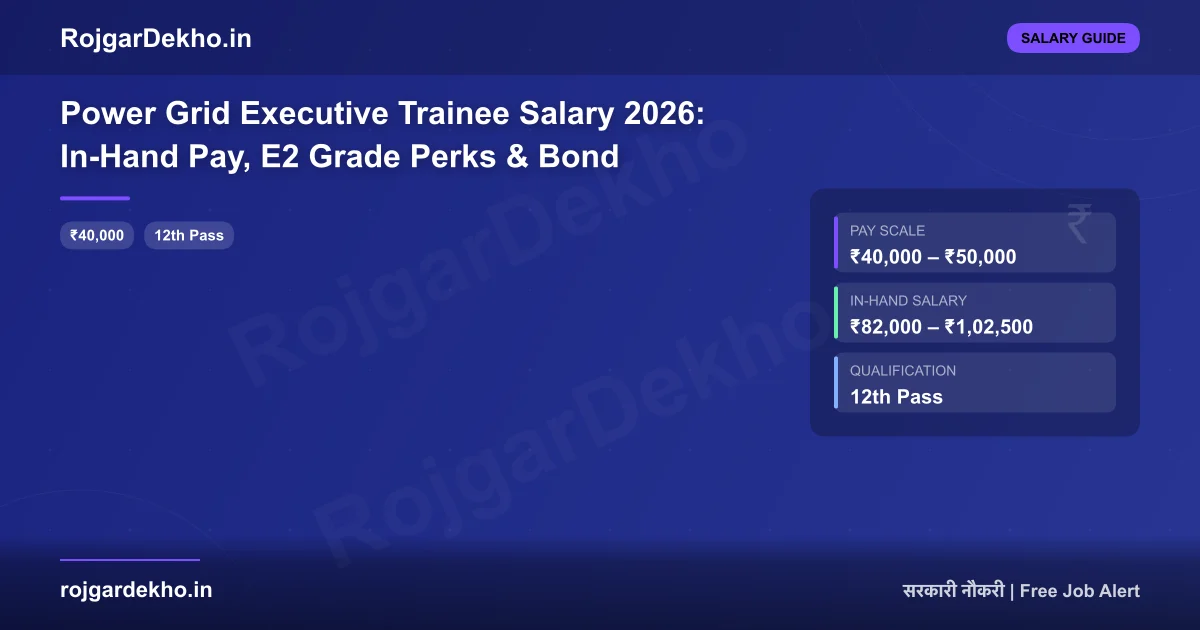
The first 12 months at Power Grid are a training-cum-probation period. You are not yet a confirmed employee, but you are paid on the training pay scale of ₹40,000 – ₹1,40,000, meaning your starting basic pay is ₹40,000 per month. This is not a reduced stipend — it is a full IDA executive pay scale from day one.
On top of basic, you receive the following allowances from the date of joining:
IDA (Industrial Dearness Allowance) — revised quarterly by the government based on the Consumer Price Index (Industrial Workers). As of early 2026, IDA for central PSU executives is running at approximately 50–55% of basic pay. On ₹40,000, this adds roughly ₹20,000–₹22,000 per month.
HRA or Company Accommodation — PGCIL has residential townships and quarters at most of its substation and regional office locations. If you get company accommodation (which is the norm at most posting locations), HRA is not paid in cash — the housing is the benefit. If no company quarters are available, HRA at 30% of basic (₹12,000/month) is paid instead.
Cafeteria Allowances — PGCIL follows a cafeteria perks model at 35% of basic pay. During training, this comes to ₹14,000/month. You allocate it across approved items: conveyance, children's education, medical reimbursement, transport, newspapers, or professional development — your choice.
Conveyance Reimbursement — monthly reimbursement of actual conveyance expenses up to prescribed limits.
| Component | During Training (Basic ₹40,000) | After E2 Confirmation (Basic ₹50,000) |
|---|---|---|
| Basic Pay | ₹40,000 | ₹50,000 |
| IDA (approx. 52%) | ~₹20,800 | ~₹26,000 |
| HRA (30%, if applicable) | ~₹12,000 | ~₹15,000 |
| Cafeteria Perks (35%) | ₹14,000 | ₹17,500 |
| Gross Salary (estimate) | ~₹86,800 | ~₹1,08,500 |
| Less: PF (12% of basic) | −₹4,800 | −₹6,000 |
| Estimated In-Hand | ~₹82,000 | ~₹1,02,500 |
These are estimates based on the current IDA rate and standard allowance structure. Actual in-hand varies with each quarterly IDA revision, posting location, whether company accommodation is provided, and professional tax in your state of posting.
After Training: E2 Grade — Your Confirmed Pay Package
After you complete the 12 months of training and pass the final assessment, Power Grid absorbs you into the E2 Executive Grade with a pay scale of ₹50,000 – ₹1,60,000. The annual increment within this band is 3% compounded. So your basic grows from ₹50,000 in Year 1 to approximately ₹57,964 in Year 5, even without a promotion to E3.
With E2 basic of ₹50,000 and current allowances, your gross salary runs approximately ₹1,05,000–₹1,15,000 per month depending on posting city and accommodation type. After PF deduction, in-hand is roughly ₹98,000–₹1,08,000 per month. For a fresh engineering graduate, this places PGCIL in the top tier of central PSU compensation packages.
Complete Career Pay Scale: E2 to E9
This is the data most websites do not show you. The complete PGCIL executive pay ladder — from E2 where Executive Trainees land after training, all the way to the top executive grade E9 — is published on the official powergrid.in website under the Pay and Allowances section:
| Grade | Pay Scale (₹/month) | Annual Increment | Typical Designation |
|---|---|---|---|
| Training Scale | 40,000–1,40,000 | 3% | Executive Trainee (Year 1) |
| E2 | 50,000–1,60,000 | 3% | Engineer (Confirmed) |
| E3 | 60,000–1,80,000 | 3% | Senior Engineer |
| E4 | 70,000–2,00,000 | 3% | Senior Engineer / AGM |
| E5 | 80,000–2,20,000 | 3% | Deputy General Manager |
| E6 | 90,000–2,40,000 | 3% | General Manager |
| E7 | 1,00,000–2,60,000 | 3% | Chief General Manager |
| E8 | 1,20,000–2,80,000 | 3% | Executive Director |
| E9 | 1,50,000–3,00,000 | 3% | Director / CMD |
Source: powergrid.in/en/pay-allowances — IDA pattern, effective 01.01.2017.
An engineer joining at E2 today with a basic of ₹50,000 will have their basic in the ₹65,000–₹70,000 range at E3 within 5–7 years, and gross salary north of ₹1,40,000 per month — without accounting for additional IDA revisions that further push every allowance upward.
Perks and Benefits Beyond the Salary Slip
The monthly bank credit does not tell the full story of PGCIL compensation. These non-cash benefits are substantial:
Company Leased Accommodation
PGCIL operates residential townships adjacent to its extra-high-voltage substations and regional offices across the country. At these locations, company quarters are available at a nominal house rent recovery of approximately 5–7% of basic pay — roughly ₹2,500–₹3,500 per month for housing that would cost ₹15,000–₹35,000 at market rates in the same area. Engineers posted to PGCIL townships routinely save 30–45% of their gross salary because they have no rent burden. Over a 25-year career, this compounds into a dramatically higher savings rate than a private sector peer earning 20–30% more but paying metro rents.
Comprehensive Medical Coverage
PGCIL provides group medical coverage for the employee, their spouse, dependent children, and dependent parents. Treatment at empanelled hospitals is cashless. For serious or complex conditions requiring super-specialty private hospitals, PGCIL covers costs. This eliminates the single largest financial risk for most families — an unexpected major medical expense.
Performance Related Pay (PRP)
After confirmation at E2, you become eligible for annual PRP linked to PGCIL's company performance rating and your individual performance score. PRP is not guaranteed but in strong operational years it adds the equivalent of 10–20% of annual CTC as a one-time payout on top of regular salary.
Provident Fund — Employer's Share
PGCIL contributes 12% of your basic pay as employer PF every month. At E2 basic of ₹50,000, that is ₹6,000 per month from the company going into your EPF account — ₹72,000 per year in tax-exempt retirement savings you never see in your bank account but will access at retirement. Your own 12% contribution is ₹6,000 per month, so the total PF corpus grows by ₹12,000 per month from day one.
Leave Travel Concession
LTC allows you and your family to travel anywhere in India every two years with train or air fare reimbursed by PGCIL. For a family of four, a round trip to a distant location could be worth ₹30,000–₹70,000, absorbed entirely by the company.
Group Insurance and Accident Cover
All PGCIL executives are enrolled in group life insurance and personal accident policies at zero cost. Engineers posted to high-voltage transmission substations particularly benefit from the accident coverage.
The Service Bond: ₹5 Lakh — Read This Before Accepting
Before you join, you sign a service bond. The specific terms as per the advertisement (CC/04/2025):
- General / EWS / OBC-NCL candidates: Bond amount ₹5,00,000 — minimum service obligation of 3 years after completing the 1-year training period. Total commitment from date of joining: 4 years.
- SC / ST / PwBD candidates: Bond amount ₹2,50,000 — same 3-year post-training service obligation.
This is legally enforceable. If you resign before completing 3 years of post-training service, PGCIL recovers the full bond amount — either from your final settlement dues or through legal means. Compared to IOCL's ₹10 lakh bond, PGCIL's ₹5 lakh is moderate. But treat it as real, not theoretical.
If you plan to leave within 4 years to pursue an MBA, a startup, or a foreign opportunity, factor ₹5 lakh as your exit cost. If you plan a career in India's power sector, 4 years is a short commitment for the stability and compensation PGCIL provides.
👉 Power Grid ET Selection Process 2026 — GATE carries 85% weightage — far more than GD (3%) or PI (12%). Full stage-by-stage guide.
Power Grid vs Other PSU ETs: Side-by-Side
| PSU | Entry Grade | Basic (Entry) | Service Bond | App. Fee |
|---|---|---|---|---|
| PGCIL | E2 (post-training) | ₹50,000 | ₹5 lakh / 3 yr | ₹500 |
| GAIL India | E2 | ₹60,000 | None confirmed | None |
| IOCL OT | E1 (training) | ₹50,000 | ₹10 lakh / 3 yr | ₹250–500 |
| ONGC GT | E1 | ₹60,000 | ₹3 lakh / 3 yr | ₹300 |
| BHEL ET | E2 | ₹40,000 | ₹3 lakh / 3 yr | ₹500 |
GAIL wins on entry basic (₹60,000 vs ₹50,000) and reportedly has no bond — making it the highest immediate take-home among PSU ETs. PGCIL's compensation edge is its accommodation network, which effectively neutralises the ₹10,000 basic difference in cities where PGCIL townships are available. IOCL has the steepest bond (₹10 lakh) but also the Fortune Global 500 brand and international operations exposure.
Is Power Grid the Right Fit for You?
Choose Power Grid if you want a 20–30 year technical career in infrastructure, value stability over maximum starting salary, prefer company accommodation to navigating rental markets in different cities, and are in electrical, electronics, civil, or computer science engineering.
Think carefully if you plan to leave within 4 years (the ₹5 lakh bond is a real cost), if you want a metropolitan office posting (PGCIL substations are spread across India including remote areas), or if you specifically need the highest immediate in-hand pay — in which case GAIL or ONGC may be a better starting point.
Frequently Asked Questions
Q: What is the starting in-hand salary for a PGCIL Executive Trainee in 2026?
During the 1-year training period, your basic is ₹40,000/month. With IDA (~52%), cafeteria perks (35%), and HRA (30%) — assuming no company accommodation — gross is approximately ₹86,800. After 12% PF deduction, in-hand is roughly ₹82,000 per month. After E2 confirmation it rises to approximately ₹1,02,500/month. Both figures are estimates and shift with quarterly IDA revisions.
Q: What is the E2 pay scale at Power Grid?
E2 pay scale is ₹50,000 – ₹1,60,000 with 3% annual increment. Executive Trainees are confirmed into E2 after successfully completing the 1-year training. Source: powergrid.in/en/pay-allowances.
Q: What is the service bond amount for PGCIL ET?
General, EWS, and OBC-NCL candidates sign a ₹5,00,000 bond for 3 years of post-training service. SC, ST, and PwBD candidates sign a ₹2,50,000 bond for the same period. Leaving before completing 3 post-training years means paying the full bond amount. Source: advertisement CC/04/2025.
Q: Does Power Grid provide accommodation?
Yes — company quarters at most substation and regional office townships at a nominal monthly recovery of about 5–7% of basic (roughly ₹2,500–₹3,500). If no company housing is available at your posting, HRA at 30% of basic is paid in cash instead.
Q: How frequently is IDA revised at PGCIL?
IDA is revised quarterly — every January, April, July, and October — by the government based on the Consumer Price Index (Industrial Workers). Revisions are automatic; no application is needed. Over a 25-year career, IDA revisions significantly increase effective salary without any promotion.
Q: What is the total CTC of a PGCIL Executive Trainee?
No official CTC is published. Based on the pay structure, total cost to company during training is broadly ₹15–18 LPA (cash + PF + insurance + accommodation value). At E2 confirmed grade, it rises to approximately ₹18–24 LPA. Figures vary materially by posting location and IDA rate at time of joining.
Q: Does Power Grid have a Performance Related Pay bonus?
Yes. After E2 confirmation, employees become eligible for annual PRP linked to company and individual performance ratings. PRP can add 10–20% of CTC in good years. It is not guaranteed — it depends on PGCIL's MoU performance score with the government for that year.
Q: Can I apply to both PGCIL and GAIL in the same year?
Yes, they are separate recruitments with separate applications. You can appear for both GD/PI rounds if shortlisted at both. However, they typically use GATE 2026 scores, so if you sit for GATE in the correct papers, you become eligible to apply to any PSU that accepts that paper.