RRB JE Salary 2026 – Complete In-Hand Breakdown with Railway Perks and Promotion Path
Railway Junior Engineer is one of the most applied-for technical government posts in India — and also one where candidates consistently have an unclear picture of what the actual take-home salary looks like. You see "Level 6, ₹35,400 basic" in the notification, but that tells you nothing about what lands in your account every month. The real picture requires adding DA (55% in January 2026), figuring out whether you get a railway quarter or cash HRA, and understanding the privilege pass and CGHS benefits that do not appear on your payslip but have real financial value.
This article gives you the complete, honest number — not a rough estimate. All figures are based on the 7th Pay Commission pay matrix and DA at 55% effective January 2026.
RRB JE Pay Scale 2026 – Basic Structure
| Component | Details |
|---|---|
| Post | Junior Engineer (JE) – Indian Railways |
| Pay Level (7th CPC) | Level 6 |
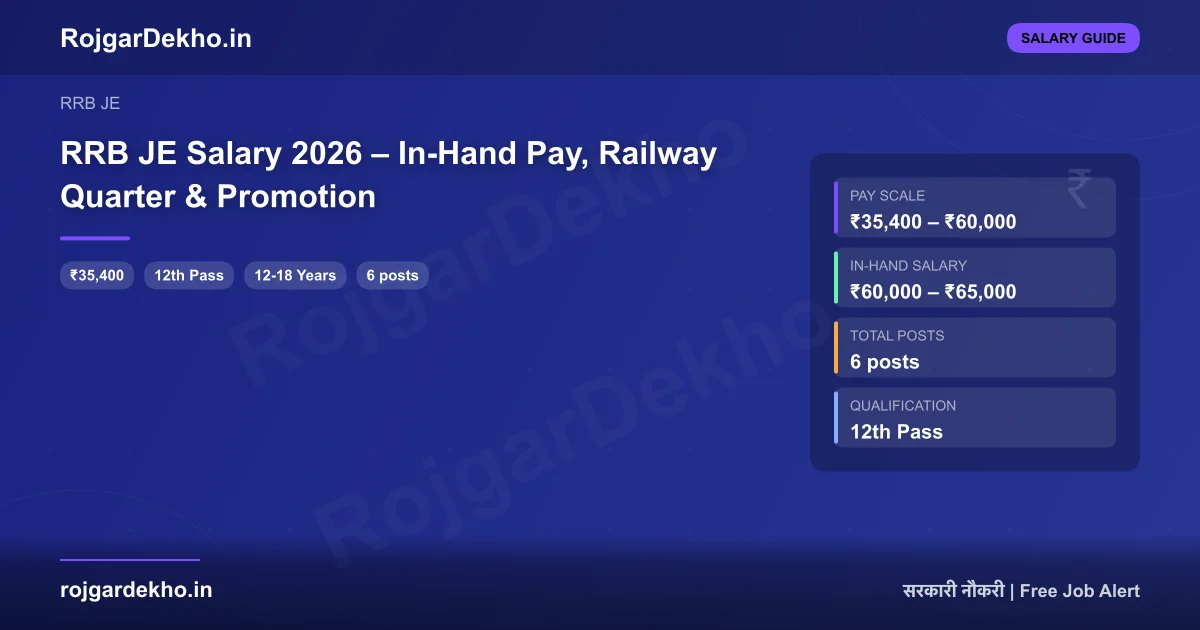
| Basic Pay at Entry | ₹35,400 |
| Dearness Allowance (DA) | 55% of Basic = ₹19,470 per month |
| HRA or Railway Quarter | Either cash HRA (27/18/9% of basic based on city) OR railway quarter at nominal licence fee |
| Transport Allowance (TA) | ₹3,600 + DA on TA (X/Y city) OR ₹1,800 + DA on TA (Z city/rural) |
| NPS (Employer Share) | 14% of Basic + DA = ₹7,681 per month (goes to corpus, not payslip) |
The "Level 6" pay level is the same as KVS PRT teacher, SSC CGL Level 6 posts (like NIA SI, ASO), and Railway Station Master. RRB JE is not underpaid relative to similarly-levelled central government posts — it is a perfectly respectable Pay Level 6 position with one major additional benefit that most other Level 6 posts do not offer: the railway quarter system.
RRB JE Salary With Railway Quarter – The Most Common Scenario
Most Railway JEs posted in divisional headquarters or workshop locations get a Type II or Type III railway quarter. When you live in a railway quarter, you do not receive cash HRA — instead, you pay a nominal "licence fee" of ₹500–₹2,000 per month for the accommodation (market rent for equivalent housing in a tier-2 city: ₹8,000–₹20,000). This saves you ₹6,000–₹18,000 per month compared to private housing.
Here is what a freshly joined RRB JE's monthly salary looks like when posted with a railway quarter in a Y-category city (no cash HRA):
| Component | Calculation | Amount |
|---|---|---|
| Basic Pay | Level 6 entry | ₹35,400 |
| Dearness Allowance (DA) | 55% of Basic | ₹19,470 |
| HRA | Not payable (railway quarter allotted) | ₹0 |
| Transport Allowance | ₹3,600 + 55% DA on TA | ₹5,580 |
| Gross Salary (approx) | — | ₹60,450 |
| NPS Deduction (Employee) | 10% of Basic + DA | −₹5,487 |
| CGHS Contribution | Health scheme | −₹500 |
| CGEGIS (Group Insurance) | Fixed insurance | −₹1,500 |
| Railway Quarter Licence Fee | Nominal deduction | −₹500 to −₹2,000 |
| Net In-Hand (approx) | — | ₹60,000–₹65,000 |
At ₹60,000–₹65,000 in-hand, the number looks modest compared to some private sector engineering roles. But this comparison is misleading. The railway quarter has a market value of ₹8,000–₹20,000 per month. Adding that saved rent back, the effective monthly value is ₹68,000–₹85,000 — for what is essentially an engineering job with no performance targets, no job insecurity, and regular working hours in most technical postings.
RRB JE Salary With Cash HRA – Y City, No Quarter
If a railway quarter is not immediately available (which happens in some postings, especially newly joined JEs), you receive cash HRA instead. Here is the same calculation for a Y-city posting with cash HRA:
| Component | Calculation | Amount |
|---|---|---|
| Basic Pay | Level 6 entry | ₹35,400 |
| Dearness Allowance (DA) | 55% of Basic | ₹19,470 |
| HRA | 18% of Basic (Y city) | ₹6,372 |
| Transport Allowance | ₹3,600 + 55% DA on TA | ₹5,580 |
| Gross Salary (approx) | — | ₹66,822 |
| NPS Deduction (Employee) | 10% of Basic + DA | −₹5,487 |
| CGHS Contribution | Fixed | −₹500 |
| CGEGIS | Fixed | −₹1,500 |
| Net In-Hand (approx) | — | ₹68,000–₹72,000 |
With cash HRA in a Y-city, net in-hand climbs to ₹68,000–₹72,000. But from this, you need to pay actual rent (₹8,000–₹15,000 in most Y-cities for decent accommodation) — leaving you with a post-rent disposable of ₹53,000–₹62,000. Compare this to the quarter scenario where your ₹60,000–₹65,000 in-hand has essentially no rent outgo (just the ₹500–₹2,000 licence fee). The quarter situation is almost always financially better.
RRB JE in X City (Metro) – With Cash HRA
Some JE postings are in major cities — Mumbai Division, Delhi Division, Chennai Division, Kolkata Division etc. In X cities with cash HRA (27% of basic):
| Component | Calculation | Amount |
|---|---|---|
| Basic Pay | Level 6 | ₹35,400 |
| DA (55%) | Basic × 0.55 | ₹19,470 |
| HRA (27%) | X city | ₹9,558 |
| Transport Allowance | ₹3,600 + 55% | ₹5,580 |
| Gross | — | ₹70,008 |
| NPS, CGHS, CGEGIS deductions | — | −₹7,487 |
| Net In-Hand (approx) | — | ₹62,000–₹68,000 |
In a metro city without a railway quarter, net in-hand ₹62,000–₹68,000 still requires you to pay city rent (₹12,000–₹25,000 in Mumbai or Delhi for a decent flat near the railway colony). That makes metro postings without quarters financially challenging. Most experienced Railway employees put themselves on the quarter waiting list and try to move into one as soon as possible.
Annual CTC – What the Real Package Is Worth
| Component | Amount (Annual) | Notes |
|---|---|---|
| Basic + DA + TA (12 months) | ₹6,45,840 | Core salary excluding HRA |
| HRA or Quarter Savings | ₹76,464 HRA (Y city) OR ₹96,000–₹2,40,000 quarter savings | Quarter savings = avoided rent |
| Employer NPS Contribution (14%) | ₹92,172 | Goes to retirement corpus — not payslip |
| CGHS Family Coverage | ₹20,000–₹50,000 equivalent | Medical cost savings for family |
| LTC (Leave Travel Concession) | ₹15,000–₹30,000 once in 2 years | Rail/air fare reimbursed |
| Privilege Railway Passes | ₹30,000–₹80,000 value | 4 sets/year; self + family travel free on Indian Railways |
| Annual CTC Equivalent | ₹12–14 LPA (cash) + ₹4–6 LPA perks | Total effective value ₹16–20 LPA in quarter posting |
The privilege railway pass deserves special attention. As a Railway employee, you and your family get 4 sets of privilege passes per year — each pass allows free travel on Indian Railways in an appropriate class (most JEs get Second Class/Sleeper, with higher passes on promotion). For families who travel 2–4 times annually, this saves ₹30,000–₹80,000 per year. Many Railway families explicitly factor in the travel savings when deciding whether to join Railways over other government services.
RRB JE Promotion Path – From JE to Divisional Engineer
This is where RRB JE's career truly differentiates itself from other Level 6 posts. The promotion ladder in Indian Railways for technical officers is well-defined and has historically moved at a reasonable pace:
| Post | Pay Level | Basic Pay | Typical Timeline | Route |
|---|---|---|---|---|
| Junior Engineer (JE) | Level 6 | ₹35,400 | At joining | RRB JE recruitment |
| Senior Section Engineer (SSE) | Level 7 | ₹44,900 | 5–8 years | DPC (Departmental Promotion Committee) — seniority + CR |
| Junior Engineer (Group B – temporary) | Level 7 | ₹44,900 | Concurrent to SSE | Internal — same pay as SSE |
| Assistant Divisional Engineer (ADE/AEN) | Level 9 or 10 | ₹53,100–₹56,100 | 12–18 years | SSE LDCE exam (GATE-based or departmental) |
| Divisional Engineer / AEN (DEN) | Level 10 | ₹56,100 | 18–25 years | Gazetted officer — Group A entry |
| Senior Divisional Engineer (Sr. DEN) | Level 12 | ₹78,800 | 25–30 years | Senior Group A |
The JE to SSE promotion is the most important step in the career. SSE at Level 7 (₹44,900 basic) earns approximately ₹80,000–₹88,000 gross in a Y-city posting, translating to ₹70,000–₹78,000 in-hand (or more effective value with quarter). This promotion typically happens in 5–8 years through the Departmental Promotion Committee (DPC) process, which is primarily seniority-based with service record assessment.
The path from SSE to AEE/AEN involves a Limited Departmental Competitive Examination (LDCE) or GATE-based internal selection. JEs who take GATE seriously and maintain good GATE scores can use this to accelerate their promotion into the ADE/AEN (Group B Gazetted) level — bypassing the full wait for DPC seniority promotions.
SSE Salary After Promotion – What to Expect
Once you are promoted to Senior Section Engineer (Level 7), your salary structure changes meaningfully:
| Component | JE (Level 6) | SSE (Level 7) |
|---|---|---|
| Basic Pay | ₹35,400 | ₹44,900 |
| DA (55%) | ₹19,470 | ₹24,695 |
| HRA (Y city, 18%) | ₹6,372 | ₹8,082 |
| TA (Y/X city) | ₹5,580 | ₹11,160 |
| Gross (Y city, cash HRA) | ₹66,822 | ₹88,837 |
| Net In-Hand (approx) | ₹60,000–₹65,000 (quarter) or ₹68,000–₹72,000 (HRA) | ₹78,000–₹85,000 |
| Annual CTC | ₹12–14 LPA effective | ₹16–18 LPA effective |
Railway Perks Beyond Salary – The Full Benefits Picture
- Privilege Railway Passes: 4 sets per year for self and family. Invaluable for families with children in different cities or elderly parents at hometowns. Annual value: ₹30,000–₹80,000 depending on travel frequency.
- CGHS Medical: Cashless medical treatment for you and your family at empanelled hospitals. Alternatively, at Railway hospitals (often on campus in divisional headquarters).
- Railway Quarter: Type II/III accommodation at ₹500–₹2,000 licence fee per month. Market equivalent: ₹8,000–₹20,000 in tier-2 cities. Some locations in metros have Type IV quarters with market value of ₹30,000–₹50,000/month — at the same nominal rent.
- NPS (Retirement Corpus): Combined employee + employer contribution of 24% of Basic+DA every month. For a JE: ₹5,487 + ₹7,681 = ₹13,168/month going into retirement savings.
- Leave Benefits: 30 Earned Leaves + 8 Casual Leaves + unlimited half-pay leaves. EL encashable up to 300 days at retirement.
- School Pass: Children of Railway employees get school-specific passes for travel — useful for families with children in government railway schools.
- Subsidised Railway Canteen: Most Railway workshops and divisional offices have subsidised canteens. Monthly savings: ₹2,000–₹5,000 on food.
Department-wise Posting Differences
RRB JE posts span multiple engineering departments — Civil, Electrical, Mechanical, Signal & Telecom, IT. The salary is identical across departments at the same level, but the nature of work and posting conditions differ:
| Department | Typical Posting Location | Work Nature | Quarter Availability |
|---|---|---|---|
| Civil Engineering (PWI/JE) | Along track / rural sections | Track maintenance, bridges, earthworks | Yes — most positions have residential quarters near track |
| Electrical (General / TRD) | Divisional HQ / traction substation | Station lighting, OHE maintenance, locomotives | Good quarter availability in divisional towns |
| Mechanical (C&W / Loco) | Workshops / loco sheds | Train maintenance, coach workshops | Workshop colonies — often with good quarters |
| Signal & Telecom (S&T) | Along sections / divisional HQ | Signal maintenance, communication systems | Yes in most divisional postings |
| IT / Computer (CRIS etc.) | Zonal / divisional HQ | Desk-based systems work | Limited — HQ postings may not always have quarters |
Civil and Mechanical JEs in track-side or workshop postings typically have the easiest access to railway quarters — the Railways has an extensive housing colony system along its network. IT and administrative-side JEs in urban headquarters may wait longer for a quarter and rely on cash HRA in the interim.
Frequently Asked Questions
What is the actual in-hand salary of RRB JE 2026 with a railway quarter?
An RRB JE posted with a railway quarter in a Y-city earns approximately ₹60,000–₹65,000 in-hand per month. This comes from Basic ₹35,400 + DA ₹19,470 + TA ₹5,580 (no cash HRA when quarter is allotted) = gross ~₹60,450. After NPS employee deduction (₹5,487), CGHS (₹500), CGEGIS (₹1,500), and quarter licence fee (₹500–₹2,000), net in-hand is ₹60,000–₹65,000. The quarter itself saves you ₹8,000–₹18,000 per month in rent — making the effective financial value ₹68,000–₹83,000.
What is the annual CTC of RRB JE including all perks?
Cash CTC (salary components only) works out to approximately ₹12–14 LPA. Adding employer NPS contribution (₹92,172/year), CGHS family medical value (₹20,000–₹50,000/year), railway privilege pass savings (₹30,000–₹80,000/year), and quarter savings (avoided rent ₹96,000–₹2,40,000/year), the effective total annual value is ₹16–22 LPA. This makes RRB JE significantly undervalued when compared purely on cash CTC to private sector engineering roles.
How long does it take for an RRB JE to become SSE?
The typical timeline for JE to SSE (Senior Section Engineer) promotion is 5–8 years. The promotion goes through the Departmental Promotion Committee (DPC) which evaluates service record, confidential reports, and seniority. In some departments and zones with high vacancy rates at the SSE level, the promotion happens faster (4–5 years). In zones with low vacancy, it may stretch to 8–10 years. SSE sits at Pay Level 7 (₹44,900 basic) — a meaningful salary jump from JE Level 6.
Do all RRB JE employees get a railway quarter?
Not immediately. Railway quarters are allocated on a waiting list basis — seniority plays a role. Newly joined JEs often spend 6 months to 3 years on the waiting list before a quarter becomes available, during which they receive cash HRA. Postings in rural track sections, workshops, and divisional headquarters generally have better quarter availability than urban HQ postings. Once you get a quarter, it stays with you until transfer — and on transfer, you apply for a new quarter at the new posting.
Is RRB JE salary better than SSC CGL at the same level?
Both are at Pay Level 6 with identical basic pay of ₹35,400. On raw cash in-hand, they are similar — SSC CGL Level 6 posts (ASO, NIA SI) may have slightly better HRA in Delhi compared to a Railway JE in a smaller town. But the Railway perks (privilege pass, quarter, railway hospital access, workshop canteen) add ₹4–8 LPA in effective value that SSC CGL Level 6 posts do not offer. For candidates with an engineering background who can use their technical training on the job, RRB JE provides a more career-matched role and better total compensation value.