Uttar Pradesh DSP Salary 2026 – In-Hand Pay, Perks, and What Makes This Post Different
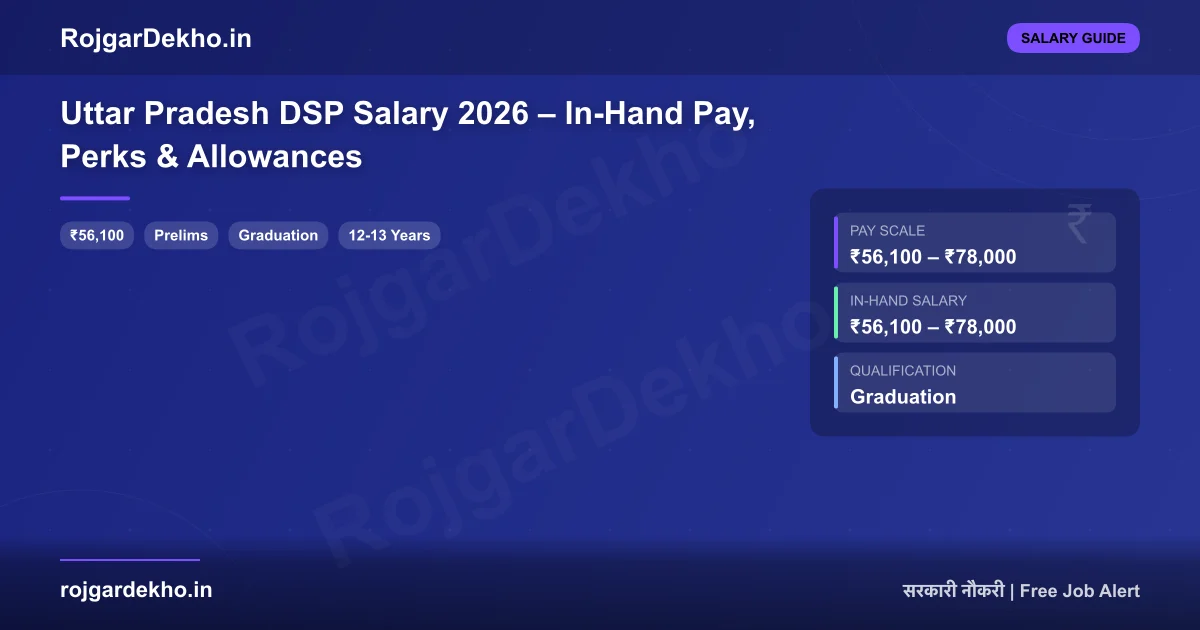
A Deputy Superintendent of Police (DSP) in Uttar Pradesh earns a starting basic pay of ₹56,100 per month at Pay Level 10 of the 7th Central Pay Commission matrix. That's the official number. The real take-home — after adding DA, HRA, travel allowance, and duty allowances — works out to ₹78,000–₹88,000 per month, depending on your posting location and unit. But the salary is only part of the picture. The vehicle, the bungalow, the orderly staff — these perks add another ₹60,000–80,000/month in equivalent value. This article breaks down every component.
👉 Uttar Pradesh Inspector Salary 2026 — If you are an Inspector targeting DSP promotion, see how your salary compares and what changes at Level 10.
Uttar Pradesh DSP Salary 2026 – Full Component Breakdown
DSP is a gazetted officer post at Pay Level 10. Here is what makes up the monthly pay packet:
| Salary Component | Amount (Approx) | Notes |
|---|---|---|
| Basic Pay (Pay Level 10) | ₹56,100/month | 7th CPC — starting of Level 10 |
| Dearness Allowance (DA) | ~₹25,806/month (46% of basic) | Revised twice yearly by Centre — Jan & Jul |
| House Rent Allowance (HRA) | ₹8,976 (Y-class, 16%) to ₹4,488 (Z-class, 8%) | Y-class (Lucknow, Agra, Varanasi) / Z-class (districts) |
| Travel Allowance (TA) | ₹3,600–₹7,200/month | Level 9 and above — grade-dependent |
| Uniform/Ration Allowance | ₹2,500–₹3,500/month | Non-taxable benefit |
| Night Duty / OT | ₹800–₹1,500/month | Applicable where rostered |
| Special Duty Allowance | STF/ATS posting: risk/operational allowance (~₹3,000–5,000/month) | If posted in qualifying unit/area |
| Total In-Hand (Estimate) | ₹78,000–₹88,000 | Y/Z-class posting without special allowance |
Dearness Allowance is revised every January and July based on AICPI index. At 46% DA (current mid-2026 rate), the combined basic + DA for a Uttar Pradesh DSP comes to approximately ₹81,906/month before HRA and other allowances. UP has the largest police force in India — more DSP postings, faster promotions in high-demand units like STF, ATS, EOW.
The Non-Cash Perks: Why DSP Compensation Is Understated
The in-hand salary figure underrepresents what a DSP actually receives. The perks below are real, assignable to the officer by virtue of rank, and have significant market equivalent value.
| Perk / Benefit | Details for DSP | Market Value Equivalent |
|---|---|---|
| Official Vehicle + Driver | Government jeep (usually Bolero/Scorpio) + driver — available 24/7 | ₹40,000–60,000/month if hired privately |
| Government Bungalow | Type-IV/V government quarters in district headquarters | Market rent ₹15,000–30,000/month |
| Orderly Staff | Cook, domestic help, and security personnel assigned by state | ₹25,000–40,000/month if hired privately |
| Medical Coverage | Full family — cashless treatment at empanelled hospitals | ₹30,000–50,000/year premium equivalent |
| NPS (Retirement) | State + employee contribution 10%+14% | Substantial retirement corpus |
| Telephone / Communication | Official mobile + data reimbursement | ₹1,500–2,000/month |
| Children Education | Education allowance for 2 children | ₹2,250/month/child |
The official vehicle alone — a government jeep with a full-time driver, fuel, and maintenance covered by the state — would cost ₹40,000–60,000/month to replicate privately. Add subsidised government accommodation in the district headquarters (where market rents can be ₹15,000–30,000/month), and the total compensation package of a Uttar Pradesh DSP is closer to ₹1.5–2 lakh/month in equivalent terms.
Posting Unit Matters: How Allowances Vary
Not all DSP postings carry the same salary. Your unit assignment significantly affects your monthly take-home.
| Unit / Posting | Nature of Work | Salary Implication |
|---|---|---|
| STF (Special Task Force) | Anti-organised crime operations | Risk allowance + operational budget |
| ATS (Anti-Terrorism Squad) | Counter-terrorism operations | Risk allowance + commando training allowance |
| EOW (Economic Offences Wing) | Financial crime investigation | Standard pay + Lucknow HQ posting (Y-class HRA) |
| SCB (Senior Civil Branch) | Law & order, district policing | Standard pay scale — no special allowance |
| CB-CID | Criminal investigation | Standard pay, Lucknow/divisional postings |
Direct DSP vs Promoted DSP: Same Pay, Very Different Careers
In Uttar Pradesh, there are two ways to become a DSP: through the state PSC exam (direct route) or through departmental promotion from Inspector. Both start at the same Pay Level 10, but the career trajectories are fundamentally different.
| Factor | Direct DSP (State PSC) | Promoted DSP (from Inspector) |
|---|---|---|
| Route | State PSC exam (e.g. UPPSC, RPSC, BPSC) | Departmental promotion after ~12–13 years as Inspector |
| Age at Joining as DSP | Typically 24–30 years | Typically 38–45 years |
| Years as DSP | Can serve 25–30 years | Serves only 12–18 years |
| Promotion Potential | Can reach DIG/IG/ADG with time | Rarely goes above SP |
| IPS Deputation | State PSC DSP eligible for IPS vacancy if promoted to SP via UPSC review | Generally not eligible |
| Starting Pay | Same Level 10 — ₹56,100 | Same Level 10 — ₹56,100 |
| Career Advantage | Longer career at gazetted level, higher pension potential | Seniority, local knowledge, pension secured |
The single biggest advantage of the direct route is time — a DSP who joins at 26 can potentially serve for 30+ years in the gazetted tier, reaching ADG or DGP level. A promoted DSP who joins at 40 has 18 years left before retirement, limiting how far they can rise regardless of ability.
DSP to SP: The Promotion Path
Promotion from DSP to Superintendent of Police (SP) is the critical career milestone — it brings command of an entire district, Pay Level 14 (₹1,18,500 basic), and IPS-equivalent status in the state cadre.
| Route | Post | Service Required | Timeline |
|---|---|---|---|
| Departmental DPC | Superintendent of Police (SP) | 8–12 years as DSP | 10–15 years total service |
| State PSC Exam (lateral) | SP (Direct IPS equivalent) | No minimum | Competitive — few seats |
| UPSC / IPS (direct) | ASP / IPS cadre | Open for service officers too | Very competitive |
| MACP Pay Upgrade | Pay Level 11 (₹67,700 basic) | 10 years in Level 10 | Financial benefit only |
3 Myths About UP DSP Salary — Debunked
Myth 1: "DSP salary is lower than private sector." Reality: The in-hand cash figure is ₹78,000–₹88,000. Add the government vehicle (₹40K/month equivalent), bungalow (₹20K/month equivalent), and domestic staff (₹30K/month equivalent), and the total package exceeds ₹1.5 lakh/month — comparable to a mid-senior corporate manager.
Myth 2: "Inspector is enough — no need to become DSP." Reality: Inspector is Pay Level 7 (₹44,900 basic). DSP is Level 10 (₹56,100 basic) — that's a 25% jump in basic, plus the entitlement to vehicle, bungalow, and orderly staff that Inspectors don't get. The gazetted status also opens doors to selection committees and prestige postings.
Myth 3: "Promotion from DSP to SP is very slow." Reality: In most states, exceptional performers with good ACR (Annual Confidential Report) ratings reach SP in 8–10 years. The promoted DSP who joined as Inspector at 22 and became DSP at 35 can still become SP by 45 — with full pension entitlement.
How to Become a UP DSP: The Direct Route
The direct route to DSP is through the UPPSC (Uttar Pradesh Public Service Commission). Here is what the process looks like:
| Stage | Details |
|---|---|
| Notification | UPPSC releases DSP vacancy in Combined State/Upper Sub. Service Exam |
| Prelims | GS Paper I + Paper II (CSAT) — 200 marks each, objective |
| Mains | 8 papers — GS I/II/III/IV + Essay + Optional (2 papers) + Hindi |
| Interview/Viva | 200 marks — conducted by UPPSC board |
| Physical / Medical | Physical efficiency test + medical examination |
| Training | 1–2 years at Police Training College (PTC), Moradabad |
The direct DSP exam is one of the most competitive state-level exams. The selection process typically spans 12–18 months from notification to joining. Prepare for Prelims (GS + CSAT style), Mains (descriptive — GS, Law, Current Affairs), and a physical test followed by a detailed interview. The police-specific law portions (IPC, CrPC, Evidence Act, state police acts) carry significant weight at both Mains and interview stages.
NPS Corpus: What Retirement Looks Like for a UP DSP
Unlike the old defined-benefit pension, NPS requires discipline to build wealth. The good news: a DSP's rising basic pay means NPS contributions compound aggressively over a 30-year career.
| Years of Service | Approx Basic at that Point | Monthly NPS Contribution (State+You) | Projected Corpus at Retirement |
|---|---|---|---|
| 5 years | ~₹65,000 | ~₹15,600/month | Just accumulating |
| 15 years | ~₹88,000 | ~₹21,120/month | ~₹45–60 lakh |
| 25 years | ~₹1,20,000 | ~₹28,800/month | ~₹1.5–2 crore |
| 35 years (retirement) | ~₹1,60,000+ | ~₹38,400/month | ~₹3–5 crore |
A UP DSP who retires after 35 years with a ₹4–5 crore NPS corpus can buy an annuity generating ₹1.2–2 lakh/month for life. This is comparable to what a ₹2–3 crore fixed deposit would generate — except the FD gets depleted; the annuity runs for life. The key is to not withdraw from NPS early (which is allowed under specific conditions but reduces the final corpus).
True Monthly Cost of Living for a UP DSP
When you factor in government perks, the actual monthly cash expenditure for a UP DSP is dramatically lower than what the salary figure suggests.
| Expense | Without Govt Perks (self-arranged) | With DSP Govt Perks |
|---|---|---|
| Accommodation | ₹15,000–30,000/month rent | Govt bungalow — licence fee ₹500–1,500/month |
| Vehicle + fuel | ₹15,000–25,000/month (EMI + fuel + driver) | Govt jeep + driver — full state cost |
| Domestic help | ₹8,000–15,000/month | Orderly staff — state assigned, no cost |
| Medical (family) | ₹3,000–5,000/month (insurance + OPD) | Fully covered at government hospitals |
| Mobile/Internet | ₹1,000–2,000/month | Official phone + data reimbursed |
| Total Monthly Outgo | ₹42,000–77,000/month (self) | ₹500–3,000/month (licences/nominal) |
| Effective Monthly Saving | — | ₹40,000–74,000/month — on top of ₹78,000–₹88,000 in-hand |
A UP DSP effectively "saves" ₹40,000–70,000/month in equivalent expenses that would otherwise come out of the salary. This is why the effective financial position of a DSP is significantly better than an employee earning the same ₹88,000 in the private sector with no perks.
Annual Salary Growth for a UP DSP: Year-by-Year
Every April, a UP DSP receives a 3% annual increment on basic pay. Over a 10-year career without promotion, the basic pay grows from ₹56,100 to approximately ₹75,000. Combined with DA growth (DA has risen from 17% in 2020 to 46% in 2026), the total cash in-hand increases by roughly ₹15,000–20,000 over that same period — purely from time-in-service. When a DSP is promoted to SP (Pay Level 14, basic ₹1,18,500), the salary jumps significantly — but the non-cash perks (vehicle, bungalow, orderly) also upgrade to SP-level entitlements including a larger official residence and a second vehicle in some states. The compound effect of increments, DA growth, and promotion makes the Uttar Pradesh DSP career one of the most financially rewarding state government posts available at the graduation level.
Frequently Asked Questions
Q: What is the exact basic pay of a DSP in Uttar Pradesh?
₹56,100 per month at the start of Pay Level 10 (7th CPC). After annual increments of 3%, basic reaches ₹57,783 in Year 2, ₹59,517 in Year 3, and so on. By Year 10, basic pay is typically ₹73,000–76,000 before any promotion to SP.
Q: Does a Uttar Pradesh DSP get an official vehicle?
Yes. DSP is an entitled rank for a government vehicle (typically a Bolero, Scorpio, or Thar depending on the state's fleet). The vehicle comes with a driver and fuel allocation. In field postings, the vehicle is available around the clock. In headquarters postings, it follows a pool arrangement.
Q: Is Uttar Pradesh DSP salary the same across all districts?
Basic pay and DA are uniform. The difference is in HRA — a DSP in Lucknow, Agra, Varanasi earns higher HRA than one in a Z-class district. The special duty and operational allowances also vary by unit and posting location.
Q: What is the pension for a Uttar Pradesh DSP?
Officers appointed after January 2004 are under NPS (National Pension System) — no defined pension. Both state and employee contribute 10% each (some states contribute 14%). With 30 years of service and rising basic pay, the NPS corpus at retirement can reach ₹2–3 crore, generating ₹80,000–1,20,000/month annuity.
Q: Can a Uttar Pradesh DSP become an IPS officer?
DSPs promoted to SP rank become eligible for consideration for IPS cadre through the UPSC-managed Select List process (for state police officers). Direct DSPs have a better chance of reaching SP than promoted DSPs due to longer service time. Getting onto the IPS Select List is competitive and depends on state cadre vacancy and merit.
📌 Related on RojgarDekho: