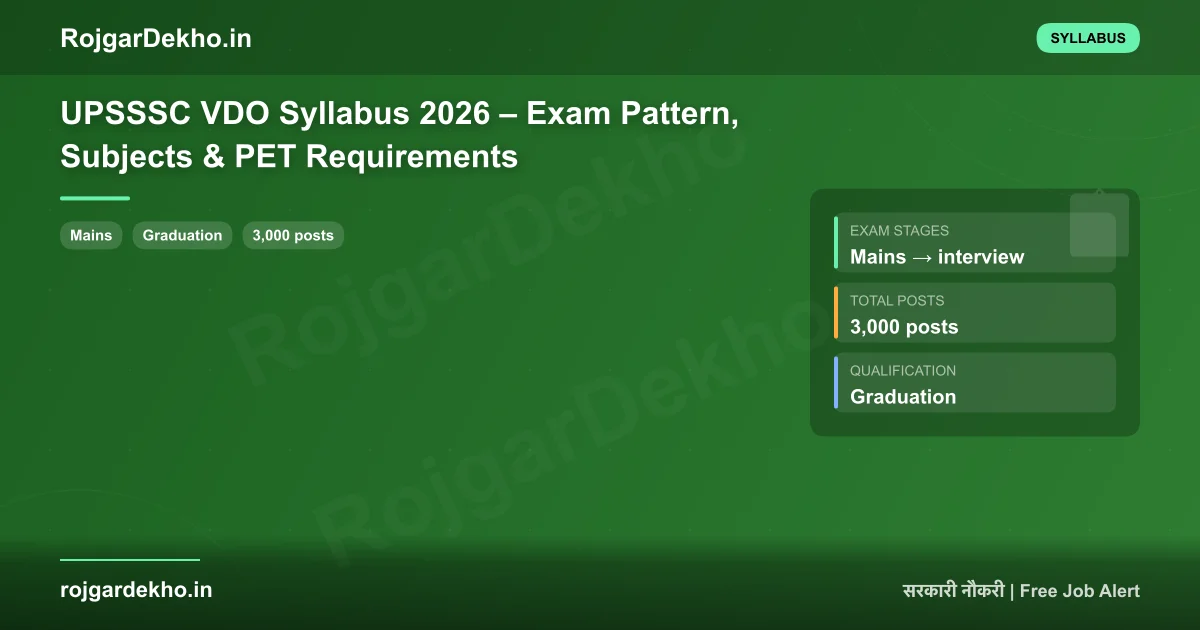
UPSSSC VDO Syllabus 2026 – Complete Exam Pattern, Subjects and PET Guide
Cracking the UPSSSC VDO (Village Development Officer) exam requires understanding two stages: PET (Preliminary Eligibility Test) as a qualifying gateway, and the Mains written exam that determines your final merit rank. This article gives you the complete picture — PET structure, Mains exam pattern, subject-wise topic breakdown, recommended books, and a preparation roadmap. All information is based on previous UPSSSC VDO recruitment cycles; the 2026 official notification will have the definitive pattern.
👉 UPSSSC VDO Eligibility 2026 — age limits, graduation + CCC requirement, UP domicile rules
UPSSSC VDO Selection Process – 3 Stages
UPSSSC uses a three-stage selection process for VDO recruitment since the 2021 PET reform:
| Stage | Name | Purpose | Qualifying / Merit |
|---|---|---|---|
| Stage 1 | PET (Preliminary Eligibility Test) | Common gateway for all UPSSSC posts | Qualifying (score used for shortlisting) |
| Stage 2 | Mains Written Exam | Post-specific subject knowledge test | Merit-based (final rank) |
| Stage 3 | Document Verification (DV) | Certificate check at UPSSSC office | Qualifying (go/no-go) |
PET is a common exam held once a year. A valid PET score (typically with a 1-year validity window for specific recruitment cycles) is mandatory before your Mains application is accepted. There is no interview stage for VDO.
PET Exam Pattern
UPSSSC PET was introduced to standardise screening across all UPSSSC posts. The pattern is the same regardless of the post you are targeting:
| Subject / Area | Marks |
|---|---|
| Indian History (Harappan, Vedic, Medieval, Mughal, Modern/Freedom Struggle) | 5 |
| Indian Geography (Physical, Resources, Climate, Rivers) | 5 |
| UP-Specific Topics (Geography, Culture, History, Economy) | 10 |
| Indian Economy & Current Affairs | 10 |
| Indian Constitution & Public Administration | 5 |
| General Science (Physics, Chemistry, Biology — Class 10 level) | 5 |
| Elementary Arithmetic (Percentage, Average, Ratio, Profit-Loss, Simple Interest) | 5 |
| General Hindi (Grammar, Vocabulary, Comprehension) | 15 |
| General English (Grammar basics, vocabulary) | 5 |
| Reasoning & Mental Ability | 5 |
| Harijan/Backward Class Welfare (UP schemes) | 5 |
| Women Empowerment & Child Development | 5 |
| Environment Conservation & Energy | 5 |
| Agriculture (UP crops, Kisan schemes, mandi) | 5 |
| Current National & International Events | 10 |
| Total | 100 marks |
Duration: 2 hours | Negative marking: –1/4 (–0.25) per wrong answer | Medium: Hindi + English
A valid PET score is mandatory for applying to VDO Mains. UPSSSC typically shortlists candidates for Mains based on PET scores — roughly 10–15× the number of vacancies.
👉 UPSSSC VDO Salary 2026 — ₹29,200 Level 5 pay, in-hand ₹38K–₹50K, MACP growth path
VDO Mains Exam Pattern
The Mains is the deciding exam for final merit. It is a single paper covering five subject areas, each carrying 20 marks:
| Subject | Questions | Marks |
|---|---|---|
| General Hindi | 20 | 20 |
| General Studies | 20 | 20 |
| Village Development & Rural Society | 20 | 20 |
| Village Panchayat & Revenue Administration | 20 | 20 |
| Mental Ability & Reasoning | 20 | 20 |
| Total | 100 | 100 |
Duration: 2 hours | Type: MCQ (4 options) | Negative marking: As per official notification | Medium: Hindi
No interview. No physical test. The Mains merit list directly feeds into the final selection and DV. This makes UPSSSC VDO a purely exam-based recruitment — ideal for candidates who prepare methodically.
Subject 1: General Hindi – Detailed Syllabus
Hindi carries 20 marks in Mains and 15 marks in PET — making it the highest-weight single subject across both stages combined. Focus areas:
- Sandhi (संधि): Swar sandhi, vyanjan sandhi, visarg sandhi — rules + examples
- Samas (समास): Tatpurusha, dvandva, bahuvrihi, avyayibhav — identifying type from compound words
- Karak (कारक): 8 karaks — vibhakti signs + usage in sentences
- Vachan (वचन) & Ling (लिंग): Singular/plural + masculine/feminine transformations
- Paryayvachi (पर्यायवाची) & Vilom (विलोम): Synonyms and antonyms — usually 30–50 high-frequency pairs repeat across UPSSSC exams
- Muhavare (मुहावरे) & Lokoktiyaan (लोकोक्तियाँ): Idioms and proverbs — meaning + sentence use
- Anekarthi shabda: Words with multiple meanings — a regular trap in MCQs
- Vartani (वर्तनी): Correct spelling — common misspellings in government Hindi
- Ras, Chhand, Alankar: Basic literary devices — identification from given lines
- Apathit Gadyansh: Reading comprehension passage — answer 5 MCQs from unseen text
Subject 2: General Studies – Detailed Syllabus
This 20-mark section covers a wide range but with a strong UP focus. UPSSSC GS questions lean heavily on current affairs and UP-specific knowledge:
- Indian Polity: Constitution basics, Preamble, Fundamental Rights, DPSP, Panchayati Raj (73rd Amendment), RTI Act, MGNREGA Act
- Indian History: Freedom movement — 1857 to 1947; UP's role (Lucknow Pact, Kakori, Chauri Chaura); post-independence milestones
- Indian Geography: Rivers of UP (Ganga, Yamuna, Gomti, Ghaghra, Saryu), climate, soil types, crops
- UP Current Affairs: State government schemes (Mukhyamantri Kanya Sumangala, UP Bhulekh portal, CM Helpline 1076), new districts, recent appointments
- General Science: Basic physics/chemistry/biology at Class 8–10 level; health and nutrition; common diseases and prevention
- Sports & Awards: UP athletes in national games; Padma awards connected to UP; major sports events
- Economy: UP GDP contribution, major industries (leather — Agra/Kanpur, handloom — Varanasi, sugar mills), MSME clusters
Subject 3: Village Development & Rural Society
This is the most VDO-specific section and one where focused study pays off. Questions are drawn from actual scheme implementation and rural sociology:
- MGNREGA: Act provisions, job card system, muster roll management, social audit process, wage rates (₹237/day in UP as of 2026)
- Pradhan Mantri Awas Yojana – Gramin (PMAY-G): Beneficiary identification process (SECC data), construction stages and fund release tranches, role of VDO
- Swachh Bharat Mission – Gramin: ODF village declaration process, toilet construction monitoring, Grameen Bharatmala
- Jal Jeevan Mission: Har Ghar Jal scheme — Village Water & Sanitation Committee (VWSC) structure, role of gram panchayat
- PM Kisan & Kisan Samman Nidhi: ₹6,000/year in 3 instalments, eligibility verification by VDO
- Rural sociology concepts: Joint family, caste structure, kinship, rural-urban migration, BPL list methodology, Social capital in villages
- Gram Sabha: Quorum, frequency, mandatory agenda items, VDO's role as secretary
- Community development programmes: Self-Help Groups (SHG), DRDA, NRLM (Aajeevika Mission), micro-finance
Subject 4: Village Panchayat & Revenue Administration
This section tests knowledge of UP-specific administrative and revenue laws — directly relevant to day-to-day VDO work:
- UP Panchayat Raj Act 1947 & UP Kshettra Panchayat and Zila Panchayat Adhiniyam 1961: Structure of three-tier Panchayati Raj, election process, term, powers
- 73rd Constitutional Amendment: 29 subjects transferred to Panchayats, devolution of funds/functions/functionaries
- Revenue records in UP: Khatauni (Plot register), Khasra (Field map), Jamabandi — how VDO assists in updating
- UP Revenue Code 2006: Land rights categories (Bhumidhar, Aasami, Sirdar), rights of record holders
- Gram Sabha property (Gaon Sabha bhumi): VDO's role in managing common land, encroachment removal
- UP Zamindari Abolition and Land Reforms Act 1950 (UPZALR): Key provisions — ceiling limits, tenancy rights
- Gram Nyayalaya: Village courts — jurisdiction, VDO's role in village-level dispute resolution
- Fiscal duties: House tax, property tax collection at gram panchayat level; utilisation certificate for scheme funds
Subject 5: Mental Ability & Reasoning
Standard reasoning section — 20 marks, solvable with practice. Recurring question types:
- Number series: Missing number in pattern (arithmetic/geometric progression, difference series)
- Analogy: Word analogy (Hindi) — Doctor : Patient :: Teacher : ?
- Classification (Odd one out): 4 items, find the one that doesn't belong
- Direction sense: 4–5 step direction problems; final direction or distance
- Blood relations: "A is the son of B's mother's sister" type — draw the tree
- Coding-decoding: Alphabet shift codes (A=1, B=2 etc.); substitution codes
- Seating arrangement: Linear or circular — 5–6 people, 4 conditions given
- Mathematical reasoning: Calendar problems (day of week), clock angles, simple data interpretation
Recommended Books for UPSSSC VDO 2026
| Subject | Recommended Resource |
|---|---|
| General Hindi | Hardev Bahri Hindi Grammar; Lucent's Samanya Hindi |
| General Studies + UP GK | Lucent's GK; Drishti UP Vishesh magazine (monthly) |
| Rural Development / Panchayati Raj | UPSSSC VDO specific guides (Arihant / Upkar); UP Panchayat Raj Act text |
| Mental Ability | R.S. Aggarwal Verbal & Non-Verbal Reasoning |
| Previous Year Papers | UPSSSC VDO 2016 question paper + PET 2021/2022 papers |
Preparation Strategy
Given the 5-subject structure, allocate your time this way for a 90-day preparation plan:
- Week 1–3: PET base topics — UP GK, Indian History/Geography, General Hindi grammar foundation
- Week 4–6: Rural Development + Panchayati Raj deep dive — read the actual Acts (UP Panchayat Raj Act, MGNREGA Act)
- Week 7–9: Mental Ability daily practice (30 min/day minimum); Mains GS + Hindi revision
- Week 10–12: Full mock tests (both PET-pattern and Mains-pattern); analyse weak areas per subject
The Village Development and Panchayat section is where most candidates lose marks — it requires reading actual government scheme guidelines, not just textbook theory. Download the MGNREGA, PMAY-G, and Swachh Bharat Mission operational guidelines from the respective ministry websites. Even 20 minutes of reading real guidelines beats two hours of reading someone's summary.
Frequently Asked Questions
Q: Is PET mandatory for UPSSSC VDO 2026?
Yes. Since 2021, UPSSSC requires a valid PET score as a prerequisite for all subordinate service exams including VDO. Without clearing PET, candidates cannot apply for the Mains stage. PET is held annually — check UPSSSC's official website for the current PET schedule.
Q: Is there negative marking in UPSSSC VDO Mains?
Previous UPSSSC VDO cycles did not have negative marking in the Mains. However, PET carries –0.25 per wrong answer. The 2026 official notification will specify whether negative marking applies to the Mains exam — do not assume.
Q: How many questions are there in UPSSSC VDO Mains?
Based on previous recruitment cycles: 100 MCQ questions for 100 marks across 5 subjects (20 each), completed in 2 hours. The 2026 official notification should be verified for any changes.
Q: Is there any interview for UPSSSC VDO?
No. UPSSSC VDO selection is entirely exam-based — PET (qualifying) + Mains (merit) + Document Verification. There is no personal interview or viva stage.
Q: Which subject has the highest weightage in VDO Mains?
All five subjects carry equal weight — 20 marks each. But strategically, General Hindi + Rural Development + Panchayati Raj (combined 60 marks) are your biggest levers. Mental Ability is fastest to improve with practice and should never be left under-prepared.
Q: Can UP domicile holders only appear for UPSSSC VDO?
Yes. VDO is a state government post — only UP domicile holders are eligible. The eligibility rules are covered in detail in the UPSSSC VDO Eligibility article.
Q: What is the medium of UPSSSC VDO Mains exam?
The medium is Hindi. Question papers are provided in Hindi, and answers are marked in Hindi (since it's MCQ, you're selecting from numbered options). English is not an alternate medium for VDO Mains — only for PET's General English section.
Q: How long does it take from notification to joining for UPSSSC VDO?
Based on previous UPSSSC VDO cycles, the end-to-end timeline from notification to result declaration is typically 8–18 months, depending on court stays, PET scheduling, and administrative processes. Joining happens 2–4 months after the final merit list is published.
UPSSSC VDO Previous Year Paper Analysis
The 2016 UPSSSC VDO exam was the last large-scale recruitment cycle before the PET reform. Analysing that paper gives the best insight into what to expect in 2026:
| Subject | Frequently Tested Topics (2016 pattern) | Difficulty |
|---|---|---|
| General Hindi | Sandhi, Muhavare, Paryayvachi, Gadyansh comprehension | Medium |
| General Studies | UP current affairs, 73rd Amendment, Panchayati Raj Act, Indian freedom movement | Medium–Hard |
| Village Development | MGNREGA Act provisions, Gram Sabha rules, PMAY-G process, BPL criteria | Medium |
| Panchayat & Revenue | UP Panchayat Raj Act 1947, Khasra-Khatauni terminology, Bhumidhar rights | Hard (UP-specific) |
| Mental Ability | Number series, Blood relations, Direction sense, Coding-decoding | Easy–Medium |
The Panchayat & Revenue section consistently trips candidates who have not read the actual UP Panchayat Raj Act — the questions use Act-specific terminology (Bhumidhar, Gram Sabha quorum rules, utilisation certificate requirements) that does not appear in standard coaching notes. This section is the clearest differentiator between top-10 and top-100 rank candidates.
How PET Score Affects Mains Shortlisting
Since PET scores determine who gets shortlisted for VDO Mains, understanding the score threshold matters. In the 2022–23 UPSSSC PET cycle, the General category cut-off hovered around 60–70 out of 100 (varies each year). To be safely shortlisted for VDO Mains (assuming typical vacancy count of 1,000–3,000 posts), aim for a PET score of 70+ for General, 60+ for OBC, and 55+ for SC/ST.
PET score is not added to Mains score — it only determines who gets a Mains admit card. Final merit is based 100% on Mains score. So a candidate with PET 75 and Mains 85 outranks a candidate with PET 90 and Mains 82, as long as both cleared the Mains shortlisting threshold.