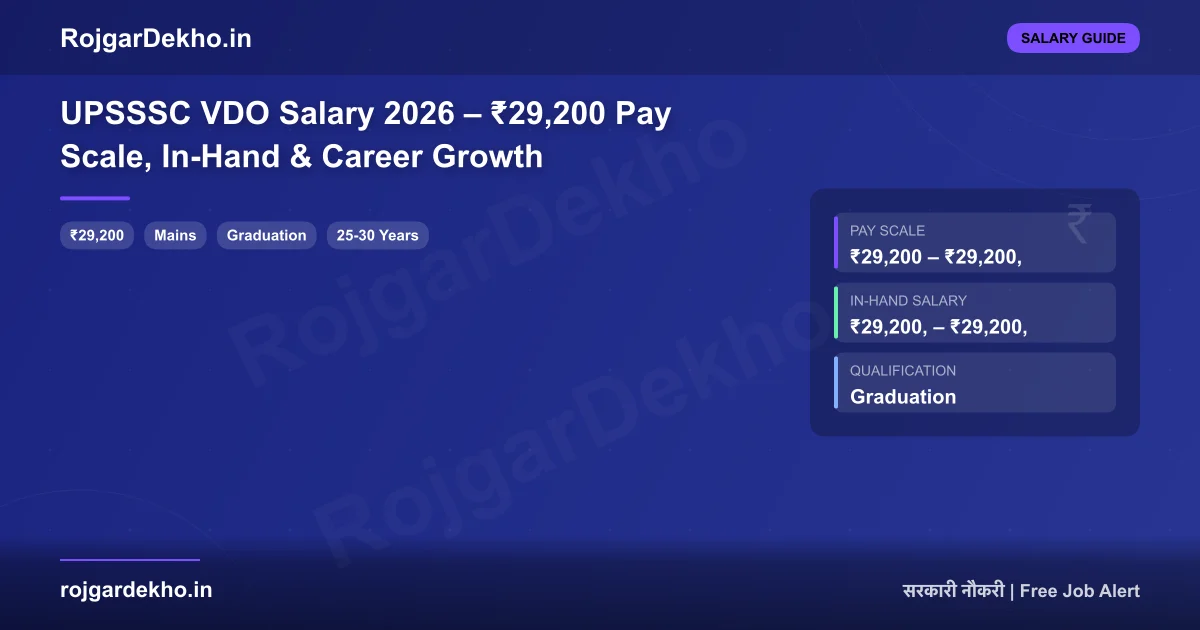
UPSSSC VDO Salary 2026 – ₹29,200 Pay Scale, In-Hand Pay and Career Growth
UPSSSC VDO (Village Development Officer), officially called Gram Vikas Adhikari, is one of the most in-demand Group C posts in Uttar Pradesh. With Pay Level 5 under the 7th Pay Commission, a starting basic of ₹29,200, and no physical test requirement, it attracts lakhs of graduates every recruitment cycle. This article covers every salary component in full: basic pay, DA, HRA by posting zone, in-hand after all deductions, allowances, MACP upgrades, and what your retirement looks like after 25–30 years.
👉 UPSSSC VDO Eligibility 2026 — graduation + CCC certificate + UP domicile: full checklist before you apply
UPSSSC VDO Pay Scale 2026 – Snapshot
The VDO post is classified under Pay Matrix Level 5 of the 7th CPC — the same level as UPSSSC Lower Subordinate and other mid-tier Group C positions. The entry basic is ₹29,200, rising by 3% (₹876 in Year 1) every July 1 on annual increment date.
| Parameter | Details |
|---|---|
| Pay Commission | 7th CPC |
| Pay Matrix Level | Level 5 |
| Entry Basic Pay | ₹29,200/month |
| Pay Band Range | ₹29,200 – ₹92,300 |
| Annual Increment | 3% of Basic (₹876 in Year 1) |
| Post Group | Group C (Non-Gazetted) |
| Recruiting Body | UPSSSC |
| Department | Panchayati Raj / Rural Development, UP |
Monthly In-Hand Salary: Rural vs District HQ vs Lucknow
VDO salary varies by HRA zone. Most postings are at the gram panchayat level (8% HRA). District headquarters and semi-urban offices attract 16% HRA. Major cities — Lucknow, Kanpur, Agra — get 24% HRA. Here is the full breakdown:
| Component | Rural / Gram Panchayat | District HQ | Lucknow / Kanpur |
|---|---|---|---|
| Basic Pay | ₹29,200 | ₹29,200 | ₹29,200 |
| DA (53%) | ₹15,476 | ₹15,476 | ₹15,476 |
| HRA (8%/16%/24%) | ₹2,336 | ₹4,672 | ₹7,008 |
| NPS Employee (–10% of Basic+DA) | –₹4,468 | –₹4,468 | –₹4,468 |
| Professional Tax | –₹200 | –₹200 | –₹200 |
| Net In-Hand | ₹38,000–₹43,000 | ₹42,000–₹47,000 | ₹44,000–₹50,000 |
Ranges account for small variations: TA if applicable, GIS deduction (₹30–60/month), DA revisions mid-year, and minor advance recoveries. DA is revised every January and July; at 53% in 2026, it is expected to reach 55–57% by January 2027.
👉 UPSSSC VDO Syllabus 2026 — PET qualifying pattern + Mains subjects + complete topic list
Allowances for UPSSSC VDO
| Allowance | Rate / Amount | Notes |
|---|---|---|
| Dearness Allowance (DA) | 53% of Basic | Revised every 6 months (Jan + Jul) |
| House Rent Allowance (HRA) | 8% / 16% / 24% | Based on city class Z/Y/X |
| Transport Allowance (TA) | ₹900–₹3,600/month | Lower amounts for rural/Z-class cities |
| Children Education Allowance | ₹2,250/child/month | Max 2 children; school receipt mandatory |
| Medical (DGEHS) | State medical coverage | Cashless at UP-empanelled hospitals |
| Leave Travel Concession (LTC) | Twice in 4-year block | Rail fare reimbursement for self + family |
| Earned Leave Encashment | Up to 300 EL days | Lump-sum payment at retirement |
Deductions Explained
Two deductions are certain every month: NPS and professional tax. Here is what comes out before the salary lands in your account:
| Deduction | Rate / Amount | Remarks |
|---|---|---|
| NPS (Employee) | 10% of Basic+DA = ₹4,468 | Goes to your pension corpus — not lost |
| NPS (Government) | 14% of Basic+DA = ₹6,254 | Employer share; credited to your NPS Tier I |
| Professional Tax (UP) | ₹200/month | State levy; fixed for this salary slab |
| Income Tax | Nil at entry level | Annual income ~₹5.8L — below threshold after standard deduction + NPS 80CCD |
| Group Insurance (GIS) | ₹30–₹60/month | Life cover for employee + nominee |
The government's 14% NPS contribution is a genuine financial benefit that does not appear in your in-hand salary but builds your retirement corpus alongside your own 10% contribution.
Year-by-Year Salary Progression
| Service Year | Basic Pay | Annual CTC (approx) | In-Hand/month (rural) |
|---|---|---|---|
| Year 1 (Entry) | ₹29,200 | ~₹7.2 LPA | ₹38,000–₹43,000 |
| Year 3 | ₹30,984 | ~₹7.8 LPA | ₹40,000–₹44,000 |
| Year 5 | ₹32,876 | ~₹8.3 LPA | ₹42,000–₹46,000 |
| Year 10 (MACP-1) | ₹35,400 (Level 6) | ~₹9.0 LPA | ₹46,000–₹52,000 |
| Year 20 (MACP-2) | ₹44,900 (Level 7) | ~₹11.5 LPA | ₹58,000–₹65,000 |
| Year 30 (MACP-3) | ₹47,600 (Level 8) | ~₹12.3 LPA | ₹62,000–₹70,000 |
CTC includes employer NPS contribution (14% of Basic+DA). The in-hand figures for later years assume DA reaches 70–80% by Year 10, which is realistic based on the historical AICPI trend since 2016.
MACP Career Growth Path
MACP (Modified Assured Career Progression) guarantees three financial upgrades for Group C employees who don't receive regular departmental promotions:
- MACP-1 (after 10 years): Basic moves from Level 5 (₹29,200) to Level 6 (₹35,400) — a 21% jump without any exam or promotion.
- MACP-2 (after 20 years): Level 6 → Level 7 (₹44,900). At this point, the in-hand with revised DA exceeds ₹58,000 for most rural postings.
- MACP-3 (after 30 years): Level 7 → Level 8 (₹47,600). Final guaranteed upgrade before retirement.
Beyond MACP, departmental promotion is possible through the Departmental Competitive Examination. A promoted VDO can reach Gram Panchayat Adhikari (GPA) → Khand Vikas Adhikari (KVA) → District Panchayat Raj Officer (DPRO) — all Group B posts with basic pay of ₹44,900–₹56,100. This ladder is realistic for candidates who stay engaged with UP rural development policy and clear the internal exams.
UPSSSC VDO vs Other UPSSSC Posts – Salary Comparison
| Post | Level | Basic | In-Hand (rural) | Min Qualification |
|---|---|---|---|---|
| VDO (Gram Vikas Adhikari) | Level 5 | ₹29,200 | ₹38K–₹43K | Graduation + CCC |
| Lekhpal | Level 6 | ₹35,400 | ₹44K–₹50K | 12th + computer cert |
| UPSSSC Lower Subordinate | Level 5 | ₹29,200 | ₹38K–₹43K | Graduation |
| Platoon Commander / Block Organizer | Level 6 / Level 5 | ₹35,400 / ₹29,200 | ₹44K / ₹38K | Graduation + physical |
| UPSSSC Forest Guard | Level 2 | ₹19,900 | ₹26K–₹29K | 12th + physical test |
| UPSSSC Junior Assistant | Level 4 | ₹25,500 | ₹33K–₹36K | 12th |
Lekhpal earns about ₹6,200 more per month at entry (Level 6 vs Level 5) but handles land records and revenue administration — desk-heavy work. VDO work is field-based rural development. If you hold a degree and are comfortable with field visits and scheme implementation, VDO is a strong entry into UP state service with a clear Group B promotion path.
Leave Entitlements
Government employment benefits extend far beyond the monthly salary. UPSSSC VDOs are entitled to:
- Earned Leave: 30 days per year, accumulates up to 300 days (encashable at retirement)
- Casual Leave: 14 days per year (cannot be carried forward)
- Sick/Medical Leave: 20 days on half pay annually; full-pay leave with medical certificate
- Maternity Leave: 180 days with full pay (female employees)
- Child Care Leave: 730 days over entire service (female employees)
- Gazetted Holidays: 14 central + state gazetted holidays annually
Retirement Benefits Under NPS
VDOs appointed after 2004 are under the National Pension System. At retirement (age 60), the NPS corpus is split: 40% must buy an annuity (monthly pension for life), and 60% is paid out as a tax-free lump sum. For a VDO retiring after 30 years of service:
- NPS corpus estimate: ₹1.5–₹2 crore (assumes 9% CAGR on Tier I balanced fund)
- Monthly pension (annuity from 40%): ₹18,000–₹25,000/month
- Lump-sum payout (60%): ₹90 lakh–₹1.2 crore
- Earned Leave encashment: ₹15–₹25 lakh (300 EL days × last drawn pay)
- Gratuity: Up to ₹20 lakh (tax-free ceiling under Payment of Gratuity Act)
These figures dwarf what you see in your monthly salary slip. The combined retirement benefit for a 30-year VDO career can easily exceed ₹1.5 crore. This is the actual long-term value of the post — not just the monthly ₹38,000 starting figure.
Frequently Asked Questions
Q: What is the exact in-hand salary for UPSSSC VDO in a rural posting in 2026?
With 53% DA (effective 2026), a VDO posted at gram panchayat level (8% HRA) takes home approximately ₹38,000–₹43,000 per month after NPS deduction of ₹4,468 and professional tax of ₹200. The gross pay before deductions is around ₹47,000.
Q: What Pay Level is UPSSSC VDO under 7th CPC?
Level 5, with an entry basic of ₹29,200 and a pay band ceiling of ₹92,300. This corresponds to the old Pay Band PB-1 with Grade Pay ₹2,800 under the 6th CPC.
Q: Does UPSSSC VDO get government accommodation?
VDOs in rural postings are sometimes provided quarters near the block office or gram panchayat — but this depends entirely on availability. There is no guaranteed housing. Most VDOs in rural areas either commute from home or rent privately, with the 8% HRA as the only housing support.
Q: How much does VDO salary increase after 10 years?
After 10 years, MACP-1 upgrades the basic from Level 5 (₹29,200) to Level 6 (₹35,400). Combined with DA revisions (likely 70%+ by then), in-hand salary for a rural VDO would be approximately ₹46,000–₹52,000 at the 10-year mark.
Q: What is the difference between VDO and Lekhpal in terms of salary?
Lekhpal is in Level 6 (₹35,400 basic) vs VDO's Level 5 (₹29,200). Monthly in-hand gap is about ₹6,000–₹7,000. However, Lekhpal handles land records and revenue — different work. VDO focuses on rural scheme implementation at the gram panchayat level.
Q: Is there any risk or hardship allowance for VDO posted in flood-prone areas?
There is no permanent hardship allowance for VDOs. However, during natural disasters and relief operations, VDOs deployed for extended field duty may receive additional compensatory claims through departmental channels. This varies by district and year — it is not a fixed component.
Q: What happens to NPS corpus if a VDO resigns after 5 years of service?
Under NPS exit rules, if service is less than 10 years, 80% of the corpus must be used to purchase an annuity and only 20% can be withdrawn as lump sum. Both your 10% contribution and the government's 14% contribution are retained in your NPS account — nothing is forfeited. You just lose some flexibility on the exit.
Q: Can UPSSSC VDO take a government home loan at preferential rates?
Yes. As UP state government employees, VDOs are eligible for housing loans through UPHFCO (UP Government Employees Housing Finance Corporation) at subsidized interest rates — typically 1–2% below commercial rates. Loan ceilings are ₹30 lakh for rural areas and ₹50 lakh for urban areas.
UP VDO vs Other State VDO Posts – Salary Comparison
How does UPSSSC VDO compare to similar gram panchayat-level posts in neighbouring states? This comparison helps you benchmark the offer before committing to the UP state exam ecosystem:
| State / Post | Pay Level | Basic Pay | In-Hand (approx) |
|---|---|---|---|
| UP VDO (UPSSSC) | Level 5 | ₹29,200 | ₹38K–₹43K |
| Rajasthan Gram Sevak | Level 5 | ₹29,200 | ₹37K–₹42K |
| Bihar VDO | Level 5 | ₹29,200 | ₹36K–₹41K |
| Haryana Gram Sachiv | Level 5 | ₹29,200 | ₹38K–₹48K (NCR cities higher) |
| MP Panchayat Secretary | Level 5 | ₹29,200 | ₹36K–₹40K |
All comparable state VDO positions fall in the same Pay Level 5 (₹29,200 basic) since they follow the 7th CPC matrix. The differences in in-hand pay arise from state-specific HRA zones, DA revision timing, and city classification. Haryana Gram Sachiv posts in NCR districts (Gurugram, Faridabad) earn significantly more due to 24% HRA — the highest among comparable state posts.
NPS Corpus Calculation – 30-Year VDO Career
The NPS retirement corpus is frequently underestimated by candidates who only look at in-hand salary. Here is a realistic 30-year projection assuming you join at age 25 and retire at 60:
| Parameter | Assumed Value | Notes |
|---|---|---|
| Monthly NPS contribution (Employee + Employer) | ₹10,722/month at entry | 10% + 14% of ₹44,676 (Basic+DA) |
| Average monthly contribution over 30 years | ~₹18,000–₹22,000 | Rises as salary grows with DA and MACP |
| NPS investment return (CAGR) | 9% (conservative) | NPS Tier I balanced fund historical average |
| Estimated total corpus at 60 | ₹1.5–₹2.0 crore | After 35 years of compound growth |
| Lump-sum (60% of corpus) | ₹90L–₹1.2 crore | Tax-free |
| Monthly pension (from 40% annuity) | ₹18,000–₹28,000/month | Depends on annuity rate at time of purchase |
For a VDO joining at 25, the effective CTC over a 35-year career — including the lump-sum, monthly pension, gratuity, and leave encashment — exceeds ₹3–4 crore in present-value terms. This makes the post significantly more valuable than the ₹38,000 starting in-hand figure suggests.
Salary During Training Period
Newly recruited UPSSSC VDOs undergo a probation and training period — typically 2 years. During this period, the full regular salary is drawn from Day 1. Unlike PSU trainee posts (where a lower stipend applies during the training year), UP state government VDOs receive the full Level 5 pay from the date of joining. The only difference is that increments and MACP seniority count only from the date of regular appointment (after probation confirmation).
Salary Slip – What It Actually Looks Like
Understanding the salary slip format helps you reconcile what UPSSSC told you with what the bank credits. A typical UPSSSC VDO salary slip has two sections: earnings (basic + DA + HRA + TA + CEA if applicable) and deductions (NPS employee share + professional tax + GIS + any advance recovery). The difference is your net take-home. Do not confuse "gross pay" shown on the slip with "in-hand" — the difference is always at least ₹5,000–₹7,000 due to NPS and PT alone.