Army TES 56 Salary 2026 – What You Earn as a Lieutenant After 4-Year Training
The Indian Army Technical Entry Scheme (TES) is one of the few paths that gives you both a Permanent Commission as a Lieutenant and a B.Tech engineering degree from the same 4-year training. But most students searching for TES salary information encounter either incomplete numbers or numbers that confuse the training stipend with the post-commissioning pay. This article separates the two clearly, explains every component of the officer's pay package, and gives you an honest picture of what TES 56 is financially worth — from Day 1 at IMA Dehradun to the rank of Colonel.
👉 Army TES 56 Eligibility 2026 — PCM 60% requirement, JEE Main condition, age limits and physical standards
Training Stipend — What You Earn During 4 Years at IMA and Technical Institutes
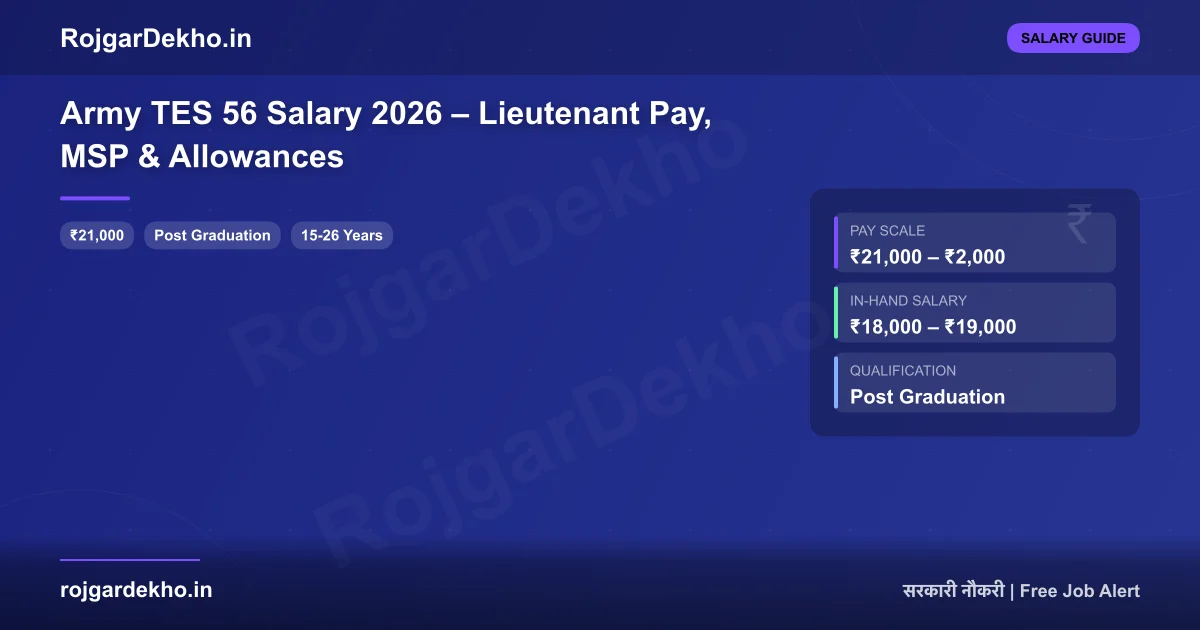
TES cadets join IMA Dehradun and spend 4 years in combined military and technical training. During this entire period, they receive a stipend — not the officer salary:
| Training Phase | Stipend (₹/month) | Location | Duration |
|---|---|---|---|
| Year 1 — Basic Military Training | ~21,000 | IMA Dehradun, Uttarakhand | 1 year |
| Years 2–4 — B.Tech Technical Training | ~21,000 | CME Pune / MCTE Mhow / MCEME Secunderabad | 3 years |
Out of the ₹21,000 stipend, approximately ₹2,000–₹3,000 is deducted for messing (food). Net in-hand during training: ₹18,000–₹19,000/month. All accommodation at IMA and the technical institutes is provided free of cost. Uniform, equipment, and medical care are also covered by the Army — so the actual cost of living during training is near zero for a cadet.
The stipend may seem modest compared to what engineering college graduates earn at their first jobs. The correct comparison, however, is total package: a cadet simultaneously earns a B.Tech degree (which costs ₹4–₹12 lakh in a private college) and completes officer training — without paying fees or tuition. The opportunity cost calculation strongly favours TES for students who are genuinely interested in the Army.
Pay After Commissioning — The 7th CPC Structure
After completing 4 years of training, TES cadets are commissioned as Lieutenants. The full officer salary kicks in on the day of commissioning at the Passing Out Parade:
| Pay Component | Amount (₹/month) | Notes |
|---|---|---|
| Basic Pay (Level 10) | 56,100 | 7th CPC; same as NDA and AFCAT-commissioned Lieutenants |
| Military Service Pay (MSP) | 15,500 | Officers-only allowance; not subject to DA revision |
| Dearness Allowance (DA) | ~29,733 | 53% of basic as of Jan 2026 |
| Transport Allowance (TPTA) | 3,600–7,200 | Depends on posting city classification |
| Gross (before accommodation benefit) | ~1,04,000–1,10,000 | Varies by city and quarter allotment |
The Military Service Pay of ₹15,500/month deserves attention. It is a fixed allowance that Army, Navy, and Air Force officers receive — which IAS, IPS, or civilian engineers in equivalent pay levels do not. It is not revised with each DA cycle — it stays at ₹15,500 regardless of inflation. This makes the military pay premium over equivalent civilian roles stable and predictable throughout the career.
👉 Army TES 56 Syllabus 2026 — JEE Main shortlisting, SSB 5-day process, what tests are involved
In-Hand Salary — What Actually Reaches Your Account
The gross figures above don't tell the whole story because several deductions reduce the bank credit:
| Deduction Type | Approximate Amount (₹/month) | Notes |
|---|---|---|
| NPS Contribution (10% of basic + DA) | ~8,600 | Matched by government's 10% contribution |
| DSOP Fund (voluntary defence fund) | 500–2,000 | Officers choose contribution level |
| Income Tax | 0–5,000 | Depends on regime, HRA, and deductions claimed |
| ECHS Contribution | ~500 | Annual ₹6,000 spread monthly |
| Mess Bill (if applicable) | 500–2,000 | Varies by station and mess |
After these deductions, a Lieutenant's net in-hand salary typically ranges from ₹80,000 to ₹95,000/month depending on the posting city, quarter allotment situation, and tax regime chosen. The variance is real — a Lieutenant posted in Delhi with HRA (no quarter allotted) earns a different net amount than one posted in a rural cantonment with a free quarter.
Ration Money — Non-Taxable Income Worth ₹18,000–₹22,000/Month
Army officers at peace stations receive ration money (cash equivalent of free rations) in addition to their salary. As of 2025, this amounts to approximately ₹18,000–₹22,000/month and is completely non-taxable. At field postings, officers receive actual rations in kind instead of cash — which serves the same economic purpose.
This is frequently overlooked in salary comparisons. An Army Lieutenant whose taxable gross is ₹1,05,000 actually has an effective package closer to ₹1,25,000 once non-taxable ration money is included. A civilian engineer at the same gross income spends ₹12,000–₹20,000 on food from their taxable salary — the Army officer doesn't.
Accommodation — Government Quarter or HRA
TES-commissioned Lieutenants, like all Army officers, are entitled to government accommodation (Army quarter) at the posting station. The licence fee is nominal — ₹500–₹2,000/month depending on the type of quarter and rank. Where Army quarters are not available, House Rent Allowance is paid:
| City Classification | HRA Rate | HRA for Lieutenant (₹/month) |
|---|---|---|
| X Class (Delhi, Mumbai, Kolkata, Chennai, Bengaluru, Hyderabad) | 24% of basic | 13,464 |
| Y Class (State capitals and cities above 5 lakh population) | 16% of basic | 8,976 |
| Z Class (All other towns) | 8% of basic | 4,488 |
Over a 25-year career with 8–10 postings, an Army officer's cumulative saved rent is ₹30–₹50 lakh in avoided commercial accommodation costs. This is money that stays in the officer's savings or grows in the NPS corpus rather than being paid to landlords.
ECHS — Medical for Family Including Parents
Ex-Servicemen Contributory Health Scheme (ECHS) covers the officer, spouse, dependent children, and dependent parents. During service, Army medical infrastructure — Military Hospitals, Command Hospitals, empanelled private hospitals — provides primary care. ECHS continues post-retirement for the officer and spouse for life. Annual contribution is approximately ₹6,000 for officers (roughly ₹500/month). For a family with elderly parents or a family member requiring specialist care, this coverage is worth ₹1–₹2 lakh/year in avoided out-of-pocket medical costs.
DSOP Fund and NPS — Retirement Corpus
TES officers contribute to both NPS (National Pension System) and the DSOP Fund (Defence Services Officers Provident Fund). NPS: 10% of basic + DA from the officer, matched by the government's 10% contribution — so ₹11,210+₹11,210 = ₹22,420/month flowing into the NPS corpus. At 8% annualised return, a Lieutenant who joins at 22 and serves until 54 (32 years) can accumulate an NPS corpus of ₹3–₹4 crore before retirement. DSOP Fund is an additional tax-free savings vehicle that many officers use for education expenses, home purchases, or emergencies.
Rank-Wise Pay Progression — Lieutenant to Colonel and Beyond
| Rank | Pay Level | Basic Pay (₹) | Typical Time from Commissioning |
|---|---|---|---|
| Lieutenant | Level 10 | 56,100 | Entry |
| Captain | Level 10B | 61,300 | 2 years (automatic) |
| Major | Level 11 | 69,400 | 6 years (time-based) |
| Lt Colonel | Level 12A | 1,21,200 | 13 years (selection-based) |
| Colonel | Level 13 | 1,30,600 | 15–26 years (selection-based) |
| Brigadier | Level 13A | 1,39,600 | Highly selective |
| Major General | Level 14 | 1,44,200 | Top performers, rare |
| Lt General / COAS | Level 15–18 | 1,82,200–2,50,000 | Army leadership cadre |
The promotion from Major to Lt Colonel is the largest pay jump — basic goes from ₹69,400 to ₹1,21,200, a 75% increase. However, this transition is selection-based, not time-based. Approximately 60–70% of eligible Majors are promoted to Lt Colonel. The factors that matter: ACRs (Annual Confidential Reports), Staff College selection, operational deployments, and posting history. TES-commissioned officers, who enter with a technical/engineering background, often do well in technical arms (Corps of Engineers, Signals, EME) where their B.Tech degree is directly applicable.
TES vs AFCAT vs NDA — Salary Comparison
| Entry Route | Age at Commissioning | Starting Pay | Training Duration | Degree Awarded |
|---|---|---|---|---|
| Army TES 56 | ~22 years | Level 10 (₹56,100) | 4 years (IMA + Tech Institute) | B.Tech (AICTE recognised) |
| NDA (Army) | ~21–22 years | Level 10 (₹56,100) | 3 yrs NDA + 1 yr IMA | B.Tech (from NDA) |
| AFCAT (GD Non-Tech) | ~22–26 years | Level 10 (₹56,100) | 52 weeks AFA | No additional degree |
| CDS (IMA entry) | ~22–27 years | Level 10 (₹56,100) | 18 months IMA | No additional degree |
Starting salary is identical across all routes — Pay Level 10 is Pay Level 10. The real differences are: TES gives you a B.Tech degree (which other routes don't), TES is exclusively for 10+2 students (no graduate entry), and TES gives Permanent Commission only (no Short Service Commission option, unlike AFCAT). If you hold a JEE rank and want both an Army career and an engineering degree without spending 4 years in a private college, TES is structurally the best deal.
CSD Canteen — What You Save on Day-to-Day Life
Army officers have access to the Canteen Stores Department (CSD) which sells groceries, electronics, vehicles, appliances, and liquor at subsidised prices — typically 15–25% below market rates. Over a career, CSD access translates to ₹8–₹15 lakh in cumulative savings on household purchases. A CSD car purchase alone saves ₹1.5–₹3 lakh on a vehicle costing ₹10–₹15 lakh commercially.
Frequently Asked Questions
Q: What is the in-hand salary of a TES-commissioned Lieutenant in 2026?
Approximately ₹80,000–₹95,000/month in bank credit, depending on posting, quarter allotment, and tax deductions. The effective package — including non-taxable ration money (₹18,000–₹22,000/month) and the value of free or subsidised accommodation — is ₹1,05,000–₹1,25,000/month equivalent.
Q: What salary do TES cadets receive during the 4-year training period?
A stipend of approximately ₹21,000/month throughout all 4 years — whether at IMA Dehradun (Year 1) or at the technical training institute (CME/MCTE/MCEME, Years 2–4). After mess deductions, net in-hand is around ₹18,000–₹19,000/month. Accommodation, food, uniform, and medical are provided by the Army at no cost.
Q: Do TES officers get pension?
TES grants Permanent Commission — officers serve until the age of retirement (around 54 years for most ranks). PC officers are covered under NPS (for those commissioned after 2004) plus OROP (One Rank One Pension). OROP ensures that officers who retire in the same rank with the same years of service receive the same pension, regardless of which year they retired. This is a specific armed forces benefit not available to civilian NPS subscribers.
Q: Is the TES salary better than a private sector engineering job?
At entry level, a TES-commissioned Lieutenant earns ₹80,000–₹95,000/month in-hand — comparable to mid-tier software or core engineering roles in metros. The key advantage is the additional non-monetary package: free accommodation (saving ₹12,000–₹25,000/month in rent), ration money (₹18,000–₹22,000/month), ECHS medical, and job security. In total effective package terms, TES often compares favourably to ₹15–₹18 LPA private sector offers at the same age. The trade-off is choice of posting location and the structured military career.
Q: Does the B.Tech degree from TES have value outside the Army?
Yes — the B.Tech degrees from CME Pune, MCTE Mhow, and MCEME Secunderabad are recognised by AICTE and equivalent to civilian engineering degrees for purposes of higher education (GATE, M.Tech, MBA) and employment. Officers who take premature retirement after the minimum service period often use their B.Tech degree to transition to PSUs, defence contractors, or technical roles in the private sector. The combination of an engineering degree and Army service record is a strong profile for senior technical management roles.
Q: What field area allowances does an Army officer get?
Officers posted to high-altitude areas, active operational zones, or counter-insurgency areas receive: High Altitude Field Area Allowance (₹3,400–₹25,000/month depending on altitude), Counter Insurgency Allowance (₹6,300–₹10,500/month), and for Siachen Glacier postings: ₹31,500/month. TES officers in technical arms (Engineers, EME, Signals) do serve in operational areas, especially in infrastructure and communications roles in border regions.
📌 Related on RojgarDekho:
TES vs NDA — Same Lieutenant Pay, Different Degrees
A common question from JEE aspirants is: does TES entry pay more than NDA? The answer is no — both routes commission as Lieutenant at exactly the same pay level.
| Parameter | TES Entry | NDA Entry |
|---|---|---|
| Commission Rank | Lieutenant | Lieutenant |
| Pay Level | Level 10 — ₹56,100 | Level 10 — ₹56,100 |
| MSP | ₹15,500/month | ₹15,500/month |
| Degree Awarded | B.Tech (from CME/MCTE/MCEME) | B.Sc — JNU (IMA) |
| Training Duration | 4 years (1 yr IMA + 3 yr technical) | 4 years (3 yr NDA + 1 yr IMA) |
The practical difference: TES graduates hold a B.Tech degree from a Central Government engineering institution, which can be valuable in post-retirement civilian careers in technical fields. NDA graduates hold a B.Sc from JNU — strong academically but less technical. Both, however, lead to the same Army career trajectory, same promotions, and same pension entitlements.