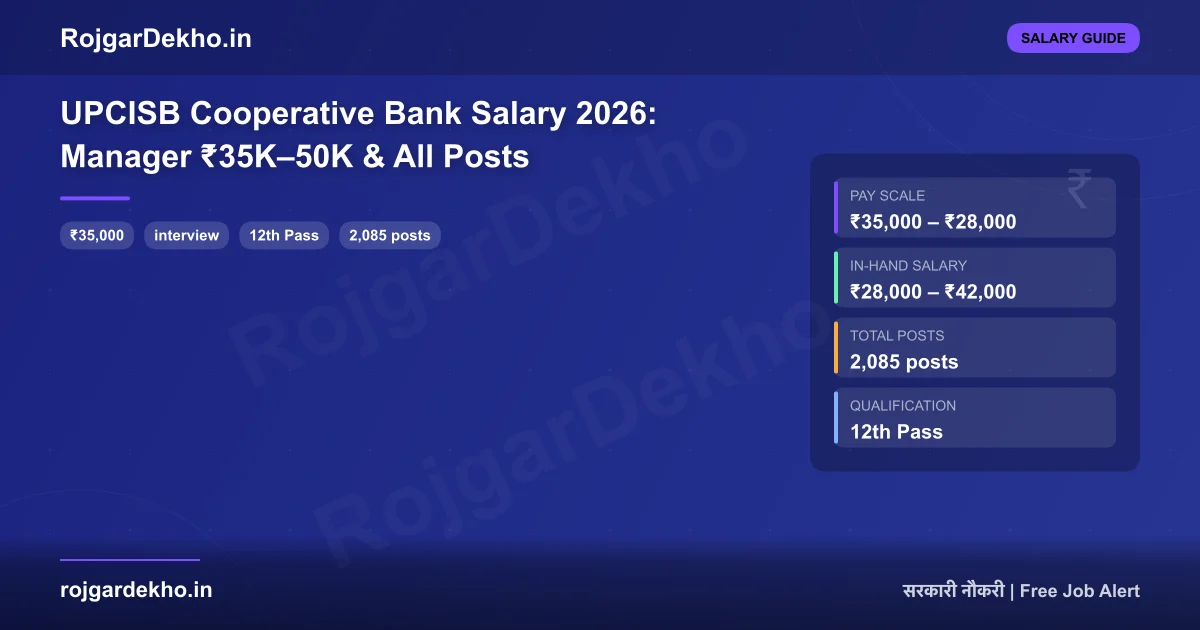
UPCISB Cooperative Bank Salary 2026: Manager ₹35,000–50,000 & All Posts Pay Scale
The UP Cooperative Institutional Service Board (UPCISB) has notified 2,085 posts for 2026 — Manager, Junior Manager, Assistant/Cashier, Computer specialist posts, Accountant, and others across UP's district cooperative banks. One thing most job seekers don't realise upfront: this is the cooperative banking sector, not the commercial banking sector. The pay scales here are set by UP cooperative bank norms, not by IBA (Indian Banks' Association) — so the salary structure is different from IBPS PO or SBI. Here is the real pay picture.
📚 UPCISB Cooperative Bank Syllabus 2026 — IBPS-pattern written exam topics, banking awareness sections, and exam strategy.
Pay Scale — Post-Wise Salary Range
UP Cooperative banks follow their own pay scale approved by the UP government — not IBA scale. Here is the post-wise breakdown:
| Post | Vacancies | Basic Pay Range | In-Hand (Approx.) |
|---|---|---|---|
| Manager | 65 | ₹28,000–₹42,000* | ₹35,000–₹50,000 |
| Junior Manager | 486 | ₹22,000–₹32,000* | ₹28,000–₹38,000 |
| Assistant/Cashier/Banking Clerk | 887 | ₹16,000–₹24,000* | ₹20,000–₹28,000 |
| Asst Manager (Computers) | Various | ₹22,000–₹32,000* | ₹28,000–₹36,000 |
| Accountant | Various | ₹22,000–₹32,000* | ₹27,000–₹35,000 |
| Junior Engineer (JE Civil) | Various | ₹22,000–₹32,000* | ₹27,000–₹35,000 |
| Stenographer / Typist | Various | ₹14,000–₹22,000* | ₹18,000–₹25,000 |
*UP Cooperative Bank pay scales are set under UP government cooperative sector rules — not IBA scale. Verify exact scale from the official UPCISB notification or your specific bank's service rules.
Why Cooperative Bank Pay Is Different from Commercial Banks
This is the most misunderstood point about UPCISB jobs. Many candidates compare this with IBPS PO or SBI PO salaries — that is an apples-to-oranges comparison. Here is what is actually different:
- No IBA wage settlement: Commercial banks (SBI, nationalised banks, private banks) revise pay every 5 years under the Indian Banks' Association bipartite settlement. UP cooperative banks are not party to this — their pay is fixed by UP government policy
- No DA revision on IBA scale: Commercial bank employees get DA revised quarterly based on the All India Consumer Price Index (AICPI). Cooperative bank DA revision follows state government notification — may be less frequent or at a lower rate
- However: Job security is comparable: UPCISB jobs are government/quasi-government in nature — termination requires departmental proceedings, making them more secure than private sector
- Scope of promotion: Manager to Senior Manager to General Manager within the cooperative banking hierarchy is the promotion path
Monthly Gross — Manager Post Detailed Breakdown
For a newly joined Manager in a district cooperative bank in UP (mid-sized city):
| Component | Amount (Approx.) | Notes |
|---|---|---|
| Basic Pay | ₹28,000 | Entry-level Manager scale |
| Dearness Allowance (DA) | ~₹4,200–₹6,000 | UP cooperative sector rate, ~15–22% of basic |
| HRA | ~₹2,800–₹5,600 | 10–20% of basic depending on city |
| Special Allowance | ~₹1,500–₹3,000 | Bank-specific |
| Other Allowances | ~₹500–₹1,200 | Medical, conveyance fixed components |
| Gross Salary | ~₹37,000–₹43,800 | Before deductions |
Monthly Gross — Junior Manager (486 posts, largest officer cadre)
| Component | Amount (Approx.) |
|---|---|
| Basic Pay | ₹22,000 |
| Dearness Allowance | ~₹3,300–₹4,800 |
| HRA | ~₹2,200–₹4,400 |
| Special Allowance / Others | ~₹1,500–₹2,000 |
| Gross Salary | ~₹29,000–₹34,200 |
Monthly Deductions
| Deduction | Manager | Junior Manager | Cashier/Assistant |
|---|---|---|---|
| PF/EPF (Employee) | ~₹3,360 | ~₹2,640 | ~₹1,920 |
| Income Tax (TDS) | ~₹1,000–₹3,000 | ~₹0–₹1,000 | Nil (below threshold) |
| Professional Tax (UP) | ₹200 | ₹200 | ₹200 |
| Cooperative Insurance/GIS | ~₹300 | ~₹200 | ~₹150 |
| Total Deductions | ~₹4,860–₹6,860 | ~₹3,040–₹4,040 | ~₹2,270 |
In-Hand Salary Summary
| Post | Gross | In-Hand (Approx.) |
|---|---|---|
| Manager | ~₹37,000–₹43,800 | ~₹35,000–₹40,000 |
| Junior Manager | ~₹29,000–₹34,200 | ~₹27,000–₹31,000 |
| Cashier / Assistant | ~₹22,000–₹27,000 | ~₹20,000–₹25,000 |
Benefits Beyond the Pay Slip
- EPF/PF corpus: Cooperative banks maintain EPF. With employer contribution (also ~12% of basic), the corpus builds over a career — at retirement, Manager-level employees can have a corpus of ₹30–60 lakh depending on years of service and increments
- Gratuity: After 5 years of service, gratuity is payable on exit/retirement — calculated at 15 days basic per year of service
- Loan benefits: Cooperative bank employees often get staff loans at subsidised rates (home loan, vehicle loan, personal loan at 2–4% vs market rate 8–12%)
- Posting location: UPCISB covers UP's district cooperative banks — you are likely posted within UP, often in your home district or a nearby district
UPCISB vs Commercial Bank Jobs — Honest Comparison
| Parameter | UPCISB Cooperative Bank | IBPS PO (Commercial Bank) |
|---|---|---|
| Manager Entry Pay | ₹35,000–₹50,000 | ₹52,000–₹60,000 (Scale II+) |
| Clerk Entry Pay (In-Hand) | ₹20,000–₹28,000 | ₹32,000–₹38,000 |
| Job Security | High (quasi-govt) | High (PSB / govt bank) |
| Transfer Risk | Low (within UP only) | Pan-India possible |
| Competition Level | Lower than IBPS | Very high |
✅ UPCISB Cooperative Bank Eligibility 2026 — age limit, OBC/SC/ST relaxation, O Level and CCC certificate requirements explained.
Frequently Asked Questions
Q: Is UPCISB salary on par with SBI or nationalised bank salaries?
No — cooperative bank salaries are lower than IBA-scale commercial bank salaries. An IBPS clerk in-hand is typically ₹32,000–₹38,000 versus ₹20,000–₹28,000 for UPCISB assistant/cashier. An IBPS PO is around ₹52,000–₹60,000 gross versus UPCISB Manager at ₹37,000–₹43,800 gross. The trade-off is lower transfer risk and easier competition.
Q: Is there NPS or EPF in UPCISB posts?
UPCISB cooperative bank posts typically come under EPF (Employees' Provident Fund), not NPS. EPF means: 12% of basic deducted from your salary; employer also contributes 12% of basic. This corpus earns interest (EPF rate typically 8–8.5%/year) and is fully withdrawable after retirement or 5 years of service. You do not need to buy an annuity — you get the full corpus as a lump sum, unlike NPS where 40% must be annuitised.
Q: Do cooperative bank managers get a vehicle or accommodation?
Managers in district cooperative banks may get access to a staff vehicle for official use at branch level, but this is not guaranteed across all UP cooperative banks. Housing accommodation is generally not provided — HRA is paid instead. Verify with the specific district cooperative bank where you are posted.
Q: Can UPCISB employees switch to commercial banks later?
Not automatically — there is no lateral transfer between cooperative banks and commercial banks. If you want to join IBPS PO or SBI PO later, you would have to resign from your cooperative bank position and clear the relevant exam independently. Cooperative banking experience does help in banking interviews, but it does not substitute for IBPS/SBI written selection.
Q: What is the promotion path from Junior Manager in UPCISB?
Typical promotion ladder in UP cooperative banking: Junior Manager → Manager → Senior Manager → Branch Manager → General Manager. Timelines depend on the specific bank's service rules and vacancy availability, but typically 5–8 years to move from Junior Manager to Manager through DPC (Departmental Promotion Committee). Senior officers can also move between banks within the UP cooperative system.
📌 Related on RojgarDekho:
Post-wise Salary Structure
UPCISB (Uttar Pradesh Cooperative Institutional Service Board) recruits for multiple posts in cooperative banks across UP. Salary varies significantly by designation:
| Post | Basic Pay (₹) | All-in CTC (₹/month) | Approx In-Hand (₹) |
|---|---|---|---|
| Manager | ₹29,500–38,000 | ₹40,000–55,000 | ₹35,000–46,000 |
| Junior Manager | ₹23,700–28,500 | ₹32,000–42,000 | ₹27,000–36,000 |
| Cashier / Assistant | ₹18,500–22,000 | ₹25,000–32,000 | ₹21,000–27,000 |
| Clerk / Data Entry | ₹16,000–19,000 | ₹21,000–27,000 | ₹18,000–23,000 |
Allowances Breakdown
Beyond basic pay, cooperative bank employees receive several allowances:
- DA (Dearness Allowance): Revised periodically. Cooperative banks follow state government DA rates (UP government). Currently approximately 42–46% of basic pay.
- HRA (House Rent Allowance): 8–16% of basic depending on city. Urban postings get higher HRA.
- TA (Travel Allowance): For official travel within district. Fixed amount + actual conveyance.
- Medical Allowance: Fixed monthly amount (typically ₹500–1,000/month) for routine medical expenses.
- Annual Increment: 3–5% of basic annually on satisfactory performance.
UPCISB vs SBI Clerk vs SBI PO — Honest Comparison
Students often wonder whether UPCISB is worth targeting. Here is an honest comparison:
| Parameter | UPCISB Cashier | SBI Clerk | SBI PO |
|---|---|---|---|
| Basic Pay (₹) | ₹18,500 | ₹26,730 | ₹41,960 |
| In-Hand (₹) | ₹21,000–27,000 | ₹36,000–42,000 | ₹66,000–75,000 |
| Posting | UP state only | Pan India | Pan India |
| Exam Difficulty | State-level (easier) | National (harder) | National (hardest) |
| Advantage | Home state posting guaranteed | Higher salary | Best salary + growth |
The honest verdict: UPCISB pays less than SBI. However, if you specifically want UP state posting and job security in cooperative banking, UPCISB is a strong option with lower competition than IBPS/SBI. Many students target both simultaneously.
NPS — Retirement Benefit
Cooperative bank employees hired after 2004 are under NPS (National Pension System). The contribution structure: employee contributes 10% of basic + DA, employer contributes 14%. This corpus grows over your career. At 30 years of service with a starting salary of ₹18,500, the estimated NPS corpus at retirement is ₹40–60 lakh depending on market returns.
Promotion Path in Cooperative Banking
The career ladder in UP cooperative banks:
- Cashier/Assistant → Junior Manager (after 5–7 years + departmental exam)
- Junior Manager → Manager (after 6–8 years + seniority/exam)
- Manager → Senior Manager / DGM (after 8–10 years)
- DGM → GM / Board level positions
Promotion is through a combination of seniority and departmental examinations. Performance matters but the process is slower than private banking. Job security is the trade-off for slower promotion.
Frequently Asked Questions
Q: Is UPCISB a state government job?
UPCISB cooperative bank positions are not exactly state government posts but fall under the cooperative sector — regulated by the UP government and the Registrar of Cooperative Societies. The job security is comparable to state government, and many perks (DA, pension) follow state government patterns, but technically these are not gazetted government posts.
Q: What is the probation period?
Typically 1–2 years of probation. During probation, performance is assessed. Confirmation leads to permanent employment status. The probation salary is the same as regular salary in most cooperative bank notifications.
Q: Can I get transferred outside UP?
No — UPCISB postings are strictly within Uttar Pradesh. This is the main attraction for UP-domicile candidates who do not want pan-India transfers that come with SBI / nationalized bank jobs.
Q: Is salary disbursed on time consistently?
This varies by district cooperative bank. Central cooperative banks and state cooperative banks generally disburse on time. Primary Agricultural Credit Societies (PACS) may have delays. Check the specific bank's track record before accepting the offer.
Q: Are there performance bonuses in cooperative banking?
Some cooperative banks offer annual profit-sharing bonus — typically 1–2 months' salary as bonus linked to the bank's annual profit. This is not guaranteed and varies by institution. No PLI (Performance Linked Incentive) structure like public sector banks.
Job Security — Cooperative Banking का Real Advantage
The most underrated advantage of UPCISB cooperative bank employment is job security. Unlike private banks (HDFC, ICICI, Axis) where performance-linked terminations happen regularly, cooperative banks — being government-regulated — offer near-permanent employment after probation confirmation. There have been no mass layoffs in UP cooperative banks even during the 2008 financial crisis, 2016 demonetisation, or 2020 COVID disruption.
For a family in UP where stability matters more than maximum salary, cooperative banking offers exactly this: steady, predictable income, home-state posting, and a career that doesn't depend on quarterly performance metrics.
How Cooperative Bank Salary Compares Over Time
At 10 years of service, a Cashier who joined at ₹18,500 basic:
- Annual increments of 3–5%: after 10 years basic ≈ ₹24,000–27,000
- DA at 46% of basic: ₹11,000–12,000
- Possible promotion to Junior Manager level (higher pay scale)
- Total in-hand at 10-year mark: approximately ₹38,000–44,000
While this is still below SBI Clerk's 10-year trajectory, UP domicile candidates get home-state posting with no relocation costs — which is a significant lifestyle advantage for many families.
Cooperative Banking as a Career Choice — Final Verdict
For UP-domicile graduates who prioritize stability, home-state posting, and work-life balance over maximum salary, UPCISB cooperative banking is a solid career path. The salary gap vs SBI (₹15,000–20,000/month less) is real — but so is the advantage of no pan-India transfers, lower competition in the exam, and NPS retirement security. If family circumstances require UP posting, UPCISB is not a compromise — it's the right choice.
Final perspective on UPCISB cooperative banking: For UP-domicile graduates where home-state posting is a priority, cooperative banking is not a compromise — it is the right strategic choice. The salary gap versus SBI is real, but so is the zero-relocation-risk advantage. Many banking exam aspirants pursue UPCISB and IBPS Clerk simultaneously since preparation overlaps significantly. Cooperative banking also offers meaningful community impact work — agricultural credit, rural finance, and financial inclusion are the backbone of UP's rural economy.