RRB Technician Salary 2026 – Grade I Signal vs Grade III In-Hand Pay, Allowances & Career Growth
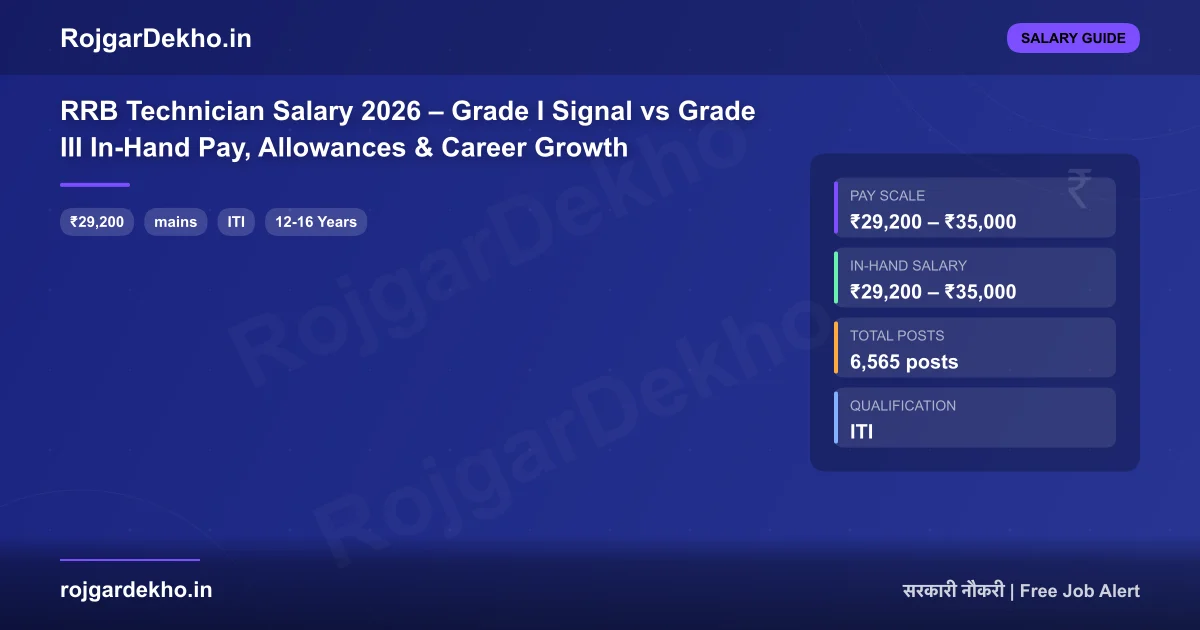
RRB Technician CEN 02/2026 has 6,565 posts across two very different grades — Grade I Signal and Grade III. Their pay structures are equally different. Grade I Signal sits at Pay Level 5 with a basic of ₹29,200 and an in-hand of roughly ₹35,000–40,000 per month. Grade III sits at Pay Level 2 with a basic of ₹19,900 and an in-hand of ₹22,000–27,000. This article gives you the exact calculation for both grades, a city-class HRA comparison, the promotion ladder, NPS details, and an annual CTC estimate.
👉 RRB Technician Eligibility 2026 — check which grade you qualify for before reading the salary breakdown
Pay Level Overview – Grade I Signal vs Grade III
| Detail | Grade I Signal | Grade III (Various Trades) |
|---|---|---|
| Posts | 323 | 6,242 |
| Pay Level (7th CPC) | Level 5 | Level 2 |
| Basic Pay (Entry) | ₹29,200 | ₹19,900 |
| DA (53% of basic, 2026) | ~₹15,476 | ~₹10,547 |
| HRA Range (8–27% of basic) | ₹2,336–₹7,884 | ₹1,592–₹5,373 |
| Transport Allowance | ₹3,600/month + DA on TA | ₹1,350/month + DA on TA |
| Gross (X-city HRA, approx) | ~₹52,000–55,000 | ~₹34,000–37,000 |
| In-Hand (after deductions) | ~₹35,000–40,000 | ~₹22,000–27,000 |
| Annual CTC (approx) | ~₹6–7 LPA | ~₹4–4.5 LPA |
DA is revised every six months (January and July) based on CPI-IW index. The 53% DA figure above is based on the January 2026 revision. By July 2026, this will likely increase — pushing in-hand salary slightly higher for both grades.
Grade I Signal – Detailed In-Hand Calculation
Grade I Signal (Pay Level 5, basic ₹29,200) is a technical supervisory role focused on railway signalling systems. Here is a worked example for a Y-class city posting (Lucknow, Jaipur, Patna):
| Component | Amount (₹/month) | Basis |
|---|---|---|
| Basic Pay | 29,200 | Pay Level 5, entry pay |
| Dearness Allowance (53%) | 15,476 | Revised Jan 2026 |
| HRA – Y city (16% of basic) | 4,672 | Cities like Lucknow, Jaipur, Ahmedabad |
| Transport Allowance | 3,600 | Fixed TA for Level 5 |
| DA on TA (53% of TA) | 1,908 | Included in gross |
| Gross Salary (Y city) | ~54,856 | Before deductions |
| Less: NPS (10% of basic+DA) | −4,468 | Employee contribution to pension |
| Less: CGHS/Medical | −250 | Health scheme deduction |
| Less: Income Tax (approx) | −1,000 | After standard deduction |
| In-Hand (Y city) | ~49,000–50,000 | Higher end estimate |
| HRA – Z city (8% of basic) | 2,336 | All other cities, workshops, sheds |
| In-Hand (Z city) | ~35,000–40,000 | Most common posting range |
The wide range (₹35,000–50,000+) is due to city classification. Most Grade I Signal postings are at divisional or zonal railway offices, which often fall in Y or Z class cities. A Z-class posting gives ₹35,000–38,000 in-hand. An X-class city posting (Mumbai, Delhi, Chennai) can reach ₹50,000+. The ₹35,000–40,000 figure cited in most places is a conservative Z-city estimate.
Grade III – Detailed In-Hand Calculation
Grade III covers trades like Electrician, Fitter, Mechanic Diesel, Welder, Carpenter, Painter, and more. All Grade III posts are at Pay Level 2 with basic ₹19,900:
| Component | Amount (₹/month) | Basis |
|---|---|---|
| Basic Pay | 19,900 | Pay Level 2, entry pay |
| Dearness Allowance (53%) | 10,547 | Revised Jan 2026 |
| HRA – Y city (16% of basic) | 3,184 | Hyderabad, Pune, Ahmedabad etc. |
| HRA – Z city (8% of basic) | 1,592 | All other cities |
| Transport Allowance | 1,350 | Level 2 TA rate |
| DA on TA (53%) | 715 | |
| Gross (Z city example) | ~33,904 | Basic + DA + HRA-Z + TA + DA-on-TA |
| Less: NPS (10% of basic+DA) | −3,045 | Employee NPS contribution |
| Less: CGHS | −250 | |
| Less: Income Tax | ~0 | Mostly nil at this income level |
| In-Hand (Z city) | ~22,000–23,000 | Most workshop/shed postings |
| In-Hand (Y city) | ~25,000–27,000 | Y-class city postings |
At this pay level, income tax liability is negligible — the standard deduction of ₹50,000 plus NPS deduction under 80CCD(1B) effectively zeroes out tax for most Grade III employees. Grade III employees in Z-class cities (most workshop and shed postings) are at the lower end (~₹22,000–23,000 in-hand).
HRA City Classification – Which City Gets How Much
| City Class | HRA Rate | Example Cities | Grade I Signal HRA | Grade III HRA |
|---|---|---|---|---|
| X (Population 50L+) | 27% of basic | Mumbai, Delhi, Chennai, Kolkata, Bengaluru | ₹7,884/month | ₹5,373/month |
| Y (Population 5L–50L) | 16% of basic | Lucknow, Jaipur, Patna, Bhopal, Nagpur, Vadodara | ₹4,672/month | ₹3,184/month |
| Z (Below 5L) | 8% of basic | All other cities, rural areas, workshops, sheds | ₹2,336/month | ₹1,592/month |
Most railway workshop and shed postings fall in Z-class cities, which is why the published in-hand figure skews toward the lower end of the range. A city-class posting makes the salary picture significantly better — an X-class Grade I Signal posting pays ₹12,000–15,000 more per month in HRA alone compared to Z-class.
Annual CTC – What Railway Pays Per Year
| Component | Grade I Signal (Annual) | Grade III (Annual) |
|---|---|---|
| Basic Pay | ₹3,50,400 | ₹2,38,800 |
| DA (53%, full year) | ₹1,85,712 | ₹1,26,564 |
| HRA (Y city avg, full year) | ₹56,064 | ₹38,208 |
| TA + DA on TA (full year) | ₹66,096 | ₹24,780 |
| NPS – Govt contribution (14%) | ₹62,553 | ₹42,638 |
| CGHS + Other perks | ~₹15,000 | ~₹12,000 |
| Approximate Gross CTC | ~₹6–7 LPA | ~₹4–4.5 LPA |
| In-Hand (net, annual) | ~₹4.2–4.8 LPA | ~₹2.6–3.2 LPA |
CTC includes the government NPS contribution (14% of basic+DA), which does not reach your hand monthly but accumulates in your pension account. This is real wealth that private sector CTC comparisons often miss.
Promotion Ladder – Grade III to Grade I and Beyond
| Stage | Grade/Designation | Pay Level | How to Reach | Timeline from Joining |
|---|---|---|---|---|
| Entry | Grade III Technician | Level 2 (₹19,900) | Direct via RRB CEN | 0 years |
| Promotion 1 | Grade II Technician | Level 4 (₹25,500) | Departmental seniority/DPC | 4–6 years |
| Promotion 2 | Grade I Technician | Level 5 (₹29,200) | Departmental promotion/GDCE | 8–12 years |
| Promotion 3 | Junior Engineer (JE) | Level 6 (₹35,400) | GDCE exam (internal competitive) | 12–16 years |
| Promotion 4 | Senior Section Engineer (SSE) | Level 7 (₹44,900) | LDCE/seniority | 18–22 years |
The GDCE (General Departmental Competitive Examination) is the key gate for Grade III employees to reach Junior Engineer level. It is an internal exam — only serving railway employees can appear. A Grade III employee who passes GDCE can jump to Level 6 (₹35,400 basic) — a significant leap over the seniority-based path alone. This is one of the most underrated career advantages of a railway Grade III job.
Grade I Signal employees directly recruited through CEN 02/2026 start at Level 5. Their path is: Grade I Signal → Senior Signal Maintainer → Junior Engineer (Signal) → Section Engineer (Signal) — faster progression because they start three levels higher than Grade III.
NPS – National Pension System Details
All central government employees (including Railway) appointed after January 2004 are covered under NPS — not the old defined-benefit pension. Here is what that means for RRB Technicians:
| NPS Component | Grade I Signal | Grade III |
|---|---|---|
| Employee contribution (10% of basic+DA) | ~₹4,468/month | ~₹3,045/month |
| Government contribution (14% of basic+DA) | ~₹6,255/month | ~₹4,264/month |
| Total monthly NPS flow | ~₹10,723/month | ~₹7,309/month |
| Approx corpus at 30 years (8% return) | ~₹1.5–2 crore | ~₹1–1.2 crore |
| Lump sum at retirement (60% of corpus) | ~₹90L–1.2 Cr | ~₹60–72 lakh |
| Monthly annuity (40% of corpus invested) | ~₹25,000–35,000/month | ~₹15,000–20,000/month |
NPS is not the same as the Old Pension Scheme (OPS), which gave 50% of last basic as guaranteed monthly pension. Under NPS, retirement income depends on market returns. However, the 14% government contribution is substantial — it is added to your corpus every month at no extra cost to you. Over 30 years, this compounds to a meaningful retirement fund even at conservative return assumptions.
Frequently Asked Questions
Q: What is the RRB Technician Grade I Signal in-hand salary per month in 2026?
Grade I Signal in-hand salary is approximately ₹35,000–40,000/month for Z-class city postings (workshops, smaller stations), ₹42,000–48,000 for Y-class cities, and ₹50,000+ for X-class city postings (Mumbai, Delhi). The base calculation uses Pay Level 5 basic ₹29,200 + DA 53% + Z-city HRA 8% + TA, minus NPS and CGHS deductions.
Q: What is the RRB Technician Grade III in-hand salary?
Grade III in-hand salary is approximately ₹22,000–27,000/month depending on city class. At Pay Level 2 (basic ₹19,900) with 53% DA, Z-city HRA (8%), and TA, gross comes to about ₹33,000–34,000. After NPS deduction (~₹3,045) and CGHS (~₹250), net in-hand is ₹22,000–23,000 in Z cities and ₹25,000–27,000 in Y cities.
Q: Can a Grade III Technician become a Grade I Signal Technician through promotion?
Not directly. Grade I Signal is a signalling-specific technical stream. A workshop or shed Grade III Electrician or Fitter cannot simply promote to Grade I Signal. The seniority path takes Grade III employees through Grade II → Grade I of their own trade. The GDCE exam can fast-track them to Junior Engineer level, but that is a different route from Grade I Signal specifically.
Q: Does RRB Technician get a house or HRA?
Railway employees get either railway quarters (if available at the posting station) or HRA. If quarters are allotted, HRA is not paid. If no quarters are available, HRA is paid at 8%, 16%, or 27% depending on city class. Most Grade III employees at workshop or shed postings are in Z-class cities and receive 8% HRA unless railway quarters are allotted.
Q: What is the difference in salary between Grade I Signal and Grade III after 10 years?
After 10 years, annual increments push Grade I Signal basic to approximately ₹34,000–36,000. A Grade III employee after 10 years would typically be at Grade II (Level 4, basic ~₹28,000–30,000) through promotion. In-hand gap remains roughly ₹15,000–18,000/month — driven entirely by the 3-pay-level difference at entry. This gap compounds over a career because higher basic means higher DA, HRA, and NPS corpus too.
📌 Related on RojgarDekho:
RRB Technician vs SSC MTS vs SSC CHSL — Salary Comparison
For ITI-qualified candidates choosing between government job options, here is a direct comparison of what you actually earn across three popular central government roles:
| Parameter | RRB Tech Grade III | RRB Tech Grade I Signal | SSC MTS | SSC CHSL |
|---|---|---|---|---|
| Pay Level | Level 2 | Level 5 | Level 1 | Level 4 |
| Basic Pay (₹) | ₹19,900 | ₹29,200 | ₹18,000 | ₹25,500 |
| Approx In-Hand (₹) | ₹27,000–31,000 | ₹38,000–44,000 | ₹22,000–26,000 | ₹32,000–38,000 |
| Promotion Ceiling | Level 4 (MACP) | Level 7+ (MACP) | Level 3 (MACP) | Level 6 (MACP) |
| Pass Facility | Free rail travel | Free rail travel | No | No |
The verdict: RRB Technician Grade I Signal is the best-paying option among ITI-route central government jobs. Even Grade III beats SSC MTS on basic pay, and comes with railway perks that SSC jobs don't offer.
Annual Increment and MACP — How Your Salary Grows
Every central government employee receives an annual increment of 3% of basic pay, applied on July 1 each year. For a Grade I Signal Technician starting at ₹29,200:
- Year 1: ₹29,200 → Year 2: ₹30,100 → Year 3: ₹31,000 (approximate, after rounding to next cell in matrix)
- After 10 years: basic reaches approximately ₹38,200–₹40,000
Beyond increments, MACP (Modified Assured Career Progression) gives a financial upgrade at 10, 20, and 30 years of service — even without promotion. Here's how MACP works for each grade:
| Grade | Entry Level | After 10 Yrs (MACP 1) | After 20 Yrs (MACP 2) | After 30 Yrs (MACP 3) |
|---|---|---|---|---|
| Grade III (Level 2) | ₹19,900 | Level 3 — ₹21,700 | Level 4 — ₹25,500 | Level 5 — ₹29,200 |
| Grade I Signal (Level 5) | ₹29,200 | Level 6 — ₹35,400 | Level 7 — ₹44,900 | Level 8 — ₹47,600 |
This means a Grade I Signal Technician who joined at ₹29,200 will be earning ₹44,900+ basic at 20 years of service through MACP — a 54% increase over 20 years, before DA adjustments. With DA at 50%+, the total gross at 20 years is approximately ₹65,000–70,000.
Frequently Asked Questions
Q: Is railway salary better than private sector ITI jobs?
For ITI-qualified candidates, railway salary beats most private sector technical roles after 5–7 years when you factor in job security, pension (NPS), free rail travel pass, medical reimbursement, and railway quarters. A private sector ITI technician at ₹25,000/month has no job security or pension. A railway Technician at ₹38,000 in-hand + quarters + pension is significantly better long-term.
Q: Do Railway Technicians get a Provident Fund?
Yes — all central government employees under NPS contribute 10% of basic + DA to their NPS account. Railway also contributes 14% (employer share). This corpus grows over your career and becomes your retirement fund. It is market-linked (unlike old pension), but over a 30-year career the corpus typically builds to ₹50–80 lakh depending on returns.
Q: What is the Railway Pass facility?
Railway employees get a privilege pass — free rail travel in the entitled class (depends on pay level) for self and family. Grade I Signal gets travel in AC-3 class. This pass covers travel across the entire Indian Railway network. Additionally, retired railway employees continue to receive passes — a significant post-retirement benefit.