Indian Air Force Agniveer Vayu Salary 2026: Pay, Seva Nidhi & Benefits
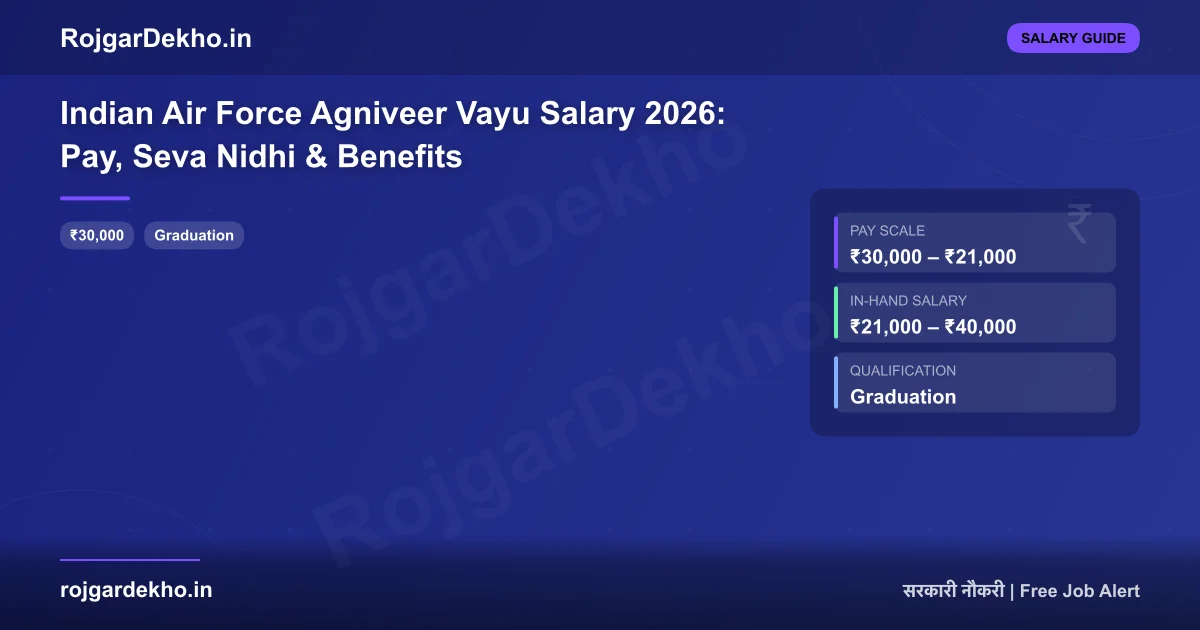
- Year 1: ₹30,000/month package (₹21,000 in-hand after 30% Agniveer Corpus deduction)
- Year 4: ₹40,000/month package, rising each year under the Agnipath scheme
- Seva Nidhi on exit: approximately ₹10.04 lakh (tax-free) after completing 4 years
By RojgarDekho Team | Updated: June 2026
The Indian Air Force Agniveer Vayu (Intake 02/2027) recruitment hires young Agniveers into the Air Force under the Agnipath scheme for a four-year tenure. The pay is structured differently from a permanent airman post: a fixed monthly package that rises each year, a mandatory Agniveer Corpus Fund contribution, and a lump-sum Seva Nidhi on completion. This article breaks down exactly what you earn each year, what reaches your hand, and what you receive at the end of four years.
IAF Agniveer Vayu Intake 02/2027: Apply 6–26 July 2026. Online test 22–23 September 2026. Fee ₹550. Check official notification →
Agniveer Vayu Monthly Pay — Year by Year
Under the Agnipath scheme, the Agniveer package increases each year of the four-year service. 30% of the package goes into the Agniveer Corpus Fund (your contribution toward the Seva Nidhi), so the in-hand amount is 70% of the package. Here is the official year-wise structure:
| Year | Monthly Package | In-Hand (70%) | To Agniveer Corpus (30%) |
|---|---|---|---|
| Year 1 | ₹30,000 | ₹21,000 | ₹9,000 |
| Year 2 | ₹33,000 | ₹23,100 | ₹9,900 |
| Year 3 | ₹36,500 | ₹25,580 | ₹10,950 |
| Year 4 | ₹40,000 | ₹28,000 | ₹12,000 |
The 30% you contribute to the Agniveer Corpus Fund is not lost — the government contributes an equal matching amount, and the total is returned to you with interest as the Seva Nidhi at the end of four years.
Seva Nidhi Package — What You Get After 4 Years
At the end of the four-year tenure, an Agniveer who does not continue in regular service receives the Seva Nidhi — a one-time, tax-free lump sum. It is built from your contributions plus an equal government contribution, plus accrued interest:
| Component | Amount (approx) |
|---|---|
| Your contribution (30% of package over 4 years) | ~₹5.02 lakh |
| Government matching contribution | ~₹5.02 lakh |
| Total corpus + interest | ~₹10.04 lakh (tax-free) |
This ₹10.04 lakh Seva Nidhi is exempt from income tax. It gives an exiting Agniveer a meaningful financial base to start a business, fund further studies, or transition to another career.
Agniveers receive a non-contributory life insurance cover of ₹48 lakh for the duration of their service, along with risk and hardship allowances, dress, and travel allowance as applicable. In case of death attributable to service, additional ex-gratia and benefits apply as per the Agnipath scheme.
Allowances and Other Benefits
| Benefit | Details |
|---|---|
| Risk & Hardship Allowance | As applicable to the posting and role, over and above the package |
| Life Insurance Cover | ₹48 lakh non-contributory cover during the service period |
| Travel Allowance | As per rules |
| Rations, Dress & Medical | Provided during service as per Air Force norms |
| Leave | 30 days annual leave + sick leave as admissible |
What Happens After 4 Years
On completion of the four-year engagement, up to 25% of each batch of Agniveers may be selected for enrolment into the regular Air Force cadre, based on merit, performance, and organisational requirements. Those selected continue as regular airmen with the full permanent pay, allowances, and pension benefits of that cadre. The remaining Agniveers exit with the Seva Nidhi package, a skill certificate, and the experience and discipline of Air Force service — a strong foundation for careers in security, aviation, government, and the private sector.
Agniveer Vayu is a 4-year tenure under the Agnipath scheme, not a guaranteed permanent job. Only up to 25% are retained in regular service after 4 years. Apply with a clear understanding of this structure — for many young candidates, the pay, Seva Nidhi, insurance, skill certificate, and the chance at permanent enrolment make it a strong opportunity; just go in informed.
Frequently Asked Questions
Q: What is the in-hand salary of an Agniveer Vayu in the first year?
In the first year, the monthly package is ₹30,000, of which 30% (₹9,000) goes to the Agniveer Corpus Fund. The in-hand amount is ₹21,000 per month. This rises each year, reaching ₹28,000 in-hand (₹40,000 package) in the fourth year.
Q: Is the Seva Nidhi taxable?
No. The Seva Nidhi package — approximately ₹10.04 lakh after four years — is exempt from income tax. It comprises your contributions, an equal government contribution, and accrued interest, paid as a one-time lump sum on exit.
Q: Do Agniveers get a pension?
Agniveers who exit after the four-year tenure do not receive a traditional pension; instead, they receive the tax-free Seva Nidhi lump sum. Those selected for the regular cadre (up to 25%) become entitled to the pay, allowances, and pension benefits of the permanent Air Force cadre.
Q: Is there life insurance for Agniveers?
Yes. Agniveers are covered by a non-contributory life insurance of ₹48 lakh for the duration of their service under the Agnipath scheme, with additional benefits in case of death or disability attributable to service.
Why the Agnipath Structure Was Introduced
To make an informed decision about applying, it helps to understand why the Agnipath scheme exists. Introduced in 2022, Agnipath was designed to bring younger profiles into the armed forces, give a large number of youth military training and discipline, and create a pool of trained, disciplined citizens who return to society after four years with a skill certificate and a financial corpus. For the candidate, this means the Agniveer Vayu role is best understood not just as a four-year job, but as a package: a respectable monthly income, life insurance, the Seva Nidhi corpus, world-class training and discipline, a recognised skill certificate, and a real chance (up to 25%) at permanent enrolment. Seen this way, even an Agniveer who exits after four years walks away with assets — financial and personal — that most 22–23 year-olds do not have.
How an Agniveer Can Use the Seva Nidhi Wisely
The roughly ₹10.04 lakh tax-free Seva Nidhi is a meaningful sum for a young person in their early twenties. Used wisely, it can fund higher education or a professional course, provide the seed capital for a small business, serve as a down payment toward an asset, or act as a financial cushion while preparing for the next career step. Many exiting Agniveers also use their service experience and skill certificate to enter careers in the security sector, aviation ground services, police and paramilitary forces (which offer reservations and relaxations for Agniveers in several states and central forces), and the private sector. The combination of cash plus credibility is the real value of completing the tenure.
Reservations and Opportunities for Ex-Agniveers
Recognising the service of Agniveers, the central government and several state governments have announced reservations and age relaxations for ex-Agniveers in various recruitments — including central armed police forces (CAPFs), state police, and other government roles. Specific percentages and relaxations vary by organisation and are announced separately. While these should not be the only reason to join, they meaningfully improve an Agniveer's prospects after the four-year tenure, and they reflect the value placed on the training and discipline an Agniveer brings.
A Balanced Final View on the Pay
The Agniveer Vayu pay is not the same as a permanent airman's lifelong salary and pension — it is important to be clear-eyed about that. But for a young person aged 17.5–21, the package is genuinely strong: a monthly income rising from ₹30,000 to ₹40,000, a ₹48 lakh insurance cover, a ₹10.04 lakh tax-free corpus, premier training, and a 25% shot at a permanent Air Force career. Compared with the uncertain early-career income of many private-sector entry roles, the Agniveer Vayu opportunity is financially and developmentally compelling for the right candidate. Apply with full understanding of the structure, and it can be one of the best starts available to a young Indian.
The Life of an Agniveer Vayu — What the Four Years Actually Look Like
Understanding the day-to-day reality helps you decide whether this opportunity fits you. After selection, an Agniveer Vayu undergoes rigorous basic training at an Air Force training establishment, where physical fitness, drill, discipline, and trade-specific skills are built from the ground up. After training, you are posted to an Air Force unit and assigned duties according to your trade — which may involve technical maintenance, support functions, logistics, security, or administrative roles depending on your stream and aptitude. The work demands discipline, punctuality, and teamwork, and it instils a level of personal organisation and confidence that stays with you for life. For a young person, four years inside one of the world's most professional air forces is a transformative experience well beyond the pay.
How the Pay Compares With Early Private-Sector Jobs
It is worth putting the Agniveer Vayu package in context. A typical private-sector entry job for an 18–20 year-old with a 10+2 qualification — in retail, a call centre, or a shop — often pays ₹10,000–₹18,000 a month with no insurance, no structured savings, and little job security. The Agniveer Vayu, by comparison, earns ₹21,000–₹28,000 in-hand, carries a ₹48 lakh life insurance cover, builds a ₹10.04 lakh tax-free corpus, receives food, accommodation, and medical care during service, and gains world-class training plus a skill certificate. When you account for these non-cash benefits, the real value of the Agniveer Vayu package is significantly higher than the headline monthly figure, and far ahead of most comparable early-career options for this age group.
Saving and Planning During the Four Years
A smart Agniveer uses the four years not just to earn but to plan. Because food, accommodation, and medical care are provided during service, your living expenses are low, which means a large share of your in-hand pay can be saved on top of the automatic Agniveer Corpus contribution. An Agniveer who saves disciplinedly during the tenure can exit at 22–23 with the ₹10.04 lakh Seva Nidhi plus personal savings — a strong combined financial base. Use the four years to also think ahead: prepare for the 25% permanent-enrolment selection, study for ex-Agniveer reserved recruitments, or build a plan for higher education or a business. The candidates who treat the tenure as both a job and a launchpad get the most out of it.
Is the Agniveer Vayu Right for You?
This opportunity suits a young, fit, disciplined candidate who wants to serve in the Air Force, values training and structure, and is comfortable with a four-year tenure that offers a real but not guaranteed path to permanence. It is an excellent choice for someone who would otherwise face uncertain early-career income, and who can use the corpus, skills, and ex-Agniveer benefits as a springboard. It is less suited to someone who needs a guaranteed lifelong government job from day one. Be honest with yourself about your goals and fitness, and if the structure fits, the Agniveer Vayu is one of the strongest opportunities available to Indian youth today.
The Skill Certificate and Recognised Credentials
One benefit that is easy to overlook is the formal recognition an Agniveer receives. On completion of the four-year engagement, Agniveers are given a detailed skill certificate and, in many cases, credentials that can be aligned with the national skills and credit framework. This means the training, discipline, and trade experience you gain are not just informal know-how — they are documented, recognised qualifications that you can present to future employers or educational institutions. For a young person without a college degree, having a government-recognised skill certificate from the Indian Air Force is a genuine differentiator in the job market, and it reflects capabilities — teamwork, discipline, technical aptitude, physical fitness — that employers across sectors actively value.
How Families Should View the Opportunity
For many candidates, the decision to apply involves the family. It helps for families to understand the full picture rather than focusing only on the four-year limit. Yes, the tenure is four years with up to 25% retained permanently — but the candidate also gains a respectable income during service, comes home with a tax-free corpus of around ₹10.04 lakh, carries a ₹48 lakh insurance cover throughout, receives premier training and a recognised certificate, and earns reservations and relaxations in many subsequent government recruitments. For a young person in their late teens or early twenties, few opportunities offer this combination of income, security, skill-building, and national service. Families that weigh the complete package, not just the tenure length, generally see the strong value it offers.