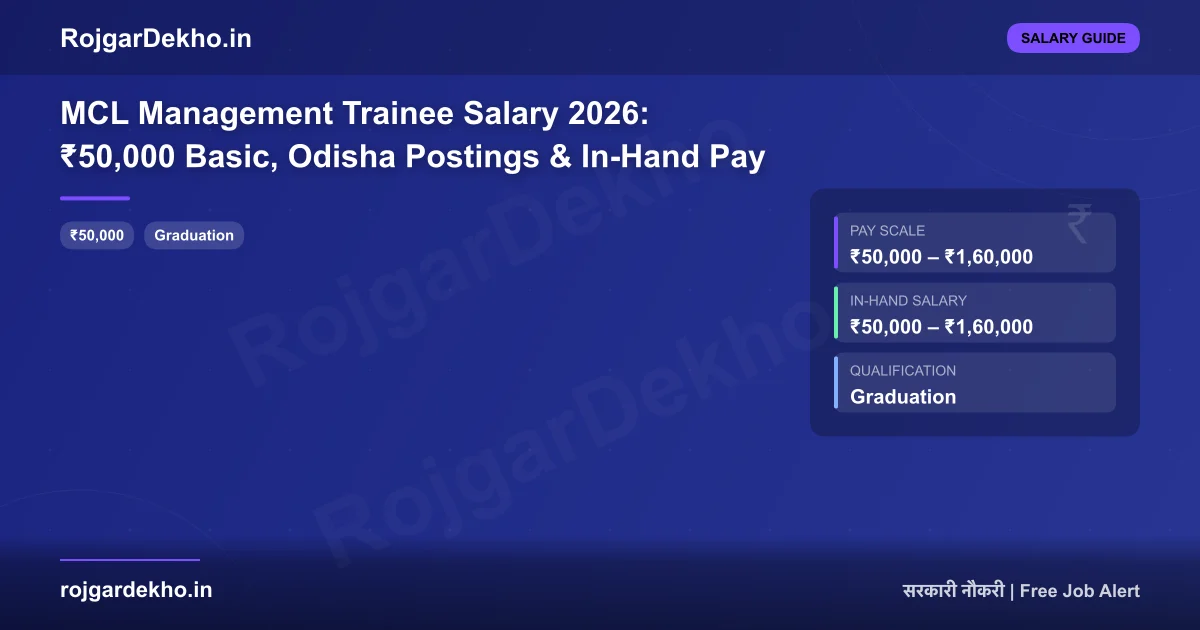
MCL Management Trainee Salary 2026: ₹50,000 Basic, Odisha Postings & In-Hand Pay
Mahanadi Coalfields Limited (MCL) Management Trainee salary follows the standard Coal India IDA (Industrial DA) pay scale — the same E-1 structure that applies to every Coal India subsidiary. What makes MCL distinct is where you work: the Talcher and IB Valley coalfields of Odisha, which are among the largest and most productive coal-bearing regions in India. Your posting location, the allowances tied to it, and MCL's operational scale all shape what your monthly in-hand looks like beyond the base figure. This article breaks it all down.
MCL MT Basic Pay Scale
MCL Management Trainees are placed on the E-1 IDA pay scale from the date of joining — ₹50,000 basic with a 3% annual increment on basic pay, rising up to ₹1,60,000. This is identical to every other Coal India subsidiary. The pay scale is determined by CIL's corporate HR policy, not by the individual subsidiary, so there is no negotiation and no difference in basic structure between MCL, WCL, SECL, NCL, ECL, or BCCL. The differentiation comes from allowances — specifically HRA, which depends on where you are posted.
| Grade | Designation | Basic Pay Min | Basic Pay Max | Annual Increment |
|---|---|---|---|---|
| E-1 | Management Trainee / Jr Manager | ₹50,000 | ₹1,60,000 | 3% of basic |
| E-2 | Manager | ₹60,000 | ₹1,80,000 | 3% of basic |
| E-3 | Senior Manager | ₹70,000 | ₹2,00,000 | 3% of basic |
| E-4 | Chief Manager | ₹80,000 | ₹2,20,000 | 3% of basic |
| E-5 | General Manager | ₹90,000 | ₹2,40,000 | 3% of basic |
Monthly In-Hand Salary at Sambalpur/Burla (MCL HQ)
MCL's headquarters is at Burla, in Sambalpur district of Odisha. Sambalpur is classified as a Y-class city, which entitles employees to 18% of basic pay as HRA — ₹9,000/month at E-1. Industrial DA is revised quarterly based on the AICPIN-IW index and has been approximately 55–60% of basic in recent quarters. Management grade employees receive 35% of basic as Perks. The following table shows a realistic monthly in-hand calculation for Sambalpur/Burla posting:
| Salary Component | Basis | Monthly Amount |
|---|---|---|
| Basic Pay | E-1 entry level | ₹50,000 |
| Industrial DA (IDA) | ~55% of basic (quarterly revised) | ~₹27,500 |
| HRA — Sambalpur/Burla (Y-class) | 18% of basic | ₹9,000 |
| Perks (Management grade) | 35% of basic | ₹17,500 |
| Gross Earnings | ~₹1,04,000 | |
| EPF (Employee) | 12% of Basic+DA | −₹9,300 |
| Income Tax (approx.) | New tax regime estimate | −₹3,000–5,000 |
| Approximate In-Hand | ₹88,000–₹92,000 |
MCL Posting Locations and Their HRA Impact
MCL operates across two major coalfield regions in Odisha. The IB Valley coalfields cover areas in Jharsuguda and Bargarh districts — including Belpahar, Lakhanpur, Lajkura, and Ib. The Talcher coalfields cover Angul district — including Talcher, Lingaraj, Jagannath, Bharatpur, and Hingula mines. Brajrajnagar is another important operational area. Each of these locations falls into a city classification that determines your HRA:
| Posting Location | District | City Class | HRA % | HRA at E-1 |
|---|---|---|---|---|
| Sambalpur / Burla (HQ) | Sambalpur | Y-class | 18% | ₹9,000 |
| Talcher (mine area) | Angul | Z-class | 9% | ₹4,500 |
| Jharsuguda | Jharsuguda | Z-class | 9% | ₹4,500 |
| Belpahar / Lakhanpur | Jharsuguda | Z-class | 9% | ₹4,500 |
| Brajrajnagar | Jharsuguda | Z-class | 9% | ₹4,500 |
| Hingula / Bharatpur | Angul | Z-class | 9% | ₹4,500 |
Like all Coal India subsidiaries, MCL provides company-owned colony accommodation at mine areas at heavily subsidised rent. This makes Z-class postings financially attractive despite the lower HRA — the colony ecosystem (quarters, hospital, school, club) effectively reduces living costs well below what private housing in those areas would cost. Many MCL employees at mine postings save proportionally more than their Sambalpur HQ counterparts.
MCL's Scale — Why It Matters for Your Career
MCL is the largest coal-producing subsidiary of Coal India. Annual production consistently exceeds 150–170 million tonnes, making it a major player in India's energy ecosystem. This scale means MCL has a large workforce, extensive infrastructure, and robust internal HR processes. For a Management Trainee, larger operations translate into: more diverse project exposure (mechanised open-cast mines, underground operations, coal washeries, railway sidings, power evacuation infrastructure), faster development of operational skills, and a broader peer network within the organisation. Mining Engineers at MCL get exposure to some of the largest open-cast coal mines in Asia — the Talcher coalfields alone hold some of India's biggest proven coal reserves.
Annual CTC Estimate at MCL
| CTC Component | Annual Amount |
|---|---|
| Monthly gross × 12 (Basic+DA+HRA+Perks) | ~₹12,48,000 |
| Employer EPF contribution (12% of Basic+DA) | ~₹1,11,600 |
| Gratuity provisioning | ~₹28,860 |
| Medical benefit (MCL hospital/CMSS scheme) | ~₹40,000–60,000 |
| LTC (biennial, prorated) | ~₹25,000/year |
| Total Approximate CTC | ₹14–16 LPA |
What No Other Site Tells You About MCL MT Salary
MCL's Talcher and IB Valley postings are often seen as remote by candidates from northern India. But here is the reality on the ground: Talcher is now a growing industrial town with good road connectivity to Bhubaneswar (approximately 3.5 hours) and Cuttack. Jharsuguda has an airport with regular flights to Delhi, Mumbai, and Hyderabad. The Odisha government has invested heavily in infrastructure across the coalfield belt. The colony ecosystem at MCL mine areas is well-developed — executive clubs with modern facilities, English-medium schools, and multi-speciality hospitals. For a candidate from Odisha, Jharkhand, Bengal, or Chhattisgarh, MCL postings are often not remote at all — they may be closer to home than an HQ posting in Sambalpur.
Second point: MCL's production scale creates more opportunities for Management Trainees to take on project responsibility early. A new MT at a large open-cast mine handles real volumes — overburden removal, equipment coordination, shift supervision — from the first year. This operational exposure accelerates career readiness for promotion exams far faster than a desk-based HQ role, even if the HQ posting has better HRA.
Third: IDA quarterly revision means MCL employees get effective salary increases 4 times a year. The compound effect over a 10-year career is substantial — an E-1 MT starting at ₹50,000 basic will earn approximately ₹67,000 basic by year 10 from increments alone, with DA scaling proportionally at each quarterly revision. The ₹88K-₹92K in-hand of year one becomes ₹1.3–1.5 lakh by year 10 without any promotion.
Salary Comparison: MCL vs Other CIL Subsidiaries
| Company | E-1 Basic | HQ City | HRA Class | Approx. In-Hand at HQ |
|---|---|---|---|---|
| MCL | ₹50,000 | Burla/Sambalpur | Y (18%) | ₹88K–92K |
| WCL | ₹50,000 | Nagpur | Y (18%) | ₹88K–92K |
| SECL | ₹50,000 | Bilaspur | Y (18%) | ₹88K–92K |
| NCL | ₹50,000 | Singrauli | Z (9%) | ₹83K–87K |
| Coal India HQ | ₹50,000 | Kolkata | X (27%) | ₹93K–98K |
Promotion Timeline and Long-Term Salary Growth
At MCL, promotions from E-1 to E-2 (Manager) typically occur after 4 years of confirmed service through the Departmental Promotion Committee (DPC) process. E-2 to E-3 (Senior Manager) takes another 4–6 years depending on vacancies and DPC results. A 25-year-old MCL MT who follows the standard promotion track can expect to be at E-3 by approximately age 35, with monthly gross salary in the range of ₹1.45–1.60 lakh. By E-5 (General Manager), which is achievable by age 50–55 for high performers, the monthly gross exceeds ₹2.2–2.5 lakh at then-current DA rates. Each promotion brings both a grade pay increase and a fresh basic pay level, compounding significantly with DA applied on the new, higher base.
Additional Benefits at MCL
MCL Management Trainees receive the complete executive benefits package: medical treatment for self and dependents at MCL hospitals or empanelled hospitals under the CMSS (Coal Mines Social Security) scheme, children's education assistance for schooling up to graduation from recognised institutions, Leave Travel Concession every two years, National Pension System contributions (10% employee + 14% employer), and access to MCL's executive guest houses and holiday homes across Odisha. Post-retirement, employees continue on the NPS annuity plus receive gratuity of approximately ₹20–30 lakh depending on final basic pay. The combination of guaranteed salary growth, benefits, and retirement security makes MCL MT one of the more financially secure career tracks available to engineering graduates in India's public sector.
Frequently Asked Questions
Q: What is the MCL MT starting salary in 2026?
MCL Management Trainee starting basic pay is ₹50,000/month on the E-1 IDA scale. With IDA (~55%), HRA (18% at Sambalpur HQ), and Perks (35%), the gross is approximately ₹1,04,000/month. After EPF and income tax deductions, in-hand is approximately ₹88,000–₹92,000/month at Sambalpur posting.
Q: Is the MCL MT salary higher or lower than Coal India (CIL) parent company MT?
The basic pay and IDA structure are identical — both E-1 at ₹50,000. The difference is HRA: Coal India's Kolkata HQ is X-class (27% HRA = ₹13,500) vs MCL's Sambalpur HQ Y-class (18% HRA = ₹9,000). CIL HQ MTs earn approximately ₹4,500 more in HRA. However, MCL mine area postings with company accommodation can offset this gap through near-zero housing costs.
Q: Are MCL mine postings in Talcher and IB Valley considered remote?
They are industrial towns, not remote villages. Talcher is connected by road and rail, approximately 3.5 hours from Bhubaneswar. Jharsuguda has its own airport. Both areas have MCL colony infrastructure including schools, hospitals, and clubs. For candidates from Odisha and neighbouring states, these are not significantly remote locations.
Q: Does MCL provide housing to Management Trainees?
MCL provides company quarters at mine area colonies at heavily subsidised rates. At HQ Sambalpur/Burla, quarters are subject to availability and seniority — junior MTs may initially need private accommodation. During the training period, MCL typically provides hostel or guest house accommodation for newly joined MTs.
Q: What is the bond period at MCL and what is the penalty?
MCL Management Trainees sign a service bond at joining — typically a 3-year minimum service commitment. Leaving before the bond period requires payment of the penalty amount specified in your appointment letter. Bond amounts vary between recruitment batches and are specified in the appointment letter, not in the general notification.
📌 MCL MT Complete Guide:
MCL vs Private Sector Mining — Why PSU Still Wins for Most Candidates
Private sector mining companies — NMDC, Hindalco's mines, Vedanta's coal-related operations, and private coal mine operators — do pay competitive salaries at the entry level. But the comparison breaks down quickly when you look beyond month one. At MCL, your Industrial DA revises upward every quarter — four effective salary hikes per year with zero performance pressure attached. Private sector salaries are subject to annual appraisal cycles, freeze periods during company downturns, and market volatility in the commodity sector. Coal mining is a cyclical industry; private operators cut costs (including headcount) during down cycles. Coal India subsidiaries have never conducted mass layoffs in their history. The security differential is real and substantial.
Second, colony accommodation at MCL mine areas eliminates a cost that private sector employees in the same locations bear entirely. A 2BHK in Talcher or Jharsuguda's private market costs ₹6,000–10,000 per month. MCL colony quarters cost a nominal ₹300–800 per month in subsidised rent — a monthly saving of ₹5,500–9,200 that compounds significantly over a 3–5 year mine posting. Add the MCL hospital system (consultations, surgery, specialist referrals — all covered for employee and family), and the effective value of the compensation package far exceeds what the in-hand salary number alone suggests.
Third, promotion at MCL is transparent and systematic. DPC cycles run on known timelines with written criteria. Private sector promotions depend on manager discretion, budget availability, and office politics. For candidates who value clarity of expectations and predictable career progression, MCL's structure is a feature, not a limitation. Most engineers who have spent 8–10 years at MCL and then assessed private sector offers find the job security, benefit ecosystem, and retirement security make the PSU the stronger long-term choice — especially for those with family responsibilities in the coalfield regions.
Building Your Financial Foundation in the First Five Years at MCL
The NPS contribution structure at MCL is one of its most underappreciated financial benefits. You contribute 10% of Basic+DA, MCL contributes 14% of Basic+DA. On an E-1 gross of ₹77,500 (Basic ₹50,000 + DA ₹27,500), the combined NPS annual contribution is approximately ₹2,94,000 — of which MCL contributes ₹1,62,750 annually on your behalf. Over 10 years at conservative 8% annual return, this NPS corpus grows to approximately ₹43–50 lakh — entirely separate from your monthly take-home. The MCL hospital system eliminates the need for private health insurance, a cost that private sector employees spend ₹15,000–25,000 annually on. Your colony housing subsidy at a mine posting saves ₹66,000–1,10,000 per year. Together, the hidden financial value of your MCL MT package adds ₹4–6 lakh annually over the stated CTC — a figure that most financial comparison charts for PSU vs private sector entirely miss.