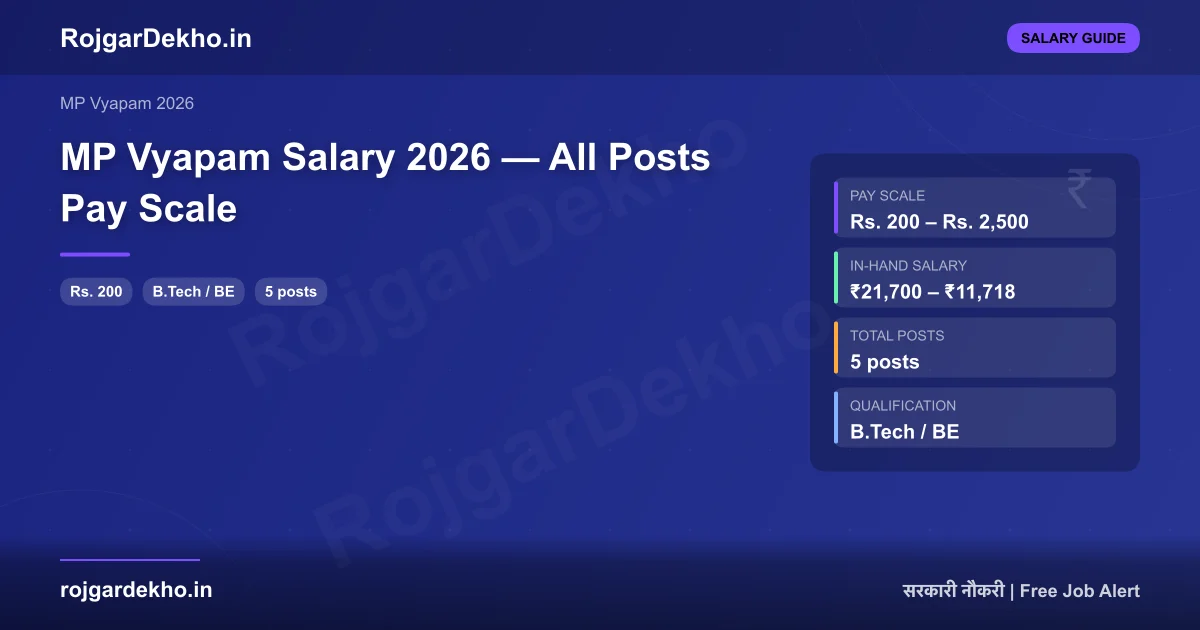
MP Vyapam Salary 2026 — All Posts Pay Scale
MP Vyapam — now formally renamed MPESB (Madhya Pradesh Employee Selection Board) — is the state's largest recruitment machine. It fills posts across more than 50 different exams covering health, revenue, police support, education, and general administration. But when candidates ask "what will I actually earn after joining?", the answer is rarely given clearly. This guide is that clear answer — post by post, group by group, with in-hand calculations that account for DA, HRA, and standard deductions.
All figures use the 7th Pay Commission matrix that is currently in force, the Dearness Allowance (DA) applicable in 2026 — approximately 53 to 55% of basic pay — and standard House Rent Allowance for urban, semi-urban, and rural postings in MP. The in-hand salary is after deducting NPS (10% of basic plus DA), professional tax (Rs. 200 monthly), and MPGHS medical contribution. If you see only the basic pay figure in a coaching centre's material, add roughly 30–40% more to get the gross, then subtract NPS and professional tax to get in-hand.
Understanding the Pay Structure Before Diving into Numbers
Every Vyapam post sits in a Pay Level from the 7th Pay Commission matrix. The Level decides your starting basic pay. On top of basic pay, you receive DA (Dearness Allowance — linked to inflation, revised twice yearly), HRA (House Rent Allowance — 8% of basic for rural/small city postings, 16% for medium cities, 24–27% for X-category cities), and Medical Allowance. Deductions include NPS (10% of basic+DA), CGHS or MPGHS contribution, and professional tax. The gross figure minus these deductions is your in-hand salary.
One critical point about HRA in MP: Bhopal and Indore qualify for a higher HRA rate, while most district headquarters in MP are in the lower HRA bracket. A Patwari posted in Bhopal will take home around Rs. 2,500–3,000 more per month than one posted in a small taluka, simply due to HRA difference. All in-hand figures below reflect a mid-range HRA assumption; your actual figure will vary slightly by posting location.
Group 1 — Senior Posts (SI, Food Inspector, Excise SI, Drug Inspector)
Group 1 is the most sought-after Vyapam tier. These are graduate-level posts with genuine administrative or law-enforcement functions. Sub Inspector (Food), Excise Sub Inspector, Drug Inspector, and similar roles sit here. Group 1 requires graduation and carries Level 5 or Level 6 pay — the highest among Vyapam non-gazetted categories.
| Post | Pay Level | Basic Pay (Entry) | DA @54% | HRA (Mid-Range) | Gross | Approx. In-Hand |
|---|---|---|---|---|---|---|
| Sub Inspector (Food / Excise) | Level 6 | Rs. 35,400 | Rs. 19,116 | Rs. 5,664 | Rs. 60,180+ | Rs. 48,000–54,000 |
| Food Inspector | Level 5 | Rs. 29,200 | Rs. 15,768 | Rs. 4,672 | Rs. 49,640+ | Rs. 40,000–44,000 |
| Drug Inspector | Level 5–6 | Rs. 29,200–35,400 | Variable | Variable | — | Rs. 40,000–52,000 |
| Cooperative Inspector | Level 5 | Rs. 29,200 | Rs. 15,768 | Rs. 4,672 | Rs. 49,640+ | Rs. 39,000–43,000 |
| Statistical Inspector | Level 5 | Rs. 29,200 | Rs. 15,768 | Rs. 4,672 | Rs. 49,640+ | Rs. 39,000–43,000 |
The in-hand range accounts for rural versus urban HRA differences. A Food Inspector posted in Bhopal will take home a few thousand more than one posted in a small district town. After NPS and tax deductions, expect Rs. 40,000–54,000 per month at entry level, rising to Rs. 55,000–70,000 after 8–10 years of annual increments. Annual increments add 3% of basic pay each year — so after 10 years of service, basic pay grows from Rs. 35,400 to approximately Rs. 47,600 for an SI.
Group 2 Sub Group 3 — Patwari, Revenue Inspector, Lab Technician, Forest Guard
This is arguably the most popular Vyapam category by sheer number of applicants. Patwari is a household name in rural MP — land records, crop surveys, daily public interaction, khasra and khatauni maintenance. Lab Technicians work in district hospitals. Revenue Inspectors supervise Patwaris across a revenue circle. Forest Guard protects forest areas and assists Range Officers.
| Post | Pay Level | Basic Pay | DA @54% | HRA | Approx. In-Hand |
|---|---|---|---|---|---|
| Patwari | Level 3 | Rs. 21,700 | Rs. 11,718 | Rs. 1,736–5,208 | Rs. 28,000–32,000 |
| Revenue Inspector | Level 4 | Rs. 25,500 | Rs. 13,770 | Rs. 2,040–6,120 | Rs. 33,000–37,000 |
| Lab Technician | Level 4 | Rs. 25,500 | Rs. 13,770 | Rs. 2,040–6,120 | Rs. 32,000–36,000 |
| Forest Guard | Level 3 | Rs. 21,700 | Rs. 11,718 | Rs. 1,736 | Rs. 27,000–30,000 |
| Assistant Grade III (Clerk) | Level 3 | Rs. 21,700 | Rs. 11,718 | Rs. 1,736–5,208 | Rs. 28,000–32,000 |
A Patwari's base in-hand of Rs. 28,000–32,000 looks modest next to private sector sales jobs in cities. But consider the full picture: many Patwari postings in MP come with free or subsidised government accommodation in the village area, the position carries daily community importance (people approach the Patwari for virtually every land-related paperwork), there is zero performance pressure or job insecurity, and after 30 years of service a pension of approximately Rs. 12,000–14,000 per month is guaranteed for life. The total lifetime value of a Patwari job significantly exceeds what the monthly salary number alone suggests.
Group 2 Sub Group 4 — Peon, Chowkidar, Class IV Posts
These are entry-level positions requiring minimal qualification (8th or 10th pass). They are not glamorous posts by any definition, but they are permanent government posts with full pension benefits — something a private sector employee earning twice as much will never get. Thousands of candidates compete for these posts in every Vyapam cycle, which is evidence of the value the market places on government employment security.
| Post | Pay Level | Basic Pay | Approx. In-Hand |
|---|---|---|---|
| Peon (Chowkidar / Daftri) | Level 1 | Rs. 18,000 | Rs. 22,000–24,000 |
| Class IV (General) | Level 2 | Rs. 19,900 | Rs. 24,000–26,000 |
| Driver (Government Vehicle) | Level 2 | Rs. 19,900 | Rs. 25,000–28,000 |
| Sweeper / Mali | Level 1 | Rs. 18,000 | Rs. 22,000–24,000 |
Group 5 — Health Department (Staff Nurse, ANM, Paramedical Staff)
MP's health department is one of the largest employers in the state. Group 5 posts are filled through MPESB exams and require specific nursing or paramedical qualifications. In-hand pay is considerably better than Group 2 posts because the required qualification is higher — GNM minimum for Staff Nurse, B.Sc. Nursing for Nursing Officer. Health department posts also carry additional responsibility allowances in some cases.
| Post | Pay Level | Basic Pay | Min. Qualification | Approx. In-Hand |
|---|---|---|---|---|
| Staff Nurse (GNM) | Level 5 | Rs. 29,200 | GNM | Rs. 40,000–44,000 |
| Staff Nurse (B.Sc.) | Level 6 | Rs. 35,400 | B.Sc. Nursing | Rs. 48,000–52,000 |
| Nursing Officer (MPESB) | Level 7 | Rs. 44,900 | B.Sc. Nursing | Rs. 58,000–65,000 |
| ANM | Level 4 | Rs. 25,500 | ANM Certificate | Rs. 32,000–36,000 |
| Pharmacist | Level 5 | Rs. 29,200 | D.Pharma / B.Pharma | Rs. 38,000–42,000 |
| Radiographer | Level 5 | Rs. 29,200 | DMRT / B.Sc. Radiology | Rs. 38,000–42,000 |
| Lab Technician (Health) | Level 4 | Rs. 25,500 | DMLT / B.Sc. MLT | Rs. 32,000–36,000 |
Teacher Salary — Samvida Varg 1, 2, and 3
MP's teacher vacancies are the numerically largest in any single Vyapam recruitment cycle. The three Varg (grades) differ by qualification and school level. After regularisation since 2022, these are full regular government posts — not contractual arrangements — with the same service conditions and NPS benefits as other government employees.
| Category | Level | School Level | Min. Qualification | Basic Pay | Approx. In-Hand |
|---|---|---|---|---|---|
| Samvida Varg 1 | Level 7 | Higher Secondary (11th–12th) | PG + B.Ed. | Rs. 44,900 | Rs. 58,000–65,000 |
| Samvida Varg 2 | Level 5 | Middle (6th–8th) | Graduation + B.Ed. | Rs. 29,200 | Rs. 38,000–44,000 |
| Samvida Varg 3 | Level 4 | Primary (1st–5th) | 12th + D.El.Ed. / TET | Rs. 25,500 | Rs. 32,000–37,000 |
A Samvida Varg 1 teacher earns Rs. 58,000–65,000 in-hand — comparable to an IT professional in a Tier-2 city with 2–3 years of experience — but with an unbeatable job security advantage: once regularised, dismissal is virtually impossible without a formal departmental inquiry, and the pension at the end is guaranteed. For candidates with PG and B.Ed. degrees, Varg 1 is among the best government opportunities available in MP in terms of salary, work-life balance, and long-term stability.
Comparing Vyapam Salary With MPPSC Salary
MPPSC gazetted posts (SDM, DSP) start at Level 10 — basic pay of Rs. 56,100. In-hand at entry: Rs. 75,000–90,000. After 10 years they earn Rs. 1.2–1.5 lakh per month. By contrast, a Vyapam Group 1 SI earns Rs. 48,000–54,000 at entry and Rs. 65,000–80,000 after 10 years of service. The gap is significant — roughly Rs. 25,000–40,000 per month at comparable experience levels.
But here is the real-world context: the path to MPPSC requires 2–3 years of intense full-time preparation with no income, whereas Vyapam Group 1 can be cracked in 6–10 months. If you spend 3 years preparing for MPPSC and fail, you have lost 3 years of both time and income. If you clear Vyapam SI in your first attempt at 22 and earn Rs. 48,000 per month from age 23, by age 30 you have 7 years of work experience, pension accumulation, and Rs. 30–40 lakh in savings or assets. The financial opportunity cost of exclusively pursuing MPPSC at the expense of Vyapam is substantial. The sensible strategy for most candidates is to target both — clear Vyapam first as the foundation, then attempt MPPSC from a position of financial security.
Salary After 5, 10, and 20 Years
Government salary is not static. Annual increments of 3% of basic pay compound over a career. A Patwari who starts at Rs. 21,700 basic in 2026 will draw approximately Rs. 25,200 basic after 5 years, Rs. 29,200 basic after 10 years (almost a full level jump), and Rs. 39,200 basic after 20 years. With proportionally rising DA, the in-hand salary at 20 years of service for a Patwari would be approximately Rs. 55,000–65,000 — nearly double the starting in-hand. This trajectory is what makes government jobs financially rewarding over a full career even when the starting salary appears modest.
MP Government Job List 2026 — All Exams & Posts
Chhattisgarh Patwari Salary 2026 — Comparison with MP
FAQs
What is the in-hand salary of an MP Patwari in 2026?
An MP Patwari at Level 3 draws basic pay of Rs. 21,700. With DA at approximately 54%, the DA component is Rs. 11,718. HRA varies — for a rural posting it may be as low as Rs. 1,302 (6% of basic at rural rate), for an urban area like Bhopal it could be Rs. 5,208 (24%). After deductions for NPS (10% of basic+DA = Rs. 3,342) and professional tax (Rs. 200), the typical in-hand figure is Rs. 28,000–32,000 per month depending on posting city class. After 5–7 years of increments, this rises to Rs. 32,000–38,000.
Does MP Vyapam provide NPS or Old Pension Scheme?
Employees appointed after January 1, 2004, fall under the National Pension System (NPS). The government deducts 10% of basic pay plus DA as the employee contribution and adds another 14% as the employer contribution. Old Pension Scheme (OPS) applies only to those appointed before January 2004. MP has discussed reverting to OPS but as of 2026, NPS still applies to all new MPESB appointees. Factor this into your retirement planning — NPS provides a market-linked corpus rather than a guaranteed fixed pension.
Are MP Vyapam teachers called Samvida or regular employees now?
Historically, teachers recruited through Vyapam were on "Samvida" (contractual) terms with lower salaries. Following court orders and policy changes between 2018–2023, most Samvida teachers have been regularised into the regular pay matrix. New recruits since 2022 are directly appointed at regular Level 4, 5, or 7 pay scales. The old Samvida salary stigma is largely gone for new appointments — check the specific recruitment notification to confirm the exact pay structure, as transitional rules still apply to some older appointees.
How much does an MPESB Nursing Officer earn compared to a regular Staff Nurse?
The MPESB Nursing Officer post (introduced in recent recruitments for hospitals and medical colleges) sits at Level 7 — basic pay Rs. 44,900, in-hand roughly Rs. 58,000–65,000 per month. A regular Staff Nurse with GNM qualification at Level 5 earns Rs. 40,000–44,000 in-hand, while a B.Sc. Nursing Staff Nurse at Level 6 earns Rs. 48,000–52,000. The Nursing Officer post requires B.Sc. Nursing as minimum — ANM-qualified candidates are not eligible. Over a 25-year career, the cumulative salary difference between a Nursing Officer and a GNM Staff Nurse amounts to Rs. 50–70 lakh, which makes pursuing B.Sc. Nursing a financially sound investment if healthcare is your field.
What salary can I expect after 10 years in a Vyapam post?
Annual increments in government service add 3% of basic pay each year. After 10 years of service, a Patwari who started at Rs. 21,700 basic would be around Rs. 29,200 basic (close to the next level), with DA pushing total in-hand to Rs. 40,000–46,000. A Group 1 SI starting at Rs. 35,400 would be earning roughly Rs. 47,600 basic and Rs. 65,000–72,000 in-hand after 10 years. This steady trajectory — unlike private sector jobs that stagnate without promotion — is one of the most underrated financial advantages of government service in India.