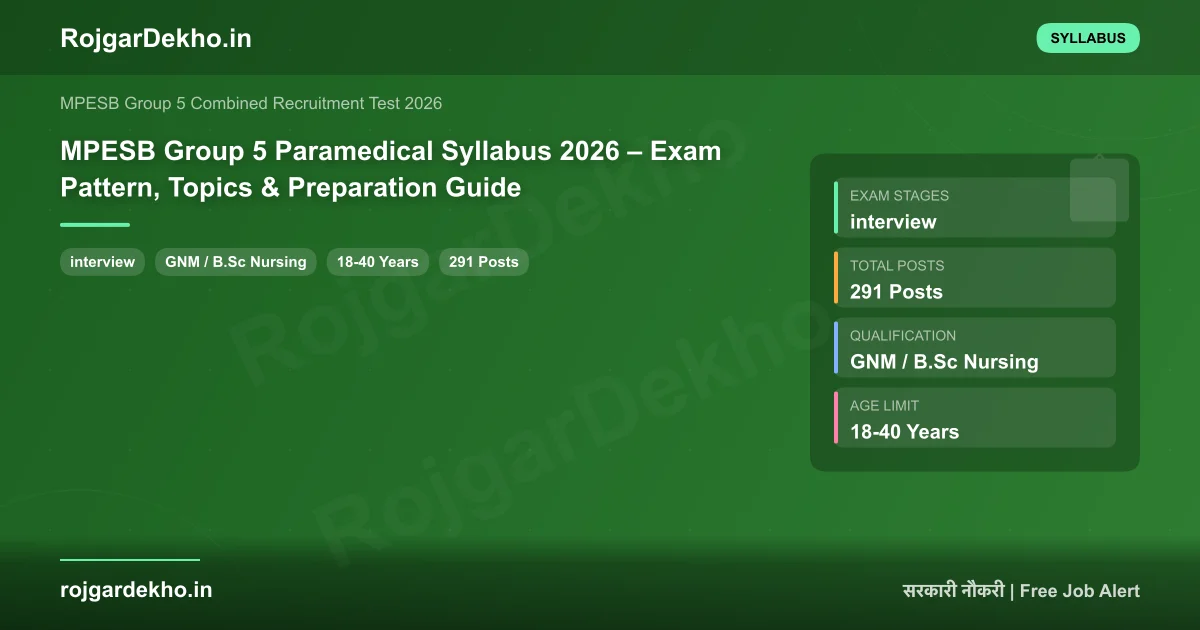
The MPESB Group 5 Paramedical Syllabus 2026 is essential for candidates appearing in the Madhya Pradesh Professional Examination Board (MPESB) Group 5 Combined Recruitment Test. The exam consists of 100 Multiple Choice Questions (MCQ) covering Nursing Science, Anatomy, Pharmacology, Microbiology and Community Health. This article provides the complete exam pattern, subject-wise syllabus and preparation strategy for all 291 vacancies including Staff Nurse, Lab Technician and Pharmacist posts.
MPESB Group 5 Exam Pattern 2026 – Overview
| Detail | Information |
|---|---|
| Conducting Body | MPESB (MP Professional Examination Board) |
| Exam Name | MPESB Group 5 Combined Recruitment Test 2026 |
| Total Vacancies | 291 Posts |
| Exam Type | Written Exam – Objective (MCQ) |
| Total Questions | 100 MCQ |
| Total Marks | 100 Marks |
| Duration | 2 Hours (120 Minutes) |
| Negative Marking | No Negative Marking |
| Language | Hindi and English |
| Qualification | 12th / Diploma / Degree |
| Age Limit | 18 – 40 Years |
MPESB Group 5 Exam Pattern – Subject-Wise Distribution
The 100 MCQ written exam is divided across the following subjects. The approximate weightage of each section is given below:
| Subject | Approx. Questions | Marks |
|---|---|---|
| Nursing Science / Professional Knowledge | 30 | 30 |
| Anatomy & Physiology | 20 | 20 |
| Pharmacology | 15 | 15 |
| Microbiology | 15 | 15 |
| Community Health & Public Health | 20 | 20 |
| Total | 100 | 100 |
MPESB Group 5 Syllabus – Nursing Science
This is the core subject with the highest weightage. Topics covered under Nursing Science include:
- Fundamentals of Nursing: Nursing procedures, patient assessment, vital signs measurement, infection control, aseptic technique
- Medical-Surgical Nursing: Pre and post-operative care, wound management, IV therapy, blood transfusion, emergency nursing
- Obstetric & Gynecological Nursing: Antenatal care, labour management, postnatal care, high-risk pregnancy, family planning
- Pediatric Nursing: Growth and development, neonatal care, immunization schedule, common childhood diseases
- Psychiatric Nursing: Mental health assessment, psychiatric disorders, therapeutic communication, psychopharmacology
- Nursing Administration: Ward management, quality assurance, nursing ethics, legal aspects of nursing
MPESB Group 5 Syllabus – Anatomy & Physiology
This section tests knowledge of the human body structure and functions:
- Skeletal System: Bones, joints, types of joints, axial and appendicular skeleton
- Muscular System: Types of muscles, mechanism of muscle contraction
- Cardiovascular System: Heart structure, blood circulation, blood pressure regulation, cardiac cycle
- Respiratory System: Lungs, mechanism of breathing, gas exchange, respiratory volumes
- Digestive System: GI tract, enzymes, absorption, liver and pancreas functions
- Nervous System: Brain structure, spinal cord, cranial nerves, reflex arc, autonomic nervous system
- Endocrine System: Hormones, glands, feedback mechanisms, diabetes and thyroid disorders
- Reproductive System: Male and female reproductive organs, menstrual cycle, gametogenesis
MPESB Group 5 Syllabus – Pharmacology
Pharmacology covers drug knowledge essential for paramedical professionals:
- General Pharmacology: Drug absorption, distribution, metabolism, excretion (ADME), routes of drug administration
- Pharmacokinetics & Pharmacodynamics: Drug-receptor interactions, dose-response relationships, bioavailability
- Antimicrobial Agents: Antibiotics, antifungals, antivirals, antimalarial drugs, drug resistance
- Cardiovascular Drugs: Antihypertensives, antiarrhythmics, antianginal drugs, cardiac glycosides
- CNS Drugs: Analgesics, anaesthetics, anticonvulsants, sedatives, antidepressants
- Drug Dosage Calculations: Pediatric and adult dosage, IV drip rate calculations, unit conversions
- Adverse Drug Reactions: Side effects, drug interactions, contraindications, drug allergy management
MPESB Group 5 Syllabus – Microbiology
Microbiology covers infectious disease knowledge and laboratory concepts:
- General Microbiology: Classification of microorganisms, bacteria, viruses, fungi, parasites
- Bacteriology: Morphology, culture methods, staining techniques, common bacterial infections
- Virology: Viral structure, replication, common viral diseases (HIV, Hepatitis, COVID, Dengue)
- Immunology: Types of immunity, vaccines, immunization schedule, autoimmune disorders
- Infection Control: Sterilization, disinfection, biomedical waste management, hospital-acquired infections
- Parasitology: Malaria, amoebiasis, filariasis, helminthic infections, vector-borne diseases
MPESB Group 5 Syllabus – Community Health
Community Health and Public Health is an important section covering national health programs:
- Epidemiology: Disease surveillance, outbreak investigation, epidemiological methods, disease prevention levels
- National Health Programs: NHM, Ayushman Bharat, Janani Suraksha Yojana, Swachh Bharat, RMNCH+A
- Maternal & Child Health: Antenatal care, safe delivery, postnatal care, IMNCI, breastfeeding promotion
- Nutrition: Balanced diet, malnutrition, deficiency diseases, ICDS, mid-day meal program
- Environmental Health: Water purification, sanitation, air pollution, waste disposal, occupational health
- Health Education: Communication methods, behavior change communication, IEC activities
- Biostatistics: Mean, median, mode, standard deviation, data presentation, vital statistics
MPESB Group 5 Selection Process 2026
| Stage | Description | Details |
|---|---|---|
| Stage 1 | Written Exam (MCQ) | 100 Questions, 100 Marks, 2 Hours, No Negative Marking |
| Stage 2 | Document Verification | Original certificates, caste certificate, domicile, etc. |
| Stage 3 | Medical Fitness Test | Physical and medical fitness as per MP state government norms |
MPESB Group 5 Preparation Tips
- Focus on Nursing Science: This carries the highest weightage (30 marks). Study NCLEX-style questions and standard nursing textbooks
- Practice MCQ daily: Since the exam is 100% MCQ with no negative marking, attempt all questions confidently
- Revise Anatomy diagrams: Draw and label diagrams of body systems regularly for better retention
- Learn drug classifications: For Pharmacology, focus on drug categories, mechanisms and common side effects rather than memorizing every drug
- Study National Health Programs: Community Health questions are often from government health schemes — read the latest NHM updates
- Take mock tests: Practice full-length 100 MCQ tests within 2 hours to build speed and accuracy
- Refer standard textbooks: BT Singh Nursing, Park's Community Medicine, KD Tripathi Pharmacology, Ananthanarayanan Microbiology
MPESB Group 5 Paramedical Syllabus – FAQ
How many questions are asked in MPESB Group 5 exam?
The MPESB Group 5 written exam consists of 100 Multiple Choice Questions (MCQ) for 100 marks. The exam duration is 2 hours and there is no negative marking.
What are the main subjects in MPESB Group 5 syllabus?
The main subjects are Nursing Science (30 marks), Anatomy & Physiology (20 marks), Pharmacology (15 marks), Microbiology (15 marks) and Community Health (20 marks).
Is there negative marking in MPESB Group 5 exam?
No, there is no negative marking in the MPESB Group 5 Combined Recruitment Test. Candidates should attempt all 100 questions.
What is the exam duration for MPESB Group 5?
The exam duration is 2 hours (120 minutes) for 100 MCQ questions. Time management is important — allocate approximately 1 minute per question with 20 minutes for revision.
Which books are best for MPESB Group 5 preparation?
Recommended books include BT Singh for Nursing, Park's Textbook of Community Medicine, KD Tripathi for Pharmacology, and Ananthanarayanan & Paniker for Microbiology. Also practice previous year MPESB question papers.
What is the selection process for MPESB Group 5?
Selection is based on Written Exam (MCQ) followed by Document Verification and Medical Fitness Test. There is no interview. Merit list is prepared based on written exam marks. Visit rojgardekho.in for latest updates.