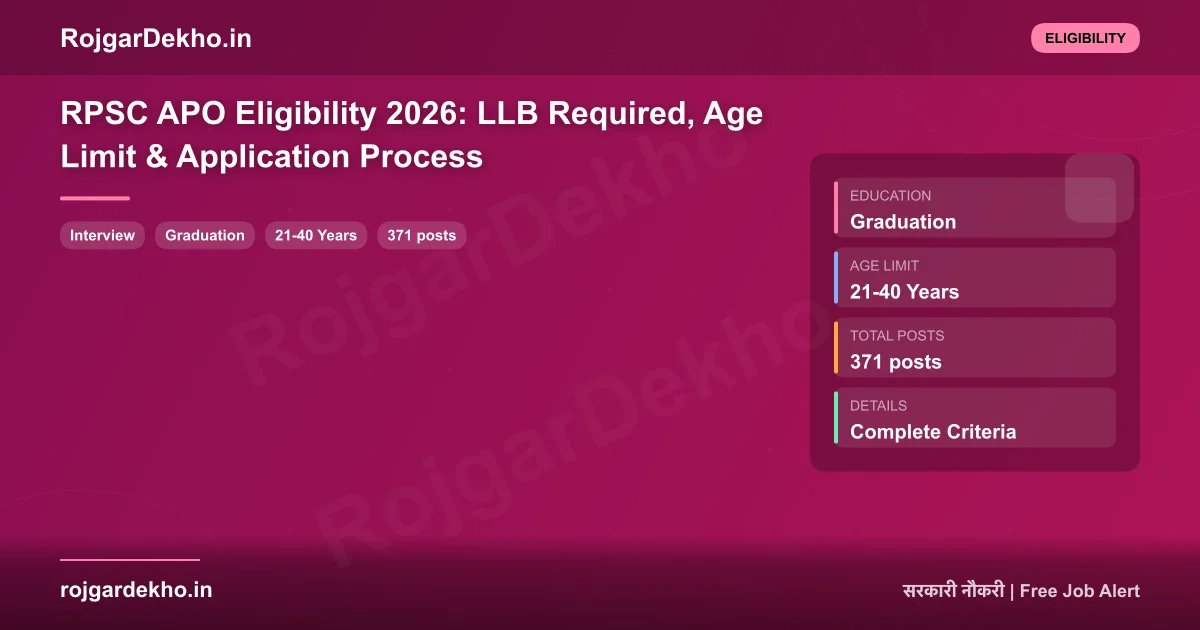
RPSC APO Eligibility 2026: LLB Required, Age Limit & Application Process
- Education: LLB from recognized university — mandatory, no exceptions
- Age: 21–40 years (Gen) | OBC/SC/ST: +5 years | Female: ₹400 fee (₹200 concession)
- 371 posts | Last date 7 July 2026 | Fee ₹600 General, ₹400 OBC/SC/ST/Female
By RojgarDekho Team | Updated: June 2026
RPSC APO 2026 has a narrow, clear eligibility criterion: you must hold an LLB degree. Unlike most RPSC exams that accept any graduation, APO is a legal specialist post. This article covers every condition — education, age, category rules, fee, and the step-by-step application process — so you can confirm eligibility and apply without confusion.
RPSC APO 2026 Apply by: 7 July 2026. SSO Rajasthan. Official notification →
Educational Qualification
| Qualification | Details |
|---|---|
| Minimum Degree | LLB (Bachelor of Laws) from a recognized university |
| Which LLB counts | Both 3-year LLB (after graduation) and 5-year integrated BA LLB / BBA LLB / B.Com LLB are eligible |
| Enrollment in Bar Council | Not mandatory at application stage — required before actual joining and court appearance. Enrollment with Bar Council of Rajasthan recommended. |
| Percentage | No minimum percentage specified for LLB — any passing grade is sufficient |
| Distance LLB | LLB through distance education is generally NOT recognized for judicial and prosecution services. The LLB must be from a regular/full-time program recognized by BCI (Bar Council of India). |
The Bar Council of India (BCI) maintains the list of recognized law colleges and universities. Degrees from colleges that lost BCI recognition may not qualify. If your law college had any affiliation or recognition issues, verify from BCI's website before applying.
Distance/correspondence LLB programs (even from recognized universities) are typically NOT valid for government prosecution or judicial service posts in India, including RPSC APO. The Bar Council of India has contested distance LLB validity in court. If your LLB is through distance education, verify your eligibility from the RPSC official notification before applying.
Age Limit
| Category | Minimum Age | Maximum Age | Effective Max Age |
|---|---|---|---|
| General (Unreserved) — Male | 21 years | 40 years | 40 years |
| General (Unreserved) — Female | 21 years | 40 years | 40 years |
| OBC (Rajasthan domicile) | 21 years | 40 years | 45 years (+5) |
| SC (Rajasthan domicile) | 21 years | 40 years | 45 years (+5) |
| ST (Rajasthan domicile) | 21 years | 40 years | 45 years (+5) |
Note: The DB data for this job shows OBC/SC/ST relaxation of 5 years each. EWS relaxation is not separately listed — verify from the official notification whether EWS gets separate age relaxation. Age is calculated as on the date mentioned in the official RPSC notification (usually the notification date or a specified cutoff date — verify this).
Application Fee
| Category | Application Fee | Payment Mode |
|---|---|---|
| General Male | ₹600 | E-Mitra (cash) OR Online — Debit/Credit Card, Net Banking, UPI |
| General Female | ₹400 | Same options |
| OBC / EWS (Rajasthan) | ₹400 | Same |
| SC (Rajasthan) | ₹400 | Same |
| ST (Rajasthan) | ₹400 | Same |
| PH / Divyang | Check notification — likely ₹400 | Same |
Female candidates of General category pay ₹400 (same as OBC/SC/ST), saving ₹200 compared to General male. This is specified in the job data from DB (female: ₹400 vs general: ₹600).
Nationality and Domicile
Indian nationality is required. The posts are state government posts in Rajasthan, so Rajasthan domicile (Mool Niwas certificate) is required for category benefits (reservation, age relaxation, fee concession). Candidates from outside Rajasthan can apply but will be treated as General category and must meet the General category age limit (40 years).
Application Process — Step by Step
| Step | Action | Platform |
|---|---|---|
| Step 1 | Create SSO ID (if not already) at sso.rajasthan.gov.in | SSO Rajasthan Portal |
| Step 2 | Login to SSO → Citizen Services → RPSC | sso.rajasthan.gov.in |
| Step 3 | Find RPSC APO 2026 notification and click Apply Online | RPSC Application Portal |
| Step 4 | Fill form: personal details, education (LLB details — university, year, percentage), category | Online form |
| Step 5 | Upload photo (JPG, 20–100 KB, white background) and signature (JPG, 10–50 KB) | Within form |
| Step 6 | Pay fee: Online (Net Banking/UPI/Debit Card) or E-Mitra kiosk (cash) | SSO portal or E-Mitra |
| Step 7 | Submit and save the confirmation receipt with application number | — |
The last date for both application AND fee payment is 7 July 2026. SSO portals become congested near the last date — apply at least 5–7 days early (by July 1–2, 2026). If paying via E-Mitra, get the printed receipt with transaction ID — fee payment failures near deadlines are common and hard to resolve without a receipt.
Document Checklist for Interview Stage
| Document | Who Needs It / Notes |
|---|---|
| LLB Degree Certificate + All Year Marksheets | All candidates — original + 3 photocopies. All year marksheets required (year 1, 2, 3 of LLB) |
| Graduation Degree (for 3-year LLB holders) | Proof of graduation — original degree or provisional certificate |
| 10th Certificate (for Date of Birth) | Primary proof of date of birth |
| Category Certificate (OBC/SC/ST/EWS) | Must be Rajasthan domicile certificate, current (OBC NCL validity: 1 year, renew if expired) |
| Rajasthan Mool Niwas (Domicile Certificate) | For age relaxation, fee concession, and reservation |
| Bar Council Enrollment Certificate | Enrollment with Bar Council of Rajasthan — needed before court appearance; have it ready at joining |
| Aadhar + PAN Card | Identity documents |
Special Area (SA) Posts — What It Means
Of the 371 total posts, 15 are designated as Special Area (SA) posts — these are in tribal-dominated districts of Rajasthan (typically Dungarpur, Banswara, Pratapgarh, parts of Udaipur — the former Tribal Sub-Plan area). SA posts have separate merit lists and may require proof of residence in that area. If you're from a tribal district, applying for SA posts gives you a better chance since you compete in a smaller pool. Check the official notification for which districts fall under SA designation for this recruitment.
Attempts — No Formal Limit
RPSC APO does not specify a formal attempt limit. You can appear as many times as you are within the age limit. Unlike UPSC Civil Services (6-attempt General category limit), RPSC exams generally allow unlimited attempts within the age limit. This means law graduates who don't succeed in the first attempt can prepare more comprehensively and try again in the next cycle.
Frequently Asked Questions
Q: Can an LLM (Master of Laws) holder apply even if they haven't enrolled in the Bar Council?
Yes — LLM holders who hold an underlying LLB degree are eligible. Bar Council enrollment is not required at the application stage. You need enrollment before you actually start appearing in court as an APO, but for the examination and selection process, your LLB degree is sufficient.
Q: Can candidates from other states apply for RPSC APO?
Yes — Indian citizens from any state can apply. However, candidates without Rajasthan domicile will be treated as General category (no OBC/SC/ST reservation benefit and no age relaxation beyond 40 years) even if they hold a valid OBC/SC/ST certificate from another state. Rajasthan state services reservation applies only to Rajasthan domicile holders.
Q: Is there a physical fitness test for RPSC APO?
No — RPSC APO is a purely academic and legal expertise based selection. There is no physical fitness test, no physical measurement requirement, and no medical fitness criterion beyond the standard fit-for-government-service medical examination at the time of joining.
Q: What if my LLB result is awaited at the time of application?
Typically, candidates who have appeared in their final LLB examination can apply, provided they complete the degree before document verification at the appointment stage. The degree must be fully completed by the time you join. If your result is expected before the APO's document verification (which happens after Mains/Interview — typically 6–12 months after application), you can safely apply now and produce the degree certificate later.
Understanding Bar Council of India Recognition — Critical for APO
Your LLB is only as valid as your law school's BCI (Bar Council of India) recognition at the time you were enrolled. This is a genuine concern for candidates who attended law colleges that were recognized later, had conditional recognition, or had their recognition lapsed and renewed. Here is how to verify:
Go to the BCI website (barcouncilofindia.org) and look up the list of recognized law colleges in Rajasthan and your state. Check if your college was in the recognized list during the years you were enrolled. If your college lost recognition while you were studying and you were enrolled before the lapse, your degree is typically still valid — but verify from BCI directly if there's any doubt. The safest evidence is a BCI recognition certificate or a verification letter from your university confirming that your LLB is from a BCI-recognized program.
For 5-year integrated law programs (BA LLB, BBA LLB, B.Com LLB), the recognition must be for the integrated program — separate BA and LLB recognitions aren't the same as recognition for the integrated course. Most NLSIU, NLU, and GNLU graduates have clearly recognized programs. Private university integrated programs: verify from BCI individually.
Domicile Certificate — How to Get One and How Long It Takes
The Rajasthan Mool Niwas (Domicile) certificate is issued by the Tehsildar of your native district. For candidates who have been away from Rajasthan for studies or work, here is what you need to know about getting the certificate in time for document verification:
The application is made to the Tehsildar's office. Required documents: Aadhar card, 10th certificate (showing Rajasthan address), property/birth records establishing Rajasthan origin, and sometimes an affidavit. Processing time varies: in some tehsils it's issued within 7–15 days; in others it can take 30–45 days. Apply well in advance — don't wait until after the exam results. If you already have a domicile certificate, check its format — some RPSC exams require the certificate to be issued by a specific level of authority or within the last one year.
Candidates who are children of Rajasthan government employees posted outside Rajasthan (e.g., IAS/IPS officers on central deputation) can claim Rajasthan domicile based on their parent's service — verify this specific provision from the RPSC notification.
Rajasthan APO 2026 — Detailed Breakdown of the 371 Posts
Understanding the full post breakdown helps you plan your application category strategically. Based on the shortDescription from RPSC's official record: 371 total posts — 355 Non-Special Area (Non-SA) and 15 Special Area (SA). Here is what this means in practice:
Non-SA posts (355): These are for regular Rajasthan districts — all 33 districts except the tribal sub-plan area districts. The competition pool for Non-SA posts is the full General Rajasthan candidate pool. Category-wise reservation within Non-SA follows the standard Rajasthan reservation matrix (approximately UR 50%, OBC 21%, SC 16%, ST 12%, with 10% EWS carved from UR — exact numbers in official notification).
SA posts (15): These are specifically for Dungarpur, Banswara, Pratapgarh, and parts of Udaipur — the Scheduled Areas (tribal belt) of Rajasthan. For SA posts, residential proof in the SA districts may be required. The competition pool is much smaller — only candidates from these districts or with proof of domicile in SA areas. If you're from a SA district, these posts offer significantly better odds of selection.
Preparation While Practicing as an Advocate
Many RPSC APO candidates are already enrolled in the Bar Council of Rajasthan and practicing as advocates. Practicing advocates have a significant advantage in the APO exam — daily court work builds familiarity with CrPC procedure and IPC sections in a way that purely academic preparation doesn't. However, two challenges arise:
First, court work tends to narrow your focus to the types of cases you handle — if you only do civil matters, you may not have refreshed your criminal law knowledge recently. Second, the GK component (Rajasthan History, Geography, current affairs) that appears in the exam is something practicing advocates typically haven't touched since law school. Allocate dedicated preparation time (2–3 hours/day minimum) for law revision and GK even if you're practicing — the exam has enough law GK questions that practitioners can't rely on court experience alone.
Alternative Routes if RPSC APO is Not Cleared
Law graduates who attempt RPSC APO and don't succeed in a particular cycle should consider parallel targets that use the same preparation base:
MPPSC ADPO (Madhya Pradesh) is directly similar in syllabus and usually has more vacancies. UPPSC APO (Uttar Pradesh) has a different exam structure but the same core law subjects. Gujarat PSC APO is another parallel target for candidates willing to relocate within India. District and Sessions Court advocate practices — while waiting for the next RPSC cycle — build both practical skills and financial independence during the preparation period. Several APO toppers spent 2–3 years in active court practice between RPSC APO attempts, crediting their courtroom experience for their eventual success.