RPSC APO Salary 2026: Pay Scale, In-Hand & Assistant Prosecution Officer Job Profile
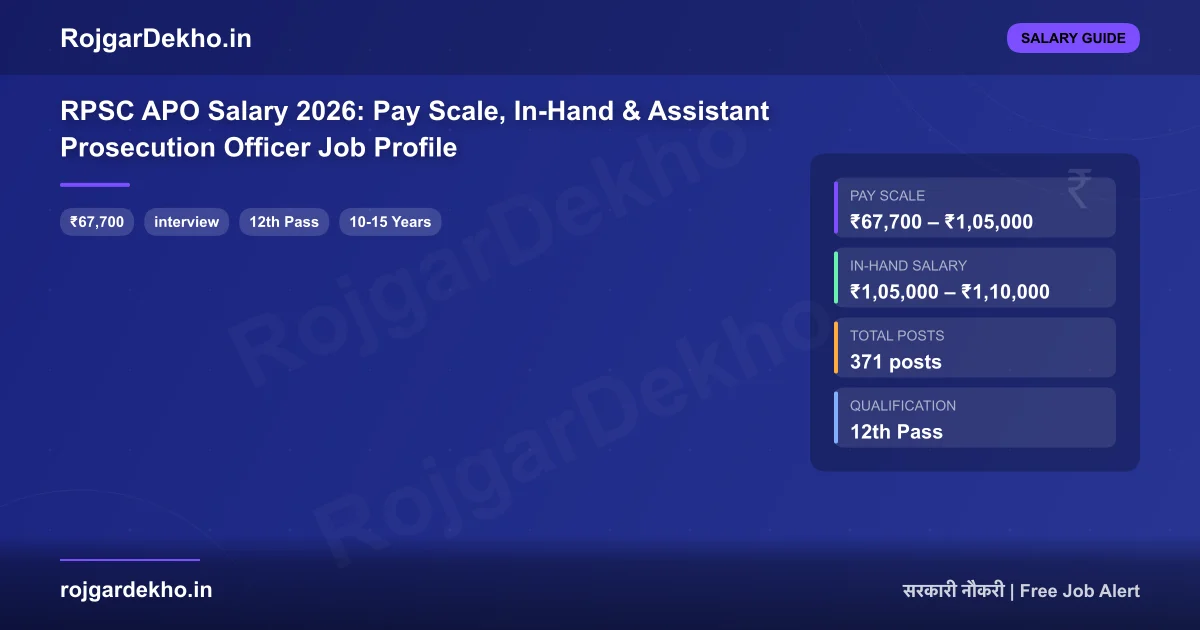
- 371 posts — 355 Non-Special Area + 15 Special Area (Tribal districts)
- Pay Level 11 as per Rajasthan 7th Pay Commission — basic ₹67,700/month
- In-hand salary: ₹95,000–₹1,10,000/month after allowances, before deductions
By RojgarDekho Team | Updated: June 2026
RPSC APO 2026 fills one of the most legally specialized state government posts in Rajasthan — the Assistant Prosecution Officer. This is not a general administrative role. You will represent the State of Rajasthan as a public prosecutor in criminal courts. Understanding the salary is one part; understanding the role is equally important before you commit months of preparation to this exam. This article covers both.
RPSC APO 2026 last date: 7 July 2026. LLB required. 371 posts. Apply via SSO Rajasthan. Check official notification →
Pay Scale — RPSC APO 2026
The Assistant Prosecution Officer in Rajasthan is a Class II Gazetted post under the Public Prosecution Department. The pay is fixed as per the Rajasthan 7th Pay Commission, which aligns broadly with the Central Government's 7th CPC matrix. The APO post falls in Pay Level 11 — the same level as many Central Government gazetted officers with equivalent seniority.
| Component | Details |
|---|---|
| Pay Level | Level 11 (Rajasthan Pay Matrix — 7th Pay Commission) |
| Basic Pay (Entry) | ₹67,700/month |
| Maximum Basic Pay (in scale) | ₹2,08,700/month (over a full career) |
| Annual Increment | 3% of basic pay, added on 1 July each year |
| Post Type | Class II Gazetted Officer — Public Prosecution Department |
| Confirming Authority | Government of Rajasthan, Home Department |
Monthly Salary Calculation — Full Breakdown
The basic pay of ₹67,700 is just the foundation. Government officers receive several additional allowances that significantly increase the gross salary. Here is a detailed monthly calculation for an RPSC APO posted at a district headquarters (Y city, mid-tier Rajasthan city):
| Allowance / Component | Rate | Monthly Amount (Approx) |
|---|---|---|
| Basic Pay | Fixed | ₹67,700 |
| Dearness Allowance (DA) | ~55% of basic (2026 estimate, state revised) | ₹37,235 |
| House Rent Allowance (HRA) | 16% of basic (Y city / district HQ) | ₹10,832 |
| Transport Allowance (TA) | Level 11 → ₹4,500 base + DA component | ~₹7,000 |
| Medical Allowance | Fixed ₹1,000/month | ₹1,000 |
| Other State Allowances | Varies by posting | ₹1,500–₹2,000 |
| Gross Pay (approx) | — | ₹1,25,267–₹1,25,767 |
Dearness Allowance is revised twice a year by the Rajasthan government, aligned with Central Government revisions. The 55% figure is an estimate based on the DA revision pattern expected in mid-2026. Verify actual DA rate from Finance Department of Rajasthan circulars when joining.
In-Hand Salary After Deductions
From the gross salary, two primary deductions reduce your take-home: National Pension System (NPS) contribution and income tax. Here is the net calculation:
| Deduction | Rate / Amount |
|---|---|
| NPS Contribution (employee) | 10% of (Basic + DA) = 10% of ₹1,04,935 = ₹10,494/month |
| Income Tax (approx) | ₹6,000–₹8,000/month depending on deductions claimed |
| Professional Tax | ₹200/month (Rajasthan state) |
| Total Deductions (approx) | ₹16,694–₹18,694/month |
| In-Hand Salary (approx) | ₹1,06,573–₹1,09,073/month → rounded: ₹1,05,000–₹1,10,000 |
NPS works as follows: you contribute 10% of (Basic + DA) monthly, and the government contributes 14% of (Basic + DA). Your total annual NPS contribution is therefore 24% of (Basic + DA). For an APO at entry level, this amounts to approximately ₹25,000/month going into your NPS account — building a substantial retirement corpus over a 30-year career.
APO officers are entitled to government residential accommodation at their posting location. In most Rajasthan district headquarters, Type II or III quarters are available. If quarters are provided, HRA is NOT paid — but you save significantly on rent. In smaller district towns, this housing benefit effectively adds ₹8,000–₹15,000 equivalent value per month to your compensation.
Benefits Beyond Monthly Salary
The financial value of an RPSC APO position extends well beyond the monthly in-hand figure. State government officers in Rajasthan receive a comprehensive package that includes the following significant benefits, none of which appear in the salary slip:
| Benefit | Details |
|---|---|
| Government Accommodation | Type II/III quarters in district headquarters — saves ₹8,000–₹20,000/month in rent depending on location |
| RGHS Medical Coverage | Rajasthan Government Health Scheme — cashless treatment at empanelled hospitals for self, spouse, and dependent children. No insurance premium deduction. |
| Leave Encashment | Earned leaves can be encashed — up to 300 days equivalent over career. At retirement, this is a significant lump sum. |
| Children Education Allowance | ₹2,250/month per child (max 2 children) for school-age children — ₹4,500/month if you have 2 school-going children. |
| LTC (Leave Travel Concession) | Travel allowance for self and family — one all-India LTC in 4 years and home-town LTC in intervening years. |
| Official Vehicle / Driver | At SDM/APO level in some districts, official transport for court appearances. Depends on posting location and district budget. |
Salary Growth — RPSC APO Career Trajectory
The basic pay grows through annual increments (3% per year on 1 July) and periodic pay commission revisions. Additionally, promotion to Senior Prosecution Officer or Deputy Director of Prosecution carries a higher pay level. Here is the realistic salary trajectory for an APO who joins at age 25 and stays in the prosecution service:
| Year | Age | Designation | Basic Pay (approx) | In-Hand (approx) |
|---|---|---|---|---|
| Year 1 | 25 | APO (Probationer) | ₹67,700 | ₹1,05,000 |
| Year 5 | 30 | APO (Confirmed, Senior) | ₹78,500+ | ₹1,18,000+ |
| Year 10 | 35 | APO / Senior Prosecution Officer | ₹91,000+ | ₹1,32,000+ |
| Year 20 | 45 | Senior Prosecution Officer / DPO | ₹1,20,000+ | ₹1,70,000+ |
| Year 30 | 55 | Deputy Director / Director, Prosecution | ₹1,50,000+ | ₹2,00,000+ |
RPSC APO vs Other Law-Based Government Jobs
If you hold an LLB, you have multiple government job options beyond RPSC APO. Here is an honest comparison to help you decide where to focus:
| Post | Pay Level | Entry In-Hand (approx) | Nature of Work | Exam Body |
|---|---|---|---|---|
| RPSC APO (Rajasthan) | Level 11 | ₹1,05,000–₹1,10,000 | Criminal prosecution in Rajasthan courts | RPSC |
| MPPSC ADPO (Madhya Pradesh) | Level 10 | ₹95,000–₹1,00,000 | Criminal prosecution in MP courts | MPPSC |
| Public Prosecutor / Additional PP | Level 12–13 | ₹1,10,000–₹1,30,000 | Higher courts prosecution; appointment by government, often after years as APO | Govt appointment |
| Civil Judge (Rajasthan) | Level 12+ | ₹1,10,000+ | Civil and criminal judicial work | RPSC (RJS exam) |
| Legal Advisor (PSU) | Similar or higher | ₹1,00,000–₹1,50,000 | Contract and regulatory legal work for PSU | PSU direct recruitment |
The APO role is prosecution-specific — you will work exclusively in the criminal justice system. If your career interest is criminal law, this is an excellent entry point into government legal service. If you prefer civil law, contract work, or judicial work, the Civil Judge examination (Rajasthan Judicial Service) or PSU Legal Advisor routes may be more aligned.
The Reality of Criminal Prosecution Work
As an APO in Rajasthan, your day-to-day work involves appearing in Sessions Court and subordinate criminal courts to present the prosecution's case in trials. This means drafting charges, examining witnesses, cross-examining defense witnesses, arguing on bail applications, arguing sentencing after conviction, and filing appeals in appropriate cases. The court calendar is demanding — criminal courts handle high volumes of cases, and an APO may appear in 20–30 cases on busy hearing days.
The work is intellectually stimulating for those interested in criminal law. You will handle cases ranging from minor theft to serious offences under IPC including murder, sexual assault, and financial fraud. The quality of your preparation of each case — organizing evidence, briefing investigating officers, identifying gaps in the prosecution case — directly impacts whether justice is delivered. This is meaningful, weighty work.
The challenge is the workload. Rajasthan's courts are significantly overburdened — the state has a high case pendency ratio. APOs often handle very large caseloads with limited support staff. Work-life balance is difficult in busy district courts. Senior APOs who survive the initial years typically find it manageable because experience makes case preparation faster and court appearances more efficient.
Frequently Asked Questions
Q: What is the exact in-hand salary for RPSC APO at a district headquarters posting?
At a district headquarters (Y city category), an APO at entry level (basic ₹67,700, DA ~55%, HRA 16%) takes home approximately ₹1,05,000–₹1,10,000/month after NPS contribution and income tax. This is net of all standard deductions. If government accommodation is provided, HRA is not paid but the housing benefit is significant.
Q: Does RPSC APO get a pension?
APOs recruited after January 2004 are under the National Pension System (NPS), not the old defined-benefit pension. Your 10% contribution plus 14% government contribution goes into an NPS account earning market-linked returns. Over 30 years of service, the corpus is substantial. At retirement, 40% of the corpus is used to buy an annuity (monthly pension) and 60% is received tax-free as a lump sum.
Q: How does RPSC APO salary compare to a private lawyer?
A fresh law graduate in private practice typically earns ₹15,000–₹40,000/month in the first 3–5 years in Rajasthan, with income highly variable. An RPSC APO starts at ₹1,05,000+ in-hand from day one, with full job security, government accommodation, and medical coverage for family. The financial certainty advantage of the government APO role over private practice is overwhelming in the early career years. After 10–15 years, successful private lawyers (especially those with corporate or high court practices) can earn significantly more — but most lawyers don't reach that level.
Q: Are there any perks specific to the prosecution department?
APO officers sometimes receive bar library facilities at court — access to legal references and case law. Official robes (court dress) are typically provided by the department. In some districts, the District Prosecution Office has official transport for court appearances. APOs also receive bar association membership fees reimbursed in some districts.
Q: What are the chances of promotion to Senior Prosecution Officer?
Promotion from APO to Senior Prosecution Officer or equivalent typically happens after 8–12 years of service, subject to DPC (Departmental Promotion Committee) decisions based on Annual Confidential Reports (ACR) and seniority. The promotion brings you to a higher pay level (Level 12 or 13), significantly increasing both basic pay and in-hand salary.
How the APO Job Compares to Judicial Service (Civil Judge)
Many law graduates preparing for RPSC APO simultaneously consider the Rajasthan Judicial Service (RJS) examination for Civil Judge. The two roles are fundamentally different, and the comparison is worth understanding before you decide where to invest your preparation time.
As an APO, you represent the state government in criminal cases as a prosecutor. You are an advocate for the prosecution — your job is to present evidence, examine witnesses, and argue that the accused is guilty beyond reasonable doubt. The APO is a government employee, serving under the Public Prosecution Department, with a fixed salary and service rules. You are not independent in the way a private lawyer or a judge is — you follow the state's prosecution policy.
As a Civil Judge (from RJS), you are a member of the judiciary — independent, impartial, and responsible for deciding cases. You hear both civil and criminal matters at the entry level. The Civil Judge earns slightly more at entry (typically Level 12 or 13 in Rajasthan), has a different working culture (judicial independence vs. government employee hierarchy), and follows a separate career path through the Rajasthan High Court's supervision rather than through the state government's service rules.
The choice depends on your interest. If you're drawn to adversarial work — arguing cases, examining witnesses, building prosecution strategy — the APO role suits you. If you're drawn to adjudicating and deciding cases impartially, the Civil Judge route is the right call. The exam preparation overlaps significantly (IPC, CrPC, Evidence Act), but the interview and career philosophy are different.
APO Probation and Training — What to Expect in Year 1
After selection, APOs serve a probation period of typically 2 years. During probation, you attend a foundational training program run by the Public Prosecution Department and possibly the Rajasthan Police Academy at Jaipur. The training covers Rajasthan-specific court practice, revenue law basics (as APOs sometimes handle land-related criminal matters), procedure for drafting charges, examination of witnesses, and the administrative systems of the state prosecution department.
During probation, your full salary is paid — there is no reduced probation salary. You are posted to a district prosecution office and work under a senior Prosecution Officer (PP or APP) who mentors you through your first cases. First-year APOs typically assist in preparing case files and observe trials before handling their own arguments. By the end of year 1, most APOs are appearing independently in Magistrate courts.
Rajasthan-Specific Working Conditions — District Courts
The working environment in Rajasthan's district courts is demanding but distinctive. Courts sit from approximately 10:30 AM to 5:00 PM, with a lunch break. Criminal courts at the district level often have full benches from day one — you're not eased in. On a busy day, you might be appearing in 15–25 cases in the same court, managing your diary, talking to investigating officers (police) between arguments, and preparing for the afternoon session in the lunch break.
One unique aspect of prosecution work in Rajasthan is the state's heavy SC/ST (Prevention of Atrocities) caseload. Rajasthan reports significant SC/ST atrocities cases annually. APOs in districts with large SC/ST populations (like Barmer, Bikaner, and Chittorgarh) handle substantial SC/ST Act case volumes. Mastery of this legislation is practically non-negotiable for a Rajasthan APO.
Earnings vs. Effort — Is RPSC APO Worth Preparing For?
The RPSC APO exam is genuinely hard. The law paper tests deep understanding of IPC, CrPC, and Evidence Act — not surface awareness. The competition includes law graduates who have been specifically coaching for prosecution officer roles for 1–2 years. Clearing the exam requires at minimum 4–6 months of serious, focused preparation — assuming you have a solid law school foundation to build on.
Is it worth it? The salary at ₹1,05,000+ in-hand, the job security, the government accommodation, the medical coverage, and the social standing as a gazetted government law officer in Rajasthan make this one of the better government career opportunities for law graduates from the state. Compared to 5 years of uncertain private practice income, the stability and quality of life the APO role offers are significant. If criminal law genuinely interests you, this is also intellectually fulfilling work — not just a salary-safe job.