UGC NET JRF Fellowship 2026: ₹37,000 Stipend, SRF Upgrade & Complete Benefits
Clearing UGC NET is a well-known milestone for anyone targeting a teaching career. But JRF — Junior Research Fellowship — is a different story. JRF doesn't just give you an eligibility certificate. It gives you a monthly research stipend, a contingency grant for books and travel, and a clear path into PhD research without spending your own money. Here's exactly what you get, how it works, and what the difference is between JRF and NET-only qualification.
📋 NTA UGC NET June 2026 — Apply Online — Application open 29 Apr–20 May 2026 at ugcnet.nta.nic.in
JRF Fellowship 2026 — Quick Snapshot
| Detail | Value |
|---|---|
| Awarding Body | University Grants Commission (UGC) via NTA |
| JRF Monthly Stipend (Year 1–2) | ₹37,000/month |
| SRF Monthly Stipend (Year 3–5) | ₹42,000/month |
| Total Duration | 5 years (2 years JRF + 3 years SRF) |
| JRF Offer Validity | 3 years from result — must join within this period |
| Exam to Qualify | UGC NET (same paper — automatic based on rank) |
| Age Limit for JRF | 30 years (General) | 35 years (OBC/SC/ST/PwD/Female) |
JRF vs SRF — How the Fellowship Progresses
JRF is not a permanent fellowship. It runs for 2 years, after which UGC evaluates your research progress. If your work is satisfactory, you get upgraded to Senior Research Fellow (SRF) with a higher monthly stipend for the remaining 3 years.
| Stage | Period | Monthly Stipend | Condition |
|---|---|---|---|
| JRF | Year 1 & 2 | ₹37,000 | Enrolled in PhD at UGC-recognised institution |
| SRF (Upgrade) | Year 3, 4 & 5 | ₹42,000 | Satisfactory assessment of 2-year JRF work |
| Total lifetime fellowship earnings (approx.) | ₹21.6 lakh total over 5 years | Before HRA and contingency grant | |
The SRF upgrade is not automatic — your research supervisor and institution have to submit a satisfactory progress report to UGC after 2 years. In practice, the large majority of JRF fellows successfully upgrade to SRF.
Contingency Grant — What It Is and How Much You Get
Besides the monthly stipend, JRF fellows receive a contingency grant — money for research-related expenses like books, software, stationery, conference travel, and lab materials. The amount depends on your subject area.
| Discipline | JRF Period (Year 1–2) | SRF Period (Year 3–5) |
|---|---|---|
| Humanities, Social Sciences, Commerce, Education, Fine Arts, Law, Languages | ₹10,000/year | ₹20,500/year |
| Sciences (Computer Science, Electronic Science, Environmental Sciences, Forensic Science) | ₹12,000/year | ₹25,000/year |
House Rent Allowance (HRA)
If you don't get hostel accommodation at your institution, you get HRA on top of your stipend. HRA is calculated as a percentage of your monthly stipend based on city category:
| City Category | Examples | HRA % | Monthly HRA on JRF Stipend |
|---|---|---|---|
| X (Metro) | Delhi, Mumbai, Chennai, Kolkata, Bengaluru, Hyderabad | 30% | ₹11,100 |
| Y (State capitals, large cities) | Lucknow, Jaipur, Pune, Patna, Bhopal, Chandigarh | 20% | ₹7,400 |
| Z (Other cities/towns) | Smaller university towns | 10% | ₹3,700 |
Other Benefits for JRF Fellows
| Benefit | Details |
|---|---|
| Leave | Casual leave + maternity/paternity leave as per institutional norms |
| Medical | Medical benefits as per the host institution's policy |
| Conference Travel | Support for attending national/international academic conferences |
| Reader/Escort (PwD) | ₹2,000/month additional for PwD fellows requiring assistance |
| PhD Admission | JRF score used for direct PhD admission in central universities — no separate entrance test required at most institutions |
JRF vs NET Only — What You Actually Get
| What You Get | JRF Qualifier | NET Only (Asst Prof) |
|---|---|---|
| Monthly fellowship | ✅ ₹37,000 (JRF) → ₹42,000 (SRF) | ❌ No fellowship |
| Assistant Professor eligibility | ✅ Yes | ✅ Yes |
| PhD admission advantage | ✅ Direct admission at most central universities | ✅ Eligible but may need entrance |
| Age limit | Max 30 years (General) | No upper age limit |
| How determined | Top scorers within age limit in each category | All qualifiers who meet minimum marks |
Both outcomes come from the same single application and same exam. You don't choose — NTA automatically assigns JRF or NET-only based on your rank within your category. Top scorers (within age limit) get JRF; rest get NET eligibility.
JRF Validity — The 3-Year Window Explained
When NTA releases results, JRF awardees get an award letter. This letter is valid for 3 years from the date of issue. You must join a UGC-recognised institution for PhD research within this 3-year window. If you don't join within 3 years, your JRF offer lapses — you cannot claim the fellowship after the validity expires.
This means if you got JRF in the June 2026 cycle and results come in September 2026, you have until September 2029 to join. If you want to wait for the right institution or supervisor, you have that flexibility — but the clock is running.
Can You Use JRF for Just Assistant Professor, Not PhD?
Yes. JRF automatically gives you NET eligibility too. You can apply for Assistant Professor posts at any university or college without ever enrolling for PhD. The fellowship is optional — taking the fellowship is your choice. Many JRF holders use the certificate for government college recruitment without pursuing the fellowship at all.
How JRF Is Different from CSIR NET Fellowship
Two different councils award fellowships for research in India — UGC and CSIR. This matters because many students confuse the two or wonder which is better.
| Point | UGC NET JRF | CSIR NET JRF |
|---|---|---|
| Awarding body | University Grants Commission (UGC) | Council of Scientific & Industrial Research (CSIR) |
| Subjects | Humanities, Social Sciences, Commerce, Education, Languages, Law, Computer Science, etc. (85 subjects) | Pure sciences only — Life Sciences, Chemical Sciences, Earth Sciences, Mathematical Sciences, Physical Sciences |
| Monthly Stipend (JRF) | ₹37,000 | ₹37,000 (same amount) |
| Monthly Stipend (SRF) | ₹42,000 | ₹42,000 (same amount) |
| Exam conducting body | NTA (National Testing Agency) | NTA (same) |
| Who should apply | Anyone with PG in non-science subjects | Only science PG candidates |
If your Master's is in a science subject, you should appear for CSIR NET, not UGC NET. The fellowship amounts are identical — the difference is only in which subjects are covered and which exam to take.
Real Monthly Income After JRF — What You Actually Take Home
The ₹37,000 stipend is just the base. With HRA (if you're in a city with no hostel), your actual monthly income can be significantly higher. Here's what a JRF fellow in a metro city takes home vs a smaller university town:
| Component | Metro City (X) | State Capital (Y) | Small Town (Z) |
|---|---|---|---|
| Base Stipend | ₹37,000 | ₹37,000 | ₹37,000 |
| HRA (if no hostel) | +₹11,100 (30%) | +₹7,400 (20%) | +₹3,700 (10%) |
| Effective Monthly (no hostel) | ₹48,100 | ₹44,400 | ₹40,700 |
| If hostel provided | ₹37,000 (no HRA) | ₹37,000 | ₹37,000 |
After JRF — What Are Your Career Options?
JRF is not just about the fellowship money. What you build during those 5 years determines your entire academic career path.
| Path | What You Do | Where It Leads |
|---|---|---|
| PhD + Academic Career | Complete PhD during JRF/SRF period | Assistant Professor at any central/state university, research positions, post-doctoral fellowships |
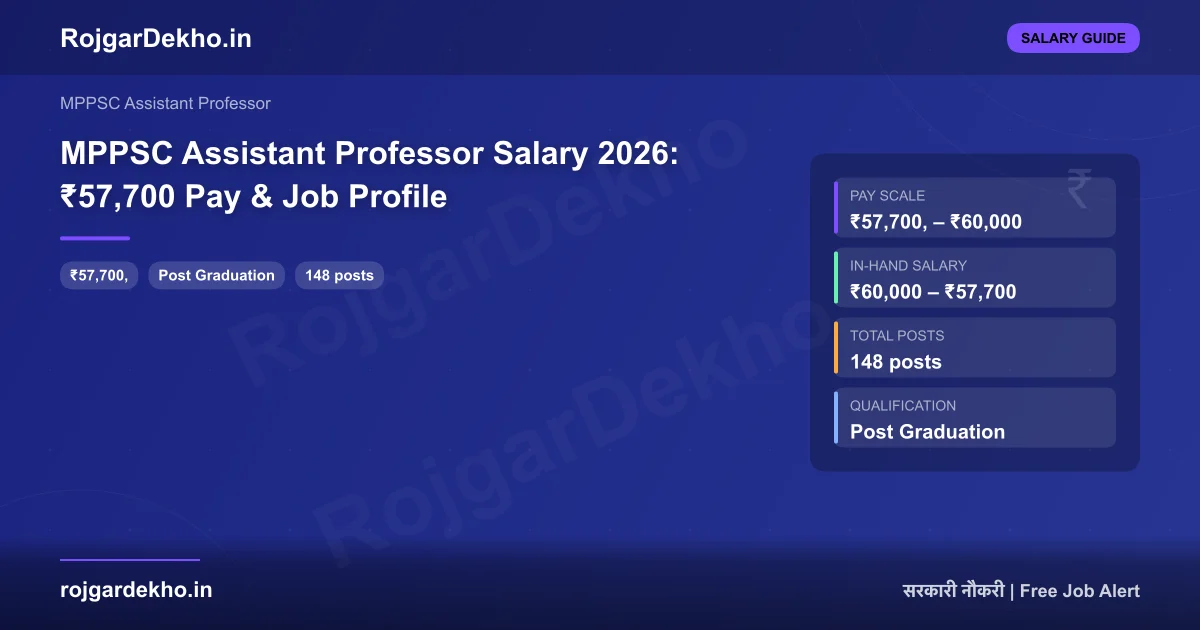
| Assistant Professor (without PhD) | Use NET/JRF certificate for state/central university recruitment | Teaching post at college — salary ₹57,700+ basic (UGC Level 10). PhD can be done part-time. |
| Post-Doctoral Fellowship | Apply for UGC-BSR, DST, ICSSR post-docs after PhD | ₹50,000–₹65,000/month fellowships, leads to Associate Professor track |
| Industry/Research Org | JRF in research institutions (ICMR, ICSSR, ICAR, ISRO, DRDO) | Scientist/Research Officer positions, separate competitive selection processes |
Common Myths About UGC NET JRF
| Myth | Reality |
|---|---|
| "JRF means I have a job" | JRF is a fellowship for research, not an employment contract. You are a fellow, not an employee. No PF, gratuity, or pension. |
| "I must do PhD to get JRF money" | Correct — you must enrol in PhD at a UGC-recognised institution to receive the fellowship. The money doesn't come to you outside PhD enrolment. |
| "NET certificate is permanent" | NET certificate for Assistant Professor eligibility has no expiry — it's a lifetime certificate. JRF award letter expires in 3 years (must join within 3 years). |
| "Only toppers get JRF" | JRF goes to top-ranked candidates within each category who are within the age limit. A consistent performance across Paper 1 and Paper 2, not just Paper 2 excellence, is what separates JRF from NET-only. |
Frequently Asked Questions
Q: Is the ₹37,000 JRF stipend taxable?
UGC/CSIR research fellowships awarded for scientific or academic research are exempt from income tax under Section 10(16) of the Income Tax Act (scholarships/fellowships for education). Most institutions treat JRF stipend as tax-free, but this can vary — confirm with your institution's accounts office when you join.
Q: What happens if my SRF assessment is not satisfactory?
If UGC's assessment of your 2-year JRF work is not satisfactory, your fellowship is terminated. You don't automatically get downgraded — the fellowship ends. This is rare, but it has happened. Your NET eligibility and Assistant Professor certificate remain valid regardless.
Q: I'm over 30 but under 35 — can I still get JRF?
Only if you belong to OBC-NCL, SC, ST, PwD, or Female category — all of these get a 5-year relaxation bringing the effective age limit to 35 years. If you're a General/Unreserved male candidate above 30, you can still qualify the exam but will only get NET eligibility, not JRF.
Q: Can I apply for JRF in one subject but use the NET certificate for Assistant Professor in another?
No. Your JRF and NET certificate are both subject-specific — they are valid only for the subject you appeared for in Paper 2. If you appeared for Economics, your certificate is for Economics only. You cannot use an Economics NET certificate to apply for a History teaching post.
Q: How many JRF slots are available per cycle?
UGC does not pre-announce a fixed number of JRF slots. The number varies by cycle based on category-wise cutoffs and the number of candidates meeting age eligibility. In recent cycles, approximately 6,000–8,000 JRF awards are made per year across both June and December cycles combined. NET-only qualifiers are a much larger number.
Q: If I qualify JRF in June 2026, can I also appear in December 2026 to improve my rank?
Yes. NET/JRF qualification is not a one-time opportunity. Appearing again doesn't affect your existing certificate. Each cycle's certificate is valid independently. However, a JRF award letter from an earlier cycle isn't replaced by appearing again — both are independently valid.