UP Lekhpal Salary 2026 – Basic Pay, In-Hand Salary & Allowances
If you cleared UPSSSC PET 2025 and are appearing in the UP Lekhpal Mains exam on May 21, 2026, understanding your future salary structure matters as much as your preparation. The 7,994 Lekhpal posts come with a government salary that is often underestimated — once you add DA, HRA, and allowances, the real take-home is significantly above the base pay. This article breaks down every component.
👉 UP Lekhpal Syllabus 2026 — Exam pattern, section-wise marks, and last-minute prep strategy for May 21 exam
UP Lekhpal Pay Scale 2026
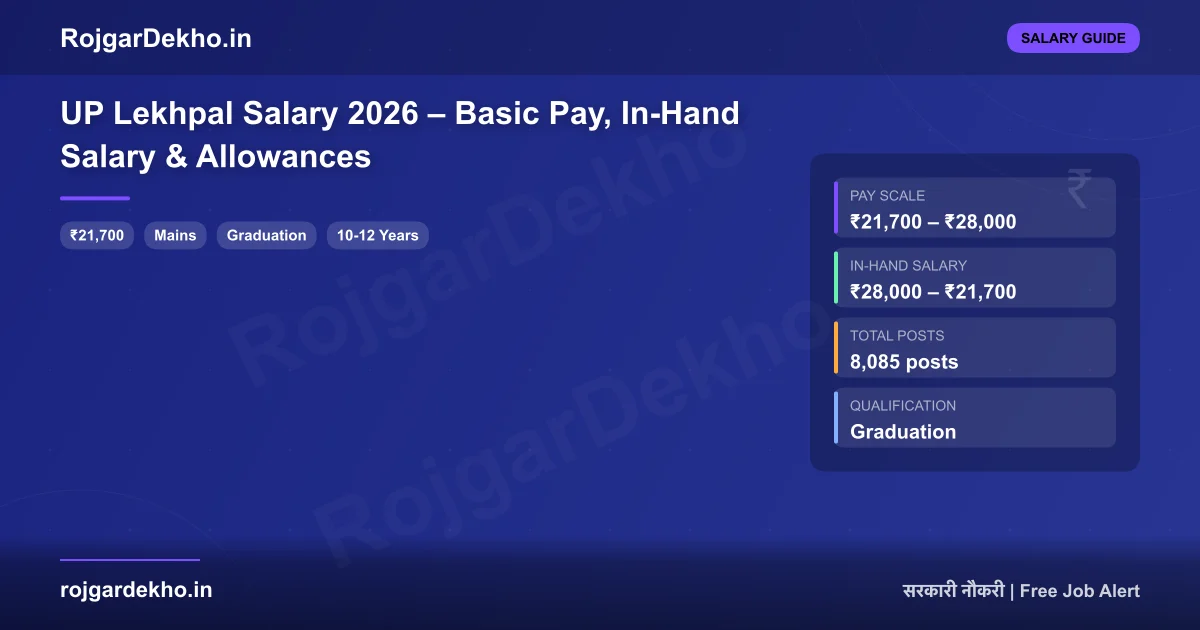
UP Lekhpal is a Group C state government post under the UP Revenue Department, selected by UPSSSC. The pay structure follows UP State Pay Matrix based on 7th Pay Commission recommendations.
| Component | Details |
|---|---|
| Pay Level | Level 3 (UP State Pay Matrix) |
| Basic Pay (Entry) | ₹21,700/month |
| Pay Scale Range | ₹21,700 – ₹69,100 (full career range) |
| Annual Increment | 3% of basic pay |
| Grade Pay (pre-revision) | ₹2,000 |
Full Monthly Salary Breakdown
| Component | Amount (Approx) | Notes |
|---|---|---|
| Basic Pay | ₹21,700 | Fixed at Level 3 entry |
| Dearness Allowance (DA) | ₹10,200–₹11,000 | UP state DA ~47-50% of basic, revised quarterly |
| HRA — Z-class (rural/tehsil) | ₹1,736 | 8% of basic — most Lekhpal postings |
| HRA — Y-class (district town) | ₹3,472 | 16% of basic — district HQ postings |
| Travel + Medical Allowance | ₹1,500–₹2,500 | Fixed components |
| Gross (Y-class posting) | ₹35,000–₹38,000 | Before deductions |
| NPS Deduction (employee 10%) | -₹3,200–₹3,500 | Compulsory pension contribution |
| Income Tax / Other | -₹500–₹1,500 | Depends on tax regime |
| In-Hand (Y-class/district) | ₹30,000–₹35,000 | Net take-home |
| In-Hand (Z-class/rural) | ₹27,000–₹32,000 | Lower HRA postings |
HRA by City Class — What Most Lekhpals Actually Get
| City Class | HRA Rate | Monthly HRA | Typical Locations |
|---|---|---|---|
| X class | 24% | ₹5,208 | Lucknow (rare for Lekhpal) |
| Y class | 16% | ₹3,472 | Agra, Varanasi, Meerut, Prayagraj urban |
| Z class | 8% | ₹1,736 | Tehsil towns, block HQ — majority of postings |
Most Lekhpal postings are in Z-class tehsil towns where HRA is only ₹1,736. However, government accommodation is available at these locations at ₹200-500/month nominal rent — making the effective housing cost very low.
Salary Growth Over 10 Years
| Service Year | Basic Pay | Approx In-Hand |
|---|---|---|
| Year 1 (Joining) | ₹21,700 | ₹30,000–₹32,000 |
| Year 3 (2 increments) | ₹23,000 | ₹32,000–₹34,000 |
| Year 5 | ₹24,400 | ₹34,000–₹36,500 |
| Year 10 | ₹28,300 | ₹40,000–₹42,000 |
| Kanungo Promotion (~10-12 yrs) | ₹29,200 (Level 4) | ₹41,000–₹43,000 |
Benefits Beyond Salary
| Benefit | Details |
|---|---|
| NPS Pension | Employer contributes 14% of basic+DA; 30-year corpus can reach ₹1.5–2 crore |
| Medical | UP state health scheme — OPD and hospitalisation for self and family |
| Job Security | Permanent government employment — no layoffs, no contract |
| Government Accommodation | Available at tehsil level — ₹200-500/month nominal rent |
| Leave | 14 days CL + 30 days EL/year + medical leave |
| Gratuity | Payable after 5 years of service — up to ₹20 lakh |
UP Lekhpal vs Rajasthan Patwari: Salary Comparison
| Factor | UP Lekhpal 2026 | Rajasthan Patwari 2026 |
|---|---|---|
| Pay Level | Level 3 — ₹21,700 basic | Level 11 Rajasthan — ₹20,800 basic |
| In-Hand (district posting) | ₹30,000–₹35,000 | ₹29,000–₹34,000 |
| Education | 12th pass | 12th pass + CCC/RSCIT mandatory |
| Selection | PET + Mains (100Q) | RSMSSB CBT (150Q) |
| Total Posts (2026) | 7,994 | ~2,500 (last cycle) |
| Promotion Path | Kanungo → Naib Tehsildar → Tehsildar | Kanoongo → Naib Tehsildar → Tehsildar |
IDA vs CDA: Why UP Lekhpal Follows a Different Pay Structure
UP Lekhpal falls under the Uttar Pradesh state government pay structure, not central government pay. The central government follows the 7th Central Pay Commission (7th CPC), while UP state follows its own adapted pay matrix. The practical difference: UP state employees get DA revised by the UP cabinet (not the central cabinet), and HRA rates follow UP government city classifications. For Lekhpal at Level 3, UP adopted the same entry basic pay as central government Level 3 (Rs 21,700) — but DA revision timing can differ, with UP state sometimes lagging 1-2 quarters behind central DA revision.
Real Cost of Living Analysis: Is Lekhpal Salary Enough?
The short answer is yes — for the posting locations where Lekhpals are actually deployed. Most Lekhpal postings are in tehsil towns and rural areas of UP, not in Lucknow or Noida. In a district town like Bulandshahr, Ballia, Banda, or Sitapur, the cost of living is significantly lower than a metro city.
A two-room flat rents for Rs 3,000-5,000/month in a district town. A family of four can manage food expenses at Rs 8,000-12,000/month. UP government schooling is essentially free. With government accommodation available at Rs 200-500/month, the net monthly expense for a Lekhpal family in a district town is approximately Rs 18,000-22,000 — leaving Rs 8,000-12,000 surplus every month from a starting in-hand of Rs 28,000-30,000.
This surplus grows every year: 3% annual increment adds Rs 650 to basic in Year 1, and DA revision adds another Rs 300-500 per quarter. A Lekhpal who joins at 25 and reaches Kanungo at 35-37 is typically earning Rs 42,000-45,000 in-hand with zero debt — a financial stability profile that most private sector jobs at the same age cannot match.
NPS Corpus Projection: What Your Pension Looks Like
| Assumption | Value |
|---|---|
| Starting basic pay | Rs 21,700 (Level 3 entry) |
| Annual increment | 3% per year on basic |
| DA (simplified average) | 50% of basic throughout career |
| Employee NPS contribution | 10% of (basic + DA) |
| Employer (UP govt) NPS contribution | 14% of (basic + DA) |
| Total annual NPS contribution (Year 1) | Rs 3,255 employee + Rs 4,557 employer = Rs 7,812 |
| Projected corpus at 30 years (7% annual growth) | Approximately Rs 1.2 - 1.5 crore |
| Monthly annuity (40% of corpus annuitised) | Approximately Rs 32,000 - Rs 40,000/month |
The NPS corpus assumes consistent investment growth at 7% per annum — a conservative assumption given NPS equity and government bond returns. The monthly pension at retirement could match or exceed your final in-hand salary at the Lekhpal level, making the financial case for this career stronger than many candidates realise.
Myths About UP Lekhpal Salary
Myth 1: Rs 21,700 basic is too low to live on. Reality: Basic pay alone is not your salary. With DA at 50% (Rs 10,850), HRA, and other allowances, gross is Rs 35,000-40,000. Net in-hand after NPS deduction is Rs 28,000-35,000 depending on location. In a district town, this is a comfortable living wage with government accommodation.
Myth 2: Private jobs pay more. Reality: A 12th-pass private sector employee in UP typically earns Rs 10,000-18,000/month with no job security, no pension, and no medical benefits. UP Lekhpal at Rs 30,000 in-hand plus all government perks is objectively better compensation for the same educational background.
Myth 3: Salary never grows. Reality: Annual 3% increment plus quarterly DA revision plus Kanungo promotion (Rs 29,200 basic) means real salary growth. At Year 10, basic is approximately Rs 28,000 vs Rs 21,700 at entry — a 29% increase in basic pay alone, plus higher DA on the larger base.
Myth 4: NPS pension is not worth it. Reality: With 14% employer NPS contribution and 30 years of compounding at 7%, the corpus can reach Rs 1.2-1.5 crore, generating Rs 32,000-40,000/month pension. That is actual retirement security, not a vague promise.
Comparison: UP Lekhpal vs Other UP Government Jobs
| Post | Pay Level | Approx In-Hand | Education Needed | Exam Difficulty |
|---|---|---|---|---|
| UP Lekhpal | Level 3 (Rs 21,700) | Rs 28,000-35,000 | 12th pass | Moderate — PET + Mains 100Q |
| UP Police Constable | Level 3 (Rs 21,700) | Rs 28,000-35,000 | 12th pass | Moderate — physical + written |
| UP Gram Panchayat Officer | Level 4 (Rs 25,500) | Rs 33,000-38,000 | Graduation | Higher education needed |
| UP Revenue Inspector (Kanungo) | Level 4 (Rs 29,200) | Rs 38,000-43,000 | Graduation or Promotion | Departmental promotion from Lekhpal |
| UPSSSC Accounts Clerk | Level 4 (Rs 25,500) | Rs 33,000-38,000 | Graduation + Commerce | Higher ed + Commerce bg |
UP Lekhpal stands out for having the lowest educational requirement (12th pass) while offering a Level 3 salary comparable to UP Police Constable — but with a more comfortable field posting environment and a clearer career progression path through the revenue hierarchy.
Lekhpal's Role in UP's Digital Land Records Revolution
In 2016, the UP government launched UP Bhulekh — a digital portal where any citizen can check their land records online. This changed the Lekhpal's job significantly. A Lekhpal today is not just a record-keeper with paper registers but an operator of the digital land records system. Here is what that means practically:
Every mutation (dakhil-kharij) that a Lekhpal processes must now be entered into the UP Bhulekh digital system. The Tehsildar passes mutation orders digitally. Khasra and Khatauni records are maintained both in paper form (traditional registers) and digital form (UP Bhulekh). This dual-system reality means computer literacy is now a job requirement, not just an exam topic. The 15-mark Computer section in the Mains syllabus directly reflects this operational reality.
The advantage for candidates: your 15 exam marks on computers are not theoretical — they are directly applicable knowledge. Understanding how digital land records work (UP Bhulekh, e-district portal, how to access Khatauni online) will help you both score in the exam and perform better on the job from Day 1.
Career Milestone: When Does a Lekhpal Get Confirmed?
After selection and joining, a Lekhpal goes through two stages before becoming a fully confirmed government servant:
Probation Period (2 years): During the first 2 years, a Lekhpal is on probation. Salary is full, duties are full, but the appointment is provisional. Annual performance reports (APRs) are written by the Kanungo and Naib Tehsildar. If performance is satisfactory, confirmation is recommended after 2 years. In practice, very few probationers are not confirmed — it is a standard administrative requirement, not a real hurdle.
Training: New Lekhpals typically undergo 4-6 weeks of departmental training at a District Training Centre covering Revenue Laws, land records maintenance, Girdawari procedures, UP Bhulekh operations, and government scheme implementation. This training is paid — you receive full salary during training.
Confirmation: After successful probation completion (and training), the Lekhpal is formally confirmed as a permanent government servant of UP. From this point, full transfer rights, promotion rights, and service protections apply.
Frequently Asked Questions
Q: Is UP Lekhpal a permanent job?
Yes. UP Lekhpal is a permanent, pensionable state government position in the UP Revenue Department. After probation (typically 2 years), you get permanent status with full government service protections — including protection from arbitrary dismissal and seniority-based promotion rights.
Q: How much does a UP Lekhpal earn in the first month?
In the first month, your in-hand is approximately ₹28,000–₹32,000 depending on your posting location. Rural/Z-class postings give lower HRA (₹1,736) while Y-class district headquarters give 16% HRA (₹3,472). The first salary includes basic + DA + HRA minus NPS deduction and professional tax.
Q: Does DA change for UP state government employees?
Yes. DA for UP state employees is revised by the state cabinet typically twice a year, following the central government pattern. Current DA stands at approximately 47-50% of basic pay. Each revision adds ₹300-500 per month at the Lekhpal pay level.
Q: When does a Lekhpal get promoted to Kanungo?
Promotion from Lekhpal to Revenue Inspector (Kanungo) typically happens after 8-12 years of service, subject to departmental promotion exam and vacancy. Kanungo sits at Level 4 (basic ₹29,200), adding approximately ₹5,000-7,000 to gross salary. The path continues: Kanungo → Naib Tehsildar → Tehsildar → SDM over a full career.
Q: What is the difference between in-hand in city vs village posting?
The key difference is HRA. A Lekhpal in Lucknow (X-class) draws ₹5,208 HRA vs ₹1,736 in a village tehsil (Z-class) — a ₹3,472/month difference. Most Lekhpal postings are rural where HRA is low, but cost of living is also lower and government accommodation is available at ₹200-500/month.