UP Police Sub Inspector SI Salary 2026 — Level-6 Pay, In-Hand & Allowances
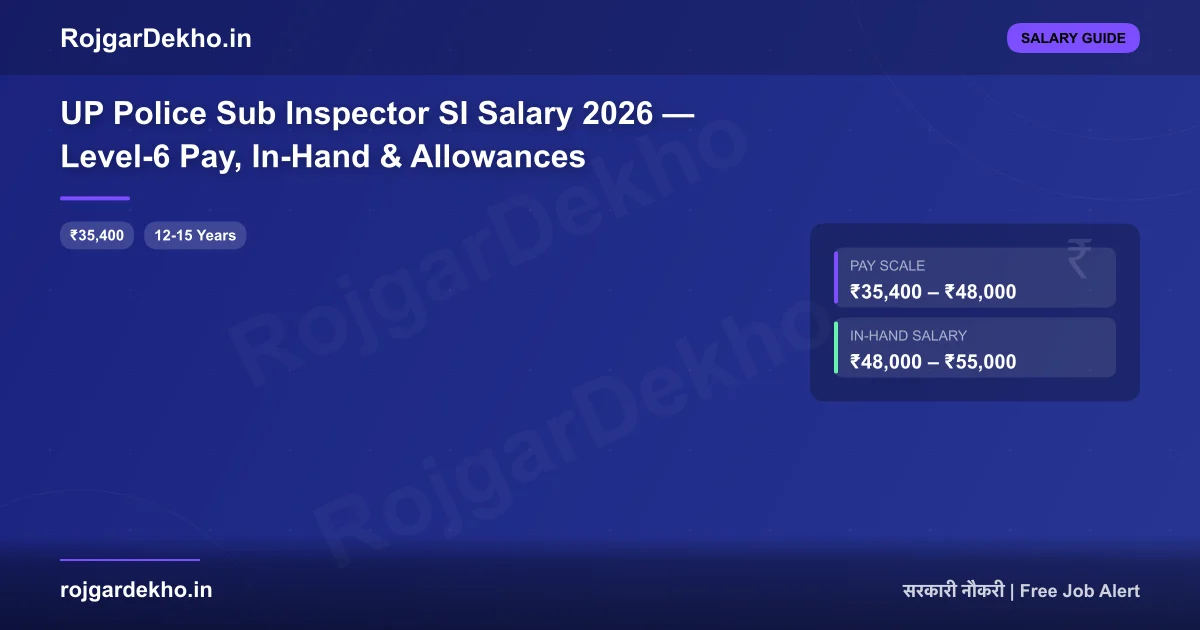
UP Police Sub Inspector (SI) is the first gazetted-equivalent officer rank in the Uttar Pradesh police hierarchy — the rank that actually works the thana floor, supervises constables, and leads investigation teams. Recruited by UPPRPB, the SI sits at 7th CPC Pay Matrix Level 6 with a basic pay of ₹35,400/month. After DA, HRA, and police-specific allowances, your in-hand at a Y-class city posting (Lucknow, Kanpur, Varanasi) is ₹50,000–₹56,000/month. At an X-class NCR posting (Noida, Ghaziabad), it reaches ₹53,000–₹60,000/month. This is the complete, number-backed breakdown — not a generic copy.
👉 UP Inspector of Police Salary 2026 — After 5–7 years as SI, you move to Level 7 (₹44,900 basic) — here is exactly how much more that means in-hand.
UP Police SI Pay Scale 2026
UP Police follows the 7th Pay Commission Pay Matrix. SI is classified at Level 6 — same as Central Government posts like Income Tax Inspector, Sub-Inspector CBI.
| Pay Component | Details |
|---|---|
| Pay Level | Level 6 (7th CPC Pay Matrix) |
| Entry Basic Pay | ₹35,400/month |
| Pay Scale Range | ₹35,400 – ₹1,12,400 |
| Annual Increment | 3% of basic pay (₹1,062 at entry) |
| DA Rate (current) | ~53% of basic pay (revised biannually) |
| Dearness Allowance | ₹18,762/month at entry |
| Risk Allowance (Police) | ₹600–₹1,500/month (posting-dependent) |
| Uniform Allowance | ₹10,000/year (one-time annual) |
Monthly Salary Breakdown — UP Police SI 2026
Here is the full breakdown for two common posting scenarios — Y-class city (Lucknow) and X-class NCR (Noida/Ghaziabad). Both figures are at entry-level basic pay of ₹35,400.
| Component | Y-Class (Lucknow/Kanpur) | X-Class NCR (Noida/Ghaziabad) |
|---|---|---|
| Basic Pay | ₹35,400 | ₹35,400 |
| Dearness Allowance (53%) | ₹18,762 | ₹18,762 |
| HRA (18% / 27%) | ₹6,372 | ₹9,558 |
| Risk Allowance (Police) | ₹1,000 | ₹1,000 |
| Transport Allowance | ₹1,350 | ₹3,600 (NCR TPTA higher) |
| Uniform Allowance (monthly share) | ₹833 | ₹833 |
| Gross Pay (approx) | ₹63,717 | ₹69,153 |
| NPS Deduction (10% of basic+DA) | −₹5,416 | −₹5,416 |
| CGEIS / GIS Insurance | −₹30 | −₹30 |
| Income Tax | Nil (entry level) | Nil (entry level) |
| Net In-Hand | ~₹51,000–₹56,000 | ~₹53,000–₹60,000 |
The ₹3,186/month HRA difference between Y-class and X-class is significant over a career. A Noida-posted SI earns roughly ₹38,000 more per year in HRA alone compared to a Lucknow-posted colleague — before factoring the higher TPTA in NCR.
👉 UP DSP Salary 2026 — Two promotions after SI gets you to DSP (Level 10) — see the full pay jump and perks including government vehicle entitlement.
State-Specific Posting Angles — UP Police SI
UP Police is India's largest state police force — over 2 lakh personnel across 1,600+ police stations. Where you're posted shapes your day-to-day work, allowances, and career trajectory significantly.
| Posting Type | Key Units / Districts | Additional Allowances / Notes |
|---|---|---|
| Urban NCR (X-class) | Noida, Ghaziabad, Agra Cantonment | X-class HRA ₹9,558; TPTA higher; cyber crime and corporate crime exposure |
| Urban Y-class | Lucknow, Kanpur, Varanasi, Allahabad | Standard Y-class HRA ₹6,372; high-traffic thana posting; STF secondments possible |
| STF (Special Task Force) | Lucknow HQ + district units | STF allowance on top of basic; organised crime and NDPS case work; career booster |
| ATS (Anti-Terrorist Squad) | UP ATS Lucknow | Risk allowance highest tier; specialised training; eligibility: 5+ years SI service |
| EOW (Economic Offences Wing) | Lucknow, Noida | Financial crime investigation; liaises with ED, CBI; preferred for law-graduate SIs |
| Rural / district posting | All 75 districts | Z-class HRA (9%) ₹3,186; maximum transfer to urban after 3 years typical |
| Railway Police (GRP) | GRP UP jurisdiction | Additional GRP allowance; distinct from civil police cadre on ground |
Pay Progression — UP Police SI to SP (20-Year View)
Promotion in UP Police from SI upward runs through departmental promotion and DPC (Departmental Promotion Committee) process. The key jump is SI → Inspector, which adds ₹9,500 in basic and approximately ₹13,000–₹15,000 in monthly in-hand.
| Rank | Pay Level | Basic Pay | Approx In-Hand | Typical Timeline from SI |
|---|---|---|---|---|
| Sub Inspector (SI) | Level 6 | ₹35,400 | ₹50,000–₹60,000 | Entry |
| Inspector of Police | Level 7 | ₹44,900 | ₹72,000–₹80,000 | 5–7 years (DPC/promotion) |
| Deputy SP (DSP) | Level 10 | ₹56,100 | ₹95,000–₹1,05,000 | 12–15 years (limited DPC) |
| Superintendent of Police (SP) | Level 14 | ₹1,44,200 | ₹1,80,000+ | IPS-level; rare from state quota |
UP also has MACP (Modified Assured Career Progression): if you do not get a regular promotion within 10 years, you automatically move to the next pay level. This means even a non-promoted SI shifts from Level 6 to Level 7 pay after 10 years — without becoming Inspector in designation.
What No Other Site Tells You — UP Police SI Reality
Most salary articles stop at the table. Here is what actually matters on the ground:
- STF selection is the fastest career accelerator: UP STF SIs work high-visibility organised crime cases. A well-written charge-sheet or key arrest here gets noticed at range IG level — and DPC discretionary promotions often favour STF-experienced SIs.
- Night duty allowance is rarely documented but real: SIs on night duty get an NDA (Night Duty Allowance) per shift — it is small (₹200–₹400/night) but adds up over a month of rotating shifts.
- NCR posting requests are competitive: Noida and Ghaziabad SIs earn the X-class HRA, but posting requests are oversubscribed. Fresh recruits typically go to their home district or adjacent district first.
- NPS is a real cost unlike the old pension: The 10% NPS deduction on basic+DA is ₹5,416/month at entry — that is ₹65,000/year that does not appear in your bank account. The government adds 14% employer contribution, which grows in your NPS corpus but is not liquid.
- Uniform allowance is annual, not monthly: ₹10,000/year comes once — do not count it as monthly income in your planning.
Frequently Asked Questions
Q: What is the UP Police SI starting salary in hand in 2026?
At a Y-class city posting like Lucknow or Kanpur, the net in-hand is approximately ₹50,000–₹56,000/month. At an X-class NCR posting (Noida, Ghaziabad), it is ₹53,000–₹60,000/month. These figures include DA at ~53%, standard allowances, and subtract NPS and GIS deductions.
Q: What is the HRA for UP Police SI in Noida vs Lucknow?
Noida and Ghaziabad are X-class cities — HRA is 27% of basic, which is ₹9,558/month. Lucknow and other state capitals are Y-class — HRA is 18%, which is ₹6,372/month. Rural district postings are Z-class at 9% — ₹3,186/month.
Q: How many years to become Inspector from UP Police SI?
The typical timeline is 5–7 years through the DPC (Departmental Promotion Committee) route. MACP guarantees a pay-level upgrade after 10 years regardless of designation change. Top performers posted to STF or with strong ACR (Annual Confidential Report) ratings are promoted faster.
Q: Does UP Police SI get a government quarter?
Accommodation availability depends on the posting station. Urban thana postings in Lucknow and Noida have limited quarters — most SIs take HRA and arrange their own accommodation. Rural district thanas often have barracks/quarter accommodation on campus.
Q: What is the risk allowance for UP Police SI?
Risk allowance ranges from ₹600 to ₹1,500/month depending on posting type. Standard thana posting is at the lower end; STF, ATS, and SOG (Special Operations Group) postings attract the higher rate. This is separate from the base salary and DA.
Q: Is UP Police SI eligible for CGHS?
UP Police SIs are covered under the UP state government health scheme — not CGHS (which is Central Government). The state scheme covers the SI, spouse, and dependent children at empanelled hospitals. Some cantonments and district hospitals are also available without cost.
Complete Deduction Breakdown — What Gets Cut Before Salary Credit
The in-hand figure is after mandatory deductions. Here is every cut from a UP Police SI's gross pay at entry basic ₹35,400:
| Deduction Head | Monthly Amount | Basis |
|---|---|---|
| NPS Tier-I (Employee Share) | ~₹5,400 | 10% of Basic + DA (₹35,400 + ₹18,762) |
| Group Insurance Scheme (GIS) | ₹120–₹240 | Level 6 UP state rate |
| UP State Health Scheme Premium | ₹250–₹500 | Family coverage, empanelled hospitals |
| Income Tax (TDS) | ₹0–₹1,200 | Nil–low at entry after NPS 80CCD deduction |
| Total Deductions | ~₹5,800–₹7,300 | At entry level (no govt quarter) |
Y-class posting (Lucknow, Kanpur): Gross ≈ ₹57,000 → Net ≈ ₹50,000–₹52,000. NCR posting (Noida, Ghaziabad): Gross ≈ ₹67,000 → Net ≈ ₹59,000–₹62,000. If a government quarter is allotted, an additional 10% of basic (₹3,540) is deducted as license fee — but you save rent. The NPS deduction is the biggest monthly cut, but it builds your retirement corpus simultaneously.
National Pension System (NPS) — How It Builds Your Retirement
UP Police SIs appointed after 1 January 2005 are under the National Pension System (NPS) — not the old defined-benefit pension. Here is how the NPS corpus grows:
- Employee contribution: 10% of Basic + DA = ~₹5,400/month at entry
- UP Government contribution: 14% of Basic + DA = ~₹7,560/month at entry
- Total monthly NPS credit: ~₹12,960 at entry level
- Managed by: PFRDA-registered NPS Trust; invested in G-Sec and equity funds
On retirement at 60 years, 60% of the accumulated corpus is paid as tax-free lump sum and 40% mandatorily goes toward an annuity that provides monthly pension. A UP Police SI who serves 30 years and reaches a basic pay of ₹90,000+ can realistically accumulate ₹1.5–₹2 crore in NPS corpus, depending on market returns.
Children's Education Allowance and Leave Travel Concession
Two allowances UP Police SIs routinely overlook when calculating their effective take-home:
Children's Education Allowance (CEA): ₹2,250 per child per month (maximum 2 children), reimbursed on production of fee receipts from any recognized school. Applicable for Classes 1 to 12. That is ₹54,000/year per child — ₹1,08,000/year for two children — a significant real benefit.
Hostel Subsidy: If the child studies in a hostel, ₹6,750/month is reimbursed per child (max 2 children) — ₹81,000/year. Cannot be claimed simultaneously with CEA for the same child.
Leave Travel Concession (LTC): UP state employees get two types: Home Town LTC (once every 2 years — train fare for self and family to declared home town) and All India LTC (once every 4 years — to any destination in India). For a family of four, a round-trip All India LTC reimbursement can cover ₹20,000–₹40,000 in travel costs. The four-year block resets every 4 calendar years.
Uniform Allowance and Other Annual Benefits
UP Police SIs are issued duty uniform on joining and receive an annual uniform allowance for maintenance and replacement. The allowance is revised periodically by state orders. Officers posted to specialized units — PAC battalions, STF, ATS, Counter Terrorism — receive additional tactical kit stipends for operational gear.
SIs are also eligible for the Canteen Stores Department (CSD) facility at designated outlets, which offers household appliances, groceries, and vehicles (especially two-wheelers and four-wheelers) at 15–25% below market price. Most SIs do not fully utilize this benefit — it can save ₹30,000–₹1,00,000 on a vehicle purchase alone.
Training Period Stipend — First 6–9 Months
During initial training at the UP Police Training Centre (Sitapur or Moradabad), newly recruited SIs do not draw full salary. A training stipend is paid instead — typically in the range of ₹21,700–₹25,000/month. Full Level-6 salary starts only after the passing-out parade and official joining at the designated thana or unit. Factor this into your early-career financial planning.
Court Duty Allowance and Overtime
UP Police SIs who attend courts for deposing as witnesses or for escort duty receive court duty allowance for days spent in court (per diem basis). SIs do not receive overtime pay in the standard sense — but night duty allowance applies for sustained night shifts beyond the normal duty roster. These add ₹300–₹600/day on applicable days.
Q: What is the gratuity payout for UP Police SI after 30 years of service?
Gratuity is calculated as: (Basic Pay + DA) × 15/26 × completed years of service. The ceiling is ₹20 lakh (7th CPC limit). An SI retiring at basic ₹90,000 after 30 years gets approximately ₹15–₹20 lakh as gratuity — separate from the NPS retirement corpus.
Q: Can UP Police SI take part-time work or run a business?
No. Under UP Government Servant Conduct Rules, a serving police officer — including Sub Inspectors — cannot engage in private employment, run a business, or practice any profession for gain. Violation invites departmental proceedings and can lead to suspension or dismissal.
Q: What is the DA rate for UP Police SI in 2026, and when does it revise?
Dearness Allowance (DA) is currently 53% of basic pay, revised biannually by the UP state government — typically in January and July each year. A 4% increase in DA on ₹35,400 basic translates to ₹1,416/month more in gross salary. Tracking DA revision orders from the Finance Department is important for accurate salary planning.
Q: What happens to UP Police SI salary after MACP?
Modified Assured Career Progression (MACP) scheme gives automatic pay-level upgrades after 10, 20, and 30 years of service if regular promotion has not come. If an SI is not promoted to Inspector within 10 years, MACP moves them from Level 6 to Level 7 (₹44,900 basic) without a change in designation. This is a financial safeguard — not a promotion, but the pay is identical to an Inspector's entry pay.
📌 Related on RojgarDekho:
- 💰 UP Inspector of Police Salary 2026 — Level-7 Pay & Career Path
- 💰 UP DSP Salary 2026 — Level-10 Pay, Vehicle & Perks
- 💰 UP SP Salary 2026 — IPS-Level Pay & Entitlements
- ⚖ Rajasthan Police SI Salary 2026 — Compare with UP
- ⚖ Haryana Police SI Salary 2026 — NCR vs Non-NCR Pay
- 📋 UP Police SI DV/PST Exam Date 2026 — Admit Card & Schedule