UPSC CDS Salary 2026 — What a Fresh Lieutenant Actually Takes Home
When you clear the UPSC CDS exam and get commissioned as a Lieutenant, your salary structure is nothing like a regular government job. The basic pay is higher, there are unique allowances nobody else gets, and several perks have a real monetary value that never shows up in any salary slip. Here is a complete breakdown of what you earn from day one.
Basic Pay + Military Service Pay
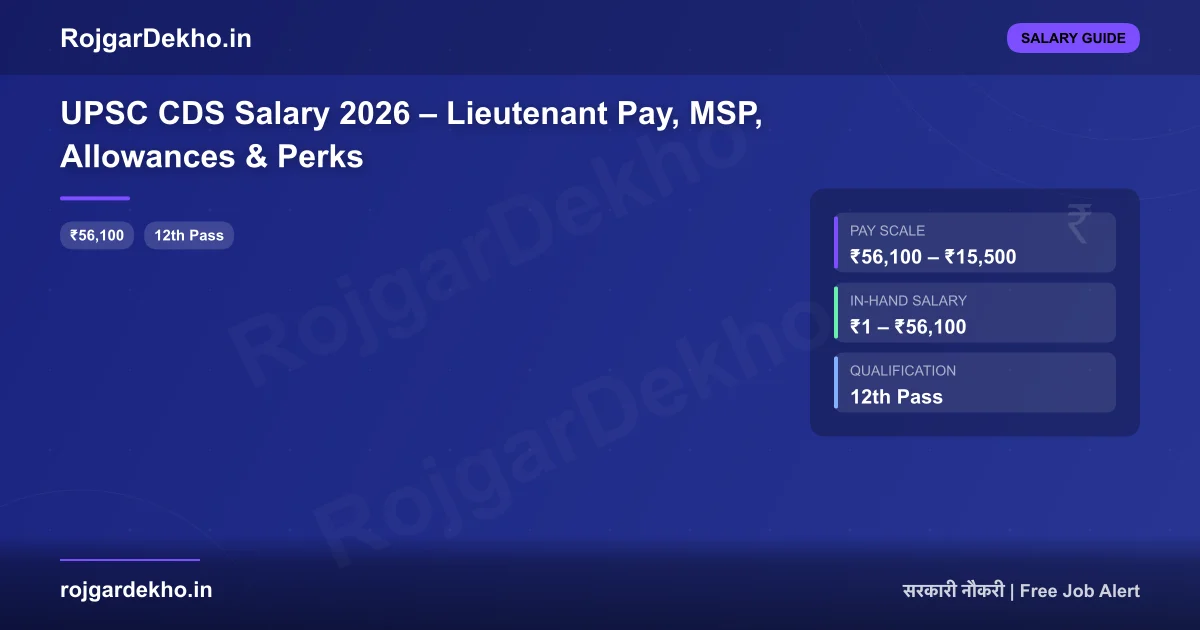
A fresh Lieutenant is placed at Pay Level 10 of the 7th CPC pay matrix. The basic pay is ₹56,100/month. On top of this, every commissioned officer from Lieutenant to Brigadier receives a Military Service Pay (MSP) of ₹15,500/month. MSP is fixed — it does not change when DA is revised, and it is not a grade pay. It is a permanent addition specifically for military officers, recognising the unique service conditions they face.
Why In-Hand Salary Crosses ₹1 Lakh at a Peace Station
At a peace station (most postings in the first 2–3 years), the in-hand calculation looks like this:
| Component | Amount/Month |
|---|---|
| Basic Pay (Level 10) | ₹56,100 |
| Military Service Pay (MSP) | ₹15,500 |
| Dearness Allowance (DA @ 53%) | ₹29,733 |
| Transport Allowance | ~₹3,600 |
| HRA | Nil (govt quarters provided) |
| Gross (approx.) | ~₹1,04,933 |
How CDS Salary Compares to IPS and IAS
A common question among aspirants is whether CDS is financially worth it compared to IPS or IAS. At the Lieutenant level, a CDS officer earns roughly similar gross pay to an IPS probationer (also Pay Level 10, ₹56,100 basic + MSP of ₹15,500). However, the non-monetary advantages tip significantly in favour of CDS: free furnished accommodation, CSD canteen, free medical, and the DSOP Fund pension scheme — none of which IPS officers enjoy to the same extent. An IPS officer may earn more in-hand if posted in a metro with HRA (since they may not always get police quarters), but the CDS officer's total compensation package is comparable or superior.
By the rank of Major (6 years of service, basic ₹69,400), a CDS officer's gross including MSP, DA, and transport comfortably crosses ₹1,40,000/month. By Lt Colonel (13 years, basic ₹1,21,200), gross exceeds ₹2,50,000/month — a level most civilian counterparts do not reach until 20+ years of service.
Tax Benefits That Reduce the Effective Tax Burden
Several components of a defence officer's salary are exempt from income tax, reducing the effective tax burden significantly:
- MSP (₹15,500/month): Fully exempt from income tax for officers serving in field areas
- Field Area Allowance: Fully exempt under Section 10(14) of the Income Tax Act for notified field areas
- Siachen Allowance: Fully exempt
- High Altitude Allowance: Fully exempt
- DSOP Fund interest: Tax-free (like PPF)
Even in a peace station, the effective tax rate for a Lieutenant is lower than for a civilian officer at the same gross, because free accommodation avoids a major taxable perquisite that private sector employees face.
Short Service Commission (OTA) vs Permanent Commission (IMA) — Financial Difference
This is the single most important financial decision for CDS aspirants. The salary during service is identical — a Short Service Commission officer and a Permanent Commission officer at the same rank draw the same pay, MSP, and allowances. The difference comes entirely at retirement:
- PC officer (IMA/INA/AFA route): Eligible for full service pension after 20 years. Pension = 50% of last reckonable pay, plus DA, indexed to inflation for life. Gratuity is also payable.
- SSC officer (OTA route, without PC conversion): No pension. Receives a one-time ex-gratia of ₹50,000–₹60,000 per year of service (exact formula varies). No lifetime income after leaving service unless converted to PC.
- SSC with PC conversion: After 14 years of service, SSC officers (including women, per the 2020 Supreme Court order) can apply for PC and become eligible for pension if approved.
The pension advantage of a PC officer, compounded over a 20–25 year retirement period, can amount to ₹1.5–₹2 crore or more in present value terms. This is why IMA/INA/AFA are significantly more competitive than OTA.
The Real Value of Free Accommodation
This is consistently undervalued in salary discussions. A Lieutenant posted in Delhi, Pune, or Bengaluru gets a fully furnished (or semi-furnished) government quarter in a cantonment area. The equivalent market rent for a similar 2-BHK in these cities starts at ₹20,000–₹35,000/month. Over a 20-year career with multiple postings, the cumulative accommodation benefit amounts to ₹50–₹80 lakh in equivalent rent savings — money you never have to earn or spend.
CDS vs PSU — Which Pays More Over a Career?
This is a comparison many defence aspirants avoid making clearly. Here is an honest side-by-side:
| Parameter | CDS Lieutenant (PC) | PSU ET (NTPC/ONGC E1) |
|---|---|---|
| Starting Basic Pay | ₹56,100 (CDA) | ₹40,000–₹50,000 (IDA) |
| In-hand (peace station) | ₹1,00,000–₹1,10,000 | ₹65,000–₹85,000 |
| Pension | Yes — 50% of last pay (PC) | NPS (market-linked) |
| Free Accommodation | Yes (at all postings) | Only at project sites |
| Medical (family) | Free, no limit | Capped insurance |
| Bond Period | No formal bond (service commitment) | 2–4 years bond |
Kit Maintenance Allowance and Annual Benefits
A Lieutenant receives a Kit Maintenance Allowance (KMA) of ₹20,000 per year as a lump sum to maintain uniforms and field gear. The actual cost of a complete officer uniform set (mess dress, service dress, combat, ceremonial) exceeds ₹80,000–₹1,20,000 — so the initial joining kit grant plus annual KMA together represent a meaningful benefit unique to defence service.
Officers also receive a Leave Travel Concession (LTC) covering railway or air travel for self and family to their home town or any Indian destination. Effectively, the government pays for one or two family vacations per year — a benefit that most private sector employees do not get. Combined with the 60 days of annual leave (30 earned + 30 casual/medical), a defence officer's work-life balance, especially in peace postings, is considerably better than the standard corporate or central government civilian job.
Kit Maintenance Allowance and Annual Benefits
A Lieutenant receives a Kit Maintenance Allowance (KMA) of ₹20,000 per year as a lump sum to maintain uniforms and field gear. The actual cost of a complete officer uniform set (mess dress, service dress, combat, ceremonial) exceeds ₹80,000–₹1,20,000 — so the initial joining kit grant plus annual KMA together represent a meaningful benefit unique to defence service.
Officers also receive a Leave Travel Concession (LTC) covering railway or air travel for self and family to their home town or any Indian destination. Effectively, the government pays for one or two family vacations per year — a benefit that most private sector employees do not get. Combined with the 60 days of annual leave (30 earned + 30 casual/medical), a defence officer's work-life balance, especially in peace postings, is considerably better than the standard corporate or central government civilian job.
Actual Take-Home Calculation — After All Deductions
The in-hand salary figure of ₹1,00,000–₹1,10,000 is a gross estimate. Here is a more precise calculation with all deductions for a fresh Lieutenant at a peace station (X-class city, government quarters allotted):
| Component | Amount |
|---|---|
| Basic Pay | ₹56,100 |
| MSP | ₹15,500 |
| DA (53%) | ₹29,733 |
| Transport Allowance | ₹3,600 |
| Gross Earnings | ₹1,04,933 |
| DSOP Fund (6% of Basic+MSP) | –₹4,296 |
| AGIF (Army Group Insurance Fund) | –₹5,000 (approx.) |
| Income Tax (approx.) | –₹2,000–₹4,000 |
| Net In-Hand | ~₹90,000–₹95,000 |
Frequently Asked Questions
Q: Is the CDS officer salary better than a fresh IIT engineer joining a top MNC?
A fresh IIT graduate at a Tier-1 MNC earns ₹12–18 LPA on paper, but after tax (30% slab), ESIC, PF, and no accommodation allowance, the in-hand figure is often ₹75,000–₹1,00,000/month — comparable to a CDS Lieutenant. The difference is that a CDS officer also receives free accommodation, free medical for the entire family, heavily subsidised canteen (CSD), and a guaranteed pension for life. Net lifetime value of the defence package significantly exceeds a private sector salary at the same gross.
Q: Does DA keep increasing, and does it affect in-hand salary?
Yes. DA is revised twice a year (January and July). As DA rises, gross salary rises automatically — no separate notification needed. At 53% DA currently, a Lieutenant earns ₹29,733/month in DA alone. When DA hits 100% (historically happens every few years), the government typically merges it into basic pay, effectively doubling the base for further calculations including pension.
Q: Can a Short Service Commission officer get a pension?
No. SSC officers who complete their 10+4 year service and leave do not receive a monthly pension. However, they receive a gratuity, DSOP Fund corpus with interest, and eligibility for ex-serviceman benefits (ECHS medical, CSD canteen, priority in state government jobs). Permanent Commission officers who complete 20 years of qualifying service receive the full defined-benefit pension for life.
Q: What is the HRA situation — do officers always get free accommodation?
Officers are entitled to government accommodation (quarter) at their station. If a quarter is not available, they receive HRA instead — 27% of basic pay in X-class cities (₹15,147/month for a Lieutenant). In most peace stations, quarters are available. In field areas, officers may live in unit lines — accommodation is provided but may not be family-type quarters.
The AGIF (Army Group Insurance Fund) is a mandatory group insurance scheme that provides life insurance cover of ₹50–75 lakh to officers and their families. The premium (~₹5,000/month) is deducted from salary but gives substantially higher cover than equivalent private insurance at the same premium. The DSOP Fund contribution (minimum 6% of basic+MSP) is compulsory — it is your own retirement savings, returned with interest on retirement alongside the pension.
Annual Increment — How Basic Pay Grows Each Year
Every year on 1 January, a defence officer receives an annual increment of 3% of basic pay. Starting at ₹56,100, this increment adds ₹1,683 to the basic pay in year 2, making it ₹57,783. This compounds annually. After 5 years as a Lieutenant (before promotion to Captain), the basic pay would have grown to approximately ₹65,000+ purely through increments — before any promotion-related jump. Promotions to Captain (Level 10B, ₹61,300 starting) and Major (Level 11, ₹69,400 starting) are time-based and add to this progression.
Over a 25-year career, the CDS PC officer's total compensation — including the pension, free accommodation value, and tax exemptions — exceeds most PSU career tracks. The catch is the uncertainty of field postings and the service discipline that PSU employees do not face.
Post-Retirement Benefits — Ex-Serviceman Advantages
Retirement from a Permanent Commission as a defence officer opens a significant set of lifelong benefits that most career guides overlook:
- Ex-Serviceman (ESM) status: Priority in state government jobs with dedicated ESM quota. Jobs in DGR (Directorate General Resettlement) empanelled companies.
- ECHS (Ex-Servicemen Contributory Health Scheme): Lifelong medical coverage for the officer and spouse at ECHS polyclinics and empanelled hospitals — similar to active service medical, at negligible cost.
- CSD access for life: CSD canteen access continues after retirement for the officer and surviving spouse.
- Priority railway booking: Emergency quota in Railways — a practical benefit for frequent travellers.
- Second career support: DGR facilitates placement in corporate security, oil sector, and government PSUs for retired officers. Many Colonels and Brigadiers take up leadership roles in private companies immediately after retirement.
After DSOP Fund contribution and minor deductions, in-hand salary is approximately ₹1,00,000–₹1,10,000/month. HRA is not paid when government quarters are allotted — which is the standard situation. Instead, you get free accommodation, which is worth ₹15,000–₹30,000/month in equivalent rent at most station cities.
Field Postings — When Salary Jumps Further
Once you get posted to a field area or a high-altitude location, additional allowances kick in that can dramatically increase your monthly earnings:
- Field Area / Modified Field Area Allowance: ₹10,500–₹25,000/month depending on the category of area (active counter-insurgency postings attract the highest rate)
- Siachen Allowance: ₹42,500/month — for postings at the Siachen Glacier, the world's highest battlefield
- High Altitude Allowance: ₹1,600–₹16,900/month depending on altitude band (starts above 9,000 feet)
A Lieutenant posted in a field area can realistically take home ₹1,25,000–₹1,40,000/month, tax-free on several components.
Rank-Wise Pay Progression
| Rank | Pay Level | Basic Pay | Approx. Service |
|---|---|---|---|
| Lieutenant | 10 | ₹56,100 | On joining |
| Captain | 10B | ₹61,300 | 2 years |
| Major | 11 | ₹69,400 | 6 years total |
| Lt Colonel | 12A | ₹1,21,200 | 13 years total |
| Colonel | 13 | ₹1,30,600 | ~26 years |
| Brigadier | 13A | ₹1,39,600 | Selection-based |
DSOP Fund + Pension — The Retirement Advantage
This is one of the most significant advantages of a Permanent Commission (PC) officer's career. PC officers are covered under the Defence Services Officers Provident Fund (DSOP) and the defined-benefit pension scheme — not NPS. After a minimum of 20 years of qualifying service, you are entitled to a pension equal to 50% of your last pay drawn, for life, inflation-indexed. A Colonel retiring at ₹1,30,600 basic would draw a pension of ~₹65,300/month. This is guaranteed, unlike NPS which is market-linked.
Short Service Commission (SSC) officers — who join via OTA — are under CPF (Contributory Provident Fund) with no automatic pension unless they convert to Permanent Commission after 14 years of service.
Non-Monetary Perks That Actually Matter
- CSD (Canteen Stores Department): Goods sold at 10–50% below MRP. Monthly purchase ceiling for officers is ₹11,000 for groceries. Significant savings on daily essentials, electronics, and even vehicles (CSD car scheme).
- Free Medical: You and your entire family — spouse, children, dependent parents — get free treatment at Military Hospitals and Command Hospitals. No insurance premium, no co-pay, no cap.
- Free Accommodation: Furnished/semi-furnished government quarters at every posting. This is worth ₹15,000–₹30,000/month in equivalent rent at most station cities.
- Railway Passes: Annual privilege passes for self and family — effectively free travel across India.