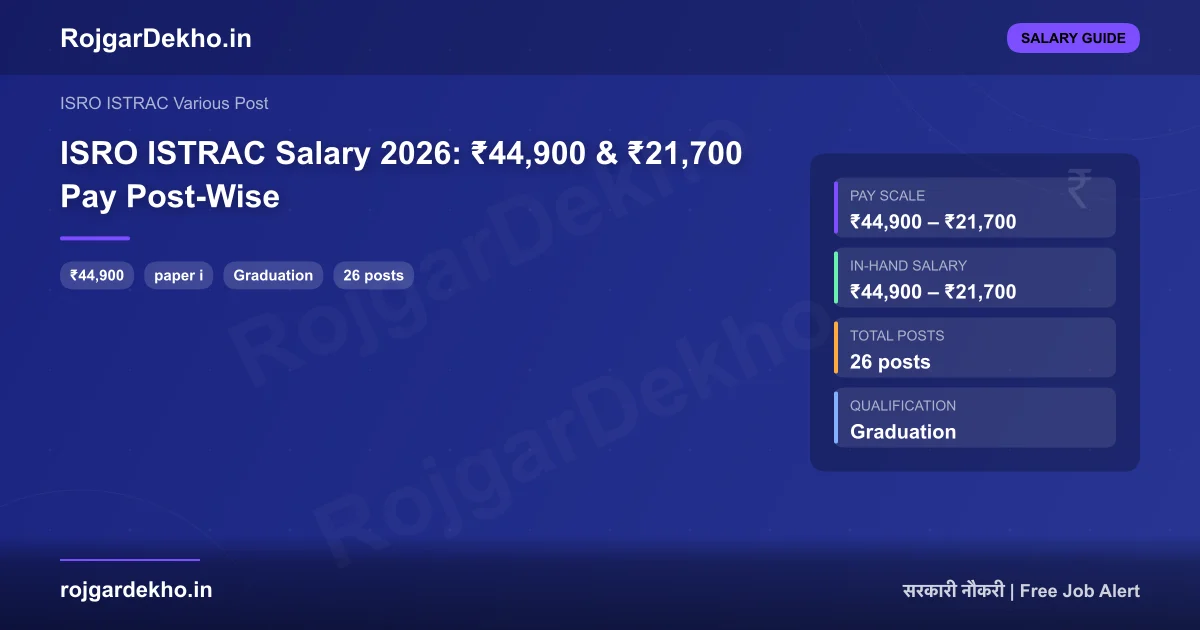
The UPSSSC Havaldar Instructor 2026 notification says Pay Level 3, basic pay ₹21,700. That number on its own doesn't tell you much. What actually lands in your account every month, what changes with posting location, what the Home Guard department adds on top — this article covers all of it so you can make an informed decision before spending months preparing.
| Pay Level | Level 3 (7th CPC) |
| Entry Basic Pay | ₹21,700/month |
| Maximum Basic Pay | ₹69,100/month |
| Dearness Allowance (DA) | 60% of basic = ₹13,020/month |
| HRA (Y-city, 20%) | ₹4,340/month |
| Transport Allowance | ₹1,800 + DA on TA = ~₹2,880/month |
| Gross (Y-city posting) | ~₹41,940/month |
| In-Hand (after deductions) | ₹36,000–₹38,000/month |
Basic Pay — Level 3 Annual Progression
Every year on 1 July, your basic pay increases by 3% as annual increment. Here is how Pay Level 3 grows over your career:
| Year of Service | Basic Pay (₹) | Annual Increment |
|---|---|---|
| Year 1 (Entry) | ₹21,700 | — |
| Year 2 | ₹22,400 | ₹700 |
| Year 3 | ₹23,100 | ₹700 |
| Year 5 | ₹24,500 | ₹700 |
| Year 8 | ₹26,800 | ₹800 |
| Year 10 | ₹28,400 | ₹800 |
| Year 15 | ~₹32,900 | ~₹900 |
| Maximum | ₹69,100 | — |
Dearness Allowance — Revised to 60% in 2026
The Cabinet Committee on Economic Affairs revised DA to 60% of basic pay effective 1 January 2026. On the entry basic of ₹21,700, that is ₹13,020 per month. DA is revised every six months (January and July), so this number keeps increasing. Three months of DA arrears (January–March 2026) were disbursed with April 2026 salary for existing employees.
HRA — Depends on Posting Location
Havaldar Instructors are posted within Uttar Pradesh at various district Home Guard locations. HRA varies by city classification:
| City Category | HRA Rate | Monthly HRA (on ₹21,700) | Example UP Cities |
|---|---|---|---|
| Y (Large cities) | 20% | ₹4,340 | Lucknow, Kanpur, Agra, Varanasi |
| Z (Smaller towns) | 10% | ₹2,170 | District HQ towns across UP |
Most Havaldar Instructor postings will be at district level — which means Z-category HRA for many. This reduces your gross compared to Lucknow. However, district postings often come with government quarters (accommodation), which offsets the lower HRA.
Transport Allowance
For Level 1–8 employees in non-metro cities (which covers most UP district postings), Transport Allowance is ₹1,800 per month plus DA on TA. With DA at 60%: ₹1,800 + ₹1,080 = ₹2,880/month. In larger UP cities (classified higher), TA may differ as per city classification rules.
In-Hand Salary — Calculation for Different Postings
| Posting Type | Estimated Gross | Approx In-Hand |
|---|---|---|
| Lucknow/large city (20% HRA) | ~₹41,940 | ₹37,000–₹38,500 |
| District town (10% HRA) | ~₹39,770 | ₹35,000–₹36,500 |
Income tax at this salary level (annual gross ~₹4.8–5 lakh) is negligible or zero under the new tax regime with standard deduction of ₹75,000.
Monthly Deductions
| Deduction | Amount (Approx) | Notes |
|---|---|---|
| NPS (Employee — 10%) | ₹3,472 | 10% of basic+DA; builds pension corpus |
| CGHS Contribution | ~₹250 | Central Govt health scheme; covers family |
| CGEGIS (Group C) | ~₹500 | Group insurance; partially refunded on exit |
| Income Tax | Nil or minimal | Annual gross below ₹7L — no tax under new regime |
Your employer (UP Government) contributes an additional 14% of (basic + DA) = ₹4,861/month to your NPS corpus — this doesn't appear in your salary slip but accumulates for retirement.
Benefits Beyond Salary
- Government quarters: Available subject to vacancy at district Home Guard locations — saves rent entirely
- CGHS medical: Free/subsidised treatment for you and your family at CGHS-empanelled hospitals
- 30 days annual leave + casual leave + medical leave as per UP government rules
- LTC (Leave Travel Concession): Travel reimbursement twice in a 4-year block
- Uniform allowance: Kit and uniform costs partly covered
UPSSSC Havaldar Instructor vs Other 12th-Pass Govt Jobs
| Post | Pay Level | Entry In-Hand (Approx) |
|---|---|---|
| UPSSSC Havaldar Instructor | Level 3 | ₹35,000–₹38,500 |
| UP Police Constable | Level 3 | ₹34,000–₹37,000 |
| SSC CHSL (LDC) | Level 2 | ₹28,000–₹32,000 |
| Railway Group D | Level 1 | ₹25,000–₹29,000 |
Havaldar Instructor at Level 3 is competitive among 12th-pass government jobs. The in-hand is comparable to UP Police Constable, with the additional benefit of a structured training role rather than active patrol duty.
Frequently Asked Questions
Q: Does the Havaldar Instructor get a pension?
Yes — under NPS. On joining after 2004, all central and most state government employees (including UP Home Guard) are covered under NPS. Your combined monthly NPS contribution (employee 10% + employer 14%) of ~₹8,333 accumulates over your service period.
Q: Is accommodation provided?
Government quarters are available at many Home Guard locations, subject to availability. If you get quarters, you do not receive HRA — instead you pay nominal licence fee. If quarters are not available, you get full HRA in cash.
Q: Does salary increase if posted to a bigger city?
Yes — the HRA component changes. A Lucknow posting gives 20% HRA (₹4,340) vs a small district town at 10% (₹2,170). The difference is ₹2,170/month. Basic, DA, and TA remain the same regardless of location.
In-Hand Salary — What Actually Reaches Your Account
Your gross salary includes basic pay, DA, HRA, and allowances. But what hits your account every month is less, because statutory deductions happen first. Here is the full picture for Pay Level 3 (₹21,700 basic) at a Y-category city posting:
| Component | Amount (₹) | Basis |
|---|---|---|
| Basic Pay | 21,700 | Pay Level 3, Cell 1 |
| Dearness Allowance (60%) | 13,020 | 60% of basic — Jan 2026 rate |
| HRA (Y-City 20%) | 4,340 | 20% of basic, no govt quarter |
| Transport Allowance | 1,350 | TPTA Level 1-2 rate + DA |
| Gross Earnings | ~40,410 | Before deductions |
| NPS Deduction (10%) | −2,170 | 10% of basic mandatory |
| CGHS / CGEGIS | −250 | Health + insurance |
| Estimated In-Hand | ~37,990 | Net monthly |
Z-category cities (smaller towns) have 10% HRA = ₹2,170, so gross drops by about ₹2,170 and in-hand comes to roughly ₹35,820. Government quarter allotment reduces HRA to zero but provides free accommodation, so actual value is similar.
Additional Allowances for Havaldar Instructor
Beyond the standard 7th CPC structure, Havaldar Instructors in the Home Guard / Awaasiya Seema Suraksha Bal get a few department-specific benefits worth knowing:
- Uniform Allowance: One-time kit allowance at joining (~₹8,000–₹10,000), then a recurring component every 3 years.
- Ration / Consolidated Ration Money: Applicable during field deployment. Not a fixed monthly component but kicks in during training camps or deployment.
- Night Duty Allowance: If assigned night shifts, you get a calculated per-hour overtime rate under 7th CPC rules.
- Risk Allowance: Applicable if posted in notified risk zones. Currently ₹60–₹80 per month for Group C.
- Children Education Allowance: ₹2,250/month per child (max 2 children) for school-going children — revised upward in 2024.
Salary After Promotion — Long-Term Earning Trajectory
Joining as Havaldar Instructor is not a dead end. The UP Home Guard department has a defined promotion ladder, and each step brings a meaningful salary jump:
| Post | Pay Level | Basic Pay (₹) | Est. Gross (Y-City) |
|---|---|---|---|
| Havaldar Instructor | Level 3 | 21,700 | ~40,410 |
| Senior Instructor / ASI | Level 5 | 29,200 | ~54,000 |
| Sub-Inspector Instructor | Level 6 | 35,400 | ~65,500 |
| Inspector Instructor | Level 7 | 44,900 | ~83,000 |
Annual increments add 3% to basic pay each July. With normal increments and one promotion in 8–10 years, your basic pay crosses ₹25,000 easily without a DPCR or promotion test.
How Salary Compares — UPSSSC Havaldar vs Similar Government Posts
Candidates often apply to multiple exams at the same time. Here is an honest comparison so you can prioritise your effort:
| Post | Pay Level | Basic (₹) | Est. In-Hand (₹) | Job Nature |
|---|---|---|---|---|
| UPSSSC Havaldar Instructor | Level 3 | 21,700 | ~37,990 | Training / instructional |
| UP Police Constable | Level 3 | 21,700 | ~38,000 | Field law enforcement |
| SSC GD Constable (CISF/BSF) | Level 3 | 21,700 | ~39,500 | Central paramilitary |
| Railway Group D | Level 1 | 18,000 | ~33,500 | Technical / field |
| UPSSSC ASO | Level 6 | 35,400 | ~58,000 | Office clerical |
Salary-wise, Havaldar Instructor is on par with UP Police Constable and SSC GD. The differentiation is in job nature — this is an instructional and training role, lighter on field patrol duty, which many candidates prefer.
Pension and Retirement Benefits
State government employees recruited after 2005 fall under the New Pension Scheme (NPS). Here is what that means in practice:
NPS at a glance: You contribute 10% of basic + DA; the government contributes 14%. The corpus grows in market-linked funds. At retirement (60 years), you can withdraw 60% tax-free lump sum; the remaining 40% buys an annuity. A 35-year-old joining today with consistent increments can expect a corpus of ₹80–₹90 lakh at retirement — annuity of ₹20,000–₹25,000/month. This is an estimate, not a guarantee.
Additionally, gratuity of up to ₹20 lakh applies on retirement or death in service, and leave encashment of up to 300 days of earned leave is paid out at retirement.
Frequently Asked Questions
Q: Does UPSSSC Havaldar Instructor get the same salary as UP Police Havaldar?
Both fall under Pay Level 3, so basic pay (₹21,700) is identical. Allowances may differ slightly — UP Police Constables get a Scooter Maintenance Allowance in some postings that Havaldar Instructors may not. Net in-hand is nearly equal at roughly ₹37,000–₹39,000.
Q: What is the DA rate for January 2026?
60% of basic pay, revised from 58% effective 1 January 2026. This means an additional ₹434/month for a Level 3 employee compared to the previous rate.
Q: Is NPS mandatory or can I opt out?
NPS is mandatory for all state government employees recruited after January 2004. You cannot opt out. The 10% employee contribution is deducted before salary is credited.
Q: Does the salary increase during probation?
Yes — you receive full pay from day one, even during the probation period (typically 2 years). There is no reduced probation salary in the 7th CPC structure.
Q: What is the HRA if the government provides a quarter?
If you are allotted a government quarter, HRA is not paid. A licence fee is deducted instead (usually ₹200–₹500/month depending on quarter type), which is far less than market rent. Government quarter is a financial benefit, not a loss.
Medical Exam — What It Tests and How to Prepare
Before joining, all selected candidates must clear a medical fitness examination conducted by a government Medical Officer. This is not just a formality — candidates have been rejected at this stage for conditions they were unaware of. Here is what gets checked:
| Parameter | Standard Required | Note |
|---|---|---|
| Vision (Distance) | 6/6 in one eye, 6/9 in the other (corrected) | Spectacles allowed up to specified power |
| Colour Vision | Normal — no colour blindness | Tested with Ishihara charts |
| Hearing | No significant hearing loss in either ear | Whisper test at 6 metres |
| Blood Pressure | Normal range (systolic ≤140, diastolic ≤90) | Measured twice |
| Flat Foot / Knock Knee | Absent | Orthopaedic inspection |
| Weight | Proportionate to height — BMI ~18.5–27.5 | Assessed by doctor |
| Varicose Veins | Absent | Visual inspection |
Pre-medical check: Get a private medical done 2–3 months before the exam. Check blood pressure, vision, and haemoglobin levels. Iron deficiency anemia is common among candidates and can cause medical rejection. Simple dietary changes and iron supplements can fix this well in advance.
Real Salary Example — Constable from Meerut District (Married, 1 Child)
Here is a realistic example for a married Havaldar Instructor posted in Meerut (Y-category city) with one school-going child:
| Component | Monthly (₹) |
|---|---|
| Basic Pay (Level 3, Year 1) | 21,700 |
| DA (60%) | 13,020 |
| HRA (20% — Y city) | 4,340 |
| Transport Allowance | 1,350 |
| Children Education Allowance (1 child) | 2,250 |
| Gross | 42,660 |
| NPS (−10% basic) | −2,170 |
| CGHS + CGEGIS | −250 |
| Net In-Hand | ~40,240 |
This is the take-home salary without income tax (Level 3 earnings fall below the basic tax threshold after deductions). The government also pays ₹14% of basic into NPS on the candidate's behalf, which builds the retirement corpus.
Leave and Work-Life Balance
One aspect that gets overlooked when comparing government vs private sector is leave entitlement:
- Earned Leave (EL): 30 days per year, encashable at retirement (max 300 days)
- Half Pay Leave: 20 days per year, can be commuted to Full Pay Leave on medical grounds
- Casual Leave (CL): 8 days per year
- Restricted Holidays: 2 per year (from a notified list)
- Maternity Leave: 180 days fully paid for female employees (2 deliveries)
- Paternity Leave: 15 days for male employees
Total annual leave potential: 38+ days (CL + EL), which compares very favourably with most private sector roles that offer 12–21 paid leave days. The work schedule is regular office/shift hours — this is not a field patrol role.
What Does a Havaldar Instructor Actually Do? (Role Context)
Before calculating take-home pay, it helps to understand what the job involves — because job nature directly affects allowances, shift patterns, and work-life quality.
A Havaldar Instructor in the UP Home Guard / Awaasiya Seema Suraksha Bal trains recruits in physical fitness, drill, and basic law enforcement procedures. This is an instructional role, not a frontline enforcement role. In practice, that means:
- Location: Posted at training centres, district headquarters, or Home Guard Battalions — mostly urban or semi-urban postings
- Hours: Primarily morning parade and daytime training sessions. No random night duty callouts typical of patrol police
- Physical activity: Regular physical exercise is part of the job, which many candidates view as a health benefit rather than a burden
- Seniority advancement: The instructor role has a defined path to Senior Instructor, Sub-Inspector Instructor, and Inspector Instructor — administrative roles with lighter physical duty
- Weekend duty: Government holidays, CL, and restricted holidays apply — similar to any Group C state government post
Unlike UP Police Constable postings which can involve field patrol, night duty, and VIP bandobast, this role is more structured and predictable in its daily routine.
DA Revision History — How Salary Has Grown Since 2016
Dearness Allowance is revised every January and July. For Level 3 employees, here is how the DA component has grown since the 7th CPC implementation:
| Period | DA Rate | DA Amount (₹) on ₹21,700 basic |
|---|---|---|
| Jan 2016 | 0% | 0 (7th CPC base) |
| Jan 2020 | 17% | 3,689 |
| Jul 2021 | 28% | 6,076 |
| Jan 2023 | 42% | 9,114 |
| Jan 2025 | 55% | 11,935 |
| Jan 2026 | 60% | 13,020 |
DA typically increases by 3–4% every six months. At this pace, DA will cross 70% by 2027–28, adding another ~₹2,170 to monthly earnings purely from DA revision — before any increment or promotion.
Havaldar Instructor vs UPSSSC ASO — Salary Comparison
Both posts were notified in the same cycle (2026). If you are deciding between them, here is the honest salary comparison:
| Factor | Havaldar Instructor | UPSSSC ASO |
|---|---|---|
| Pay Level | Level 3 | Level 6 |
| Basic Pay | ₹21,700 | ₹35,400 |
| DA (60%) | ₹13,020 | ₹21,240 |
| HRA (Y-city 20%) | ₹4,340 | ₹7,080 |
| Est. In-Hand | ~₹37,000–₹40,000 | ~₹58,000–₹62,000 |
| Eligibility | 12th pass + PET | Graduation required |
| Vacancies | 209 | 929 |
| Job nature | Physical / instructional | Office / clerical |
If you are a graduate and physically fit, applying for both makes strategic sense — ASO has higher salary but more competition. Havaldar Instructor has a physical barrier (PET) that filters out less-prepared candidates, making it relatively accessible for those who cleared PET-2025.
📋 Apply: UPSSSC Havaldar Instructor 2026 — Online Form (Opens: 19 June, Last Date: 9 July 2026)
Also read: Eligibility 2026 | Syllabus & Exam Pattern