UPSSSC JTC Special Education Teacher Salary 2026 – Complete Pay Breakdown
Here is a question most JTC candidates never think to ask: does a special education teacher earn more than a regular UP government teacher? The answer — and many people are surprised by this — is no. The salary is identical. There is no extra allowance for your RCI registration, your Braille training, or the extra complexity of teaching children with disabilities. Same pay level, same allowances, same promotion path.
So why should you still seriously consider this recruitment? Because the competition is roughly 10 times lower. While 5 lakh people fight for regular UPTET posts, only around 3,000 candidates seriously prepare for JTC. The salary is government-grade, the job security is real, and the entry barrier is dramatically lower. That is the honest picture. Let's now go through every rupee of what you will actually earn.
JTC Grade vs HTC Grade – Two Pay Levels to Know
The UP special education teacher cadre has two entry points, and knowing the difference will affect how you plan your long-term income:
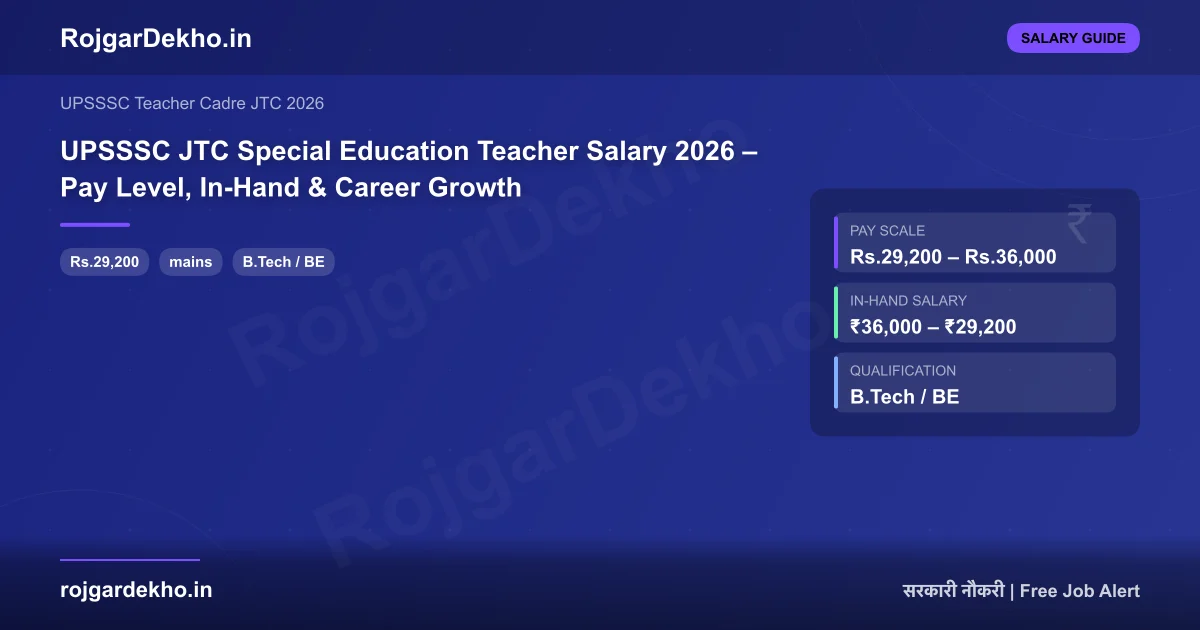
- JTC Grade (Junior Teacher Certificate): This is the entry-level post. It corresponds to Pay Level 5 under the 7th Pay Commission, with a basic pay of Rs. 29,200/month.
- HTC Grade (Higher Teacher Certificate): This is the senior grade, corresponding to Pay Level 6, with a basic pay of Rs. 35,400/month. Direct recruitment sometimes happens at this level too, but most people reach HTC through promotion from JTC.
Both posts are in the UP government's regular teacher cadre. The salary structure follows standard 7th Pay Commission norms — no separate "special education" allowance is built in.
JTC Teacher Salary Breakdown 2026 – Full Table
The figures below are based on 7th Pay Commission Pay Level 5, with DA at the current rate of 55% (revised quarterly by the central government, adopted by UP with some lag).
| Salary Component | JTC Grade (Level 5) | HTC Grade (Level 6) |
|---|---|---|
| Basic Pay (starting) | ₹29,200 | ₹35,400 |
| Dearness Allowance (DA @ 55%) | ₹16,060 | ₹19,470 |
| HRA – Lucknow/Kanpur (X city, 24%) | ₹7,008 | ₹8,496 |
| HRA – District HQ (Y city, 16%) | ₹4,672 | ₹5,664 |
| HRA – Rural/Block level (Z, 8%) | ₹2,336 | ₹2,832 |
| Transport Allowance (approx) | ₹1,350–3,600 | ₹1,350–3,600 |
| Gross (Lucknow posting) | ₹53,000–56,000 | ₹64,000–68,000 |
| NPS Deduction (10% of basic) | ₹2,920 | ₹3,540 |
| CGHS / State Health Scheme | ₹150–300 | ₹150–300 |
| Group Insurance (GIS) | ₹1,500 | ₹1,500 |
| Estimated In-Hand (district posting) | ₹36,000–42,000 | ₹44,000–50,000 |
Note: DA is revised by the UP government periodically. The 55% rate used above reflects early 2026 figures. In-hand figures assume a district-level posting (16% HRA) which is the most common case for new JTC recruits.
HRA by District – Where You Are Posted Matters
One of the most commonly misunderstood parts of UP government salary is the House Rent Allowance. It is not a flat rate — it depends entirely on where you are posted:
- X-Category cities (Lucknow, Kanpur, Agra, Varanasi, Prayagraj): HRA = 24% of basic pay. A JTC teacher gets Rs. 7,008/month in HRA here.
- Y-Category (district headquarters and major towns): HRA = 16% of basic pay. Rs. 4,672/month for JTC.
- Z-Category (rural areas, village-level postings): HRA = 8% of basic pay. Rs. 2,336/month — but rural postings often come with government accommodation, which effectively makes your real take-home comparable.
Special education teachers are typically posted at inclusive education centers, Composite Schools with special wings, or District Blind Schools. District-level postings are the norm for most new recruits, so the 16% HRA figure is the most realistic baseline.
What the Daily Work Actually Looks Like
This is where the job is genuinely different from a regular teaching post — not in salary, but in the nature of work. As a JTC special education teacher, your responsibilities will include:
- Teaching children with visual impairment using Braille, large-print materials, and audio aids
- Teaching children with hearing impairment through Indian Sign Language (ISL) and lip-reading techniques
- Adapting regular curriculum for children with intellectual disabilities — breaking concepts into smaller, achievable steps
- Working with children with locomotor disabilities, ensuring physical accessibility within the classroom
- Maintaining Individual Education Plans (IEPs) for each student — documentation that regular teachers do not handle
- Coordinating with parents, therapists, and mainstream class teachers for inclusion support
The work is more intensive on a per-student basis than a regular classroom. Batch sizes are smaller (8–15 students versus 40+ in a regular class), but each student requires significantly more individualized attention. If you have gone through the special education diploma genuinely because you care about this field, you will find the work meaningful. If you are only here for the salary and the lower competition, that is also honest — just be prepared for the reality of the classroom.
No Extra Allowance for Special Education – The Honest Truth
Many JTC aspirants ask whether there is a "Special Education Allowance" or a "Disability Teaching Allowance" on top of the regular salary. The short answer is: no, there is no such allowance at the moment in UP's teacher cadre structure. Your salary is exactly the same as a JTC teacher of any other subject in the regular cadre.
This is different from some central government schemes where specially trained special education teachers get modest top-up pay. In UP's state cadre, the pay structure has not been differentiated. This may change in future pay revisions, but as of 2026, do not factor in any such allowance.
Comparison with Private Special Education Salary
If you are weighing the JTC government job against working at a private special school, NGO, or special education center, here is the honest comparison:
- Private special schools (unaided): Rs. 8,000–15,000/month. Some reputed private schools in metro cities pay Rs. 18,000–22,000, but these are exceptions, not the norm.
- NGOs (disability sector): Rs. 12,000–20,000 with project-based contracts. Job security is low — funding cycles end, projects close.
- Government JTC post: Rs. 36,000–42,000 in-hand, plus NPS pension, medical coverage, and job security for life.
The government salary advantage is not marginal — it is 2 to 4 times higher than the private sector for the same qualification. This is the most compelling reason to target the JTC recruitment seriously.
NPS Pension and Retirement Benefits
JTC teachers come under the National Pension System (NPS), the same as all UP government employees recruited after 2005. Here is how it works:
- 10% of your basic pay is deducted every month and goes into your NPS account
- The government contributes another 14% of your basic pay to your NPS corpus
- This money is invested in a pension fund and grows over your career
- On retirement (age 60), you can take 60% as a lump sum (tax-free) and must use 40% to buy an annuity (monthly pension)
For a JTC teacher who joins at 26 and retires at 60, the NPS corpus at retirement — assuming moderate 8% annual returns — will be approximately Rs. 1.5–2 crore. The monthly pension from the annuity portion will be around Rs. 15,000–25,000/month depending on market conditions at retirement. This is not the old defined-benefit pension (which was Rs. 50% of last drawn salary), but it is still a meaningful retirement safety net.
Summer and Winter Vacation – What You Actually Get
This is a legitimate perk that many people underestimate when comparing teaching jobs to other government posts. UP government teachers get:
- Summer vacation: Approximately 45–55 days (mid-May to end of June, with slight variation by district)
- Winter break: About 15–20 days in December–January
- Diwali/Holi holidays as per government calendar
- Regular gazetted holidays (around 14–17 per year)
- Casual leave (14 days/year), medical leave, and earned leave that accumulates
In practice, the total "off days" for a UP government teacher are significantly higher than for most government employees. For special education teachers, the vacation periods also provide time for professional development, RCI-related training, and assessment preparation.
Career Growth: JTC → HTC → Headmaster
The promotion ladder for a JTC special education teacher in UP is straightforward:
- JTC Grade (Pay Level 5): Entry point. Most teachers spend 5–10 years here depending on the vacancy position in the department.
- HTC Grade (Pay Level 6): Promotion to HTC happens through a departmental process. Basic pay jumps to Rs. 35,400. This is where your in-hand salary moves into the Rs. 44,000–50,000 range.
- Headmaster / Principal (Special School): Further promotion to manage a composite school or district special school. Pay Level 7 or higher. Administrative role with additional responsibility allowances.
The timeline for HTC promotion in UP has historically been 8–12 years, though this depends on the batch size and vacancies. Teachers with strong performance records and additional qualifications (B.Ed Special Education, M.Ed) tend to move faster.
RCI Registration – Why It Is More Than Just an Eligibility Condition
Your Rehabilitation Council of India (RCI) registration is not just a box to check for this recruitment. Once you have it, it opens doors to similar recruitments across other states — Madhya Pradesh, Bihar, Rajasthan, and others all have their own special education teacher cadres, and most of them require RCI registration. If you do not clear the UPSSSC JTC exam this cycle, your RCI certificate remains valid for the next attempt — and for other state recruitments simultaneously.
Think of RCI registration as a qualification multiplier. One registration, multiple state-level opportunities. This is a genuine long-term career advantage that regular UPTET candidates do not have.
Frequently Asked Questions
JTC teacher ki in-hand salary kitni hai 2026 mein?
A freshly recruited UPSSSC JTC Special Education Teacher at a district-level posting earns approximately Rs. 36,000–42,000 in-hand per month. This includes basic pay of Rs. 29,200 (Pay Level 5), DA at 55%, and HRA at 16% for district headquarters, minus NPS and other standard deductions. Lucknow or Kanpur posting would give Rs. 3,000–4,000 more in HRA.
Private special education school se government job kitna behtar hai salary mein?
Significantly better. Private special schools in UP typically pay Rs. 8,000–15,000/month, with rare exceptions up to Rs. 20,000 in premium metro schools. The government JTC post pays 2 to 4 times more, adds NPS pension contributions, government medical coverage, and job security that private schools simply cannot match. For anyone with the RCI qualification, the government route is the clear financial winner.
Kya JTC teachers ko summer vacation milti hai?
Yes, absolutely. JTC special education teachers are part of the UP government's teacher cadre and receive the same vacation entitlement: roughly 45–55 days of summer vacation, 15–20 days of winter break, plus all gazetted holidays and leave entitlements. This is a significant real benefit that adds to the overall compensation package.
JTC se HTC promotion kitne saal mein hoti hai?
Based on recent history in UP's teacher cadre, the JTC to HTC promotion typically takes 8 to 12 years, depending on departmental vacancies and your seniority position. Teachers with B.Ed Special Education (in addition to the diploma) and consistent good performance reports tend to be favoured. Upon HTC promotion, basic pay increases to Rs. 35,400 and in-hand moves to Rs. 44,000–50,000.
Regular UPTET teacher aur JTC teacher ki salary mein kya fark hai?
There is no difference in salary structure. Both regular UPTET teachers (Primary/Junior level) and JTC special education teachers are part of UP's government teacher cadre and are paid as per the same 7th Pay Commission Pay Levels. JTC teachers do not get any extra special education allowance. The difference is entirely in job nature (teaching children with disabilities) and competition level — JTC has far fewer applicants than regular UPTET vacancies.
📌 Related on RojgarDekho:
Frequently Asked Questions
Can a special education teacher apply for mainstream teaching posts also?
Yes, provided you meet the eligibility criteria for the mainstream post. Holding a B.Ed Special Education (B.Ed SE) with RCI registration qualifies you for special education posts. If you additionally hold a B.Ed (regular, NCTE-recognised) or a D.El.Ed, you may also be eligible for mainstream teaching positions. Many special education teachers hold dual qualifications. However, for UPSSSC JTC Special Education specifically, the RCI-recognised B.Ed SE or D.El.Ed SE is the primary requirement, and the recruitment is categorically different from general JTC positions. The salary structure once selected is comparable — the difference lies in the exam, the role, and the students you serve.
What is the difference between a JTC and a Special Education Teacher in UPSSSC?
Junior Teacher Cadre (JTC) is a broad category in UPSSSC covering upper primary school teachers (Classes 6 to 8). Within JTC, Special Education Teacher is a specific sub-category designated for teaching students with disabilities in government special schools or inclusive education programmes. A regular JTC teacher teaches general curriculum subjects in mainstream schools. A special education JTC teacher works with children who have visual impairment, hearing impairment, intellectual disability, or locomotor disability — and uses specialised instructional methods, adapted materials, and Individualised Education Plans (IEPs) that general teachers do not use. The pay structure is the same (7th Pay Commission Level 6, basic ₹35,400), but the work content and required qualifications are distinct.