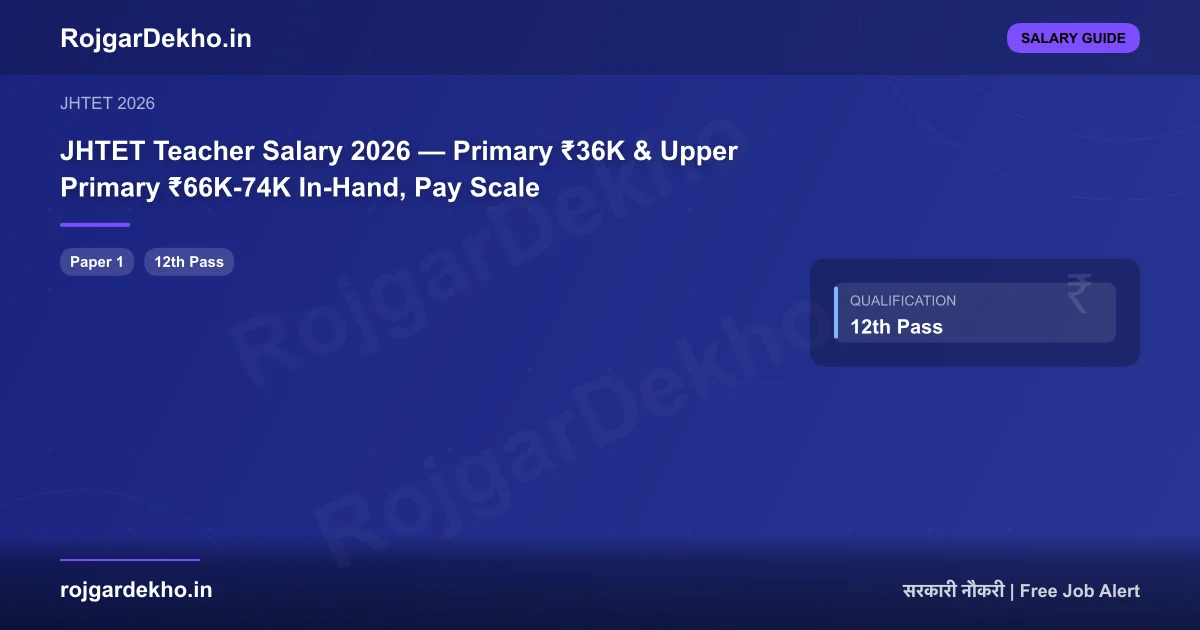
Clearing JHTET is the first step to becoming a government teacher in Jharkhand — but the real reward comes when you get appointed. Jharkhand follows the 7th Pay Commission, and the salaries are genuinely impressive, especially at the Upper Primary level where teachers earn more than many bank POs.
Salary Overview
| Post | Pay Level | Basic Pay | In-Hand (Approx) |
|---|---|---|---|
| Primary Teacher (Class 1-5) | Level 4 | ₹25,500 | ₹33,000-36,000 |
| Upper Primary Teacher (Class 6-8) | Level 7 | ₹44,900 | ₹66,000-74,000 |
That's not a typo — Upper Primary teachers in Jharkhand can take home ₹66,000-74,000 per month. Level 7 is the same as what UPSC Grade B officers start at in some services.
Primary Teacher Salary Breakdown
| Component | Amount |
|---|---|
| Basic Pay | ₹25,500 |
| DA (53%) | ₹13,515 |
| HRA (20%) | ₹5,100 |
| Other Allowances | ₹2,000 |
| Gross | ~₹46,115 |
| NPS + Deductions | -₹10,000 |
| In-Hand | ~₹33,000-36,000 |
Upper Primary Teacher Salary Breakdown
| Component | Amount |
|---|---|
| Basic Pay | ₹44,900 |
| DA (53%) | ₹23,797 |
| HRA (20%) | ₹8,980 |
| Other Allowances | ₹3,000 |
| Gross | ~₹80,677 |
| NPS + Tax + Deductions | -₹8,000-14,000 |
| In-Hand | ~₹66,000-74,000 |
In Jharkhand — where living costs are among the lowest in India — ₹66,000-74,000 provides an excellent lifestyle. Government quarters, medical, pension, 60+ days leave, summer/winter vacation — teaching in Jharkhand is one of the best government careers for graduates.
Benefits Beyond Salary
- NPS: 10% employee + 14% government = strong retirement corpus
- Medical: Free treatment at government hospitals
- Leave: Casual, earned, medical + summer & winter vacation
- Children Education Allowance
- Promotion: Headmaster → Block Education Officer with experience
👉 Exam pattern: JHTET Syllabus 2026 — Paper 1 & 2 Exam Pattern
👉 Eligibility: JHTET Eligibility 2026 — Age, Education & Qualifying Marks
Primary vs Upper Primary — Why Such a Big Difference?
The salary gap between Primary (Level 4) and Upper Primary (Level 7) teachers in Jharkhand is striking — ₹36K vs ₹66-74K. That's almost double. The reason is simple: Upper Primary teachers need a graduation + B.Ed, while Primary needs only 12th + D.El.Ed. The higher educational requirement is compensated with a significantly higher pay level.
This also means if you're currently eligible for only Paper 1 (Primary), it might be worth completing your B.Ed to become eligible for Paper 2 (Upper Primary). The salary jump from Level 4 to Level 7 over a 30-year career amounts to crores of rupees in difference.
How Jharkhand Teacher Salary Compares to Other States
| State | Primary Teacher Pay Level | Approx In-Hand |
|---|---|---|
| Jharkhand (Primary) | Level 4 (₹25,500) | ₹33,000-36,000 |
| Jharkhand (Upper Primary) | Level 7 (₹44,900) | ₹66,000-74,000 |
| Bihar (BPSC TRE Primary) | Level 5 (₹29,200) | ₹38,000-42,000 |
| UP (UPTET Primary) | Level 6 (₹35,400) | ₹52,000-57,000 |
| Rajasthan (REET Level 1) | Level 5 (₹29,200) | ₹35,000-40,000 |
Jharkhand Primary teachers earn slightly less than UP and Bihar at the starting level, but Upper Primary teachers in Jharkhand earn more than primary teachers in ANY other state. Level 7 is genuinely exceptional for a teaching position.
Allowances Breakdown — What's Included
- Dearness Allowance (DA): Currently 53% of basic pay. Revised twice a year (January and July). This is the biggest component after basic pay — and it keeps increasing every 6 months.
- House Rent Allowance (HRA): 20% of basic pay for Ranchi and major cities, 16% for district headquarters, 8% for rural areas. Most teacher postings are in semi-urban or rural — HRA is typically 8-16%.
- Transport Allowance: ₹1,800-3,600 depending on city classification.
- Medical Allowance: ₹500/month fixed. Plus free treatment at government hospitals for self and dependents.
- Children Education Allowance: Up to 2 children — hostel subsidy and tuition reimbursement.
NPS and Retirement Benefits
Jharkhand state government employees are under the New Pension Scheme (NPS):
- Employee contribution: 10% of basic pay (deducted from salary)
- Government contribution: 14% of basic pay (this is free money)
- Over a 30-year career, the NPS corpus at retirement can be ₹50-80 lakh for Primary teachers and ₹80-1.2 crore for Upper Primary teachers
- 60% of the corpus can be withdrawn as lump sum (tax-free up to ₹25 lakh), remaining 40% buys an annuity providing monthly pension
Promotion Path
| Current Post | Promotion To | Pay Level | Timeline |
|---|---|---|---|
| Primary Teacher | Headmaster (Primary) | Level 6 | 10-15 years |
| Upper Primary Teacher | Headmaster (UP) | Level 8 | 8-12 years |
| Headmaster | Block Education Officer | Level 9-10 | Departmental exam |
Teaching Perks That Don't Show on the Salary Slip
- Summer vacation: 45 days paid leave (May-June). No other job offers this.
- Winter vacation: 15 days (December). Plus Dussehra, Diwali, and all government holidays.
- Working hours: 10 AM to 4 PM typically. No late nights, no weekend work.
- Social respect: "Sarkari Master" carries significant weight in Jharkhand's rural and semi-urban areas.
- Stability: Cannot be fired. Cannot be transferred frequently (unlike police or administrative services). Most teachers serve in the same block for decades.
Frequently Asked Questions
What is the starting salary of a Jharkhand primary teacher?
Basic pay ₹25,500 (Level 4). With DA, HRA, and allowances, gross is around ₹46,000. In-hand after deductions: ₹33,000-36,000/month.
How much does a Jharkhand Upper Primary teacher earn?
Basic pay ₹44,900 (Level 7). In-hand: ₹66,000-74,000/month. This is one of the highest teacher salaries at the TGT level in India.
Do Jharkhand teachers get pension?
Yes, through NPS. Government contributes 14% of basic pay. After 30 years, lump sum + monthly annuity.
How does Jharkhand teacher salary compare to Bihar?
Jharkhand Primary (Level 4: ₹25,500) is slightly lower than Bihar Primary (Level 5: ₹29,200). But Jharkhand Upper Primary (Level 7: ₹44,900) is significantly higher than Bihar Upper Primary (Level 6: ₹35,400).
Can JHTET qualified teachers teach in private schools?
JHTET is for government school eligibility. Private schools have their own hiring — but JHTET on your resume adds credibility.
What is the salary after 10 years?
Primary: ₹50,000-55,000 in-hand. Upper Primary: ₹85,000-95,000 in-hand. Growth comes from 3% annual increment + DA revisions.
Also Read:
Private School vs Jharkhand Govt Teacher — Real Numbers
Let's settle the most common debate once and for all. Is a government teaching job really that much better than a private school? Here are the actual numbers side by side:
| Parameter | Private School Teacher | Govt Teacher (Primary, Level 7) | Govt Teacher (Upper Primary, Level 9) |
|---|---|---|---|
| Monthly Salary | ₹8,000-15,000 | ₹33,000-36,000 (starting) | ₹66,000-74,000 (starting) |
| Pension | None | NPS (Govt contributes 14%) | NPS (Govt contributes 14%) |
| Job Security | Can be fired anytime | Lifetime — can't be removed | Lifetime — can't be removed |
| Working Hours | 10-12 hours daily | 10 AM - 4 PM | 10 AM - 4 PM |
| Vacation Pay | Usually unpaid | 60 days paid vacation/year | 60 days paid vacation/year |
| Medical Benefits | None or very basic | CGHS/State Health Scheme | CGHS/State Health Scheme |
| Annual Increment | ₹500-1,000 (if any) | 3% of basic pay | 3% of basic pay |
| Loan Eligibility | Low — banks skeptical | High — preferred borrower | High — preferred borrower |
The numbers speak for themselves. A government primary teacher earns 3-4 times more than a private school teacher, with benefits that no private school can match. And an upper primary government teacher? That's 5-8 times more. If you're currently teaching in a private school, clearing JHTET should be your number one priority.
What Your First Year Looks Like
Here's a realistic picture of what happens after you receive your appointment letter:
Joining formalities (Week 1): You'll report to the Block Education Officer (BEO) office with your documents — appointment letter, degree certificates, JHTET scorecard, caste certificate, medical fitness certificate. They'll verify everything and assign you to a school.
Meeting the headmaster (Day 1 at school): Your first day at the assigned school is actually quite simple. You meet the headmaster, get a tour of the school, and are introduced to the staff. Most headmasters are welcoming — they're usually short-staffed and happy to have a new teacher.
Classroom assignment: You'll be assigned specific classes and subjects based on the school's needs and your qualification. As a new teacher, you might get the classes that nobody else wants — that's normal. Don't complain; just do a good job and earn respect.
Learning school culture (Month 1): Every school has its own rhythm. Morning prayer, assembly, which register to maintain, how attendance is taken, when mid-day meal is served, how parents are handled. Just observe and follow what senior teachers do.
Mid-day meal duties: Yes, this is part of the job. Government teachers supervise mid-day meal distribution, maintain quality checks, and keep records. It takes about 30-45 minutes daily. Many new teachers are surprised by this, but it's a routine part of government school life.
First salary (Month 2-3): Your first salary typically arrives 1-2 months after joining because account setup, GPF registration, and salary processing take time. Keep 2-3 months' expenses saved before joining. Once the pipeline is set up, salary comes like clockwork on the 1st of every month.
Extra Income Opportunities for Govt Teachers
Government salary is already good, but there are legitimate ways to earn extra:
Private tuition: Many government teachers give tuition after school hours. In Jharkhand, there's no explicit ban on tuition (unlike some states). You can earn ₹3,000-10,000 extra per month depending on your location and subject. However, tuition should not affect your school performance — that's the unwritten rule.
Writing textbooks: State governments periodically commission teachers to write or review textbooks. If you're good at your subject and have some writing skills, this is an excellent opportunity. The fee is ₹15,000-50,000 per project, plus it looks great on your record for promotions.
Exam paper setting: Experienced teachers are called to set question papers for various school and competitive exams at district and state level. This is a paid assignment — ₹5,000-15,000 per paper. It also boosts your professional reputation.
District-level training resource person: After a few years, you can become a resource person for teacher training programs at the block or district level. These programs pay TA/DA in addition to your regular salary. It's also a fast track to promotions because it shows leadership skills.
More Frequently Asked Questions
Is there a probation period for new government teachers?
Yes, there's typically a 2-year probation period. During this time, your service is confirmed subject to satisfactory performance. Don't worry — almost everyone clears probation unless there's a serious complaint against you. Your salary, benefits, and everything else remain the same during probation. After confirmation, your job becomes essentially permanent.
Can I request a transfer to my home district?
Yes, but not immediately. You need to serve at least 3-5 years at your first posting before requesting a transfer. Transfer requests are processed based on vacancy, seniority, and compassionate grounds (medical issues, spouse posting, etc.). Mutual transfers with willing teachers in your desired district are the fastest way to move.
What is the retirement age for Jharkhand government teachers?
The retirement age is 60 years for government teachers in Jharkhand. After retirement, you receive pension benefits through NPS (for teachers joining after 2004) or the old pension scheme (for those who joined before 2004). There's also a gratuity payment based on years of service — typically ₹10-20 lakh at retirement.
Do government teachers get summer vacation like students?
Not the full summer vacation that students get. Teachers get approximately 60 days of paid leave per year (combination of earned leave, casual leave, and gazetted holidays). During school vacations, teachers may be called for training programs, administrative work, election duty, or census duty. But the workload during vacations is significantly lighter — many days you'll have nothing to do.
Salary Growth Timeline — Year by Year
The 3% annual increment compounds steadily. Here is what a Jharkhand Primary and Upper Primary teacher earns at key career milestones:
| Career Stage | Primary In-Hand | Upper Primary In-Hand |
|---|---|---|
| Year 1 (joining) | ₹33,000–36,000 | ₹66,000–74,000 |
| Year 5 | ₹38,000–42,000 | ₹75,000–82,000 |
| Year 10 (post-increment + DA rise) | ₹50,000–55,000 | ₹85,000–95,000 |
| Year 20 (post-promotion possible) | ₹65,000–75,000 | ₹1,10,000–1,25,000 |
| Year 30 (retirement) | ₹80,000+ (Headmaster) | ₹1,40,000+ (BEO) |
These are estimates based on 3% annual increment and DA revised to 60%+ by 2030 (current trajectory). The real growth driver is DA revision — every July and January, DA goes up and your gross salary rises automatically without any action on your part.